Most contact centers still send calls to “next available agent” and hope for the best. That wastes capacity, frustrates customers, and hides easy wins in the routing layer.
Advanced routing is a set of strategies that direct each interaction to the best resource using skills, priority, geography, intent, and real-time data instead of simple round-robin or hunt groups.
With advanced routing 1, the queue becomes a decision engine. It uses skills-based rules, bullseye (expanding ring) patterns, preferred-agent logic, and even AI-based predictive models. It works across voice, chat, email, SMS, and social, not just phones. For SIP devices and intercoms, it decides which team or guard desk gets which call, through which SIP trunk, under which SLA. When this layer is clean and governed, CX improves without changing a single headset.
How does skills-based routing improve CX?
Customers do not care which agent they talk to. They care whether the first person actually solves the problem without transfers and long explanations.
Skills-based routing improves customer experience by matching each interaction with an agent who has the right skills, language, and permissions to resolve the issue on the first contact.

From “any agent” to “right agent first time”
Classic routing sends calls to the next free agent in a queue. It looks fair, but it ignores the fact that agents have different skills. Some handle billing. Some handle technical faults. Some speak Korean, Arabic, or German. When we ignore this, we get transfers, long hold episodes, and lower first contact resolution (FCR) 2.
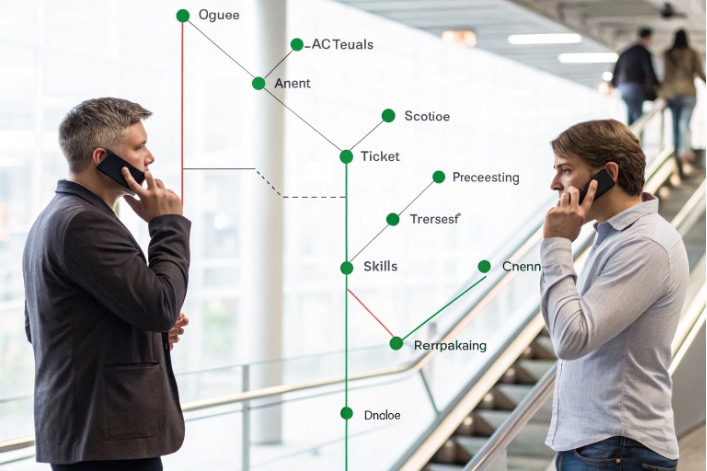
Skills-based routing 3 fixes this by tagging both interactions and agents:
- Interactions get attributes like language, product, intent, channel, and value.
- Agents get skills and levels like “Billing: expert,” “SIP intercom troubleshooting,” or “German: fluent.”
The engine then matches them. A customer in Japan pressing the help button on a SIP video door phone can land with an agent who speaks Japanese and knows that device family. That cuts talk time, re-explaining, and frustration.
Advanced methods, like bullseye routing 4, add a time dimension. We start with a small ring of best-fit agents (exact skills). If no one is free after a timeout, we widen the ring to agents with close skills. This balances CX and speed.
To keep skills-based routing healthy, we need data hygiene. Skills must stay up to date when people change teams or gain certifications. If we never clean the skills catalog, the “smart” router slowly becomes random again, and top performers get overloaded while others sit idle.
| Routing type | How it works | CX impact |
|---|---|---|
| Basic queue / round-robin | Any free agent gets the next call | Simple, but many transfers |
| Skills-based | Match call attributes to agent skills | Higher FCR, fewer transfers |
| Bullseye / ring | Start with tight skill group, then expand over time | Balance between quality and shorter wait |
| Preferred-agent | Route repeat callers to same agent/team | Better continuity and relationship |
What data drives intelligent call routing?
Routing cannot be smarter than the data behind it. If attributes are wrong or missing, even the best engine will send calls to the wrong place.
Intelligent call routing depends on accurate data about customers, agents, context, and performance, fed from CRMs, IVRs, WFM, and real-time quality metrics.
Attributes, context, and predictive signals
At the simplest level, we route on caller ID, dialed number, and IVR choices. Advanced routing goes much further. It uses:
- Customer data: account type, segment, past issues, location, language preference.
- Interaction context: channel, entry point (for example, SIP intercom vs. main hotline), IVR path, self-service steps taken.
- Agent data: skills, certifications, language, past performance on similar contacts.
- Real-time signals: current queues, occupancy, service level, agent fatigue indicators.
- Quality metrics: MOS scores, carrier performance, previous drop or one-way audio events.
Predictive routing 5 adds machine learning on top. The model looks at historical outcomes and learns patterns like, “Customer type X with issue Y has the best chance of same-day resolution with agents who have profile Z.” Then it steers similar new contacts to those agents, while respecting fairness constraints so we do not burn out the same top performers.
This data does not only shape who gets the call. It also shapes how we treat it:
- A high-value tenant pressing a blue-light phone may skip normal menus.
- A repeat caller about the same open ticket may go straight to the specialized team.
- A low-complexity intent, such as PIN reset, may stay in self-service and never reach an agent.
To make this work, we need governance and regular cleanup:
- Clear rules for which systems are “source of truth.”
- Daily or weekly syncs of skills and profiles.
- Audits to catch stale attributes and wrong tags.
Without this, “intelligent” routing slowly drifts, and we see strange patterns: VIPs stuck in general queues, new hires receiving complex emergencies, and clean data ignored in favor of outdated flags.
| Data type | Examples | How routing uses it |
|---|---|---|
| Customer | Tier, location, language, open tickets | Priority, skill choice, direct vs. standard queues |
| Interaction | Dialed number, IVR path, device ID | Intent, urgency, on-site vs. remote |
| Agent | Skills, languages, certification dates | Eligibility for specific queues |
| Real-time | Wait times, occupancy, channel load | Throttling, overflow, fairness |
| Quality / network | MOS, carrier ASR, drop rates | Carrier choice, SIP trunk routing, failover |
| Outcomes | FCR, AHT, conversion, CSAT per pair | Predictive routing models and A/B tests |
Can I route across SIP trunks and channels?
Many designs still treat “telephony routing” and “contact routing” as separate worlds. Voice follows one logic, digital channels another, and SIP trunks often sit below both as a static layer.
Yes. Modern advanced routing can span multiple SIP trunks, carriers, and channels, using the same intent, priority, and skills logic to choose both the path into the network and the destination agent.
Omnichannel and multi-carrier aware routing
On the channel side, omnichannel routing 6 applies the same rules to voice, chat, email, SMS, and social messages. A “billing, high-value” contact should reach a similar set of skilled agents, whether it starts as a phone call, a WhatsApp message, or a web chat.
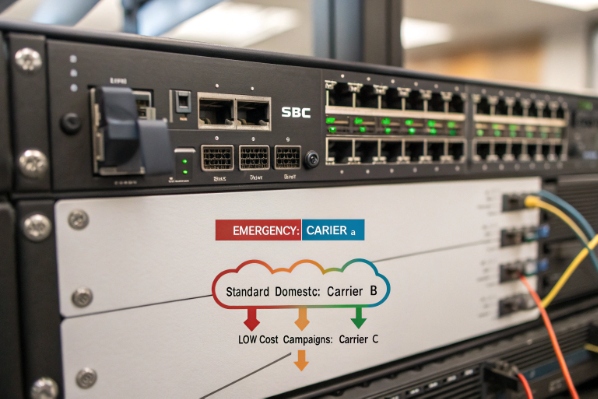
On the network side, advanced routing can be aware of multiple SIP trunks and carriers. Instead of a single fixed trunk, the contact center or SBC sees many carrier options and uses:
- Least-cost routing for routine outbound calls.
- Quality-based routing based on ASR, post-dial delay, and MOS by destination.
- Redundancy to fail over when one carrier or SBC path has issues.
Least-cost routing 7 strategies are often combined with quality-based rules to avoid cheap but unreliable paths.
This is where our SIP endpoints, intercoms, and emergency phones come into play. They register to a central SIP platform or SBC. That platform then decides not only which agent or queue should receive each call, but also which trunk or carrier should carry it, based on real-time conditions and SLAs.
Channels can also influence routing across trunks:
- Emergency calls from elevator phones might always use the most reliable trunk.
- Low-value marketing calls might prefer the lowest-cost carrier.
- Regional SIP trunks may handle local calls to keep CLI and regulations correct.
The routing brain lives above the trunks but sees their status. It can pause a broken trunk, reroute traffic, and later restore it without changing the PBX dial plan or the configuration on each device.
| Layer | Role in routing | Example decision |
|---|---|---|
| Channel / intent | Voice, chat, email, SIP intercom, SMS | Which queue or flow to enter |
| Priority / SLA | Urgent, VIP, normal | Jump the queue, special team, or normal path |
| Skills / teams | Language, product, technical level | Which agents or rings should receive the work |
| Trunks / carriers | SIP trunks, SBC paths, carriers | Which network route to use for this call |
| Failover / overflow | Backup queues, backup carriers | Where to go if primary path fails |
How do I measure routing accuracy?
Routing logic can become very complex over time. New rules, new queues, and new models pile up. If we do not measure accuracy, we cannot tell whether changes help or hurt.
Routing accuracy is best measured by how often interactions land in the “right” place on the first attempt, plus the impact different routing strategies have on KPIs like FCR, AHT, CSAT, and agent load.
First-hit success, KPI impact, and A/B testing
The first metric I focus on is first-hit routing success:
- Did the interaction reach an agent or team that could actually resolve it?
- Was there a transfer, re-queue, or manual escalation due to wrong routing?
We can track this with:
- Transfer rates by queue and intent.
- Percentage of interactions resolved without transfer.
- Time lost to misroutes (for example, “time before first transfer”).
Routing accuracy also shows up in downstream KPIs:
- Higher FCR usually means better matches between customers and agents.
- Lower AHT on complex intents can mean routing to specialists is working.
- Better CSAT on queues with advanced routing compared to simple ones.
To avoid guesswork, I like to A/B test routing strategies:
- Group A uses rule-based skills routing.
- Group B uses predictive or AI routing with the same pool of agents.
We compare AHT, FCR, CSAT, conversion, and even agent fatigue indicators. If predictive routing helps some metrics but harms others (for example, it overloads top performers), we adjust models or add fairness constraints, such as caps on how much work one agent can receive in a period.
Governance and auditability are critical. Advanced routing touches experience, cost, and sometimes compliance:
- Document which rules and models are in force.
- Keep fallbacks: if a model fails or behaves strangely, fall back to a simpler strategy.
- Log routing decisions so you can explain “why this call went there” when regulators or customers ask.
| Measure | What it shows | Why it matters |
|---|---|---|
| First-hit resolution | % of contacts resolved without transfer | Direct view of routing match quality |
| Transfer / re-queue rate | How often routing is “wrong” at first | Reveals misaligned skills or rules |
| AHT by intent and queue | Fit between complexity and agent capability | Helps tune skills and routing logic |
| FCR and CSAT by strategy | Impact of different routing models | Validates advanced or predictive approaches |
| Agent load balance | Fairness and fatigue risk | Stops optimization from burning out top agents |
When we track these metrics, routing becomes an optimization loop, not a one-time setup. We can tune rules, train models, and clean data, knowing exactly how each change moves CX, cost, and fairness.
Conclusion
Advanced routing turns your queues, SIP trunks, and channels into a flexible matching engine; with clean data, clear rules, and good measurement, it quietly upgrades CX without tearing out your whole stack.
Footnotes
-
High-level overview of call routing concepts and how advanced routing improves contact center efficiency. Back ↩
-
Defines first contact resolution, its calculation, and impact on customer satisfaction metrics. Back ↩
-
Explains skills-based routing and why matching customers with skilled agents boosts first-time resolution. Back ↩
-
Describes bullseye routing and expanding skill rings to balance wait times and expertise. Back ↩
-
Overview of predictive routing using AI to match customers and agents for better outcomes. Back ↩
-
Omnichannel routing guide showing how to unify voice and digital channels under one routing engine. Back ↩
-
Intro to least-cost routing techniques for choosing the cheapest viable telecom path for each call. Back ↩