
Plans fail when reality moves. Dynamic scheduling adjusts live so my queues, people, and promises stay on track.
Dynamic scheduling is the real-time reshaping of shifts, tasks, and priorities using current demand and staffing signals. It replaces fixed plans with continuous, small corrections to protect SLAs and team health.
I run dynamic scheduling as a loop: sense, decide, act, and verify. First, I explain intraday reforecasting 1 and how it shields service levels. Then I show which signals trigger live changes. Next, I cover auto-approvals 2 for swaps and overtime. Finally, I measure whether adherence and outcomes actually improved.
How does intraday reforecasting protect my SLAs?
The forecast at 8 a.m. is a guess. By 10 a.m., I have facts. Intraday reforecasting turns facts into coverage.
I reforecast demand and AHT every 60–120 minutes per queue. I update staffing targets, move breaks and meetings, and switch callbacks on to hold my SLA without panic hiring.
The core idea
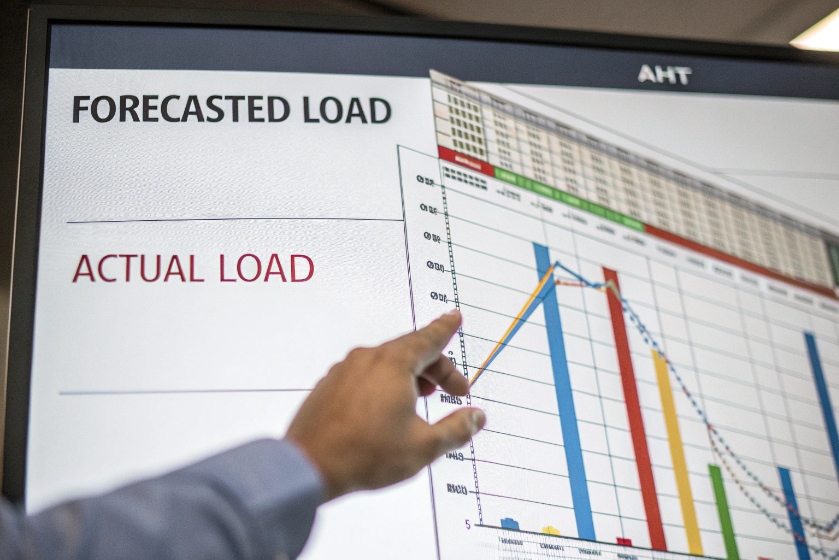
Intraday reforecasting takes actual interval data—contacts offered, handle time, abandon trend—and produces a new, short-horizon forecast. I compare that “nowcast” against the schedule, then push precise changes: shift extensions, break moves, micro-OT, and callback toggles. The math is simple: Required FTE = Offered Load ÷ Occupancy Target. Offered Load = (Contacts × AHT) / 3600. When the new load is higher than plan, I add minutes; when lower, I return minutes. Because the loop repeats each hour, corrections are small and painless.
The protective mechanisms
- Callbacks 3: If wait exceeds promise, I enable scheduled callbacks; this flattens spikes without losing customers.
- Meeting moves: The WFM tool floats coaching and training to low-demand intervals; no more “training during peak.”
- Break staggering: I slide breaks a few minutes across cohorts to fill coverage dips without breaking labor rules.
- Skill rebalance: I lend multi-skilled agents to the stressed queue, then pay the loan back later in the day.
Targets and thresholds
I set guardrails per queue:
- SLA floor (e.g., 80/20 for voice, 90% in 30 min for email).
- Abandon cap (e.g., <5% rolling hour).
- Occupancy band (e.g., 78–85% to avoid burnout).
If reforecasted Required – Scheduled > 2 FTE for two consecutive intervals, the system proposes actions. I accept or auto-apply if impacts are small and compliant.
A quick example
At 11:00, AHT jumps from 360s to 420s while contacts hold steady. Offered Load rises 17%. Required FTE goes from 50 to ~59 at the current occupancy plan. I pull three levers: move eight breaks by 10 minutes, extend five agents by 30 minutes with OT, and enable callbacks for the next hour. SLA dips for one interval, then recovers without wrecking the afternoon.
Which signals trigger schedule changes for me?
Change only when signals say so. Random tweaks create noise. Clear triggers create trust.
I watch demand deltas, AHT shifts, abandon spikes, occupancy drift, adherence gaps, and backlog growth. When two or more align, I act.
Demand and handling
- Contacts vs plan 4: If the last two intervals exceed plan by >10% (or fall below by >10%), I reforecast. Volume is the main driver.
- AHT drift: A sustained +10–15% AHT change burns coverage. I validate cause (policy change, outage) before moving schedules.
- Arrival pattern shift: If day-part shape changes (e.g., lunch peak arrives early), I pull forward breaks and meetings.
Service health
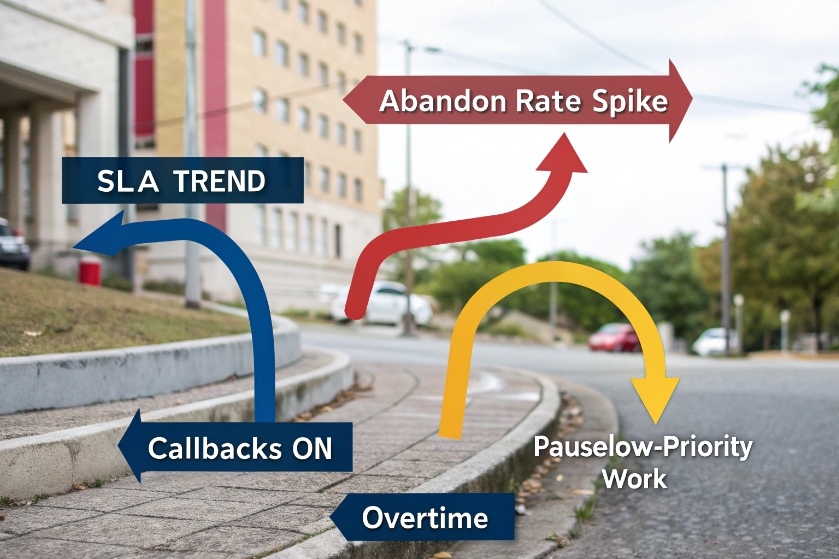
- SLA trend: If SLA stays below target for two intervals and abandon rate rises, I enable callbacks and pause low-value work.
- Abandon rate: A sudden spike suggests queue pain or IVR issues. I throttle marketing campaigns that feed the queue.
Workforce state
- Occupancy: If running >88–90% for two intervals, fatigue builds; I add short relief or turn down concurrency in chat. If <70%, I release VTO or push backlog tasks.
- Adherence gaps: If adherence drops below 93–95%, I shift coaching to later and tighten aux usage with reason codes.
- Shrinkage shocks: Sick calls or tool outages remove capacity. I immediately rebalance skills and solicit micro-OT.
Backlog and promises
- Digital backlog age: Email or case queues exceeding SLA + 25% age trigger re-allocation from voice if voice is green.
- Callback queue length: If projected callback wait exceeds promise windows, I cap new callbacks and add OT.
Routing quality
- Transfer rate up: Misroutes waste minutes. I patch IVR prompts or skill rules before adding headcount.
- Bot containment down: If self-service fails, I expect more agents; I schedule an emergency knowledge fix.
A simple rule table
| Signal | Trigger | Action |
|---|---|---|
| Volume > plan | 2 intervals >10% | Reforecast, move breaks, callbacks on |
| AHT ↑ | +15% for 2 intervals | Reforecast, SME swarm, script fix |
| SLA ↓ + Abandon ↑ | Below target 2 intervals | OT offer, pause coaching, prioritize |
| Occupancy ↑ | >90% for 30–60 min | Reduce chat concurrency, add relief |
| Adherence ↓ | <93% current hour | Supervisor outreach, aux audit |
| Backlog age ↑ | >SLA +25% | Reassign skills, VTO from voice if safe |
Signals stay simple, thresholds public, and actions reversible.
Can WFM auto-approve swaps and OT requests?
Manual approvals slow the day. Smart rules let the system say “yes” when it helps coverage and stays compliant.
Yes. I set policy windows, fairness caps, and coverage checks. If a swap or OT request improves net coverage and obeys labor rules, WFM auto-approves and logs it.

Auto-approval logic
I treat each request as a coverage trade. The system simulates the request against the latest reforecast and checks four gates:
1) Coverage gate: The change must not drop any affected interval below Required FTE (or it must improve gaps).
2) Compliance gate: Labor law and union rules pass (rest time, weekly hours, night premiums, minors, weekend limits).
3) Fairness gate: Agent stays within caps (e.g., ≤8 OT hours/week, ≤2 prime-time swaps/month).
4) Quality gate: Recent QA or adherence issues may pause eligibility for auto-OT.
If all gates pass, approval is instant. If only coverage gate fails, the tool proposes alternatives (e.g., “Swap accepted if you also move break by 15 min”).
Common policy patterns
- Swaps: Same skill, same day, similar length. Auto-approve when nets ≥0 minutes to coverage. Cross-skill swaps require supervisor eyes.
- OT: Micro-OT in 15–30 min blocks around peaks. Auto-approve when requested intervals have coverage deficit ≥ 0.5 FTE and agent hasn’t hit cap.
- VTO: Auto-approve when supply exceeds demand and backlog is under control. Protect minimum staffing per policy.
- Partial day moves: Shift start ±60 minutes if it closes gaps; keep rest periods intact.
Guardrails for trust
- Visibility: Every auto-decision lists which gate passed/failed. Agents see why.
- Equity caps: No one hoards premium hours. I publish utilization per month.
- Blackout windows: No swaps during incident response or planned launches.
- Skills integrity: Do not drain rare skills; set minimum floor per interval.
Why it works
Auto-approvals convert dozens of small decisions into fast, fair outcomes. Utilization rises, SLA stabilizes, and leaders spend time on coaching, not inbox triage. The system still escalates gray cases, but the 70–80% “obvious wins” flow without delay.
How do I measure schedule adherence improvements?
If changes stick, adherence rises and chaos fades. I prove it with a short scorecard tied to outcomes.
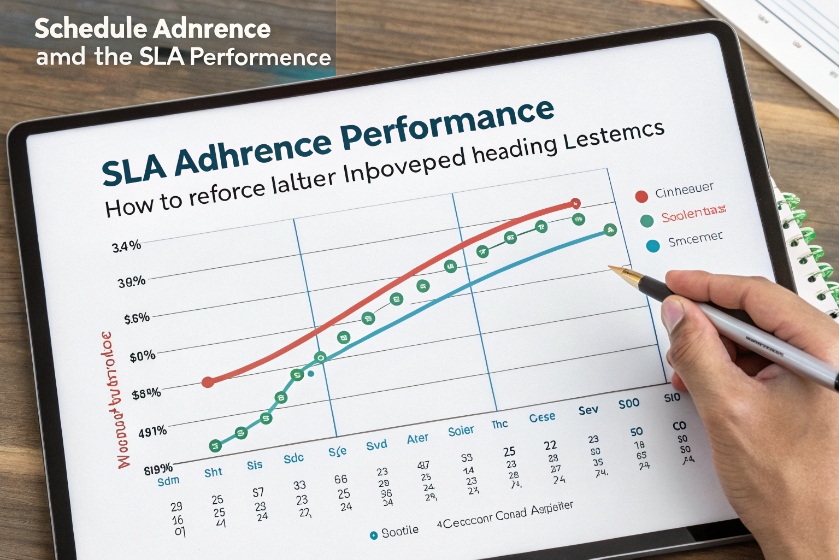
I track adherence, conformance, occupancy, and impact KPIs (SLA, abandon, AHT). I compare pre/post by cohort and run weekly control charts to lock in gains.
Definitions I use
- Schedule adherence: % of time agents are in the scheduled state (Ready, AUX, Lunch) at the right times.
- Conformance: Did the agent work the scheduled hours (start/stop) even if states varied?
- Compliance to activity: Were meetings, training, and coaching attended as scheduled?
- Occupancy: Busy time ÷ logged-in time. Too high triggers fatigue; too low wastes money.
Measurement approach
I baseline four weeks before changes, then measure four weeks after. I group by queue, tenure band, and shift so comparisons are fair. I use SPC charts (control charts) for adherence to spot sustained shifts rather than one-off spikes. I build a small causal chain: better adherence → steadier coverage → higher SLA and fewer abandons → stable AHT.
Scorecard template
| Metric | Before | After | Goal | Comment |
|---|---|---|---|---|
| Adherence (all) | 91.4% | 95.8% | ≥95% | Auto-swaps reduced late returns |
| Conformance | 96.0% | 97.2% | ≥97% | Fewer surprise early outs |
| Occupancy | 89% | 83% | 78–85% | Healthier pacing |
| SLA 80/20 | 76% | 84% | ≥80% | Reforecast + callback |
| Abandon | 7.2% | 4.1% | ≤5% | Peaks flattened |
| AHT (voice) | 510s | 495s | Stable/↓ | No speed-at-any-cost |
| Coaching kept | 82% | 96% | ≥95% | Moved to troughs |
Attribution checks
To avoid false credit, I run A/B weeks or stagger releases across sites. If adherence improves only where dynamic scheduling and auto-approvals went live, the case is strong. I also track aux reason distributions. If “Tech issue” aux drops after we fix a tool outage, adherence rises for the right reason.
Alerts and nudges
- Live nudge: If an agent misses a return by 2 minutes, a gentle prompt fires.
- Supervisor digest: Hourly list of the top five variances with suggested actions.
- Coaching triggers: Two adherence misses in three days schedule a 10-minute huddle.
Turning metrics into habit
I publish a simple, transparent adherence policy and keep dashboards visible to agents. When teams see how micro-moves support SLA and reduce overtime pain, buy-in grows. The system handles the math; leadership handles the message.
Conclusion
Dynamic scheduling is a small-moves engine. Reforecast often, act on clear signals, let WFM auto-approve safe trades, and prove gains with adherence and SLA trends. Do this, and service stays steady while the day keeps changing.
Footnotes
-
Learn about intraday reforecasting techniques to adjust staffing and improve service level outcomes. ↩ ↩
-
Read about the benefits of auto-approvals in workplace scheduling for efficiency and compliance. ↩ ↩
-
Discover how callbacks can improve customer service by reducing wait times and handling peak volumes. ↩ ↩
-
Understand the impact of contact volume variations on forecasting and scheduling in a workforce management context. ↩ ↩