
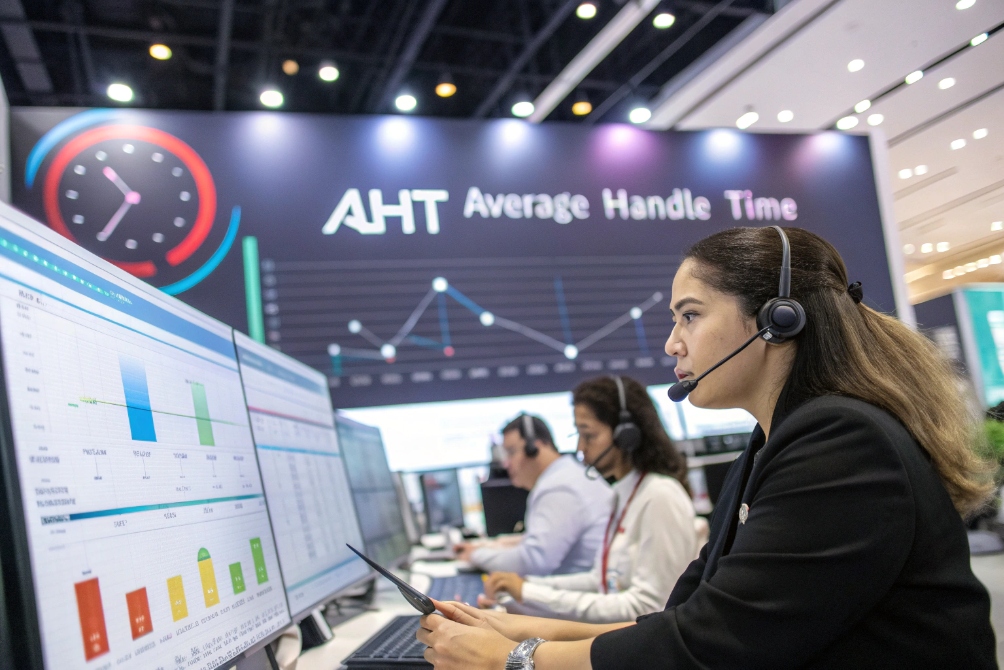
Long queues, angry callers, and stressed agents often share one hidden cause. The team works hard, but time leaks inside the call flow.
AHT (Average Handle Time) is the average total time an agent spends to finish one interaction, including talk time, hold time, and after-call work, divided by handled contacts.
AHT is a time budget, not a scoreboard
AHT is the simplest way to describe how much “work time” one contact consumes. In most VoIP contact centers, Average Handle Time (AHT) 1 includes three blocks: talk time, hold time, and after-call work (ACW) 2. Some platforms also add consult time, transfer handling time, and post-transfer wrap-up. That is why two dashboards can show two different AHT values for the same day. The metric is only useful when the start and stop rules are clear.
AHT is also different from Average Talk Time (ATT). Talk time is only the live conversation. AHT includes the extra minutes that drain capacity, like long holds and long notes. For staffing and SLA planning, AHT matters more than talk time because queues feel the full handle time, not only the speaking time.
AHT can be used the wrong way. If leadership pushes AHT down without guardrails, calls become rushed. Customers call back. Transfers increase. Agents feel pressure and quality drops. So AHT should sit next to quality metrics like customer satisfaction (CSAT) 3, first contact resolution (FCR) 4, repeat contact rate, and QA scores.
Outliers also matter. A few long troubleshooting calls can distort the mean. This is why operational reviews often track medians, 90th percentiles 5, or trimmed means in addition to standard AHT.
| Metric | Includes | Excludes | Best use |
|---|---|---|---|
| ATT (Average Talk Time) | Talk time | Hold and ACW | Coaching conversation style |
| AHT (Average Handle Time) | Talk + Hold + ACW | Depends on definition | Capacity planning and SLA modeling |
| ACW time | Wrap-up tasks | Talk and hold | Process improvement after the call |
| Hold time | Customer on hold | Talk and ACW | Tooling gaps and knowledge issues |
AHT becomes powerful when it is treated like an engineering number. It tells how many calls one agent-hour can really absorb. That is why small AHT errors can create big staffing mistakes. A 20-second error looks small, but at scale it can change how many agents are needed at the busy hour. Many teams translate volume + AHT into staffing assumptions using the Erlang C staffing model 6.
Next, the clean step is to calculate AHT for SIP calls with consistent boundaries, so reporting stays honest.
When AHT is defined in plain words and measured the same way every week, it stops being a debate and becomes a tool.
How do I calculate AHT for SIP calls?
Bad AHT math creates bad staffing. Then SLAs fail and people blame agents, even when the real issue is timing definitions.
For SIP calls, calculate AHT as (total talk time + total hold time + total after-call work) ÷ total handled calls, and document exactly when timing starts and stops.

Define the start and stop points first
SIP signaling gives clear call events, but contact centers still choose what counts. Many teams start AHT at agent answer (200 OK / connected state in simple terms). Others start earlier, like when the caller exits IVR and enters an agent queue. That choice changes what AHT means. If IVR time is included in AHT, then AHT becomes partly an IVR design metric, not only an agent metric.
A practical standard for agent AHT is:
- Start: when the agent answers and the call is connected to the agent
- Stop: when the agent completes wrap-up and the agent returns to an eligible state
This standard matches the “agent time consumed” idea, which is what workforce planning needs.
Handle transfers and consults in a consistent way
Transfers can either inflate AHT or hide work, depending on how they are counted. Two common approaches work, but they must be consistent:
- Per-agent AHT: each agent’s handle time counts only for the time they personally worked the call.
- Per-contact AHT: one interaction includes the full time across all agents involved.
Per-agent is best for coaching and fairness. Per-contact is best for process analysis and customer experience.
| Scenario | Per-agent AHT view | Per-contact AHT view | Why it changes decisions |
|---|---|---|---|
| Warm transfer | Split time between agents | Total time grows | Shows process cost of handoffs |
| Conference consult | Each agent shows time | Contact shows full combined cost | Helps justify skill routing improvements |
| Blind transfer | First agent ends early | Contact still continues | Highlights handoff risk and repeat calls |
Make the formula operational, not theoretical
A clean formula looks like this:
AHT = (Total Talk + Total Hold + Total ACW) / Handled Calls
Then define “handled calls” as calls answered by an agent and completed, not abandoned in queue. If callbacks exist, decide whether callback legs count as new handled calls or as part of one contact. If voicemail drops are used, decide if they count as handled interactions.
One simple habit helps a lot: publish the definition in one line inside the dashboard. That prevents debates later, and it keeps multi-site reporting aligned.
My own habit is to run a “sanity audit” once a month. I pick 20 calls. I compare CDRs, queue logs, and agent state logs. If the story does not match the AHT numbers, the definition needs a fix, not the agents.
Now that the calculation is stable, the next step is to understand what actually drives AHT up or down inside call queues.
What affects AHT in my call queues?
AHT does not rise because agents “talk too long.” It usually rises because the system adds friction and the agent pays the time cost.
AHT in call queues is affected by call complexity, holds, transfers, IVR design, tool speed, knowledge access, ACW steps, and routing rules that shape who gets which calls.

Queue design changes the shape of work
Routing rules decide which calls land on which agents. If routing is random, new agents get complex calls and struggle. Hold time rises. Transfers rise. AHT rises. Skills-based routing can reduce AHT by matching calls to agents who can solve faster, but it can also create long waits if too few agents qualify. So routing is a lever, not a guarantee.
Time-of-day rules also matter. A queue with thin staffing late in the day tends to see longer holds and longer ACW because agents must handle more follow-up tasks per call.
Most AHT problems are not talk-time problems. They are hold-time and ACW problems. Hold time grows when agents search for answers, wait for supervisors, or switch tools. ACW grows when notes are long, forms are slow, and dispositions are unclear.
A simple pattern shows up often:
- The customer asks a basic question.
- The answer exists in a system.
- The system is slow or scattered.
- The agent places the caller on hold.
- The hold becomes 90 seconds.
- AHT climbs even though the conversation was short.
Operational causes that inflate AHT
These causes show up across many SIP and VoIP deployments:
- Slow CRM screens or missing screen pops
- Too many disposition codes and unclear rules
- Mandatory ACW timers that are too long
- Frequent warm transfers due to unclear ownership
- Poor knowledge base search
- Bad audio quality that forces repeats
- Escalation paths that require waiting
| AHT driver | Where it appears | Typical symptom | Simple diagnostic |
|---|---|---|---|
| Hold time | Tools and approvals | “Please hold” spikes | Hold-time percentile chart |
| Transfers | Ownership and skills | High consult volume | Transfer rate by call reason |
| ACW time | Processes and compliance | Agents stuck in wrap-up | ACW time by disposition |
| Call complexity | Product and policy | Long tail calls | AHT by reason code |
| Audio/network issues | VoIP quality | Repeats and misunderstandings | Mean Opinion Score (MOS) 7 / jitter vs AHT correlation |
AHT is also affected by concurrency settings when channels like chat are involved. An agent who handles three chats while taking voice calls can show unusual AHT if the denominator is not defined carefully. Even in voice-only centers, concurrency matters when an agent is allowed to take a second call on hold or handle internal consults.
Once the drivers are visible, reducing AHT becomes less risky. The goal is not “faster calls.” The goal is “less wasted time.”
How can I reduce AHT without hurting CSAT?
Cutting AHT the wrong way creates repeat calls, complaints, and churn. Cutting AHT the right way makes calls feel easier for customers and agents.
Reduce AHT without hurting CSAT by removing hold causes, simplifying after-call work, improving routing and knowledge access, and protecting quality with FCR and QA guardrails.
Treat AHT reduction as a workflow project
The safest AHT reductions come from removing steps, not rushing speech. The best wins usually come from:
- CRM screen pops that load the right record at answer
- Guided scripts for the top call reasons
- A searchable, clean knowledge base
- Fewer disposition codes with clear definitions
- Templates for common notes
- One-click follow-up actions
These changes reduce hold time and ACW time without changing the human pace of the call.
Use coaching that improves clarity, not speed
Some AHT reduction is coaching, but it should focus on clarity:
- Ask for the goal of the call early
- Confirm key details once, not three times
- Use short summaries at the end
- Avoid long silences while searching
This improves customer confidence and reduces repeat calls. It also reduces escalations that add minutes.
Protect CSAT with paired metrics
AHT must sit next to quality. A simple rule set works well:
- Do not reward AHT reduction if FCR drops
- Do not reward AHT reduction if CSAT drops
- Watch repeat contact rate for the same issue
- Track transfer rate as a quality proxy
| Lever | AHT impact | CSAT risk | How to keep it safe |
|---|---|---|---|
| Shorter ACW steps | High | Low | Use templates and auto-fill fields |
| Better knowledge search | High | Low | Update KB weekly, track “no result” searches |
| Skills-based routing | Medium to high | Medium | Add fallback rules after X seconds |
| Reduced transfer volume | Medium | Low | Clear ownership and escalation map |
| Pushing calls to end fast | Short-term high | High | Block as a KPI tactic, enforce QA |
A practical example from a support team: AHT was high and CSAT was stable. Leadership wanted lower AHT. The team did not push agents to rush. They reduced ACW by simplifying case tags and auto-attaching call recordings. They also reduced hold time by adding a “top 20 issues” guided flow. AHT dropped, and CSAT stayed stable because the call felt smoother, not faster.
Once AHT is under control, tracking becomes the next decision. Many teams track only a single AHT number and miss the story.
Should I track AHT per agent, queue, or IVR?
One number is easy to report, but it hides the cause. The best tracking model matches the decisions that must be made.
Track AHT by agent for coaching, by queue for staffing and SLA planning, and by IVR or call reason for process fixes, and keep one shared definition so the numbers align.

Track per agent for coaching and fairness
Per-agent AHT helps spot coaching needs, but it can be unfair if call mix differs. A senior agent who handles escalations will look “slow” even when they are the reason issues get solved. So per-agent AHT should be paired with call reason mix, transfer volume, and QA results.
A useful pattern is to compare agents within the same skill group and call type. That keeps the comparison fair and reduces gaming.
Track per queue for staffing and SLA planning
Queue-level AHT is the engine number for workforce planning. Staffing models use volume, AHT, shrinkage, and service goals. If queue AHT is wrong, staffing will be wrong. Queue AHT should also be split by time of day because busy-hour behavior is different from quiet periods.
Track per IVR path or call reason for process improvement
If AHT is high for one IVR branch, it usually means one of these is true:
- the IVR is sending the wrong calls to the wrong team
- the caller arrives without needed context
- the issue requires a slow tool or approval
This is where AHT becomes a design signal. If one menu option produces long holds, the fix may be knowledge, automation, or routing, not agent behavior.
| Tracking level | Best for | Common trap | Fix |
|---|---|---|---|
| Agent | Coaching and support | Comparing different call mixes | Segment by skill and reason |
| Queue | Staffing and SLA | Using daily averages only | Use interval views and percentiles |
| IVR path | Self-service and routing | Counting IVR time inside agent AHT | Track IVR time separately |
| Call reason | Process fixes | Bad reason codes | Enforce simple, consistent tagging |
AHT is also worth tracking with distribution views. Medians and 90th percentiles show the long tail that ruins SLAs. Trimmed means can prevent one outage day from distorting the month.
The clean approach is to maintain a “metrics dictionary” for the center. It defines AHT start/stop, transfer counting, and ACW logic. Then every view becomes comparable.
Conclusion
AHT is the average time consumed per handled contact. Define it clearly, measure it consistently, and reduce it by removing friction, not by rushing customers.
Footnotes
-
Definition and components of AHT for consistent reporting and staffing math. ↩ ↩
-
Why ACW exists and how wrap-up time silently reduces queue capacity. ↩ ↩
-
CSAT basics to keep handle-time improvements from damaging customer experience. ↩ ↩
-
FCR definition to pair with AHT so “faster” does not become “repeat calls.” ↩ ↩
-
Percentile concept for reading long-tail handle times beyond simple averages. ↩ ↩
-
Erlang C overview for translating volume and AHT into busy-hour staffing needs. ↩ ↩
-
MOS overview to connect voice quality issues with longer calls and higher AHT. ↩ ↩








