VoIP can look perfect inside one VLAN, then fail the moment calls leave the subnet. Phones register sometimes, then drop. Audio works one way, then breaks. In many sites, the root cause is one IP address.
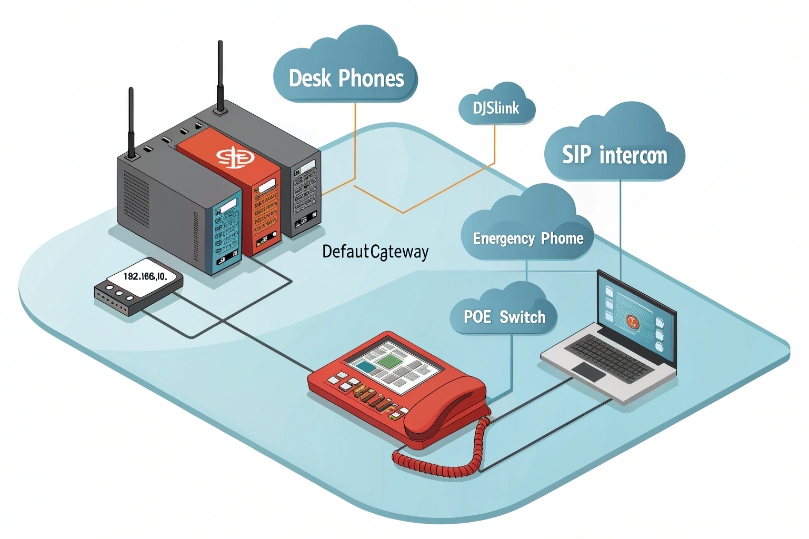
A default gateway is the router IP that your phones, IP PBX, and SBC use as the “next hop” to reach anything outside their local subnet, including SIP trunks, cloud PBX services, and remote RTP peers.
Why the default gateway matters more for VoIP than for normal data
Every device decides “local vs not local” by using its IP address and subnet mask. If the destination is not in the local subnet, the device sends the packet to the default route 1 (the default route, usually 0.0.0.0/0). Web traffic can survive a little routing mess because TCP retries. Voice cannot. Real-time Transport Protocol (RTP) 2 is real-time UDP. Late or missing packets sound like choppy audio or become one-way audio.
In SIP deployments, the default gateway influences:
- SIP registration reachability (can the phone reach the registrar?)
- RTP return path symmetry (will media come back the same way?)
- Network Address Translation (NAT) 3 bindings (where and how translations are created)
- QoS enforcement (does the first hop honor Differentiated Services Code Point (DSCP) 4 and shape uplink?)
- failover behavior (what happens when a router goes down?)
A key point: the default gateway is not “the internet.” It is just the first router hop. Still, if the first hop is wrong, nothing beyond it works reliably.
| Component | Uses default gateway for | What breaks when gateway is wrong |
|---|---|---|
| IP phone | Registering to PBX/SBC, remote calls | Registration drops, one-way audio |
| PBX/SBC | Trunk signaling, NAT, remote endpoints | Trunk down, call setup failures |
| Intercom/indoor station | Calling remote extensions or trunks | Calls time out, no audio |
| Softphone PC | VPN or WAN reachability | Random quality issues |
Once this base is clear, the next question is how the gateway handles SIP and RTP traffic specifically, because SIP and RTP behave differently on the wire.
How does a default gateway route SIP and RTP traffic?
Many teams focus on SIP port 5060/5061 and forget the media. Most “VoIP problems” are actually RTP path problems.
The default gateway routes SIP signaling and RTP media by forwarding packets to non-local IPs, applying NAT/firewall policies if configured, and ensuring return traffic follows a symmetric path so stateful devices keep RTP pinholes open.
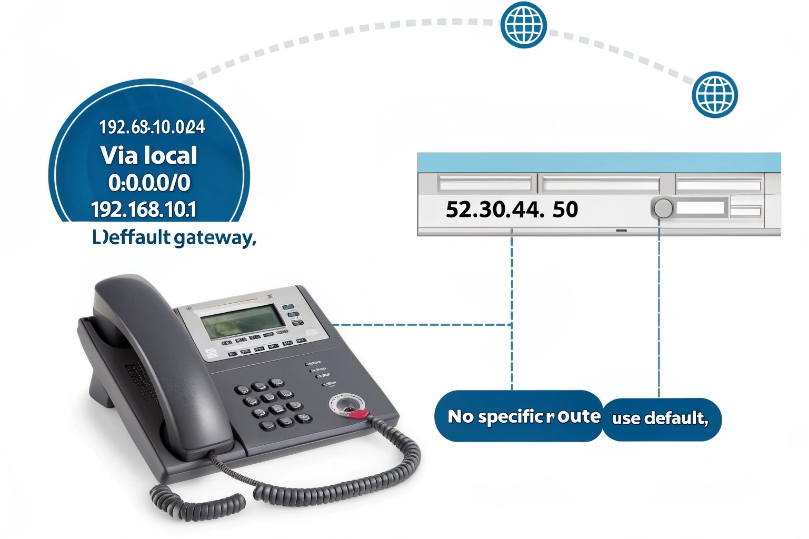
SIP signaling: small packets, stateful expectations
SIP (Session Initiation Protocol) 5 packets are usually small and periodic:
- REGISTER refreshes
- INVITE/200 OK/ACK during call setup
- keepalives and OPTIONS polls
If the default gateway is wrong, SIP can fail in obvious ways:
- no registration
- calls fail to set up
- calls ring but never connect
SIP can also fail in subtle ways when NAT is involved. If the phone registers through one gateway but tries to send INVITEs through another path (asymmetric routing), a stateful firewall may drop it because it does not match the expected session state.
RTP media: high-rate UDP streams that must stay symmetric
RTP is a steady stream of UDP packets, usually on dynamic port ranges. RTP is where most one-way audio happens. A typical media flow requires:
- outbound RTP packets leaving through the right gateway
- inbound RTP packets returning through the same stateful path
- NAT bindings staying open for the duration of the call
When the default gateway causes asymmetric routing, the symptoms look like:
- caller hears callee, callee hears nothing
- audio works for 10–20 seconds, then stops (NAT timer closes)
- DTMF fails (if carried in RTP events)
Hairpin and media anchoring changes how the gateway sees traffic
If your PBX/SBC anchors media, RTP may always flow through the PBX/SBC and then out to the trunk. If your system uses direct media, RTP may flow directly between endpoints and the carrier. In both cases, the gateway must allow the required port ranges and keep state stable.
| Call model | Where RTP flows | Gateway risk |
|---|---|---|
| Media anchored on SBC/PBX | Endpoint ↔ SBC ↔ carrier | Higher bandwidth on gateway, but simpler NAT |
| Direct media (re-INVITE) | Endpoint ↔ endpoint/carrier | NAT traversal becomes critical |
| Multi-site via WAN | Endpoint ↔ PBX across routed links | Wrong gateway or static route breaks media |
The gateway is also where QoS should begin. If RTP is not prioritized at the first hop, downstream QoS helps less because the jitter is already created.
With that, the next practical task is configuration: how to set the default gateway on phones, PBXs, and SBCs in a consistent way.
How do I set the default gateway on my IP PBX and phones?
Most gateway mistakes come from inconsistency. Phones get a gateway from DHCP. The PBX is set manually. One site uses a different voice VLAN gateway. Then troubleshooting turns into guesswork.
Set the default gateway on phones via DHCP Option 003 (or static settings for special cases), and set the PBX/SBC default route per interface so voice VLAN devices always route to the correct L3 gateway for their subnet.
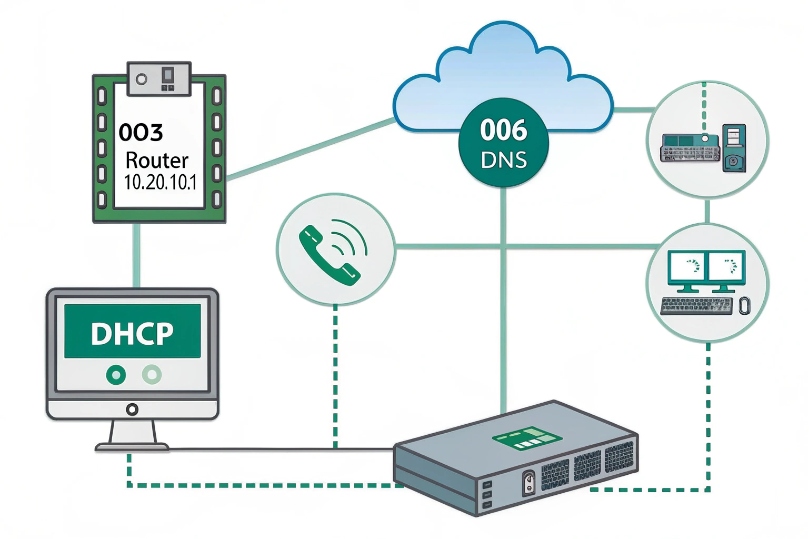
Phones: DHCP is the clean default
For most deployments:
- Phones should receive IP, mask, and gateway via DHCP.
- DHCP Option 003 (Router option) 6 supplies the default gateway.
- If you use a voice VLAN, the phone either tags VLAN via LLDP/CDP or uses a vendor option, then requests DHCP in that VLAN and gets the correct gateway.
Static gateway settings on phones are best reserved for:
- isolated industrial networks
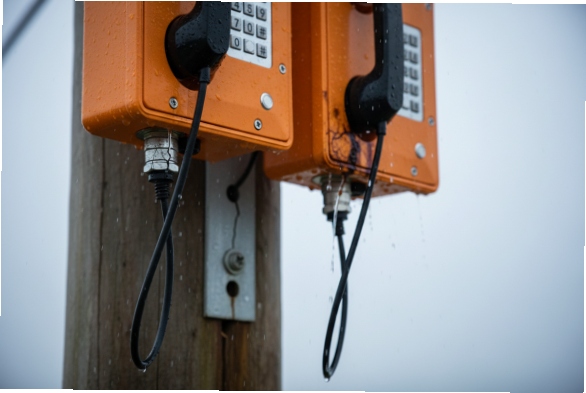
- emergency phones where DHCP is not allowed
- lab networks with strict change control
PBX/SBC: default route and interface design
PBXs and SBCs often have more than one interface:
- LAN/voice VLAN interface (phones side)
- WAN/trunk interface (carrier side)
- management interface (optional)
A common stable pattern is:
- phones and PBX live in the voice VLAN
- PBX uses the voice VLAN gateway for general routing
- trunk traffic is controlled with static routes or policy routing if needed
If the PBX has multiple uplinks, be careful. A single default gateway might not match the desired trunk egress. In that case, use:
- specific static routes for carrier SIP proxy IPs
- or policy-based routing with symmetry in mind
Keep it documented per VLAN/subnet
| Segment | Subnet | Default gateway | Who uses it |
|---|---|---|---|
| Voice VLAN | 10.10.20.0/24 | 10.10.20.1 | Phones, intercoms, PBX LAN |
| Data VLAN | 10.10.10.0/24 | 10.10.10.1 | PCs, printers |
| WAN edge | Public/ISP | ISP router | SBC WAN interface |
When gateway design is clean, most VoIP issues disappear. When it is wrong, the symptoms can look like codec problems, NAT problems, or carrier problems.
The next section explains the specific failure modes you can expect from wrong gateway settings.
Will wrong gateway cause one-way audio, registration drops, or NAT issues?
Yes, and it is one of the most common causes. The challenge is that it can fail in multiple ways depending on what part of the flow is asymmetric.
A wrong default gateway can cause registration failures, intermittent trunk drops, and one-way audio because SIP and RTP take different paths, stateful firewalls drop return traffic, and NAT bindings are created on the wrong edge device.
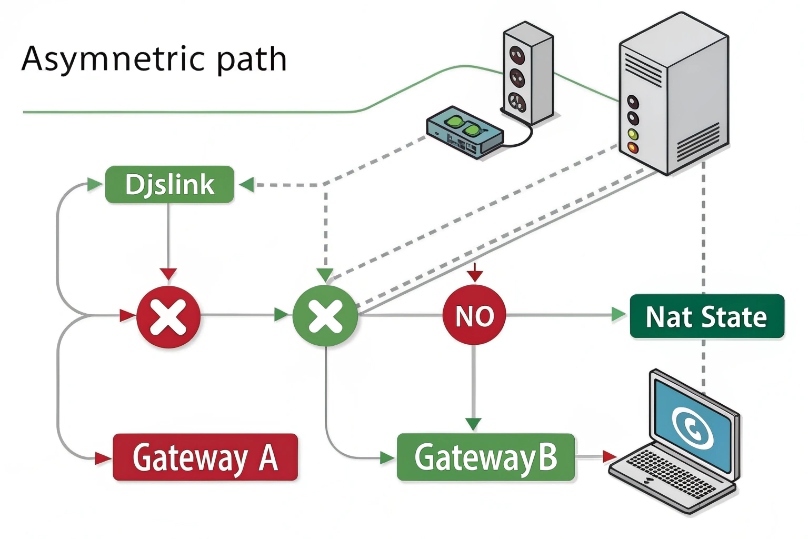
One-way audio is often “wrong path back”
One-way audio typically means RTP is only flowing one direction. Common gateway-related reasons:
- the endpoint sends RTP to the right place, but return RTP goes to a different gateway that drops it
- NAT is created on one router, but return packets arrive on another router
- wrong subnet mask makes the phone think the PBX is “local” when it is not, so it ARPs for it and fails
Registration drops can be “it works, then it doesn’t”
SIP registrations are periodic. A gateway problem can look like:
- phone registers, then fails on refresh
- PBX registers to trunk, then drops during route changes
- calls work inside LAN but external calls fail
These often correlate with:
- dual WAN links
- policy routing rules
- VRRP/HSRP failover events
- stateful firewalls that require symmetric return
NAT issues get worse with SIP ALG and mixed gateways
If NAT is performed at the gateway, SIP and RTP rely on:
- stable NAT bindings
- correct SIP header rewriting (or better, no SIP ALG)
- consistent port mappings
If you have multiple gateways and SIP ALG enabled on one of them, calls can become unpredictable because SIP headers and RTP pinholes get rewritten differently per path.
| Symptom | Gateway-related cause | Fast check |
|---|---|---|
| No SIP registration | Device cannot reach registrar | Ping gateway, then traceroute to PBX/SBC |
| Random registration drops | Asymmetric routing on refresh | Compare source IP/path on refresh traffic |
| One-way audio | RTP return path blocked | Check RTP stats and firewall state tables |
| Audio drops after ~30s | NAT timeout or wrong gateway | NAT binding timers and path symmetry |
| Calls fail only off-net | Wrong default route to carrier | Static route test to SIP proxy IP |
If your VoIP problems look random, gateway symmetry is one of the first things to validate. Once the gateway is correct, VLANs and QoS can be used to make it stable under load.
That leads to the last topic: how VLANs, QoS, and static routes change gateway design.
How do VLANs, QoS, and static routes affect my gateway design?
A voice VLAN with a clear gateway is one of the best VoIP design moves. Still, it only helps when routing and QoS are consistent across the first hop and WAN edge.
VLANs create separate L3 gateways for voice and data, QoS must be enforced at the gateway to protect RTP on the uplink, and static routes should be used to keep SIP/RTP symmetric when multiple WAN paths or SBC interfaces exist.
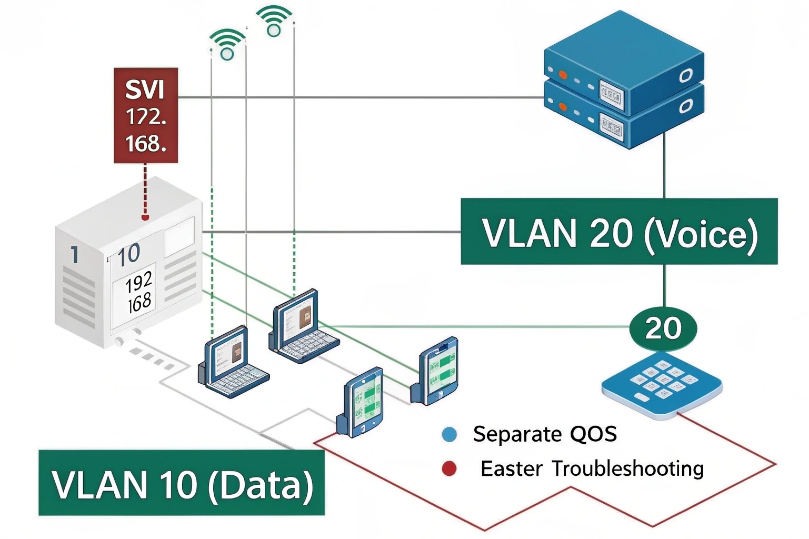
VLANs: separate gateways, separate policies
A common enterprise design:
- Data VLAN has its own gateway and internet policy.
- Voice VLAN has its own gateway with stricter QoS and ACLs.
- The voice VLAN gateway is where you enforce RTP prioritization and block risky outbound destinations.
This separation is valuable because voice traffic should not compete with bulk data.
QoS: the first hop matters most
QoS must be applied where congestion happens:
- LAN switch uplinks during peaks
- WAN uplink to ISP
- SD-WAN edge during brownouts
If the gateway does not honor DSCP markings or does not shape the uplink, RTP packets queue behind large uploads, creating jitter. That is when users say “the audio is choppy” even though bandwidth is “enough.”
Static routes: keep flows symmetric and predictable
Static routes matter when:
- the PBX/SBC has two uplinks
- you have dual ISPs
- you have private MPLS plus internet
- you have multiple carrier PoPs
In those cases, letting the default route decide everything can create asymmetric paths. A cleaner approach is:
- default route for general traffic
- specific routes for SIP proxy IPs and media relay ranges
- avoid policy routing that sends return traffic a different way unless you can keep state synchronized
Redundancy without breaking state
If you use Virtual Router Redundancy Protocol (VRRP) 7 for gateway redundancy, it usually works well for VoIP because the virtual IP stays the same. If you use two separate gateways without a shared VIP, calls can fail during failover because stateful firewalls lose session tables.
| Design feature | Benefit | Gateway requirement |
|---|---|---|
| Voice VLAN | Isolation + simpler QoS | Correct gateway per VLAN, DSCP preserved |
| QoS/shaping | Lower jitter and loss | Enforce at first-hop and WAN edge |
| Static routes | Predictable path | Keep SIP/RTP symmetric |
| VRRP/HSRP | Fast gateway failover | Shared virtual IP and tracked uplinks |
| Dual WAN | Higher uptime | Route symmetry and firewall state design |
When gateway design is correct, SIP and RTP behave predictably. That makes every other VoIP tuning step easier: codec choice, jitter buffer tuning, and carrier troubleshooting.
Conclusion
A default gateway is the first-hop router your VoIP devices use to reach off-subnet SIP and RTP peers. Correct gateways, symmetric routing, VLAN separation, and QoS at the edge prevent one-way audio and unstable registrations.
Footnotes
-
Clarifies how a default route works and why it’s the key “next hop” for off-subnet VoIP traffic. ↩ ↩
-
Defines RTP behavior and timing expectations so you can relate gateway/routing issues to real audio symptoms. ↩ ↩
-
Explains NAT behavior and why consistent translation/state matters for SIP and RTP return paths. ↩ ↩
-
Shows what DSCP is and how QoS markings are intended to prioritize real-time voice packets. ↩ ↩
-
The core SIP standard—useful for understanding registration, INVITE flows, and what breaks with asymmetric routing. ↩ ↩
-
Documents DHCP Router option (Option 003), the standard way phones learn the default gateway automatically. ↩ ↩
-
Describes VRRP and why a stable virtual gateway IP helps maintain VoIP sessions during gateway failover. ↩ ↩