
Calls go dark when ports slip.
FOC locks the cutover date so teams can plan with confidence.
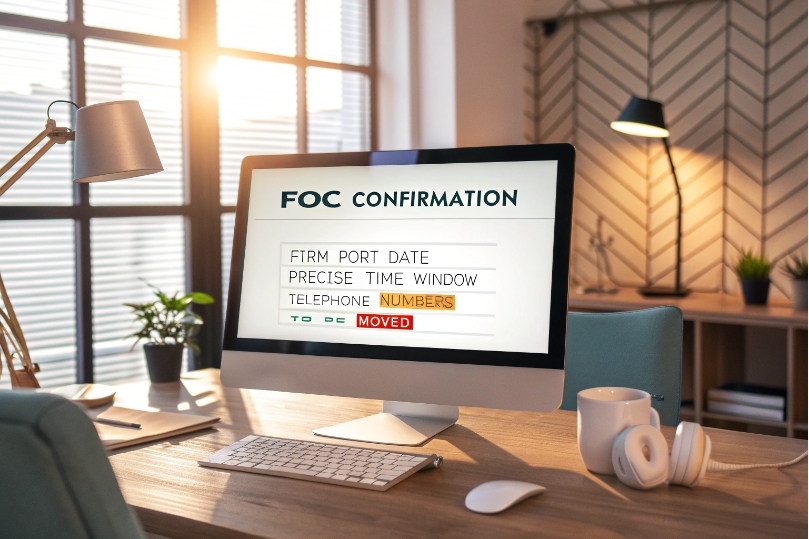
FOC (Firm Order Commitment) is the losing carrier’s written approval of your port. It lists the exact due date, time window, and the telephone numbers that will move.
Firm Order Commitment (FOC) 1 is the moment the order becomes real. The gaining carrier uses it to schedule NPAC activation, routing changes, and live tests. Treat FOC like a go-live notice. After it, changes require supplements and can push the date. Validate data early and prepare the target routing before FOC lands.
When will I receive an FOC date for my port?
Silence breeds risk.
Projects stall when dates stay vague.
Push for FOC only after clean data and a valid LSR.
You get FOC after the losing carrier validates your LSR. Typical local ports take a few business days. Toll-free can be faster. Holidays and partial ports may extend timelines.
Dive deeper
What has to happen before FOC
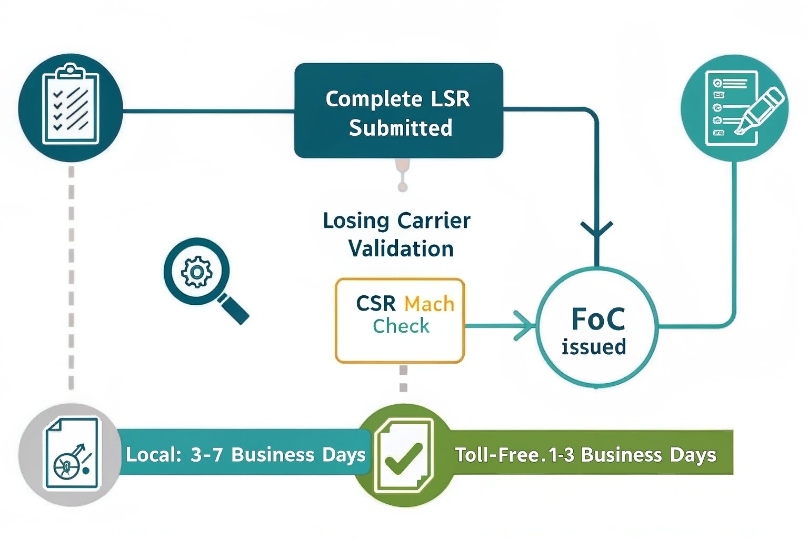
The clock starts with a complete Local Service Request (LSR) 2 submitted by the gaining carrier. The losing carrier checks CSR (Customer Service Record) fields: BTN, service address, account name, and any PINs. If details match and there is no freeze, pending order, or unpaid balance, the losing carrier issues FOC with a due date and time window. That window is often 30–60 minutes during business hours. Some carriers avoid Fridays, weekends, and holidays to reduce risk.
How long it usually takes
For geographic numbers on standard accounts: 3–7 business days from clean LSR to FOC.
For toll-free: 1–3 business days.
Complex enterprise accounts, partial ports with many TNs, or reseller chains can push past a week.
What can speed this up
Clean documents. Accurate CSR details. A signed LOA that matches the CSR exactly. A recent invoice to confirm BTN and billing hierarchy. If the account has a port freeze, clear it first. Ask for a preferred due date in the LSR, but stay flexible.
| Port Type | Typical FOC Lead | Notes |
|---|---|---|
| Local TNs | 3–7 business days | Longer if partial/complex |
| Toll-free | 1–3 business days | Often faster, still needs FOC |
| Large blocks (100+) | 5–10+ business days | Extra review/testing |
| Reseller chain | Variable | Add time for each hop |
Which documents are required for FOC—LOA, CSR, invoice?
Missing one field can stall the order.
Names, addresses, and BTN must match exactly.
Get paperwork tight before the LSR goes out.
You need a signed LOA, the CSR details, and a recent invoice. Some accounts add a PIN, account number, or freeze lift letter. Every field must align with the losing carrier’s records.
Dive deeper
The core trio
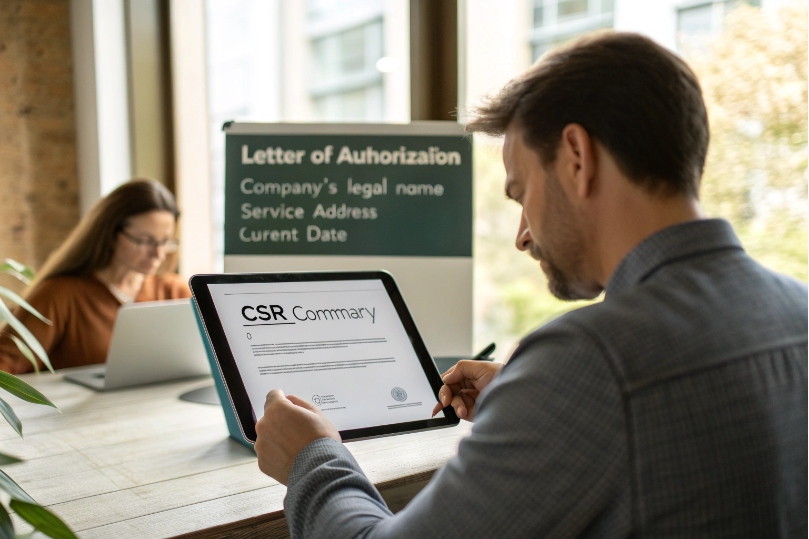
- Letter of Authorization (LOA) 3: Must show legal name on the account, service address, and authorized signer. Date should be current (some carriers reject LOAs older than 30–60 days).
- Customer Service Record (CSR) 4: Truth source for BTN, service address, account name, and sometimes a porting PIN.
- Recent invoice: Confirms account number, BTN, and billing structure.
Common extras
- Port-out PIN / passcode
- Freeze removal letter
- Entity-specific LOAs (if TNs span legal entities)
- RespOrg (Responsible Organization) letter 5 (toll-free)
Field-level alignment
Match formatting exactly (punctuation, abbreviations, suite numbers). Confirm which TN is the BTN (billing anchor). If the BTN is included in a partial port, decide whether to change BTN on remaining service or split orders.
| Document | Required | Purpose | Rejection Risks |
|---|---|---|---|
| LOA | Yes | Authorization | Wrong name, old date, unsigned |
| CSR | Yes | Data truth source | Address/BTN mismatch |
| Invoice | Yes | Ownership proof | Outdated info |
| PIN/Passcode | Sometimes | Port validation | Missing/wrong PIN |
| Freeze lift | If frozen | Remove block | Not processed yet |
| RespOrg letter | Toll-free | TFN transfer | Missing signature |
Why was my FOC rejected—mismatch, freeze, unpaid balance?
A “jeopardy” notice means the order stopped.
It is rarely random.
Fix the exact cause, then resubmit or supplement.
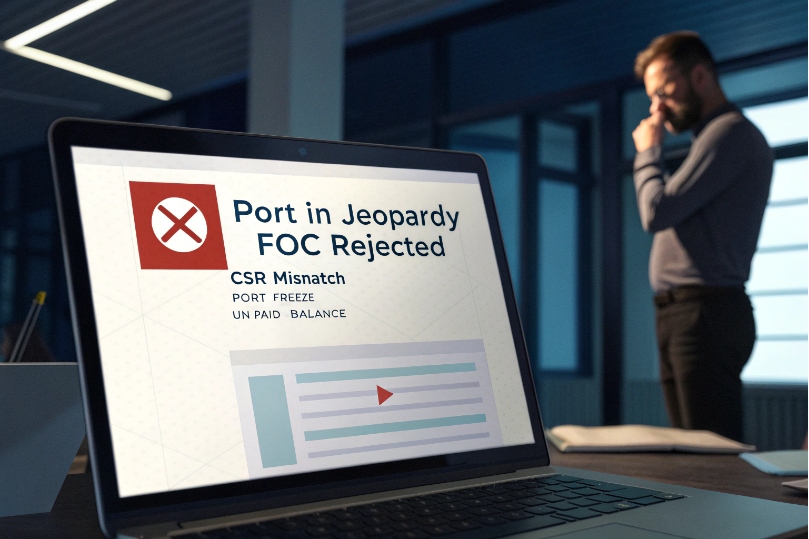
Most FOC rejections come from data mismatches, port freezes, pending orders, unpaid balances, or partial-port rules. Read the jeopardy code, correct the source, and push a clean supplement.
Dive deeper
Top rejection causes and fixes
- CSR mismatch: LSR name/address/BTN/account differs. Fix: re-pull CSR and match exactly.
- Port freeze/lock: blocks port-outs. Fix: lift freeze and include PIN if required.
- Unpaid balance/dispute: can hold ports. Fix: clear balance or obtain clearance note.
- Pending order: moves/adds/disconnects/features queued. Fix: complete/cancel pending order.
- Partial port with BTN included: may require BTN reassignment or split order.
- Reseller chain: underlying carrier review delays. Fix: escalate; expect longer timelines.
How to respond
Ask your gaining carrier for the jeopardy code and notes. Provide exactly what the losing carrier requested. Use a supplement if it’s a small fix; start a new LSR if structure is wrong.
| Jeopardy Reason | Symptom | Fastest Fix |
|---|---|---|
| CSR mismatch | FOC withheld | Correct LSR to CSR |
| Freeze/lock | Reject with freeze note | Submit lift + PIN |
| Unpaid balance | Reject until paid | Clear balance + proof |
| Pending order | Reject with order ID | Complete/cancel it |
| BTN in partial port | Reject/change required | Reassign BTN or split |
| Reseller complexity | Long silence | Escalate to underlying carrier |
How do I track FOC status and avoid service downtime?
Cutovers fail when no one watches the clock.
Ports slip when teams assume someone else is checking.
Track every milestone and prepare the new routing early.
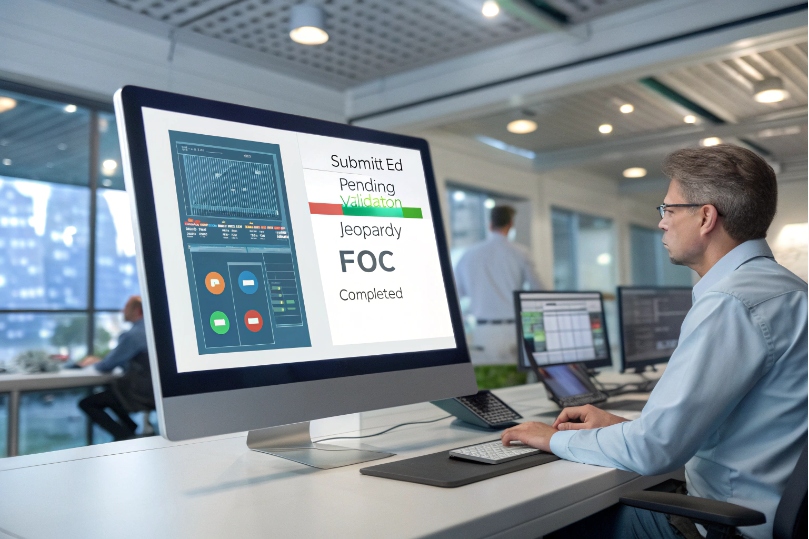
Use your carrier portal to watch LSR, jeopardy, and FOC updates. Build a cutover checklist: NPAC, routing, CNAM, E911, SMS, and failback. Test inbound from multiple networks during the window.
Dive deeper
Track the order end-to-end
States usually look like: Submitted → Pending Validation → Jeopardy/Rejected → FOC → Completed. Enable alerts. Capture the FOC due date, time zone, and window length (time zone mistakes cause real outages).
Prepare the gaining side before FOC
- Routing: inbound routes, IVR, failover on the new PBX/SBC
- E911: register each TN; test 933 callback if supported
- CNAM: set outbound name where applicable
- SMS/A2P: migrate messaging profiles if numbers text
- Auth/reputation: align signing/attestation where relevant
Tie your cutover steps to the Number Portability Administration Center (NPAC) 6 activation window, and document where E911 test calls land (many providers surface them as a Bandwidth 933 service test call 7 in reporting).
Execute on the FOC date
Provider triggers NPAC activation and translations. Expect a period where some networks route old and others route new (often 30–60 minutes). Test from mobile, landline, and another VoIP. Keep losing service active until inbound is stable. If needed, use temporary forwarding to bridge the transition.
Aftercare and rollback
Monitor CDRs and carrier-specific failures. “Snapback” is rare/time-limited; most issues resolve faster via translations + temporary forwarding.
| Step | Owner | Tool | Done? |
|---|---|---|---|
| Confirm FOC date/time zone | PM | Carrier portal | ☐ |
| Prebuild inbound routes | Voice engineer | PBX/SBC | ☐ |
| E911 + 933 test | Ops | E911 portal | ☐ |
| CNAM outbound set | Voice engineer | Carrier API | ☐ |
| SMS profile move | Messaging | CPaaS console | ☐ |
| Cutover tests (3 networks) | NOC | Test plan | ☐ |
| Post-cutover monitoring | NOC | CDR/alerts | ☐ |
Conclusion
Secure FOC early with clean data. Read jeopardy fast. Prepare routing and E911 before the window. Test during cutover and keep a simple failback ready.
Footnotes
-
Clear definition of FOC and what the due date/time window means for port cutovers. (↩) ↩
-
Shows the NPAC process flow and where LSR/FOC fit in the porting timeline. (↩) ↩
-
Practical LOA guidance and common porting documentation requirements from a carrier knowledge base. (↩) ↩
-
Explains CSR-related workflow details that commonly delay or reset port orders. (↩) ↩
-
Background on toll-free number administration and the roles involved in managing toll-free records. (↩) ↩
-
NPAC overview explaining how number portability is administered and why activation timing matters. (↩) ↩
-
Notes where 933 test calls may appear in reporting and how some providers surface E911 test activity. (↩) ↩








