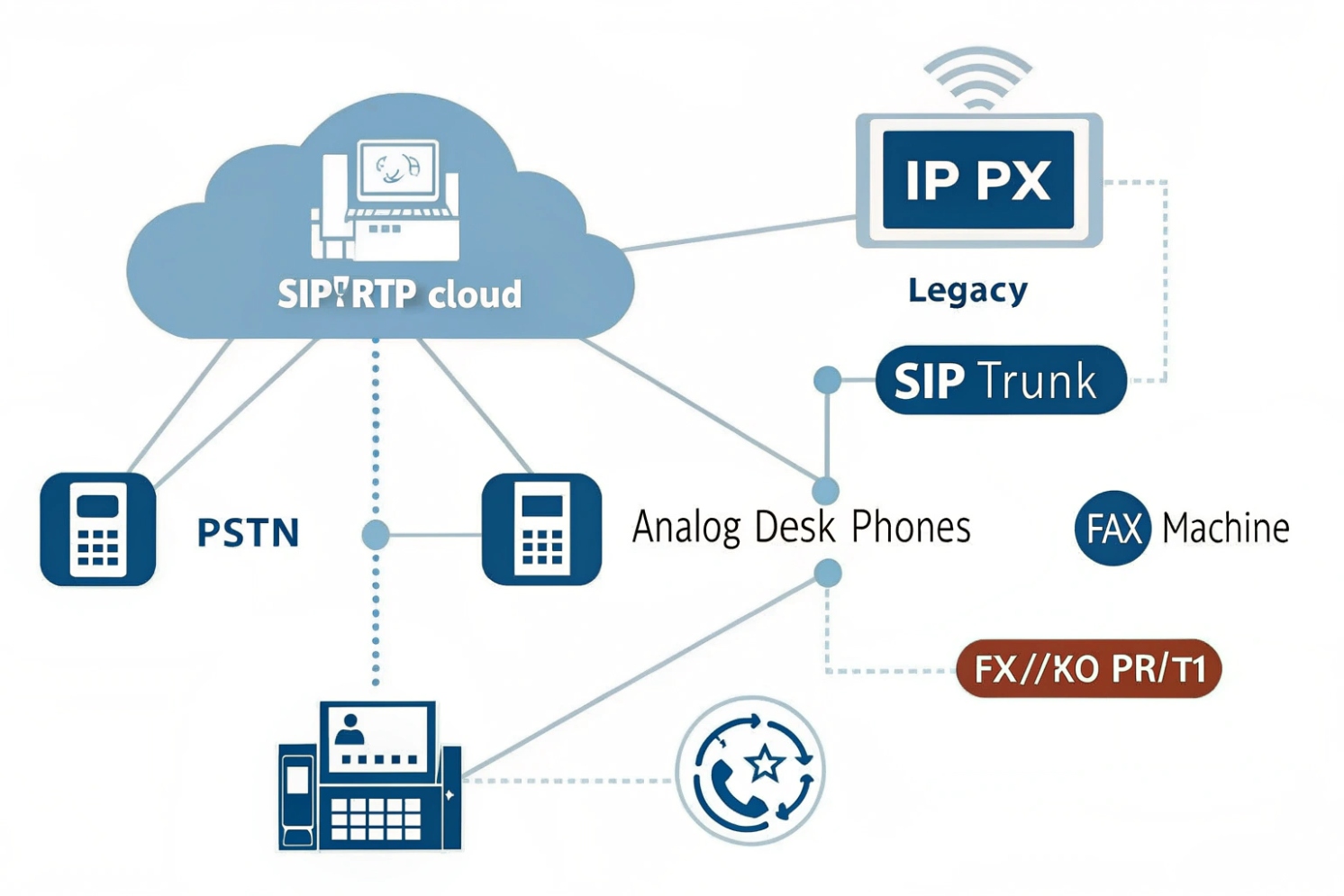
When your legacy phones keep ringing, but the internet calls you’ve been planning for are still spotty, a gateway is the bridge between your VoIP system and traditional telephony infrastructure, making sure everything connects smoothly.
A gateway is a device that links your VoIP network to legacy telephony systems like PSTN, ISDN, or analog devices, converting signaling and media from digital to analog (or vice versa).
A gateway translates voice and data signals between different technologies. It handles the conversion of voice signals into digital packets for the VoIP network and vice versa for legacy analog devices or PSTN trunks. This allows companies to seamlessly integrate their old equipment with modern VoIP infrastructure, reducing the need for complete system overhauls.
Key Gateway Functions:
- Signal Conversion: Converts analog to digital (and vice versa) so old phones or fax machines can work with a VoIP PBX.
- Protocol Translation: Handles various telephony protocols (like Session Initiation Protocol (SIP) 1, H.323, MGCP) to ensure compatibility across different networks.
- Codec Handling: Translates between codecs (e.g., G.711, G.729, Opus) for consistent audio quality, even with different endpoints.
- Call Routing and Least Cost Routing (LCR): Routes calls based on cost, quality, or destination, improving efficiency and reducing expenses.
- Fax and Voice Integration: Ensures compatibility for fax machines and legacy voice systems, using protocols like T.38 fax relay 2.
- Survivability: Provides failover options by routing calls to local PSTN during WAN or SIP trunk outages.
In simple terms, gateways allow businesses to keep their old telephony equipment while transitioning to the cost-effective, feature-rich world of VoIP.
Now, let’s dive into how these gateways connect various devices and networks.
How do VoIP gateways connect SIP trunks, PSTN, and analog devices?
Understanding what each type of gateway does will help you choose the right one for your site’s needs. They’re not all the same; some specialize in connecting your PBX to SIP trunks, while others bridge the gap to analog PSTN lines or legacy PBXs.
VoIP gateways connect your VoIP network to traditional telephony networks through different ports and technologies:
1. FXS Gateways (Foreign Exchange Station)
- What it connects: Analog phones, fax machines, and PBXs to VoIP networks.
- How it works: Foreign Exchange Station (FXS) ports 3 send dial tone and connect directly to analog devices, converting digital VoIP signals to analog audio for use with phones and fax machines.
- Common use: For businesses that want to use legacy analog phones with a modern VoIP system.
2. FXO Gateways (Foreign Exchange Office)
- What it connects: VoIP networks to analog PSTN lines (like landline phones).
- How it works: Foreign Exchange Office (FXO) ports 4 connect to the PSTN, providing an interface for your VoIP system to make calls to and receive calls from the traditional phone network.
- Common use: For businesses that still rely on traditional phone lines (PSTN) but want to use a VoIP PBX.
3. PRI/ISDN Gateways (Primary Rate Interface / Integrated Services Digital Network)
- What it connects: VoIP networks to digital PSTN lines (e.g., T1, E1 circuits).
- How it works: PRI/ISDN (T1/E1) digital trunks 5 provide a digital interface for large volumes of calls, typically connecting high-capacity lines like T1/E1 or ISDN lines.
- Common use: For businesses with high call volume or those using ISDN-based systems.
| Gateway Type | Purpose | Connection Example | Common Usage |
|---|---|---|---|
| FXS | Analog devices to VoIP | Analog phones to VoIP PBX | Small businesses or home offices |
| FXO | VoIP to PSTN | VoIP PBX to PSTN line | Hybrid setups for cost reduction |
| PRI/ISDN | High-capacity digital lines | VoIP PBX to PRI/E1 trunk | Large enterprises needing scalability |
By using these gateways, businesses can seamlessly integrate older analog or PSTN-based equipment into a new VoIP network, avoiding the need for a full upgrade while enjoying the benefits of VoIP.
Should I choose FXS, FXO, or PRI gateways for my site?
Choosing the right gateway depends on the type of telephony infrastructure your site has and how much you want to integrate with modern VoIP features.
Here’s a quick guide to help decide:
- Choose FXS if you need to connect analog phones, fax machines, or analog PBXs to your VoIP network.
- Choose FXO if your site still uses PSTN lines for incoming/outgoing calls but you want to integrate them with your VoIP system.
- Choose PRI if your business has a high call volume or uses digital trunks (e.g., T1/E1) and needs high scalability.
Considerations:
- Scalability: PRI is ideal for large businesses with many lines. It supports more concurrent calls than FXS/FXO.
- Cost: FXS and FXO gateways are cheaper and more suitable for smaller sites with minimal need for high-volume trunks.
- Reliability: PRI gateways offer robust, high-quality connections for mission-critical operations.
In essence, FXS/FXO gateways work best for smaller or hybrid setups, while PRI is ideal for larger, more scalable enterprise needs.
How do I provision codecs, DTMF, and dial plans on a gateway?
Setting up codecs, DTMF methods, and dial plans ensures that calls are routed correctly, maintain audio quality, and that all call features (like keypad inputs) work as expected.
1. Provisioning Codecs
- What it is: A codec is a method for compressing and transmitting voice data, which helps balance bandwidth and call quality.
- How to provision: On the gateway, you can specify which codecs (e.g., G.711, G.729, Opus) should be used for different call types or trunks.
- Why it matters: Different codecs have different bandwidth requirements and quality characteristics. Choosing the right one ensures optimal call quality while minimizing bandwidth usage.
2. DTMF (Dual-tone Multi-frequency)
-
What it is: DTMF signals are used for dialing numbers or interacting with automated systems (e.g., "press 1 for sales").
-
How to provision: Gateways can be configured to support different DTMF signaling methods, like:
- In-band: DTMF tones transmitted as part of the audio stream.
- RFC 2833/4733: DTMF signals are sent as discrete packets.
- SIP INFO: DTMF is sent as SIP INFO messages.
-
Why it matters: Ensures that keypad tones are recognized across different networks, whether you’re dialing a number or navigating a voicemail system.
3. Dial Plans
- What it is: A dial plan is a set of rules that define how calls are routed based on the dialed number.
- How to provision: On the gateway, you can set up dial plans to normalize numbers (e.g., convert to E.164 format), define routing rules based on number patterns, and choose which trunk to route calls through.
- Why it matters: Dial plans ensure calls are directed efficiently and cost-effectively, whether they’re internal or external, local or international.
| Feature | What it controls | Why it matters |
|---|---|---|
| Codecs | Voice quality, bandwidth use | Balance call clarity vs network load |
| DTMF Methods | Keypad signal transmission | Critical for IVR systems and call routing |
| Dial Plans | Call routing | Ensures correct destination and cost control |
Configuring these features ensures smooth call quality, accurate signal transmission, and reliable call routing for your VoIP network.
What security hardening do gateways need—TLS, SRTP, ACLs, VLANs?
VoIP gateways are often deployed at the edge of the network, making them a target for attacks like eavesdropping, toll fraud, or service disruption. Proper security hardening protects both the gateway and the broader network.
1. TLS (Transport Layer Security)
- What it is: Transport Layer Security (TLS) 6 encrypts signaling between endpoints, ensuring that SIP messages (such as call setup and teardown) are secure.
- Why it matters: Without TLS, attackers can intercept and manipulate call signaling, potentially leading to fraud or eavesdropping.
2. SRTP (Secure Real-Time Protocol)
- What it is: Secure Real-time Transport Protocol (SRTP) 7 encrypts the media stream (audio/video) itself, ensuring that voice data is protected during transmission.
- Why it matters: SRTP is critical for preventing eavesdropping on sensitive conversations.
3. ACLs (Access Control Lists)
- What it is: ACLs limit which IP addresses or subnets are allowed to connect to the gateway.
- Why it matters: By restricting access, you prevent unauthorized users or devices from accessing the gateway, protecting against toll fraud and unauthorized calls.
4. VLANs (Virtual Local Area Networks)
- What it is: VLANs segment network traffic, ensuring that VoIP traffic is isolated from other data traffic.
- Why it matters: By separating VoIP traffic, you improve security, prevent data collisions, and ensure quality of service (QoS) for voice calls.
| Security Layer | What it protects | Why it matters |
|---|---|---|
| TLS | Signaling encryption | Secures SIP messages from interception |
| SRTP | Media encryption | Prevents eavesdropping on call audio |
| ACLs | Access control | Restricts who can connect to the gateway |
| VLANs | Traffic isolation | Prevents interference and protects QoS |
By implementing these security measures, your gateway becomes much more secure, helping to protect both your calls and the integrity of your network.
Conclusion
A VoIP gateway is the critical bridge between your VoIP network and traditional telephony systems. By selecting the right gateway type, provisioning codecs and dial plans, and securing the system with encryption, ACLs, and VLANs, you ensure reliable, secure, and efficient communication for your business.
Footnotes
-
SIP specification for how endpoints set up calls and negotiate media capabilities. ↩ ↩
-
Official T.38 recommendation describing reliable fax-over-IP behavior and interop expectations. ↩ ↩
-
Explains what FXS ports provide and how they connect analog phones and fax devices. ↩ ↩
-
Explains how FXO ports interface with PSTN analog lines for inbound/outbound calling. ↩ ↩
-
Overview of PRI/ISDN trunking and how T1/E1 circuits carry many simultaneous calls. ↩ ↩
-
TLS standard reference for encrypting signaling and protecting SIP credentials and call setup messages. ↩ ↩
-
SRTP standard reference for encrypting RTP media streams to reduce eavesdropping risk. ↩ ↩