
Unknown calls get ignored. Wrong names look like spam. That hurts answer rates and trust. CNAM is the piece that decides what many phones show as your caller name.
CNAM (Caller Name) is the text name that can appear next to your caller ID number. It is looked up by the receiving carrier from a database, so it can differ by network, device, and region.
CNAM is best understood as a lookup, not a label you fully control. Your SIP trunk sends a caller ID number (often called Automatic Number Identification (ANI) 1). The receiving side may then “dip” a CNAM database—often via a Line Information Database (LIDB) 2—and pull a short name string for that number. If the receiving network skips the dip, the phone may show only the number. If the called person saved you in contacts, their phone may show that contact name instead of any carrier CNAM.
That is why CNAM feels inconsistent. It is not one global system. It is a chain of decisions: what number you present, whether the number is authorized, whether the terminating carrier does a lookup, and whether the device overrides the result. It is also region-specific. CNAM is most common in North America, while many other regions do not use the same CNAM dip model.
CNAM also has strict limits. Most carriers accept a short, uppercase-style name, and many enforce a length limit. Some words get rejected. Some carriers take days to update. So CNAM is closer to “carrier directory data” than “a real-time brand banner.”
Here is the simple model that keeps teams aligned:
| Item | What it is | Who controls it most | What the callee finally sees |
|---|---|---|---|
| Caller ID number (ANI/CLI) | The numeric calling number | Your PBX + ITSP rules | Often shown, almost always |
| CNAM | Name text tied to that number | Carrier databases + terminating carrier | Sometimes shown, often inconsistent |
| Presentation | How the phone renders it | Device OS + contacts + carrier | Can override CNAM |
| Trust signals | Verified/likely spam labels | Carriers + analytics | Can defeat “good CNAM” |
When CNAM is treated as a “nice boost” instead of a guaranteed label, decisions get easier. The goal becomes: keep outbound caller ID clean and consistent, publish a short CNAM where supported, and avoid anything that looks like spoofing.
If the business wants higher answer rates, CNAM is one lever. Still, it works best alongside good number reputation, correct STIR/SHAKEN attestation, and consistent calling behavior.
Now, the fastest way to remove confusion is to separate CNAM from the caller ID number and from how a phone presents it.
How does CNAM differ from caller ID number and presentation?
Wrong labels cause wasted time. Users blame the PBX. Then support gets stuck in circles. The fix starts by naming each layer correctly.
CNAM is the caller name text, caller ID is the caller number, and presentation is how the receiving network and device choose to display both.
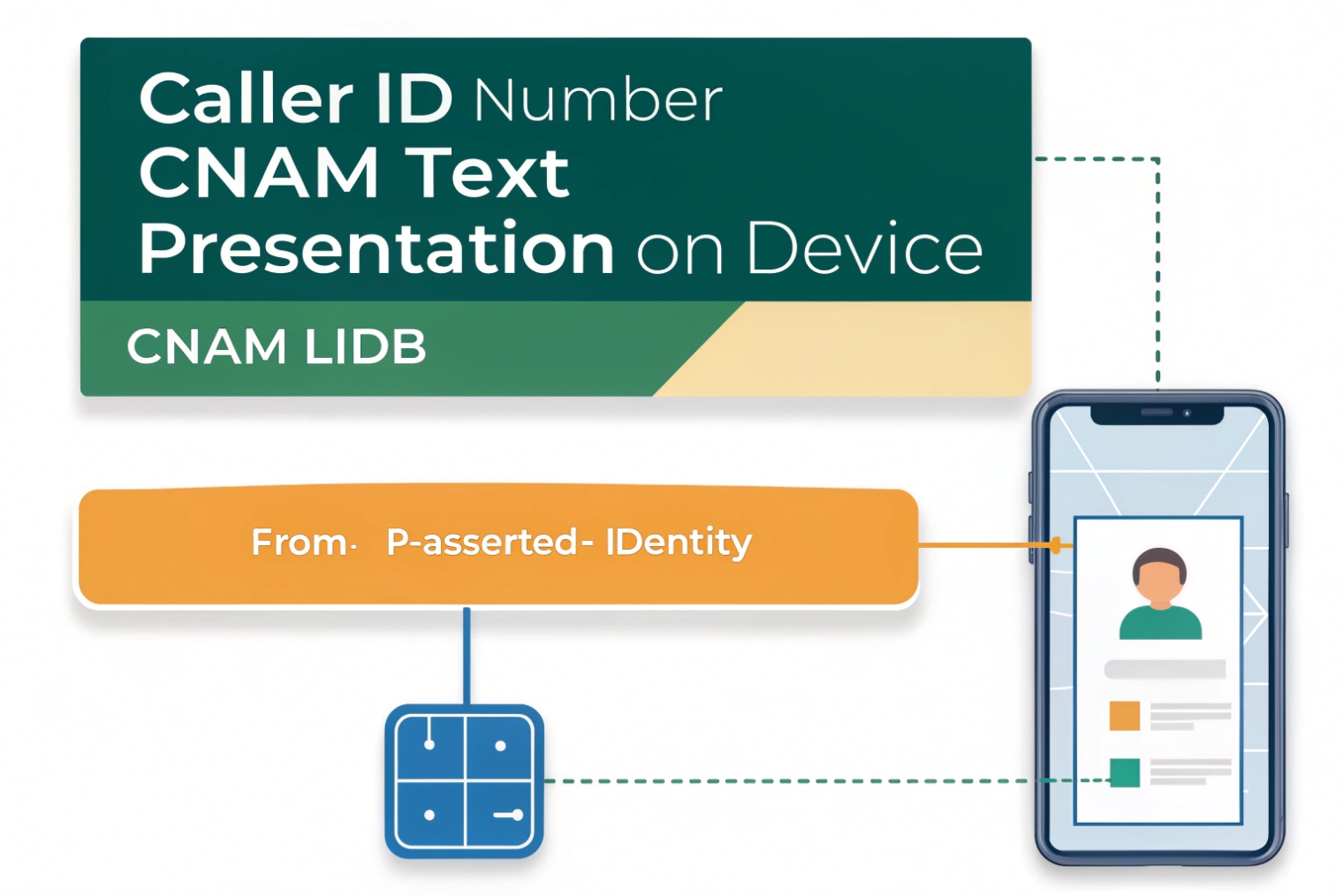
CNAM and caller ID number travel through the call differently. The caller ID number is part of call setup and routing logic. It is used for billing, blocking, and call return. CNAM, in many networks, is not “sent end-to-end” in the same way. Instead, the receiving carrier sees the number and decides whether to perform a CNAM lookup. If it does, it fetches a name string and passes that display value onward.
Presentation is the last layer. Even if the carrier returns CNAM, the device might not show it. Many mobile phones display what is in the local contacts first. If a person saved your number as “Jason – Factory Gate,” that will show, not your carrier CNAM. Some devices also show “Verified” or “Spam Risk” labels from carrier analytics, and those labels can dominate the screen more than CNAM.
This difference matters for troubleshooting. If the number is wrong, fix PBX trunk headers and number policy. If the number is right but the name is wrong, that is usually a CNAM database and propagation issue. If both are correct but the callee sees something else, it is often contact override or device-side calling app behavior.
A practical way to explain it to a team is “three layers, three owners”:
| Layer | What can go wrong | Common root cause | Where to fix it |
|---|---|---|---|
| Number | Wrong CLI, blocked calls | PBX trunk config, unauthorized number | PBX/ITSP caller ID policy |
| CNAM | Wrong or missing name | CNAM not set, slow updates, no dip | Carrier CNAM order/ticket |
| Presentation | Different name per user | Contacts override, mobile UI rules | User device, expectations, testing |
If a business needs a consistent brand label on every mobile network, CNAM alone will not deliver that. The better target is: correct number + clean reputation + a short CNAM where supported, then accept that devices may still override.
Once these layers are separated, the next question becomes cost and process: how the dip happens, and who pays for it.
How do carriers dip CNAM databases and who pays?
CNAM feels random, so finance teams ask why it costs money at all. This confusion often blocks branding requests and slows down go-live changes.
A CNAM “dip” is a per-call database lookup done by the terminating carrier. The terminating side is usually charged per lookup, and the cost is often bundled or passed through in carrier pricing.
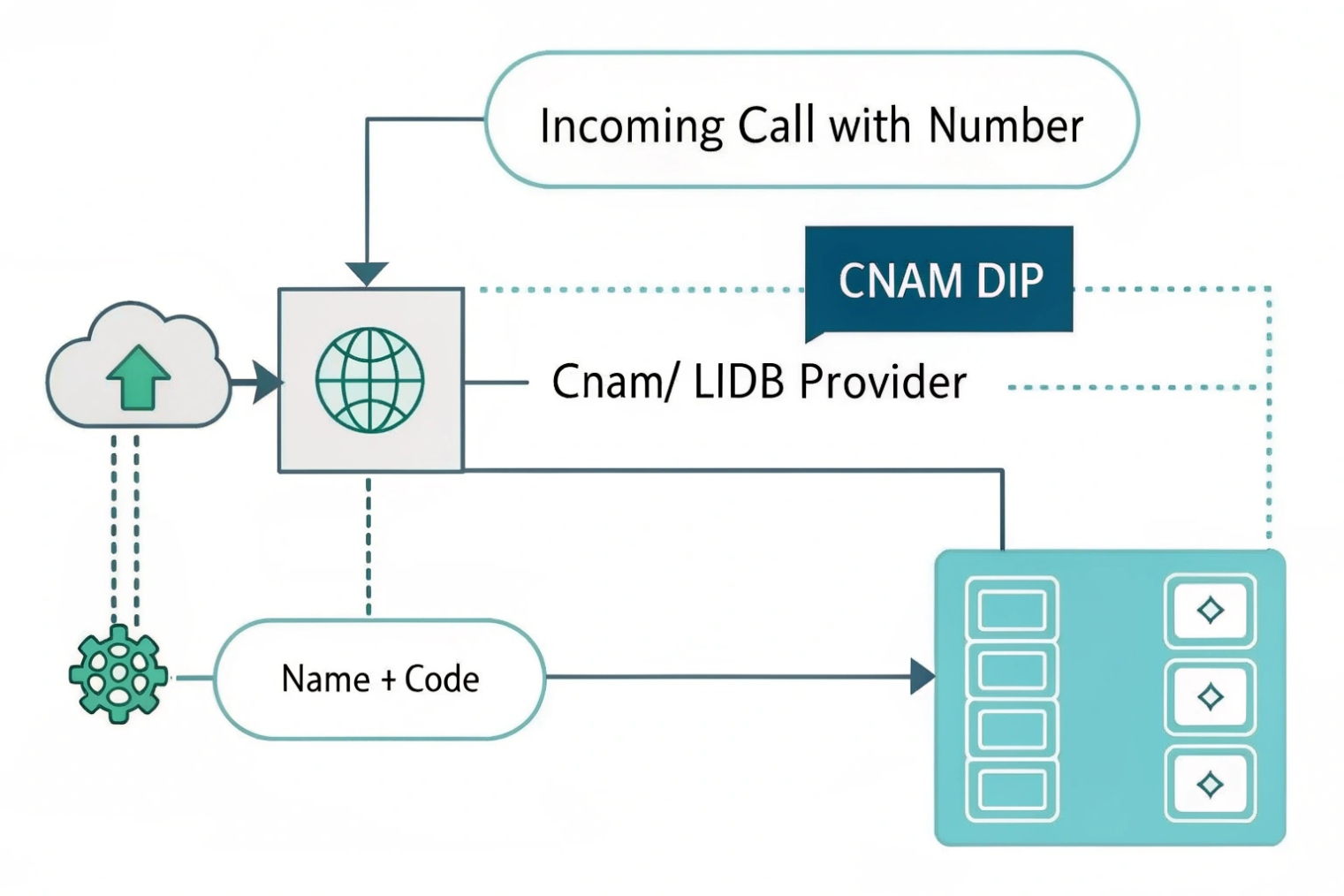
In many North American call flows, the receiving carrier decides whether to perform a CNAM dip. That lookup queries a caller name database using the calling number as the key, then returns a short name string. The key detail is this: the calling side usually does not force the lookup. The called side chooses to do it, or to skip it. That is why a single outbound call can show CNAM on one network and show only a number on another.
The cost model follows the same logic. The terminating carrier is the one running the lookup, so the terminating carrier is the one that gets charged for it. Still, nobody works for free. That cost can show up in multiple ways:
- included in retail plans as part of “caller ID name”
- added as a small per-call feature cost
- priced into the overall termination rate
- offered only on certain service tiers
This matters for your VoIP budgeting. If a provider says “outbound CNAM supported,” it often means they can publish a record for your number in their CNAM partners’ systems. It does not mean every carrier will dip it, or that every mobile phone will show it.
The clean way to manage expectations is to plan testing across several destinations:
- landline carrier A
- landline carrier B
- mobile carrier A
- mobile carrier B
- a user who has you saved in contacts
Then the results can be sorted by “dip behavior,” not by guessing.
If you need to validate displays at scale (or build automated tests), using a CNAM Lookup API 3 can help you confirm what some databases return for a number.
| Question | What to ask your provider | Why it matters |
|---|---|---|
| Who publishes CNAM? | “Which database partners do you update?” | Coverage and propagation |
| Who pays dips? | “Is dip cost bundled or itemized?” | Billing surprises |
| How long to update? | “What is your normal propagation window?” | Launch planning |
| What name format rules? | “Length, characters, blocked terms?” | Avoid rejections |
| What about toll-free? | “Do you support name display on toll-free?” | Many networks treat it differently |
A short story placeholder: one team kept changing CNAM daily, expecting instant results. The real fix was to stop changing it, pick one clean brand string, and wait for propagation. After that, complaints dropped.
Once you understand dips and costs, the next pain point is the one everyone feels: outbound CNAM not showing on SIP trunks and mobiles, even when it “should.”
Will my outbound CNAM display correctly on SIP trunks and mobiles?
Sales teams hate “UNKNOWN” labels. Support teams hate looking like robocalls. When CNAM does not show, people assume the SIP trunk is misconfigured.
Outbound CNAM may display correctly only when your caller ID number is authorized, your carrier has published your CNAM, and the terminating network performs a dip and chooses to show it. Mobile devices can still override it with contacts or analytics labels.
Start with the number. If the outbound caller ID number is not stable and authorized, CNAM does not matter. Many carriers will not publish CNAM for numbers you do not own or numbers not on your account. Some carriers also block or downgrade calls that present mismatched caller ID. So step one is always: present a caller ID number that is assigned to you and allowed on that trunk.
Next, check your SIP trunk presentation behavior. Even though CNAM is a lookup, trunk signaling still matters because it decides what number is being looked up. If the PBX sends the wrong calling number in the right header, the dip returns the wrong name. If the trunk rewrites numbers to a main pilot DID, then all calls dip to that main pilot DID CNAM. That might be desired for branding, or it might be wrong for departments.
Then focus on the destination network. Some mobile carriers rely more on:
- local contacts
- branded calling programs
- analytics-based labels
So CNAM can be present but still not visible.
A reliable test approach is simple:
- Call a known landline that usually shows CNAM.
- Call a mobile line that has never saved your number.
- Call a mobile line that has saved your number with a custom contact name.
- Compare results.
If CNAM shows on landlines but not on mobiles, it is not always a failure. It can be normal device behavior. If CNAM shows on one mobile network and not another, it is often a dip policy difference.
| Symptom | Likely reason | What to do next |
|---|---|---|
| Number shows, no name | terminating carrier not dipping | test other carriers, set expectations |
| Wrong name shows | number maps to old CNAM | confirm CNAM record, wait propagation |
| Different names per user | contacts override | test with “unknown contact” device |
| Main company name always shows | trunk rewrites CLI to main DID | confirm caller ID policy per department |
| “Spam” label appears | reputation/analytics issue | align STIR/SHAKEN, reduce complaint triggers |
CNAM is one part of “answer rate.” It helps, but it will not beat a bad reputation, mismatched caller ID, or aggressive dialing patterns. That leads into the last piece: how to manage branding, privacy, and STIR/SHAKEN in a way that stays compliant.
How do I manage CNAM branding, privacy, and STIR/SHAKEN compliance?
Branding can help. Privacy is required in some cases. Compliance is not optional. Still, it is easy to mix these goals and break one while chasing another.
Manage CNAM by using a short, consistent brand string, keeping caller ID numbers authorized, and using privacy controls only when needed. Use STIR/SHAKEN to authenticate your calling number, and remember it does not “verify” the CNAM text itself.
Branding starts with restraint. CNAM strings are short and often forced into uppercase. The best names are:
- clear business name
- no hype words
- no special characters
- consistent across all outbound numbers when possible
If the business uses multiple departments, there are two common strategies:
- Single brand CNAM for all numbers (best for recognition)
- Department CNAM per number (harder to keep consistent)
Most teams do better with the first option. It reduces confusion and reduces support cases.
Privacy is another layer. Caller ID blocking can prevent CNAM display, because if the number is suppressed, the name lookup is not used in the same way. Privacy should be used for real privacy needs, not as a default. If the business must support anonymous calling for certain roles, keep it policy-based and logged.
Compliance work should explicitly avoid caller ID spoofing 4 and align identity signaling. In many environments, that means implementing STIR/SHAKEN caller ID authentication 5 and ensuring your provider can sign calls for numbers you actually own.
If you want to go deeper than marketing terms, the standards layer matters: STIR uses mechanisms defined in Authenticated Identity Management in the Session Initiation Protocol (SIP) 6 and signs identity using a PASSporT token 7. These are about validating the calling number identity—not guaranteeing the CNAM string is displayed.
A simple rollout checklist keeps this stable:
| Goal | Control | Best practice |
|---|---|---|
| Consistent branding | CNAM string | one short business name, stable |
| Fewer display issues | Caller ID number policy | present owned DIDs only |
| Privacy when needed | per-call blocking | role-based, not global |
| Better trust | STIR/SHAKEN alignment | avoid number mismatch and forwarding tricks |
| Faster support | testing matrix | test landline + mobile + unknown contact |
A short story placeholder: one customer tried to “refresh CNAM” every day to force mobile updates. It backfired and created mismatched displays. The stable fix was one approved CNAM, one authorized number plan, and a clear expectation that contacts override everything.
Conclusion
CNAM is caller name display tied to your number by carrier lookups. It can improve trust, but it is not guaranteed. Keep caller ID authorized, publish a short CNAM, and pair it with strong identity and privacy policy.
Footnotes
-
Defines ANI and how networks identify the calling number. ↩ ↩
-
Explains LIDB, the database ecosystem often used for CNAM/line-info lookups. ↩ ↩
-
Shows how CNAM lookup works and what data may be returned for a phone number. ↩ ↩
-
FCC overview of caller ID spoofing rules and enforcement expectations. ↩ ↩
-
FCC explanation of STIR/SHAKEN obligations and caller ID authentication updates. ↩ ↩
-
RFC describing SIP identity mechanisms used by STIR for authenticated calling identity. ↩ ↩
-
RFC defining PASSporT, the token format used to sign calling identity in STIR. ↩ ↩








