
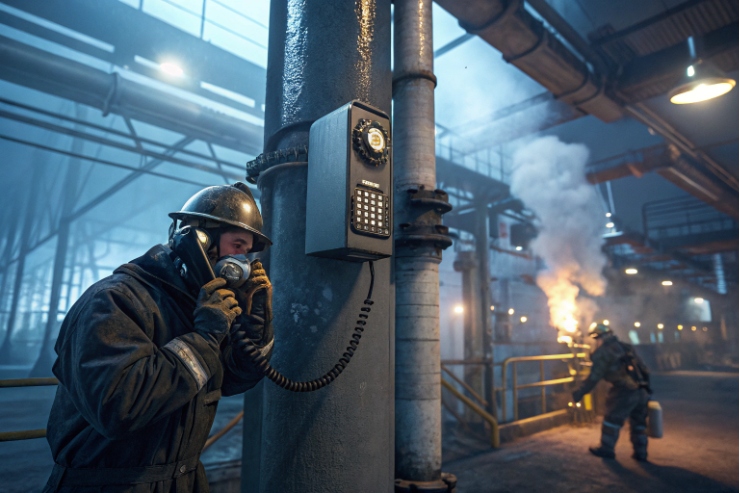
Fire risks in industrial zones are terrifying. A single spark from a standard phone could ignite gas or dust, causing catastrophic disasters. You need communication gear that actively prevents explosions.
An explosion-proof telephone is a strictly engineered communication device designed to contain internal electrical sparks and heat, ensuring they never ignite flammable gases, vapors, or combustible dust in hazardous industrial environments.
Understanding the "Explosion-Proof" Misconception
Many people misunderstand the term "explosion-proof." I often have to clarify this to my clients: it does not mean the phone can survive a bomb blast or an external explosion unscathed. Rather, it means the device itself will not cause an explosion.
In hazardous areas like oil refineries or chemical plants, the atmosphere is often thick with volatile substances 1. A standard office phone generates tiny electrical arcs when you lift the handset or press a keypad button. In a safe office, this is harmless. In a Zone 1 hazardous area, that tiny arc is a potential ignition source.
To prevent this, we engineer these phones with specific containment strategies. The housing is built to be robust, often using die-cast aluminum or Glass Reinforced Polyester 2 (GRP). The goal is to isolate the internal electrical energy from the external explosive atmosphere.
Here is a breakdown of the fundamental differences I see between standard and industrial safety phones:
| Feature | Standard Office Phone | Explosion-Proof Telephone |
|---|---|---|
| Ignition Source | Open contacts, potential sparks | Sealed components, spark-free design |
| Housing Material | Thin plastic (ABS) | Die-cast Aluminum, GRP, Stainless Steel |
| Environmental Seal | IP20 (Indoor use only) | IP66 or IP67 (Water & Dust tight) |
| Impact Resistance | Low (cracks easily) | High (IK10 rated against vandalism) |
| Voltage | Standard low voltage | Regulated voltage with barriers |
When I assess a site’s safety needs, I look beyond just the phone. I look at the "Triangle of Fire 3"—fuel, oxygen, and heat. Explosion-proof phones remove the "heat" (ignition) leg of that triangle. This requires a shift in thinking from "functionality first" to "safety absolute."
Which certifications define explosion-proof phones—ATEX, IECEx, or UL Class I Division 2?
Navigating the alphabet soup of safety certifications can be overwhelming. Is ATEX enough? Do you need IECEx? Ignorance here is dangerous.
Certifications are the legal and technical proof that a device has been tested to operate safely in specific hazardous zones, with ATEX governing Europe, IECEx acting as the global standard, and UL/NEC defining safety in North America.

The Geography of Safety Standards
I deal with partners from over 100 countries, and the first question I ask is always: "Where is this project located?" The answer dictates the certification you need.
ATEX (Atmosphères Explosibles) is mandatory in the European Union. If you are deploying in Germany or France, your equipment must carry the "Ex" hexagon logo. It is law, not just a recommendation.
IECEx (International Electrotechnical Commission Explosive) is the international standard. I prefer IECEx for global projects because it simplifies the supply chain. A single IECEx certificate is often accepted in Australia, New Zealand, and many parts of Asia and the Middle East without further testing.
UL / NEC (National Electrical Code) is the standard for the USA and Canada. While ATEX/IECEx uses "Zones" (0, 1, 2), North America traditionally uses "Classes" and "Divisions."
This table simplifies how I map these standards for my clients:
| Region | Standard | Classification Method | Key Indicator |
|---|---|---|---|
| Europe | ATEX | Zones (0, 1, 2) | CE Mark + Ex Hexagon |
| Global | IECEx | Zones (0, 1, 2) | IECEx Certificate Number |
| North America | UL / CSA | Classes (I, II, III) & Divisions (1, 2) | UL Listed Mark |
Critical Thinking: The Harmonization Challenge
The industry is slowly moving toward harmonization, but we aren’t there yet. I have seen projects in the US start accepting Zone-based classifications (Class I, Zone 1), which aligns closer to IECEx. However, you cannot simply swap an ATEX phone for a UL phone without verifying the local code.
For a global distributor, stocking dual-certified (ATEX + IECEx) devices is the smartest move. It reduces inventory risk. But for the North American market, you usually still need that specific UL or FM approval.
How do Ex d, Ex e, or Ex ib designs prevent ignition in hazardous areas?
Certifications tell you where you can use a phone. Protection concepts tell you how the phone stays safe.
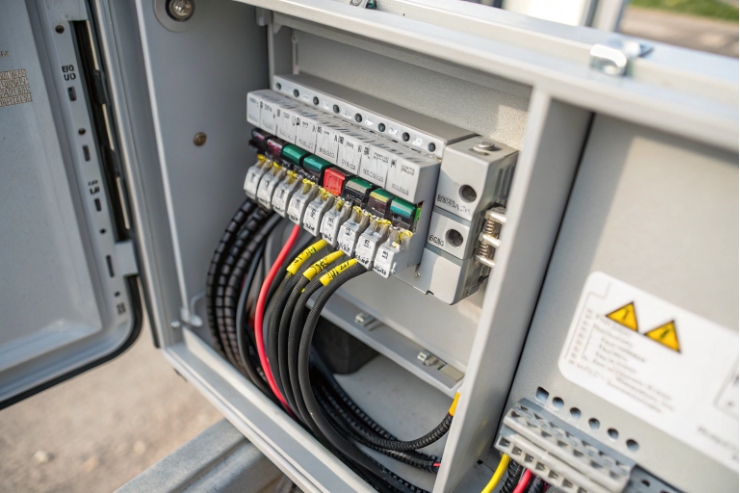
Protection concepts like Ex d (Flameproof), Ex e (Increased Safety), and Ex ib (Intrinsic Safety) represent different engineering methods to contain explosions, prevent arcs, or limit energy below ignition levels.
Dissecting the Engineering Approaches
When we design these phones at DJSlink, we have to choose a protection strategy. The three most common methods I work with are vastly different in their philosophy.
1. Ex d (Flameproof / Explosion-proof Enclosure)
This is the brute force approach. We assume an explosion will happen inside the phone. Gas might seep in, and a spark might ignite it. The "Ex d" housing is built so strongly that it contains this internal explosion. It forces the resulting hot gas to travel through a long, narrow path (flame path 4) where it cools down before reaching the outside air. By the time it escapes, it is too cold to ignite the external atmosphere.
2. Ex e (Increased Safety)
This method is about prevention. We design the terminals and connections to ensure that no arcs, sparks, or excessive heat can occur in normal operation. It is often used for junction boxes or terminal chambers on the phone. It is less heavy-duty than Ex d but requires rigorous quality control on components.
3. Ex ib / Ex ia (Intrinsic Safety)
This is the "smart" approach. We limit the electrical energy available in the circuit. Even if you cut the wire or short-circuit the board, there is physically not enough energy (voltage and current) to create a spark hot enough to ignite the gas. This is common in mobile radios but harder to implement for full-feature SIP phones that need power for speakers and screens.
Why Material Selection Matters Here
For "Ex d" designs, the material is critical.
-
Aluminum Alloy: Lightweight and dissipates heat well. It is the industry standard for most flameproof housings.
-
Stainless Steel (304/316): Necessary for offshore rigs where saltwater corrosion is a threat.
-
GRP (Glass Reinforced Polyester): I see this gaining popularity. It is corrosion-immune and anti-static. It won’t spark if you hit it with a wrench, which is a hidden safety benefit.
What features matter for industrial deployments—SIP/VoIP, PoE, IP66/IP67, IK10, corrosion-resistant housing, and relay I/O?
A safe phone that doesn’t work is just a paperweight. Industrial features determine if the device adds value to your daily operations.
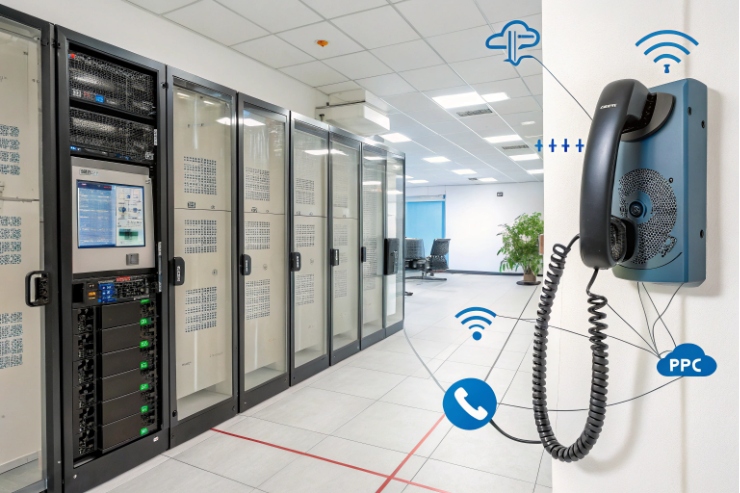
Key industrial features include SIP/VoIP for modern integration, PoE for simplified wiring, IP66/67 ratings for weatherproofing, and Relay I/O ports to trigger external beacons in noisy environments.
Connectivity: The Shift to SIP
In the past, industrial communication was analog. Now, SIP (Session Initiation Protocol) is the king. My clients want phones that integrate with their existing Cisco or Avaya systems.
-
Remote Management: With SIP, I can configure 500 phones from my desk. I don’t need to send a technician up a tower to change a volume setting.
-
PoE (Power over Ethernet): This is a game-changer. You run one Ethernet cable for both data and power. It reduces installation costs significantly, especially in hazardous zones where running power cables requires expensive conduit work.
Durability Ratings Explained
-
IP Ratings (Ingress Protection): You need at least IP66 (dust tight and protection against heavy seas/water jets). IP67 (immersion) is better for areas prone to flooding.
-
IK Ratings (Impact Protection): IK10 is the maximum. It means the phone can withstand a 5kg mass dropped from 400mm. In a mine or factory, equipment gets hit. IK10 ensures the phone survives.
The Importance of Relay I/O
This is my favorite "hidden" feature. Industrial sites are loud. You cannot hear a ringtone over a turbine.
A phone with Relay I/O (Input/Output) can trigger an external strobe light or a 110dB horn speaker when a call comes in.
-
Input: Can be connected to a panic button.
-
Output: Triggers the "blue light" alarm.
| Feature | Why it matters in Industry |
|---|---|
| SIP 2.0 | Compatibility with modern IP PBX 5 (Asterisk, Broadsoft, 3CX). |
| Dual LAN | Allows daisy-chaining devices to save cabling. |
| Self-Diagnostics | The phone reports its own health status to the control center. |
| Noise Cancellation | Essential for clear voice in 100dB+ environments. |
Where are explosion-proof telephones used—oil & gas sites, chemical plants, tunnels, and mining emergency communication?
Knowing the location helps you select the right device class and features. The environment dictates the danger.
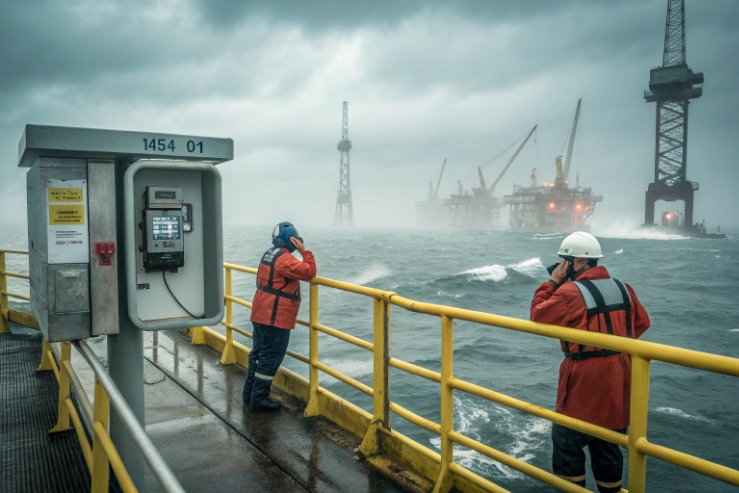
Explosion-proof telephones are critical in Oil & Gas platforms, petrochemical refineries, underground mining operations, and tunnels where trapped methane or chemical vapors create constant ignition risks.
Oil & Gas (Offshore and Onshore)
This is the classic use case. On an offshore rig, salt spray is relentless. Here, I always recommend a weatherproof, corrosion-resistant housing (yellow or orange for visibility). The risk is usually hydrocarbon gas.
-
Zone 1: Drill floor areas.
-
Zone 2: Living quarters or utility areas.
Chemical and Pharmaceutical Plants
These environments are tricky because of corrosive vapors. It isn’t just about explosion protection; it’s about the phone not dissolving. The dust from pharmaceutical powders can also be explosive. A GRP housing is often superior here as it resists chemical attack better than painted aluminum.
Mining and Tunnels
Underground, the enemy is methane 6 (firedamp) and coal dust.
-
Mining: The phones must be robust against rock falls (IK10).
-
Tunnels: Emergency SOS points. Long distances make SIP/Fiber solutions ideal. The phones often need to integrate with fire detection systems to broadcast evacuation messages automatically.
Wastewater Treatment
People forget this one. Methane builds up in sewage processing. It is a biological hazard that becomes an explosive hazard. We deploy safe phones in pump rooms and enclosed processing areas.
My Insights: The Future is Intelligent Customization
I have spent over 15 years in this industry, and I see a clear trend: Generic hardware is dying.
The clients I work with—system integrators in Germany, distributors in Dubai—don’t just want a "box." They want a solution that fits their specific nightmare scenario.
At DJSlink, we realized that being a manufacturer isn’t enough. We have to be consultants.
-
Customization is key: I had a client who needed a specific firmware modification to make the phone dial out automatically if the handset was off-hook for 3 seconds. Standard firmware didn’t do that. We wrote it for them.
-
Compatibility: The world is moving to unified communications. An explosion-proof phone must talk to a video management system (VMS) or a PA system. This is why we focus heavily on ONVIF 7 and SIP protocols.
If you are an integrator, stop buying based on the lowest price. Buy based on technical support and flexibility. Can the vendor customize the mainboard? Can they print your logo for your local brand authority? In hazardous communications, the "one size fits all" era is over. You need a partner who understands both the code inside the chip and the danger outside the box.
Conclusion
Safety is non-negotiable in hazardous zones. By choosing the right explosion-proof telephone—certified, durable, and smart—you protect both your infrastructure and your people.
Footnotes
-
Learn about hazardous chemical classifications and safety guidelines for industrial environments. ↩ ↩
-
Explore the properties and applications of fiber-reinforced plastics in engineering. ↩ ↩
-
Understand the three necessary components for a fire to start and sustain. ↩ ↩
-
Technical details on how flame paths cool escaping gases to prevent ignition. ↩ ↩
-
An overview of Private Branch Exchange systems using Internet Protocol for communications. ↩ ↩
-
Chemical structure and hazard information regarding methane gas in industrial settings. ↩ ↩
-
The global open standard for interoperability of IP-based physical security products. ↩ ↩








