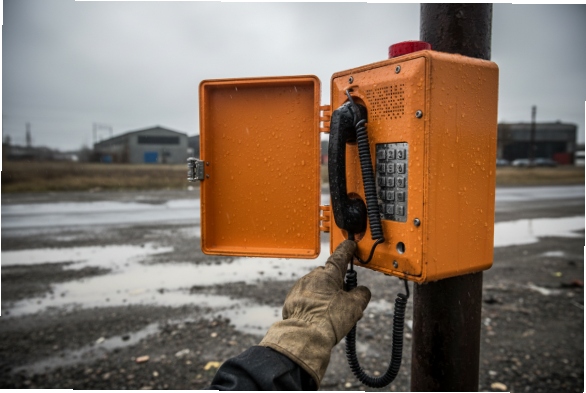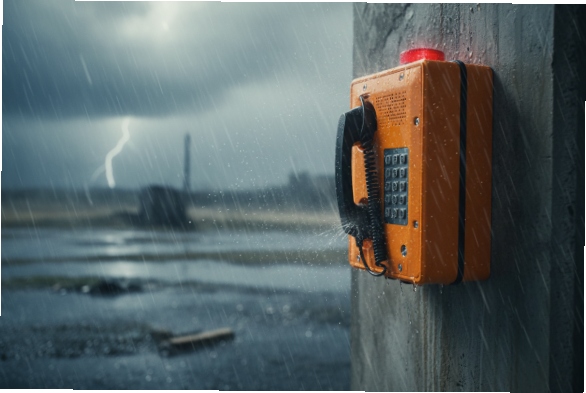
Factory noise can drown out a call. Then an “emergency phone” becomes a silent box on the wall. The fix starts with the right Sound Pressure Level 1 target and proof.
Most explosion-proof telephones can deliver clear voice when the hands-free speaker is specified around the high-80s to mid-90s dB(A) at 1 m, and the system is designed for your site SNR and intelligibility target. The exact SPL depends on test method, speaker size, and enclosure limits.
SPL in hazardous areas is a system number, not a brochure number
Start with two different “loudness” paths
An Ex telephone has two audio paths that behave differently:
-
Handset receiver at the ear: this is more about loudness rating 2 and frequency response at the ear than SPL at 1 m. Many telecom engineers prefer loudness ratings for handset performance because it matches real use.
-
Hands-free speaker at 1 m: this is where site specs usually demand an SPL number, because the user may stand back, wear gloves, and rely on loudspeaker audio.
A common project mistake is to compare “handset loudness” to “hands-free SPL.” Those are different measurements. If the tender needs one number, it should ask for two: handset receive loudness rating (or equivalent) and speaker SPL at 1 m.
Specify SPL like an audio engineer, not like marketing
SPL can look big or small depending on the method. A clean SPL statement includes:
- distance (1 m)
- axis (on-axis to speaker grille)
- field condition (free-field or half-space)
- signal type (1 kHz tone, pink noise, or speech-shaped noise)
- weighting (dB(A) or linear dB)
- duration (continuous, average, and peak)
If a supplier only says “95 dB,” that is not enough to compare products.
Typical SPL ranges used in industrial projects (use as a starting point)
| Use case | What buyers often target (at 1 m) | Why |
|---|---|---|
| Normal industrial walkways | 80–90 dB(A) | Clear speech without pain |
| Noisy process areas | 90–100 dB(A) | Keeps SNR margin with PPE |
| Extremely noisy zones | 100 dB(A)+ plus paging/horn support | Voice alone may not be enough |
These are planning ranges, not a promise. The right target must come from your ambient noise and your intelligibility requirement.
One refinery lesson that keeps specs honest
On one refinery-style site, the phone speaker SPL looked “high enough” on paper. The problem was the mounting point. A steel frame caused reflections, and the user stood off-axis. The real intelligibility was poor. After that, I always ask for an SPL-distance curve and an STI target for paging zones, not only one SPL number.
If you keep reading, the next sections show how to write SPL requirements that survive commissioning, how to use ISO 7731 and STI, and when to step up to Ex horns and amplifiers.
Now let’s start with the most direct spec question: what SPL at 1 m should be stated, and how should it be measured.
What SPL at 1 m do handset and hands-free speakers deliver, and how is it specified?
Noise hides weak specs. A phone can “meet SPL” in one lab setup and still fail on site. Clear test wording stops that problem.
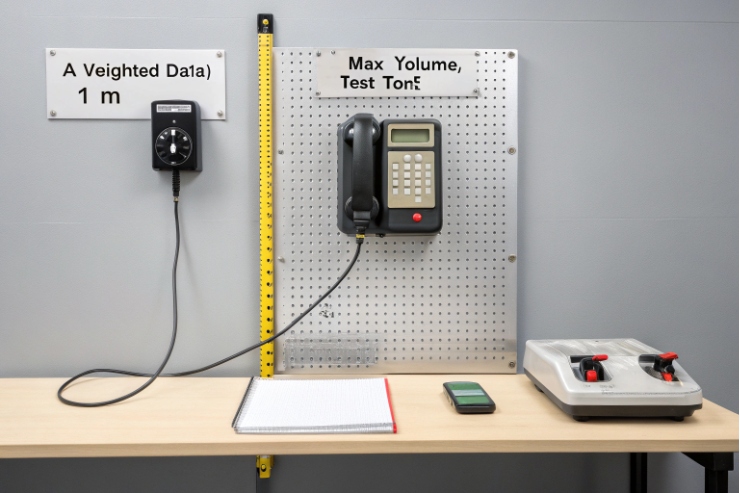
For hands-free, specify dB(A) SPL at 1 m on-axis using a defined test signal and environment. For handset, ask for handset loudness rating (not 1 m SPL) plus frequency response. Require a test report that states distance, field condition, and input level.
Handset vs hands-free: ask for the right metric
Handset audio is close-field. It is shaped by the ear coupling and handset design. Many telecom specs use loudness ratings for this reason. When a vendor gives only “handset SPL,” it often hides the real listener experience.
For hands-free speaker performance, SPL at 1 m is useful because it matches:
- stand-off use
- wall-mounted geometry
- industrial PPE behavior
Use a consistent measurement reference
For loudspeakers and paging transducers, a 1 m reference is common in standards-based reporting, and test reports often show “sound pressure level referred to 1 m” with conditions such as free-field or half-space. That detail matters because half-space mounting can add a few dB.
A clean hands-free SPL test definition looks like this:
- microphone at 1 m on reference axis
- free-field or half-space clearly stated
- speech-shaped noise or 1 kHz test tone defined
- device set to maximum safe volume setting
- record A-weighted and linear values if possible
Ask for both “max” and “usable” levels
Max SPL can include heavy distortion. Speech can become loud but unclear. So it helps to request:
- Max SPL at 1 m
- SPL at 1 m with THD ≤ a defined limit (many teams use 5–10% for a practical voice ceiling)
A tender table that makes vendor quotes comparable
| Item | Requirement line | Pass evidence |
|---|---|---|
| Hands-free SPL | “≥ __ dB(A) @ 1 m, on-axis, free-field/half-space stated” | Lab report with setup photo |
| Signal | “Speech-shaped noise or 1 kHz tone (state which)” | Report includes signal definition |
| Volume setting | “Max user setting; note any limiter behavior” | Screenshot or config page |
| Distortion | “THD ≤ % at dB(A) for voice band” | THD plot or table |
| Handset receive | “Provide handset loudness rating / receive response method” | Telecom audio test statement |
When this table is used, the project team can pick the correct device without guessing. It also prevents the “95 dB” claim from being measured at 0.3 m or at a narrow frequency that does not match speech.
Next, SPL must be tied to ambient noise and intelligibility. That is where ISO 7731 and STI become practical tools instead of standards names.
How do ambient noise and target SNR determine required SPL using ISO 7731 or IEC 60268-16 STI?
A loud speaker can still be useless if words are not understood. Intelligibility needs SNR, spectrum, and control of reflections. Standards help turn “sounds loud” into “is understood.”
Use ISO 7731 to set a minimum signal-over-noise requirement (often 15 dB above ambient, with minimum absolute level rules), and use IEC 60268-16 STI to verify that paging speech is intelligible in the real acoustic space.
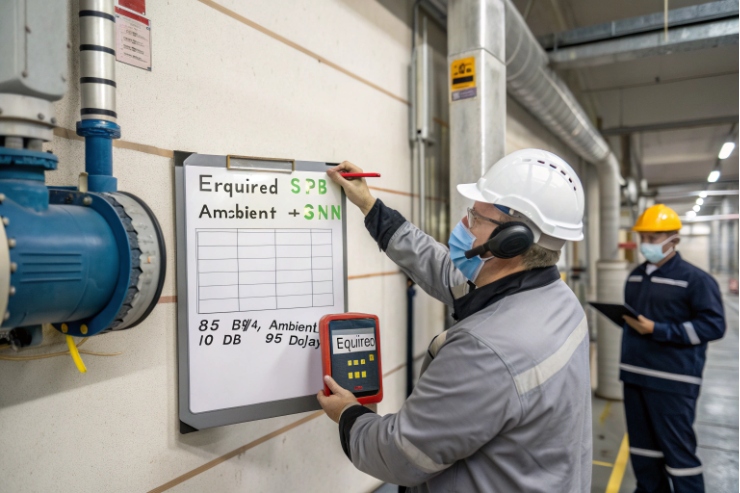
Use ISO 7731 to size the “audible” requirement
ISO 7731 3 is often used for auditory danger signals and provides a clear planning rule: the danger signal should exceed ambient noise by a defined margin and meet a minimum absolute level. That approach is useful when you set a target SNR for emergency communications in noisy zones.
A simple planning method:
1) Measure ambient noise where the user stands (in dB(A) and ideally by octave bands).
2) Set a target Signal-to-Noise Ratio 4 (SNR).
3) Convert that into required speaker SPL at the user location.
4) Add distance loss and mounting loss to back-calculate the required SPL at 1 m.
Use STI to check if people understand speech, not only hear it
STI is a 0–1 score that predicts how understandable speech is via IEC 60268-16 STI 5 through a room and system. It considers noise, distortion, reverberation, and frequency response. It is used widely in paging and evacuation audio design. For hazardous-area paging and intercom, STI is often more honest than “dB” because it captures the room effect.
STI is especially helpful when:
- the area has high reverberation (steel and concrete)
- the speaker is off-axis to the listener
- multiple reflections smear consonants
- the plant has broad-spectrum noise
Turn SNR and STI into a site class spec
| Site class | Ambient reality | Practical target | What to specify |
|---|---|---|---|
| Moderate noise | Pumps, fans, walkway | SNR margin + basic SPL @ 1 m | SPL + THD limit |
| High noise | Process units, PPE use | Higher SPL + clear SNR rule | ISO 7731-style margin |
| Paging / large bays | Echo and reflections | STI target | STI measurement method |
A short client explanation that works
- “SPL tells how loud it is.”
- “SNR tells if the message stands above noise.”
- “STI tells if the words are understood.”
Now we can talk about what to do when voice alone is not enough. Refineries and mines often need extra acoustic hardware, but it must stay Ex-compliant.
Can gain controls, built-in amplifiers, or external explosion-proof horns extend SPL for refineries and mining sites?
Some zones will not accept normal hands-free audio. The site noise wins. Then the phone must trigger something louder, but still compliant and reliable.
Yes. Use gain controls and limiters for tuning, and use external Ex-rated horn speakers or beacon/sounder devices when ambient noise demands it. Keep power, heat, and cabling within the Ex concept, and avoid modifications that affect flamepaths or IP sealing.
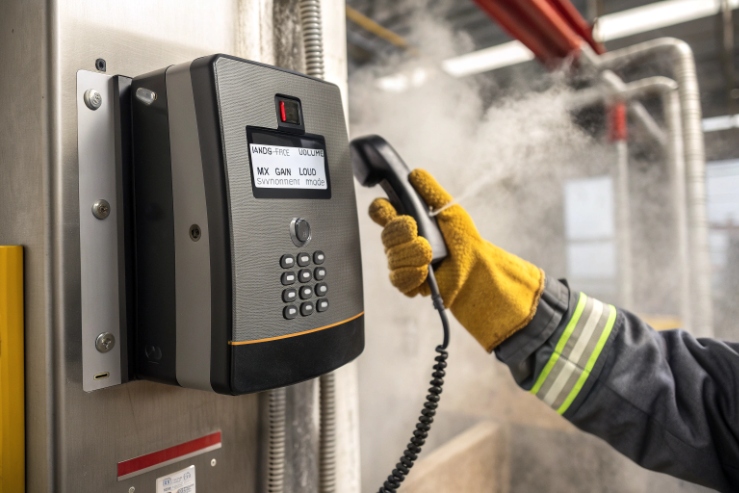
Built-in gain helps, but it has limits
A built-in amplifier can raise SPL, but it also raises:
- heat inside the enclosure
- distortion risk at max volume
- power draw on PoE (which matters for hot ambient margins)
So gain controls should be paired with a limiter and a clear “max safe” setting. In practice, I prefer a phone that allows:
- separate handset, hands-free, and ringer gain
- a maximum cap that the installer can lock
- remote configuration for consistent deployment
External Ex horns solve the “physics” problem
When ambient noise is very high, an external Ex-rated horn speaker 6 often becomes the correct tool. The phone becomes the call point and controller, and the horn becomes the acoustic actuator.
Two common architectures:
- Phone triggers a relay output to drive an external Ex paging/horn circuit.
- SIP-based paging sends audio to an Ex-rated horn speaker endpoint (or to an Ex amplifier system) on the network.
The best choice depends on your plant’s paging platform and your cabling rules.
Keep Ex and IP integrity intact
When adding horns or amplifiers, the project must still respect:
- certified cable entries and glands
- bonding and earthing continuity
- surge protection and shielding strategy
- thermal limits for the phone and any added devices
A safe tender should require that any external horn used in Zone 1/2 is certified for the zone and has a stated SPL at 1 m with distortion and frequency response.
A “when to upgrade” table for harsh sites
| Problem on site | Small fix | System fix |
|---|---|---|
| Voice is quiet | Adjust gain, check mounting | Higher SPL model or closer placement |
| Voice is loud but unclear | Reduce distortion, tune EQ | STI-based redesign, better speaker placement |
| Noise is extreme | Add visual beacon | Add Ex horn paging or distributed speakers |
| Long distance to user | Move phone closer | Add remote stations or paging zones |
External horns are not only about loudness. They also improve coverage. A single phone speaker cannot cover a long corridor the way distributed paging can.
Now we end with the most important part for tenders: which audio specs matter and how to document them so clients can approve the design.
Which audio specs matter—SPL-distance curve, distortion (THD), frequency response, and STI—for intelligible paging in hazardous areas?
A single SPL number is easy to print and easy to misuse. Paging and intercom success depends on several linked specs that match real use.
Focus on five specs: SPL at 1 m, an SPL-distance curve, THD at target SPL, frequency response in the speech band, and STI (or equivalent intelligibility measure) for paging zones. These specs predict clarity far better than “max dB” alone.
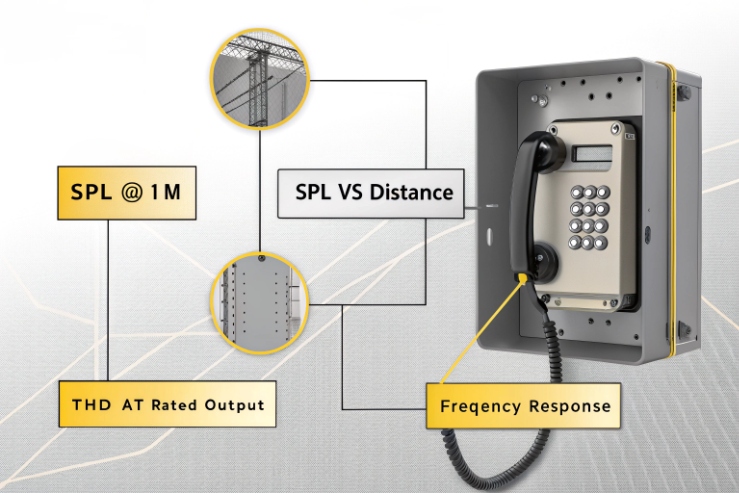
SPL-distance curve: coverage matters more than peak
Distance loss is real. A phone that is “95 dB at 1 m” can become weak at 3 m. A simple curve (1 m, 2 m, 4 m) helps the system designer plan coverage.
Request:
- A-weighted SPL values at several distances
- On-axis and a typical off-axis angle (like 30°) if the phone is mounted high
THD: loud but harsh is not usable
High THD turns speech into fuzz. So request Total Harmonic Distortion 7 (THD) at:
- a practical operating level (not only at low volume)
- a speech-relevant band
This prevents suppliers from quoting max SPL that is only achieved with heavy distortion.
Frequency response: speech band focus
A wide response is not always the goal. Speech intelligibility needs clear energy in key bands. A phone that boosts low frequencies can sound “powerful” but lose consonants. So request:
- frequency response in the speech band
- any equalization or “noise reduction” behavior described
STI for paging and intercom zones
For paging into a bay or tunnel-like corridor, STI is the number that predicts understanding. A good tender asks for:
- STI method (per standard)
- measurement points (user locations)
- target STI value for the zone class
A tender-ready audio spec table
| Spec | Why it matters | What to request from supplier |
|---|---|---|
| SPL @ 1 m (dB(A)) | baseline loudness | method + environment + signal type |
| SPL-distance curve | coverage planning | values at 1/2/4 m and axis note |
| THD | clarity at high volume | THD at target SPL and speech band |
| Frequency response | consonant clarity | response plot and any EQ notes |
| STI | intelligibility prediction | STI report points and target |
How to write this in a way clients approve fast
I keep the wording simple:
- “The system must be heard (SNR).”
- “The message must be understood (STI).”
- “The device must stay stable at max volume and max ambient (thermal and power).”
If a project uses Ex horns, the same table applies to the horn speaker. That makes the whole system auditable.
Conclusion
Explosion-proof telephone loudness is defined by measured SPL, required SNR, and intelligibility targets. Specify the test method, add STI for paging zones, and use Ex horns when noise is extreme.
Footnotes
-
A logarithmic measure of the effective pressure of a sound relative to a reference value in decibels. ↩ ↩
-
A value used to quantify the overall loudness of a telephone connection, accounting for transmission loss. ↩ ↩
-
An international standard for auditory danger signals for public and work areas, specifying SPL and frequency requirements. ↩ ↩
-
A measure used in science and engineering that compares the level of a desired signal to background noise. ↩ ↩
-
A standard defining the Speech Transmission Index (STI) for objective assessment of speech intelligibility in sound systems. ↩ ↩
-
Specialized loudspeakers designed to operate safely in explosive atmospheres by preventing ignition of flammable gases or dust. ↩ ↩
-
A measurement of the harmonic distortion present in a signal, indicating the audio quality and clarity. ↩ ↩