
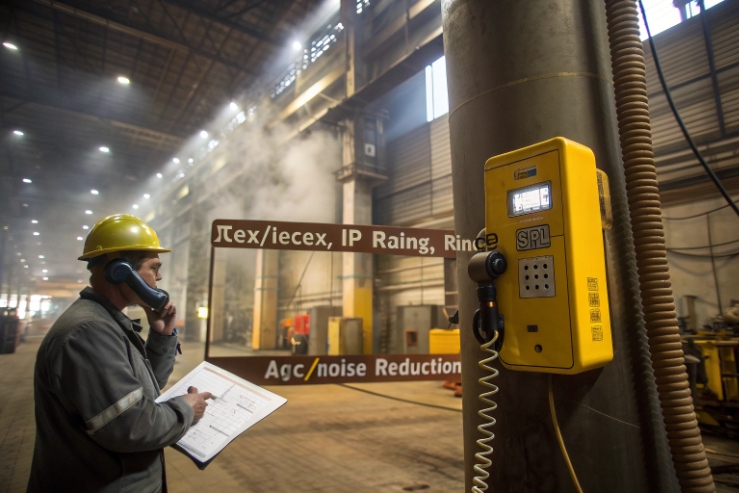
High-noise plants punish weak audio. Calls connect, but words vanish under pumps and vents. That failure looks like “network,” but it is usually the microphone path.
Some explosion-proof SIP telephones include AGC and noise reduction, but it is not universal. The right approach is to specify the DSP functions (AGC/AEC/NS), tuning controls, and test evidence (SNR/STI) instead of trusting a checkbox.
What “AGC noise reduction” really means on an Ex telephone?
AGC is only one piece of the audio chain
AGC (automatic gain control) is a gain rider. It tries to keep speech at a stable level. In a refinery, that sounds useful. But AGC alone does not remove noise. If the mic hears mostly noise, AGC may lift the noise too. So the best systems combine multiple DSP blocks:
-
Automatic Gain Control 1: stabilizes speech level across distance and speaking style.
-
noise suppression 2: reduces steady noise (fans, engines) using spectral processing.
-
acoustic echo cancellation 3: removes speaker-to-mic echo in hands-free mode.
-
Limiter/clipper: prevents overload and protects the codec input.
-
Compressor/expander: shapes dynamic range for better intelligibility.
-
Beamforming (multi-mic): focuses on a direction and rejects off-axis noise (less common in rugged phones).
On explosion-proof phones, the enclosure and sealing also affect audio. Thick metal fronts, gasket compression, and microphone port membranes can shift frequency response and reduce sensitivity. That can be good for wind and water, but it can also cut consonants if the design is not tuned.
“Noise reduction” can mean two different things
Many suppliers use the same words for different features:
1) Transmit-side noise suppression (what the far end hears)
2) Receive-side loudness control (what the local user hears)
For industrial safety calls, transmit-side clarity is usually the priority. The goal is not “louder,” it is “more understandable.”
What to require in a tender
A strong tender line does not say “AGC required.” It says:
-
which DSP blocks must exist (AGC + NS + AEC, with hands-free mode behavior)
-
which modes are adjustable (handset vs hands-free vs paging)
-
how it is configured (UI/provisioning/API)
-
what test evidence is provided (before/after SNR and intelligibility)
| Requirement | Why it matters | What to ask for |
|---|---|---|
| AGC + limiter | Prevents quiet talkers and clipping | “Target level, attack/release, max gain” |
| Noise suppression | Reduces steady plant noise | “dB reduction range and artifacts note” |
| AEC | Stops echo in hands-free | “Echo return loss enhancement and tail length” |
| Mode separation | Keeps handset natural and hands-free strong | “Separate profiles per mode” |
| Evidence | Avoids marketing claims | “Test report and audio samples” |
A simple way to explain this to clients: AGC controls level, NS controls noise, and AEC controls echo. A phone that only has AGC may still sound bad in real plants.
Now let’s break the request into the four decisions that usually decide success on site.
Sometimes a project needs only a stable handset path. Other times, hands-free paging in a compressor bay needs the full DSP stack.
Which audio DSPs are supported—AGC, AEC, noise suppression, and beamforming for high-noise industrial sites?
Noise in industrial areas is not one sound. It changes with load, wind, and distance. That is why a single “NR” label is not enough.
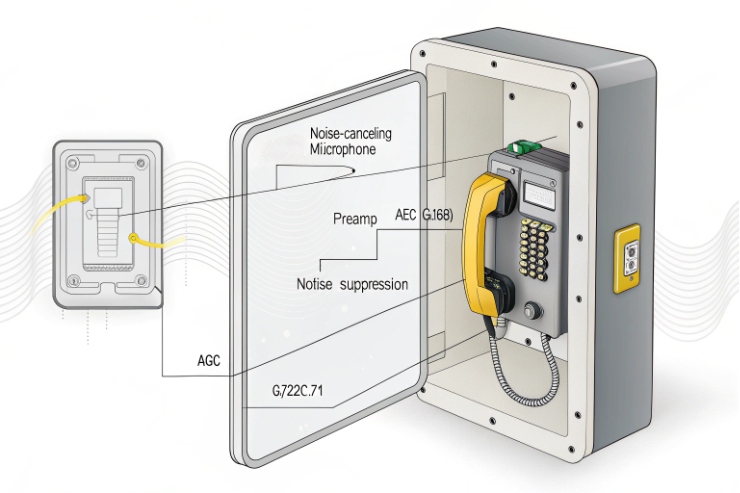
For high-noise sites, the most useful DSP stack is AGC + transmit noise suppression + hands-free AEC + a limiter. Beamforming can help, but only if the phone has multiple microphones and proven tuning for industrial noise.
AGC: what to look for
Good AGC behavior is not “always loud.” It is stable speech without pumping noise. In specs and UI, look for:
-
target level or reference level control
-
maximum gain limit
-
attack/release timing (fast enough for voice, slow enough to avoid pumping)
A hidden sign of weak AGC is sudden “breathing” where background noise rises when the talker pauses.
Noise suppression: the practical expectations
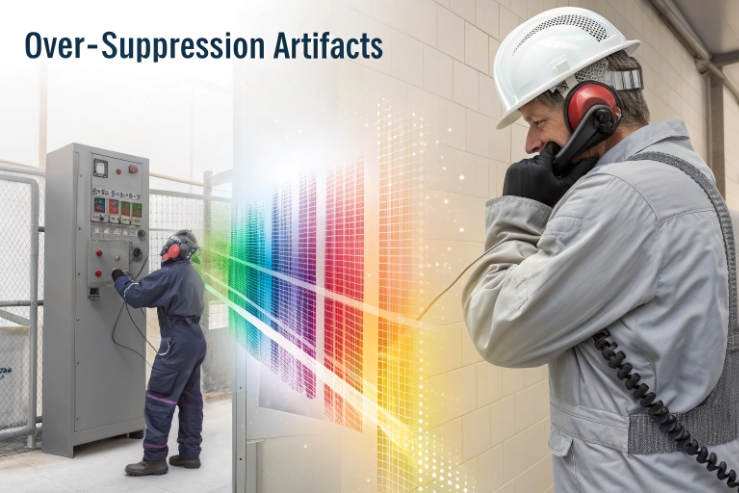
Noise suppression works best on steady noise (fans, turbines). It struggles with impulsive noise (hammer hits) and other voices. In plants, the best NS settings are often moderate. Too aggressive NS can smear consonants and create robotic artifacts.
A good supplier should be able to describe:
-
what noise types the algorithm targets
-
the maximum reduction range (for example “up to X dB”)
-
the trade-off between reduction and speech naturalness
AEC: required for hands-free talkback
Hands-free in a metal enclosure creates echo paths. AEC removes the echo the far end hears. For paging-and-talkback use cases, AEC quality can decide whether the system is usable.
Key AEC points:
-
tail length (longer tail helps in reflective areas)
-
double-talk handling (both sides speak)
-
how AEC interacts with noise suppression and AGC
Beamforming: useful, but not a default
Beamforming is powerful when:
-
the phone has two or more microphones
-
mic spacing is correct
-
the processing is tuned for the mounting geometry
In a wall-mounted Ex phone, beamforming can be complicated by reflections off the wall and enclosure. It can still work, but it should be requested only with proof.
A DSP comparison table that helps site selection
| DSP block | Best for | Risk if tuned wrong | “Proof” to request |
|---|---|---|---|
| AGC | varying talk distance | noise pumping | level stability test |
| Noise suppression | steady machinery noise | robotic voice | before/after recordings |
| AEC | hands-free talkback | echo, howling | talkback test in reflective room |
| Limiter | loud talkers, wind gusts | harsh clipping | THD/clipping report |
| Beamforming | off-axis noise rejection | poor pickup off-axis | polar plots + field demo |
If the vendor cannot explain these blocks and their interactions, the safest plan is to keep the handset path as the primary voice path and treat hands-free as “best effort.”
Next is configuration. A good DSP stack is still weak if it cannot be tuned per site and rolled out consistently across many phones.
Can AGC levels and mic gain be configured via web UI, auto-provisioning, or API?
A single “factory default” rarely fits both a quiet control room and a mining pit. But tuning one phone at a time is not realistic.
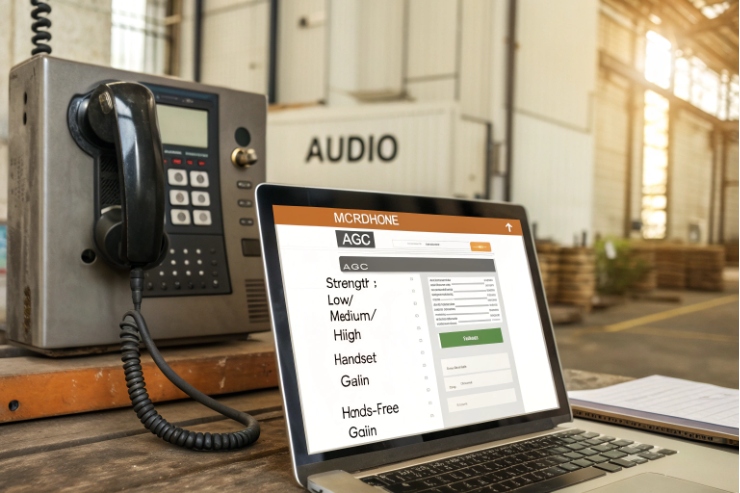
Yes, many industrial SIP endpoints allow mic gain and sometimes AGC behavior to be configured in the web UI and pushed via auto-provisioning. API control is possible on some platforms, but the project should require an exportable config template and a repeatable provisioning method.
Web UI tuning: good for pilots, risky for rollouts
A web UI is perfect during proof-of-concept:
-
adjust mic gain
-
select handset/hands-free profiles
-
enable/disable AEC and noise suppression
-
set volume caps for safety
But web UI-only control becomes a compliance risk later. Two phones end up with different settings, and nobody knows why the audio differs.
Auto-provisioning: the real requirement for industrial projects
For mass deployment, auto-provisioning 4 should support:
-
a central template file
-
parameter control for audio profiles
-
secure transport (HTTPS)
-
version control (so changes are tracked)
A clean rollout uses a “site profile” approach:
-
Profile A: refinery process units (strong NS, strong AEC, moderate AGC)
-
Profile B: offshore walkways (wind filter focus, moderate NS)
-
Profile C: control rooms (minimal processing)
API: only useful when it is stable and documented
APIs can help when your platform needs to:
-
switch profiles by schedule (day/night noise)
-
apply settings from a site database
-
audit configuration states remotely
If API is requested, it should include:
-
authentication method
-
parameter list for AGC/NS/AEC
-
a read-back function (so you can verify applied settings)
A procurement table for configuration control
| Control type | What to request | Why it matters |
|---|---|---|
| Web UI | Separate handset/hands-free gain | Faster commissioning |
| Provisioning | Audio parameters in config file | Consistent fleet settings |
| Remote audit | Config export + checksum | Compliance and troubleshooting |
| API (optional) | Documented endpoints + examples | Platform integration |
| Locking | Admin role separation | Prevents accidental retuning |
A small but important detail: the tender should ask whether audio tuning changes require a reboot. In some plants, reboot is a service interruption, so “apply live” behavior is valuable.
Next is the technical concern many engineers have: does DSP processing hurt codec quality and add delay?
How do AGC and noise suppression impact codec quality—G.722/Opus intelligibility, clipping risk, and latency?
DSP can improve clarity, but it can also create artifacts. In harsh sites, a “clean but robotic” voice can be worse than a natural voice with some noise.
Well-tuned AGC and noise suppression usually improve intelligibility for G.722 and Opus, but aggressive settings can cause pumping, clipping, and consonant smearing. Latency impact is typically small, yet AEC and noise suppression can add measurable processing delay that should be validated for paging and talkback.
Intelligibility vs naturalness: choose the right target
In industrial safety calls, intelligibility is the priority. But the “best” sound is not always the most processed sound. A good tuning target is:
-
stable speech level
-
reduced steady noise
-
preserved consonants
-
no harsh clipping
For G.722 5, the wider band can expose artifacts more clearly. For Opus 6, the codec can handle a wide range of conditions, but it will not fix distortion created before encoding.
Clipping risk: the most common field failure
Clipping happens when:
-
mic gain is too high
-
AGC maximum gain is too aggressive
-
limiter thresholds are not set correctly
-
wind bursts overload the mic port
A clipped signal stays clipped through any codec. So the audio chain should include a limiter and should be tested at max shouting distance and max wind exposure.
Latency: what matters in practice
A small DSP delay is not a problem for normal calls. It can be a problem for:
-
talkback paging where users expect fast response
-
intercom-like behavior where echo and delay feel awkward
AEC often requires buffering, and noise suppression often uses short-time analysis frames. This can add algorithmic delay. The exact number depends on implementation, so the right action is to require:
-
stated end-to-end mouth-to-ear latency under typical call paths
-
a talkback test in the expected deployment mode
A practical DSP tuning guardrail table
| Setting | If set too low | If set too high | Recommended approach |
|---|---|---|---|
| Mic gain | distant talker is weak | clipping and distortion | tune at worst-case distance |
| AGC max gain | quiet talkers disappear | noise pumping | cap gain and rely on good mic |
| Noise suppression | noise remains | robotic speech, lost consonants | moderate setting, validate with recordings |
| AEC strength | echo leaks | talkback artifacts | tune in reflective environment |
| Codec priority | quality varies | interop breaks | prefer G.722 internal, keep G.711 fallback |
The most useful acceptance method is simple: record the same script in a noise bed (refinery fan noise, mining haul truck noise), then compare “DSP off” vs “DSP on” under the same codec and network conditions.
Now comes the proof question. Clients often ask for “SNR improvement,” but the right proof depends on whether the phone is used for calling, paging, or both.
Are test metrics provided—SNR improvement, STI, and before/after dB(A) measurements in refinery or mining environments?
Many suppliers provide feature claims but no measurable outcomes. In hazardous areas, measured outcomes reduce rework and disputes.
Good suppliers can provide E2E audio test evidence, including before/after recordings and some form of measured improvement. The most useful metrics are: transmit SNR improvement (in a defined noise bed), distortion limits at target SPL, and intelligibility scoring (STI) for paging zones.
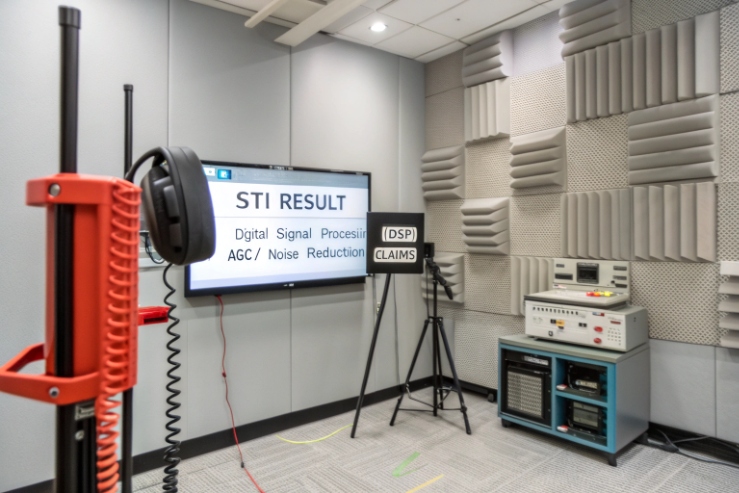
SNR improvement: define the measurement or it becomes meaningless
SNR can be measured many ways. For procurement, it must be controlled:
-
define the noise type and level (for example, 85 dB(A) steady fan noise)
-
define talker position and level
-
define measurement bandwidth
-
state whether it is transmit-side SNR at the far end
A realistic outcome statement is not “20 dB improvement.” It is “speech is X dB clearer relative to noise under the defined test.”
STI: best for paging and broadcast use cases
If the Ex telephone is used as a paging endpoint or triggers paging audio, Speech Transmission Index 7 (STI) is the strongest metric for “understood speech.” It accounts for reverberation and masking. For refineries and mines, the paging zone is often reflective. STI will show the difference between loud and understandable.
Before/after dB(A) measurements: use them carefully
dB(A) is useful for:
-
speaker output checks (hands-free at 1 m)
-
ambient noise surveys
-
SNR planning
It is not enough alone for transmit speech clarity. A phone can be loud and unclear. So dB(A) should be paired with recordings and intelligibility checks.
What to request in documentation packages
A complete supplier package should include:
-
DSP feature list and version (so firmware changes are traceable)
-
configuration parameters and recommended profiles for noisy sites
-
test report or lab note describing noise bed and method
-
audio samples (before/after) using the same script
-
thermal note if DSP features change power draw or duty cycle
A tender-ready “evidence” table
| Evidence item | Minimum | Better |
|---|---|---|
| DSP list | AGC/NS/AEC described | block diagram and mode behavior |
| Config controls | UI settings documented | provisioning parameters listed |
| Measured output | SPL and THD for hands-free | SPL-distance curve + THD at target SPL |
| Transmit clarity | before/after recordings | SNR method + results table |
| Paging intelligibility | not required for basic phones | STI report for paging zones |
When a supplier cannot provide these, the next best move is to run a site-style test during FAT: one noise bed, one script, one codec (G.722 or G.711), and a clear scoring sheet for intelligibility.
Conclusion
Explosion-proof telephones may include AGC and noise reduction, but success depends on the full DSP stack, tunable profiles, and real test evidence tied to your refinery or mining noise conditions.
Footnotes
-
Overview of how Automatic Gain Control maintains stable signal amplitude in communication systems. ↩ ↩
-
Detailed explanation of noise suppression techniques used to improve audio clarity in high-noise environments. ↩ ↩
-
Learn how acoustic echo cancellation prevents feedback loops during hands-free industrial communication. ↩ ↩
-
A guide to auto-provisioning methods for managing large-scale enterprise IP phone deployments efficiently. ↩ ↩
-
Information on the G.722 wideband audio codec used for high-definition voice over IP. ↩ ↩
-
Technical overview of the Opus audio codec, known for its versatility in speech and music. ↩ ↩
-
Understanding the Speech Transmission Index as a metric for objective speech intelligibility assessment. ↩ ↩








