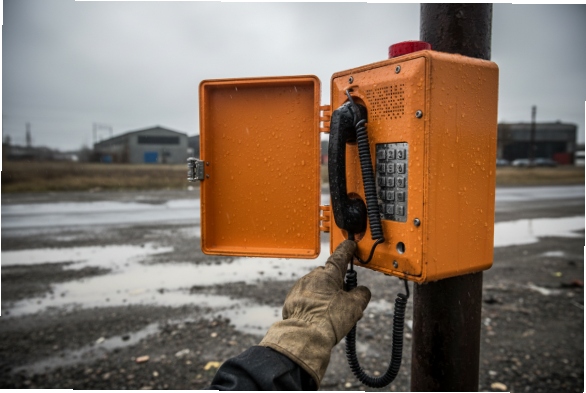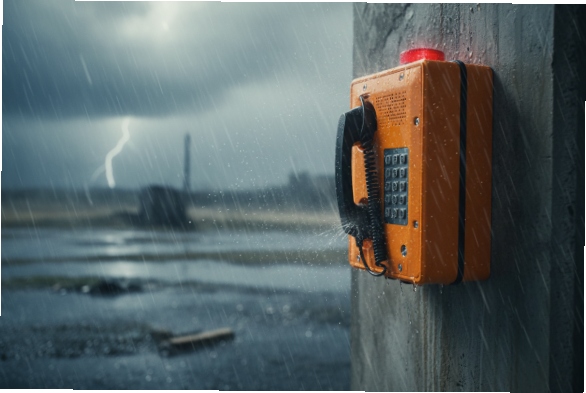
Outdoor phones do not fail in a dramatic way. They fail after one storm, one cleaning cycle, or one small flood. Then the “emergency line” becomes silence, and the project team has to explain it.
IP66 proves protection against strong water jets, while IP67 proves protection against temporary immersion. On weatherproof telephones, the better choice depends on whether your real threat is hose spray or short-term flooding.
The core difference: IP66 fights spray, IP67 fights a dunk
IP66 and IP67 both start with the same first digit when written as IP6X. That “6” matters for outdoor telephones because it means dust-tight protection 1. Dust and grit attack keypads, hooks, speakers, and seals. So most serious outdoor phones target a “6” for solids.
The big difference is the second digit:
-
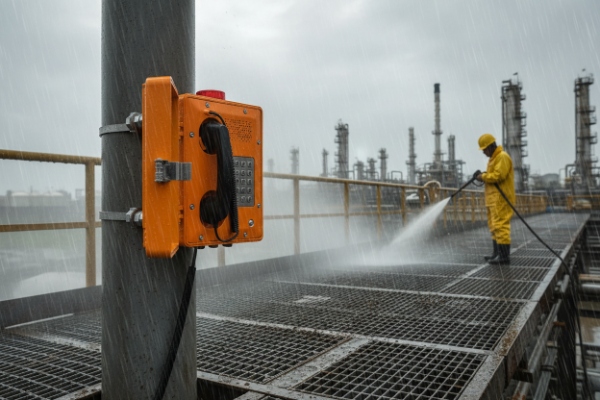
IP66 is designed around water hitting the enclosure as a jet. Think hose spray, washdown from a distance, or wind-driven rain that hits with force.
-
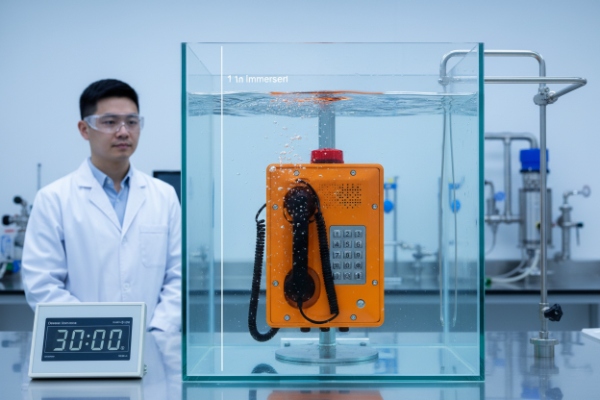
IP67 is designed around the enclosure being placed under water for a short time. Think puddles, drainage overflow, or a short flood event.
A common mistake is to treat 67 as “higher” than 66 in all ways. It is not that simple. The second digit is not a score. It is a different test method with a different water behavior. A unit can survive a dunk but still struggle with a strong jet aimed at a seam. A unit can survive jets but still fail if water pressure pushes through a weak point during immersion.
What this means specifically for weatherproof telephones
A telephone is not a plain empty box. It has weak points:
-
Keypad or push button openings
-
Speaker and microphone paths (acoustic membranes)
-
Handset cord exits, if a handset is used
-
Cable gland 2 and RJ45 path
-
Mounting holes and rear cable chambers
Jets and immersion attack these weak points in different ways. Jets create local pressure and can “peel” at edges. Immersion creates steady pressure across every seal line and can push water through tiny defects over time.
The simplest buyer-side comparison table
| Rating | What it proves | Typical real-life threat | Typical outdoor phone examples |
|---|---|---|---|
| IP66 | Strong water spray resistance | Hose spray, cleaning, storms | Parking lots, gates, ports, industrial yards |
| IP67 | Temporary immersion resistance | Flooding, pooling water | Low-mounted units, drainage zones, tunnel entrances |
| Best practice | Match the threat | Jets + occasional floods | Specify IP66 + IP67 (dual test evidence) |
Many good outdoor phones are built to pass both scenarios, but the tender must ask for the proof you need.
If the site faces cleaning jets, the next question is direct: will IP66 stop jets better than IP67?
This is where many client discussions get stuck, so the explanation needs to be simple.
Will IP66 stop water jets better than IP67 for my units?
A lot of teams assume IP67 is “stronger” because the number is bigger. Then the phone gets hit by a hose, and the assumptions break.
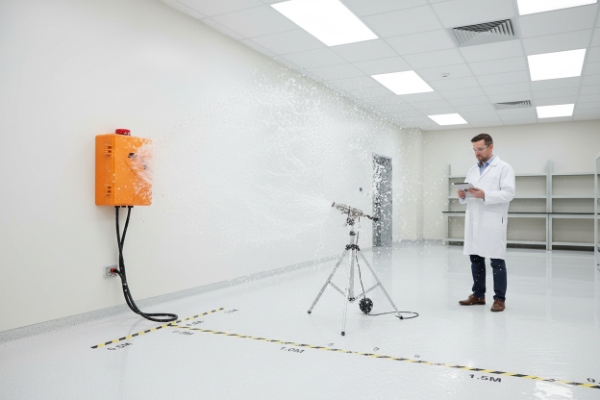
Yes. If your main risk is water jets, IP66 is the rating that directly targets that risk. IP67 does not automatically mean strong jet protection.
Why IP66 usually wins for jet scenarios
A jet creates focused force on one small spot. That spot is often:
-
a seam line,
-
a keypad edge,
-
a speaker grill area,
-
or a cable entry.
IP66 testing 3 is meant to show the enclosure can handle water delivered as a directed spray without letting water enter in a harmful amount. For weatherproof telephones, this often translates into:
-
tighter seam geometry,
-
better gasket compression control,
-
stronger front panel fastening,
-
better membrane bonding around audio paths.
IP67 immersion is different. During immersion, water is not “punching” at one seam. It is pressing everywhere at once, and time matters. Some designs that are great at immersion can still be vulnerable to jets because jets can drive water sideways along a seam or force water under a lip.
A practical spec rule that avoids wrong purchases
If the cleaning method includes hoses, the spec should call out IP66 (or higher jet-focused protection) and not rely on IP67 alone.
A quick decision aid you can paste into a project note
| Your site behavior | The rating that answers it | Why |
|---|---|---|
| “Staff may hose it down” | IP66 | Jet test matches hose behavior |
| “Storms hit it hard from the side” | IP66 | Wind-driven rain acts like spray |
| “It may be under water sometimes” | IP67 | Immersion test matches pooling/flood |
| “Both happen” | Ask for IP66 + IP67 evidence | Different tests, different proof |
Even with a solid enclosure, a weak cable gland makes jet protection meaningless. For SIP phones, that Ethernet entry path is a common failure point. A good tender should state: “IP rating applies to the complete assembled phone including supplied glands and cable entry solution.”
Now the next question matters even more: does IP67 immersion “cover” jet spray?
That assumption shows up in many client emails.
Does IP67 immersion cover jet-spray scenarios I face?
People like single numbers. So it is tempting to say, “If it can survive being underwater, it can survive a hose.” The real world does not work that way.
No. IP67 immersion does not guarantee water-jet resistance. It may survive jets, but IP67 alone is not proof for hose spray or cleaning jets.
Simple explanation: different water physics
Immersion and jets look similar on paper because both are “water.” But the water movement is different:
-
Immersion is steady and uniform. Water pressure is consistent across the enclosure. Time is the main factor.
-
Jets are dynamic and focused. Water hits with speed and creates pressure spikes at edges. Angle matters a lot.
Because the attack is different, the weak points differ:
-
With immersion, water can be pulled through tiny gaps by time and pressure.
-
With jets, water can be forced under lips, into seams, and through membranes if the bond is weak.
Why some IP67 products still pass jets
Many well-designed outdoor telephones are built with strong seals and good fastening. Those designs can often handle both. But that is a design choice, not a promise from the IP67 label.
So the safe message for clients is: “IP67 is not a jet rating. If jets exist, we need IP66 proof too.”
How to handle “but the number is bigger” objections
Use a clean, non-technical line:
-
“IP67 proves short dunk protection.”
-
“IP66 proves hose spray protection.”
-
“Your site uses hoses, so IP66 proof is required.”
-
“If the phone can also face flooding, we ask for both.”
A client-friendly analogy that works
| Rating | Simple analogy | What it tells your client |
|---|---|---|
| IP66 | A raincoat that handles a hose | Spray hits do not get inside |
| IP67 | A sealed bag that survives a short dunk | A short flood will not kill it |
| Best message | “Spray and dunk are different” | Pick based on what really happens |
After that, the real buying decision becomes easier: when is it worth upgrading from IP66 to IP67?
That is not a technical question. It is a site-risk question.
When should I upgrade from IP66 to IP67 for my site?
Some tenders jump to IP67 for every outdoor phone. That often adds cost without solving the actual failure mode. At the same time, some sites really do need IP67, and skipping it is a risk.
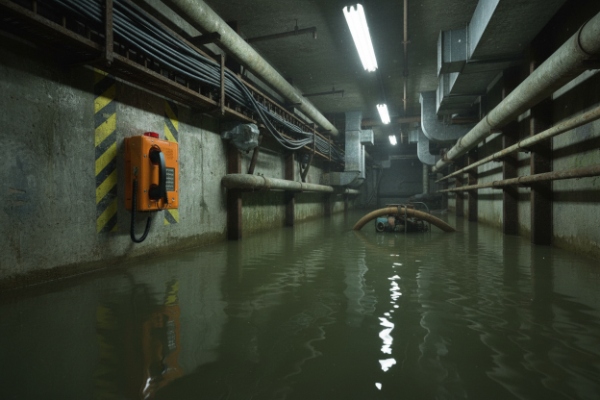
Upgrade from IP66 to IP67 when the phone can be temporarily submerged due to flooding, pooling, or low mounting. If your risk is only spray and rain, IP66 is usually the better fit.
Site conditions that justify IP67
IP67 is a good upgrade when any of these are true:
-
The unit is mounted low, near ground level, or near wheel splash zones.
-
The area has known drainage problems or seasonal floods.
-
The phone is installed in a tunnel entrance, underpass, or trench-adjacent location.
-
Water can pool around the back box or cable chamber.
-
The phone is on a pedestal where the base can sit in water.
In these cases, it is not about “more waterproof.” It is about the specific failure event: water sitting and pressing on seals.
Cases where IP66 is enough, and often better value
-
Phones mounted high on poles or walls in open parking lots.
-
Gate intercom points that face rain and occasional cleaning, but not pooling.
-
Industrial yards with spray exposure but strong drainage and elevated mounting.
In these places, the typical threat is jets and wind-driven rain. That is the IP66 world.
Practical “upgrade” options before jumping ratings
Sometimes the best fix is not a higher rating. It is a better install:
-
Raise mounting height by 30–60 cm.
-
Use correct sealed glands and plug unused holes.
-
Ensure the mounting surface is flat so the rear gasket seals evenly.
Those steps can turn an IP66 phone into a long-life solution even in rough weather.
A simple upgrade decision table
| Question | If yes | If no |
|---|---|---|
| Can water cover the lower part of the phone? | Add IP67 | Stay with IP66 |
| Is the phone low-mounted near drainage paths? | Add IP67 | Stay with IP66 |
| Is hose cleaning common? | Keep IP66 as required | IP66 still recommended for storms |
| Do you face both jets and pooling? | Ask for IP66 + IP67 evidence | Keep single rating aligned to threat |
The last part is communication. Many buyers know the numbers but not the meaning. The way the difference is explained can prevent wrong expectations.
So here is the clean client explanation that avoids technical fights.
How do I explain IP67 vs IP66 to my clients?
Clients usually want one sentence. Engineers want proof. The message needs to work for both.
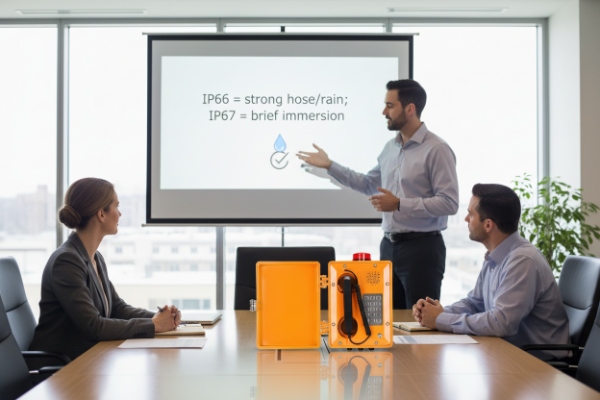
Explain it like this: IP66 is tested for strong spray and hose jets, and IP67 is tested for short-term immersion. If the site has hoses, ask for IP66. If the site may flood, add IP67.
A ready-to-use paragraph for proposals
IP ratings describe different water events. IP66 focuses on strong spray and hose-like water jets. IP67 focuses on short-term immersion. A higher number does not mean “covers everything.” The right rating depends on how water reaches the device in your location.
A short script for meetings
-
“Do you hose equipment here?”
-
“Can water pool or flood around the mounting point?”
-
“If it is hoses, IP66 is the must-have.”
-
“If it is pooling or flood, IP67 is the must-have.”
-
“If both exist, we specify both test proofs.”
This keeps the discussion on site behavior, not on numbers.
A table clients understand fast
| Client question | Your answer | What to specify |
|---|---|---|
| “Will it survive storms and spray?” | “That is IP66 territory.” | IP66 + correct gland method |
| “Will it survive a short flood?” | “That is IP67 territory.” | IP67 + sealed rear chamber |
| “We do both.” | “We need proof for both events.” | Test evidence for IP66 and IP67 |
| “Is IP67 better than IP66?” | “It is different, not always better.” | Match to the real threat |
One more line that reduces disputes after install
Make sure clients hear this early: “The rating depends on the full assembly, including cable entry and installation method.” That sentence protects everyone. It also pushes contractors to use the correct glands and to seal unused openings.
Conclusion
IP66 is for strong spray. IP67 is for short immersion. Choose based on the water event you face, and ask for proof that matches your real site risk.
Footnotes
-
A standard rating system defining the effectiveness of electrical enclosures against intrusion from foreign bodies (dust) and moisture. [↩] ↩
-
A mechanical cable entry device used to attach and secure the end of an electrical cable to the equipment, maintaining the IP rating. [↩] ↩
-
Testing procedures defined by standards like IEC 60529 to verify an enclosure’s ability to withstand powerful water jets. [↩] ↩
-
A loop in a cable that allows water to drip off the bottom before it reaches the entry point of a device, preventing water ingress. [↩] ↩