
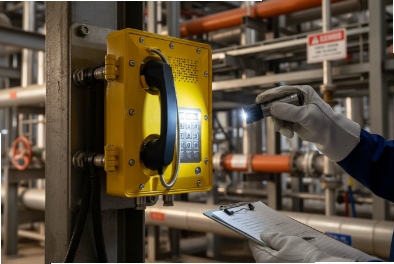
Wrong EX marking creates silent risk. The phone may pass a quick glance, then fail a safety audit when the area is live and access is restricted.
An EX marking is a compact safety “identity card.” It tells the protection method, gas/dust group, temperature limit, and protection level, so you can match the phone to Zone, product risk, and inspection rules.
EX marking is a compact safety statement, not a marketing label
What the EX marking is trying to solve
An explosion-proof telephone must not ignite an explosive atmosphere. The EX marking 1 is the short code that explains how the product achieves that. It also tells you where it can be installed and how strict your selection and maintenance rules must be.
In real projects, this matters because the same refinery can contain multiple zones. A phone at a muster point may sit outside a classified area. A phone near a pump seal or loading arm may sit inside Zone 1 2. If the marking does not match the location, the phone becomes a compliance problem even if it “works.”
The short marking links to longer documents:
-
The certificate(s) and test reports that prove the design meets a specific protection concept.
-
The “conditions of safe use,” often shown as an “X” suffix on certificates.
-
The permitted ambient temperature range (Ta) and any power limits.
-
The allowed cable entry method and approved glands.
That is why experienced safety teams read the marking first, then check the certificate number, then verify installation details like glands and bonding.
A quick “what it tells you” map
| Marking element | What it answers | Why it matters in selection |
|---|---|---|
| Protection type (d, e, i, tb) | How ignition is prevented | Drives wiring and maintenance rules |
| Group (I/II/III) | Mining vs surface vs dust focus | Prevents using the wrong industry group |
| Gas/Dust group (IIC/IIIC) | How “severe” the substance is | Decides if hydrogen/fine dust is covered |
| T-class / Max temp | How hot the surface may get | Must stay below ignition temperature margin |
| EPL (Gb/Db) | How much protection is provided | Maps to Zone suitability and risk tolerance |
If this overview feels abstract, the next section makes it practical by decoding two common markings exactly the way auditors do.
Keep reading, because once you can decode one EX line, you can validate most nameplates in minutes.
How should codes like “Ex d IIC T6 Gb” and “Ex tb IIIC T85°C Db” be read?
A marking line can look like a foreign language. If one character is misunderstood, the phone can be installed in the wrong zone.
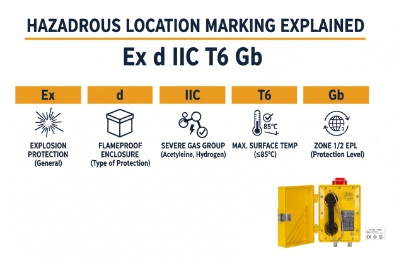
Read EX codes left to right. “Ex d IIC T6 Gb” means flameproof for gas, highest gas group, T6 surface limit, and an EPL suited to Zone 1. “Ex tb IIIC T85°C Db” means dust protection by enclosure, conductive dust group, max surface temperature 85°C, and EPL suited to Zone 21.
Decode “Ex d IIC T6 Gb” in plain words
-
Ex: Suitable for explosive atmospheres when installed as certified.
-
d: Flameproof enclosure. If ignition happens inside, the enclosure contains it and cools gases through certified flame paths 3.
-
IIC: Gas group IIC (the most demanding common group for gases). This is the group people often request when hydrogen exposure is possible.
-
T6: Temperature class. The device surface temperature must not exceed the T6 limit under rated conditions.
-
Gb: Equipment Protection Level for gas. Gb aligns with equipment intended for Zone 1 (and also acceptable for Zone 2 in many site rules).
What it means in selection: this phone is designed for gas hazards, with strong protection and a strict temperature class. It is often used in refineries, tank farms, and loading racks when the phone sits inside a classified area and must remain functional.
Decode “Ex tb IIIC T85°C Db” in plain words
-
Ex: Suitable for explosive atmospheres.
-
tb: Protection by enclosure for dust (often used for dust atmospheres). It focuses on preventing dust ingress and limiting surface temperature.
-
IIIC: Dust group IIIC (conductive dust). This is often considered the most demanding dust group because conductive dust can create additional risks.
-
T85°C: Maximum surface temperature is 85°C (dust markings often use a direct temperature, not only T-classes).
-
Db: Equipment Protection Level for dust. Db aligns with equipment intended for Zone 21 (and also acceptable for Zone 22 in many site rules).
What it means in selection: this phone is designed for dust hazards, with a controlled surface temperature and a dust enclosure concept. Dust hazards show up in grain, powders, some mining-related surface plants, and certain material handling areas.
How “Gb/Db” maps to Zones in daily engineering
This mapping helps you translate marking into installation decisions:
| EPL | Typical Zone fit | Practical note |
|---|---|---|
| Ga | Zone 0 | Highest protection, rare for full-feature phones |
| Gb | Zone 1 | Common for Ex telephones in process areas |
| Gc | Zone 2 | Often used where hazard is rare |
| Da | Zone 20 | Highest dust protection level |
| Db | Zone 21 | Common for dust areas with regular dust presence |
| Dc | Zone 22 | Dust hazard is infrequent |
One field lesson that saves time
When I review nameplates for projects, I check two “fast traps”:
1) Gas vs dust: “d” does not mean dust. “tb” does not mean gas. Many areas have both hazards, so the phone may need dual marking or a clear site decision.
2) Temperature marking style: Gas uses T6/T5/T4. Dust often uses T85°C style. Mixing these is a common misunderstanding during procurement.
Once you can read the code, the next question is where these codes come from and why the same phone may have different markings in EU vs North America.
Which standards define EX marks—ATEX, IECEx, NEC/CEC—and what are the key differences?
Teams often mix these systems and assume they are interchangeable. That creates delays at the permit stage and confusion during audits.
ATEX is an EU legal framework that requires CE marking and specific conformity documents. IECEx is an international certification scheme based on IEC standards and uses a similar marking style. NEC/CEC are North American installation codes that use Class/Division or Class/Zone markings and typically rely on NRTL listings (like UL/FM/CSA).
ATEX: compliance for the European market
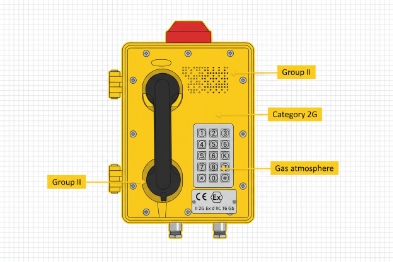
ATEX 4 is often the first keyword buyers see. In practice, ATEX means:
-
The product is assessed to the relevant harmonized standards.
-
The manufacturer issues an EU Declaration of Conformity.
-
The product carries the required CE mark and the Ex marking on the nameplate.
-
A Notified Body is involved for certain equipment categories and quality assurance modules.
ATEX is not only a certificate. It is a legal compliance route for the EU market.
IECEx: international scheme with strong transparency
IECEx 5 is built around IEC standards and a global certification framework. Many international projects accept IECEx because:
-
The certificate format is consistent across countries.
-
Test reports and quality assessment reports are structured and easier to compare.
-
The marking style aligns with IEC standards and EPL language.
In practical procurement, IECEx helps when equipment must be shipped and installed across multiple regions with one technical baseline.
NEC/CEC: installation code focus, different naming language
In North America, “explosion-proof” often appears with NEC/CEC language like:
-
Class I, Division 1 (gas/vapor) or Division 2
-
Or Class I Zone 1/2 with gas group references
Approvals are typically shown through NRTL listings or recognized certification bodies.
The key difference is not only the text on the nameplate. The whole compliance workflow is different because NEC/CEC is strongly tied to installation rules and local inspection practices.
What “different systems” means for a global tender
A global refinery group might ask for:
-
ATEX for EU sites
-
IECEx for international sites
-
UL/CSA/FM style listings for North America
This is normal. It does not mean three different products are always needed, but it does mean the offered model must carry the correct markings and documents for each region.
| System | Where it is used | What the auditor expects to see |
|---|---|---|
| ATEX | EU/EEA | CE mark, Ex marking, EU DoC, ATEX certificate references |
| IECEx | Many global projects | IECEx certificate number and marking, controlled installation conditions |
| NEC/CEC | US/Canada | Class/Division or Class/Zone marking, listing evidence, code-aligned installation |
At DJSlink, the cleanest projects are the ones that define the jurisdiction first. That prevents buying a “perfect ATEX phone” for a NEC site, then discovering the inspector needs a different approval path.
Now that standards are clear, the next step is selection. This is where gas/dust groups, temperature class, EPL, and ambient range become practical buying rules.
What do gas/dust groups, temperature class, EPL (Ga/Gb/Da/Db), and ambient range mean for selection?
Selection errors usually happen when people focus on one factor only. A phone can be IIC but fail because the ambient range is too narrow. A phone can be T6 but fail because it is only Gc.
Use EX marking as a selection matrix: match Zone with EPL, match substance with gas/dust group, match ignition risk with T-class or max surface temperature, and match site climate with the declared ambient (Ta) range.
Gas groups and dust groups: why they matter
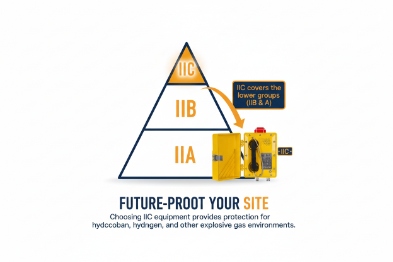
Gas group relates to how easily ignition can propagate. Higher groups are more demanding. Dust group relates to dust conductivity and particle behavior. In many tenders:
-
IIC is chosen when hydrogen 6 risk exists or when one model must cover many units.
-
IIIC is chosen when fine conductive dust risk is considered.
A conservative approach reduces future changes, but it can increase cost. The best approach is to align with the site hazardous area dossier and the materials handled.
Temperature class and max surface temperature: keep margin
Temperature class 7 is about limiting the maximum surface temperature. That limit must be below the ignition temperature of gases or dust layers with the required safety margin. Selection must also consider worst-case conditions:
-
High ambient temperatures
-
Solar radiation on outdoor housings
-
Internal heating from electronics and PoE conversion
If the phone will sit in the sun on a pipe rack, ambient range is not a footnote. It is a real risk driver.
EPL and Zone: do not downgrade accidentally
EPL is one of the easiest things to miss because it is only two letters. Still, it decides intended Zone fit:
-
Gb is a typical choice for Zone 1.
-
Gc is for Zone 2 and may not be acceptable for a Zone 1 mounting point.
The same logic applies to dust with Db and Dc.
Ambient range (Ta): the line item that prevents winter failures
The nameplate or certificate often shows something like:
- Ta = -40°C to +60°C
This must match your site reality. If the plant is in a cold region, handset cord materials and seal elasticity must also match that range. A phone that meets Ta on paper but uses a cord that cracks at -25°C becomes a maintenance loop.
| Selection input | What to match in EX marking/certificate | What to ask before ordering |
|---|---|---|
| Zone | EPL (Gb/Gc or Db/Dc) | Location list by hazardous map |
| Substance | Gas group (IIC) / Dust group (IIIC) | Product list and future expansion plan |
| Ignition risk | T-class / Max surface temperature | Worst-case ambient and solar exposure |
| Climate | Ta range | Handset/cord materials and gasket plan |
| Environment | IP rating and corrosion design | Washdown, salt fog, chemical exposure |
A small habit improves outcomes: write a short “location profile” per installation point (Zone, noise, washdown, temperature). Then select the phone and accessories to match the profile, not only the Ex line.
Finally, even if selection is correct, audits still fail when the nameplate is missing key identifiers. That is why the next section focuses on what auditors look for on the actual label.
Where are certificate numbers, notified bodies, and IP ratings shown on the nameplate for compliance audits?
Many audits happen in the field, under time pressure. The inspector wants proof on the nameplate first, then the documents. If the nameplate is unclear, the audit slows down.
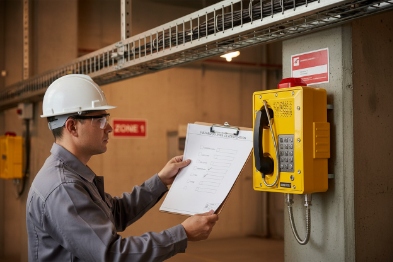
Most explosion-proof telephones show the Ex marking line, certificate numbers, and temperature/ambient limits on the main nameplate. ATEX units often show CE and a Notified Body number. IECEx units show the IECEx certificate code. IP rating is usually printed separately on the label or nearby, and it must match the enclosure configuration used on site.
What auditors typically check on the nameplate
A practical audit checklist looks like this:
1) Manufacturer and model number
2) Ex marking line(s) for gas and/or dust
3) Ambient range (Ta) if declared
4) Certificate number(s) (ATEX and/or IECEx, or North American listing references)
5) CE mark and Notified Body 8 number for ATEX compliance (where applicable)
6) IP rating and any special conditions (like “X” suffix or warnings)
If the phone supports both gas and dust, there may be two marking lines. That is normal. What matters is that the lines match the location hazards.
Where the certificate number appears and how it is formatted
Certificate formatting differs by scheme, but the label usually prints a short code that points to the full certificate. The same model can carry more than one certificate if it is sold globally. During tender submission, the document pack should include the full certificate PDF and the EU DoC if ATEX applies.
IP rating: label it, but also protect it in installation
IP rating is not only a label. It depends on:
-
Correct glands
-
Correct strain relief
-
Correct cover closing torque
-
Correct gasket condition
Auditors sometimes check the gland type and the cable entry condition because that is where IP failures 9 start.
A simple “nameplate audit” table you can reuse
| Nameplate item | What it looks like | Why it matters in audits |
|---|---|---|
| Ex marking | “Ex d IIC T6 Gb” | Confirms protection concept and intended Zone |
| Ambient (Ta) | “Ta -40°C…+60°C” | Confirms climate fit and certificate scope |
| Certificate No. | ATEX/IECEx code | Links device to official approval documents 10 |
| CE + NB | “CE 0123” style | Shows EU compliance route where required |
| IP rating | “IP66/IP67” | Confirms ingress target for washdown/outdoor |
| Serial/Batch | Unique identifier | Supports traceability and maintenance logs |
A small practical tip: during commissioning, take a photo of each nameplate and store it with the location tag in your maintenance system. This saves hours later when a compliance team asks for proof without opening cabinets or removing hoods.
Conclusion
EX markings tell you the protection concept, substance group, temperature limit, and protection level. Match them to the hazardous map, then confirm certificates, Ta range, and IP details on the nameplate.
Footnotes
-
[Standardized system of codes indicating the safety level and intended use of explosion-proof equipment.] ↩
-
[Hazardous area classification where explosive gas atmospheres are likely to occur in normal operation.] ↩
-
[Gap dimensions in flameproof enclosures designed to cool escaping gases and prevent ignition.] ↩
-
[European Union directive mandated for equipment used in potentially explosive atmospheres.] ↩
-
[International certification system ensuring equipment meets global standards for explosive environments.] ↩
-
[A highly flammable Group IIC gas requiring stringent equipment certification to prevent ignition.] ↩
-
[Classification system defining the maximum surface temperature of equipment to prevent ignition.] ↩
-
[Organization designated by an EU country to assess the conformity of certain products before being placed on the market.] ↩
-
[Ingress Protection rating failures leading to dust or water entering the enclosure, compromising safety.] ↩
-
[Official certificates verifying that equipment meets IECEx international safety standards.] ↩








