

Rain, hose-down, dust, and salt air can kill a “certified” phone faster than any gas zone. Then the site loses emergency calling when it matters most.
Most explosion-proof telephones are built to IP66 as a baseline, and many reach IP67. IP68 is only needed for real submersion cases, and it must be proven by the test report and the installed cable glands.

IP waterproof ratings in real sites, not in brochures
Explosion protection and waterproof protection are not the same thing. An Ex marking controls ignition risk in a hazardous area. An IP rating 1 controls dust and water entry into the enclosure. A phone can be “Ex certified” and still fail early if IP selection is weak, or if installation breaks the seal.
What “IP66 / IP67 / IP68” means for an explosion-proof telephone
IP has two digits. The first digit is dust. The second digit is water.
-
IP6X means dust-tight. This matters for terminals, mines, grain areas, and any place with fine dust that can jam a keypad or corrode contacts.
-
IPX6 means strong water jets. This matches heavy rain, wind-driven rain, and washdown with a hose.
-
IPX7 means temporary immersion. This is for flooding or accidental dunking, not continuous underwater service.
-
IPX8 means extended immersion under defined conditions. The depth and time are not “standard.” They are set in the product report.
A simple decision table used on projects
| Environment | Typical water exposure | Practical IP target for telephones | What to confirm before buying |
|---|---|---|---|
| Outdoor walls, tank farms, terminals | Rain + wind + dust | IP66 | Gasket design, drain paths, mic/speaker membranes |
| Process areas with hose washdown 2 | Direct jets | IP66 (or higher) | IPX6 test report and correct cable gland system |
| Flood-prone corridors, pits, low points | Short accidental immersion | IP67 | Installation height and cable entry sealing |
| Underwater, permanent wet wells | Continuous immersion | IP68 (defined depth/time) | IPX8 report with stated depth/time, service rules |
Why “higher IP” is not always better for telephones
A telephone needs acoustic paths. Many designs use membranes over the speaker and microphone openings. Those membranes can meet IP66 and sometimes IP67, but they still need cleaning rules. If the site uses aggressive chemicals, the membrane, keypad, and gasket material matter as much as the IP line on the datasheet.
In my quotations, the fastest way to avoid disputes is to write an IP requirement in the same sentence as the environment. For example: “Outdoor, heavy rain and hose washdown, minimum IP66, cable glands included.” This forces the supplier to deliver a complete sealing system, not only a metal box.
Keep reading, because the right IP level depends on the type of water exposure, and many sites misuse IP68 when IP66 is the real need.
Is IP66, IP67, or IP68 required for washdown, rain, or submersion at industrial sites?
A wrong IP target causes two bad outcomes: overspending on IP68 that never gets used, or installing IP66 where the device sits underwater after every storm.
For rain and washdown, IP66 is usually the correct industrial target. Use IP67 when temporary flooding is credible. Use IP68 only when the phone must stay submerged, and only under the tested depth and time stated in the report.
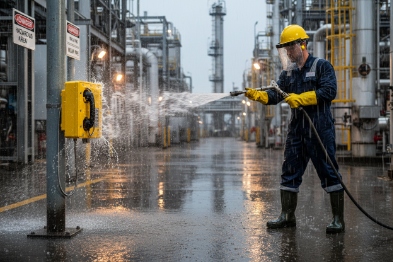
Washdown: focus on jets, not immersion
Most “washdown” on plants is a hose and nozzle, not a pressure washer. IP66 covers powerful water jets and is often the best match. If a site uses high-pressure, high-temperature cleaning, the discussion should include chemical resistance and sometimes IP69K (commonly referenced in ISO 20653 / DIN 40050-9). Still, many Ex telephones do not claim IP69K 3 because the acoustic design and seals must survive that stress.
What to specify for washdown:
-
Minimum IP66
-
Sealed keypad and sealed acoustic membranes
-
Correct gland type and tightening torque
-
Cleaning limits (no direct blasting into the mic/speaker at close range)
Rain and storm exposure: wind-driven water is the real enemy
For terminals and tank farms, rain often hits sideways. IP66 handles that well when the enclosure is dust-tight and the gasket is stable. IP65 can work in mild sites, but it is a weaker choice if the phone is mission critical.
Submersion: separate “accident” from “service condition”
-
IP67 is for short, accidental immersion. Think 30 minutes at about 1 meter. It is a safety net for flooding.
-
IP68 is for planned immersion. The supplier must state the exact depth and time. “IP68” without a depth/time statement is not enough for engineering sign-off.
Quick mapping table used in tender specs
| Use case | Common site example | Recommended IP | Notes for Ex phones |
|---|---|---|---|
| Rain only | Outdoor perimeter walls | IP66 | Check UV and gasket aging |
| Hose washdown | Process deck, loading bay | IP66 | Confirm jet test and cleaning guidance |
| Flood event | Basement corridor, pit entry | IP67 | Confirm cable entry sealing and mounting height |
| Underwater | Wet well, marine berth ladder | IP68 | Must match tested depth/time and service rules |
A simple rule works: choose the IP based on the worst credible water exposure at the installation point, not based on a general “site label.”
How do IP ratings compare to NEMA 4/4X and IK impact for harsh environments?
Many specifications mix IP, NEMA, and IK. Then procurement ends up comparing labels that do not measure the same thing.
IP ratings measure dust and water ingress. NEMA 4/4X adds enclosure performance topics like corrosion resistance and gasket aging. IK ratings measure impact strength. For harsh sites, a strong spec uses all three: IP for water/dust, NEMA (or corrosion criteria) for weathering, and IK for abuse resistance.
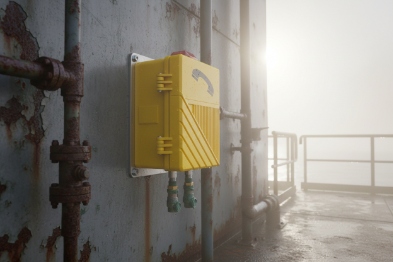
IP vs NEMA: similar goals, different test scope
IP is defined by IEC 60529 4. It tells how well the enclosure blocks dust and water entry. It does not say the enclosure resists corrosion, icing, or long gasket aging.
NEMA is a North American enclosure system. NEMA 4 is for indoor/outdoor use, hose-directed water, and windblown dust. NEMA 4X adds corrosion resistance 5 expectations. That matters for coastal terminals, chemical plants, and wastewater sites.
IK: the missing part for real “harsh” environments
A phone can be IP66 and still crack from a cart hit or tool impact. That is why IK matters. IK 6 is an impact rating per IEC 62262. Common values:
-
IK08 (moderate impact)
-
IK10 (high impact, often used for public areas and industrial abuse)
A practical comparison table for project teams
| What you want to survive | Use this rating family | Typical target for harsh sites | Why it matters for telephones |
|---|---|---|---|
| Dust entry | IP first digit | IP6X | Protects keypad, speaker cavity, electronics |
| Water jets and rain | IP second digit | IPX6 | Washdown and wind-driven rain are common killers |
| Corrosive air and cleaning chemicals | NEMA 4X or material spec | NEMA 4X + 316L / coating | Prevents fast rust and gasket damage |
| Abuse and impact | IK | IK10 | Protects handset cradle, visor, front plate |
What to write in a clear spec line
A clean line reduces arguments:
-
“Outdoor tank farm, washdown expected: IP66, IK10, 316L or equivalent corrosion protection.”
-
“Coastal terminal: IP66, NEMA 4X intent, salt-fog resistance requirement, stainless fasteners.”
When these are combined, the phone survives water, survives impact, and survives corrosion. Without that combination, the device may pass commissioning and still fail in a single season.
Will cable glands and 316L housings maintain IP rating after installation and maintenance?
The enclosure IP rating is only real if the whole sealing chain stays correct after the electrician is done and after the first maintenance visit.
Yes, the IP rating can be maintained, but only if the cable glands, plugs, and installation steps match the certified design. 316L housings help with corrosion, but IP failure usually comes from bad gland selection, wrong torque, damaged gaskets, or poor maintenance habits.
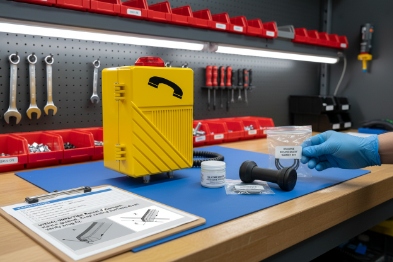
The “sealed box” myth
Many failures come from one assumption: “The housing is IP66, so the assembly is IP66.” In the field, the weakest point is often the cable entry 7.
To maintain IP:
-
The gland must match the cable outer diameter range.
-
The gland must match the IP rating target (and the Ex protection concept if in a hazardous area).
-
The threads must be sealed correctly, often with an approved sealing washer or thread seal method defined by the supplier.
-
Unused entries must use the correct certified blanking plug and seal.
316L helps, but it does not fix bad sealing
316L stainless steel 8 resists many corrosive environments, so the enclosure stays solid and the cover bolts do not seize. Still, corrosion can appear in crevices, under deposits, or where dissimilar metals touch. The gasket material is also a critical part. A strong metal enclosure with a weak gasket can still leak.
Installation and maintenance risk table
| Failure mode | What it looks like on site | Root cause | Prevention step |
|---|---|---|---|
| Water ingress at cable entry | Moisture inside, fogged lens, audio distortion | Wrong gland size or poor tightening | Use correct gland range and torque, verify with pull test |
| Leak at cover joint | Drips after rain or washdown | Gasket damaged or pinched | Replace gasket, clean mating faces, follow closing sequence |
| Corrosion at fasteners | Rust streaks, seized screws | Wrong fastener material | Use stainless fasteners and anti-seize where allowed |
| IP drop after service | Works for months then fails | Missing seal, wrong reassembly | Maintenance checklist and spare gasket kit |
A field practice that works
In many projects, the best control is simple: include glands in the supply scope, and require a short installation guide with torque and cable diameter range. That turns IP from a promise into a repeatable process.
If the environment is coastal or chemical, it also helps to specify stainless glands and stainless fasteners. The housing can be 316L, but one plated brass gland can still become the corrosion weak point.
What tests verify protection—water jet, immersion depth/time, and salt-fog corrosion cycles?
Without test details, “IP66” is just a sticker. A reliable supplier can show the test basis and the test limits.
Protection is verified by standardized ingress tests (water jet and immersion) and by corrosion tests when specified. IPX6 uses high-flow water jets. IPX7 uses short immersion. IPX8 uses manufacturer-defined depth/time. Salt-fog cycles are typically based on ASTM B117 or ISO 9227 for corrosion resistance screening.
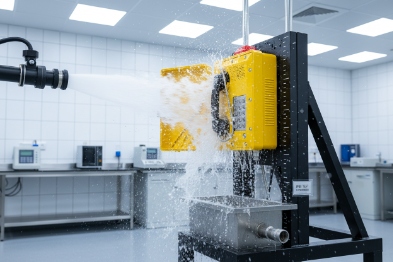
IP water tests: what “pass” usually means
IP tests are done on a sample with defined mounting and cable entries. That is important. A phone tested with a plug in the cable entry is not the same as a phone tested with a real gland and cable.
Typical test intent:
-
IPX6 (jets): strong water jets from a defined nozzle and flow rate for a minimum time, aimed at all directions.
-
IPX7 (temporary immersion): submersion around 1 meter for about 30 minutes.
-
IPX8 (extended immersion): depth and time set by the manufacturer and recorded in the report.
Salt-fog: what it can and cannot prove
Salt-fog tests 9 are often used for coastal terminals and offshore work. They are screening tests. They compare materials and coatings. They do not perfectly simulate real outdoor life. Still, they are useful for procurement because they set a measurable requirement.
Many buyers ask for a salt-fog duration like 240h / 500h / 1000h. The key is to define what “acceptable” means. Is it “no red rust”? Is it “no functional loss”? Is it “cosmetic change allowed”?
Test summary table for specification writing
| Test topic | Typical standard reference | What the report should state | What to watch in Ex telephones |
|---|---|---|---|
| Water jets | IEC 60529 (IPX6) | Nozzle type, flow, duration, pass criteria | Membrane integrity and cable entry setup |
| Temporary immersion | IEC 60529 (IPX7) | Depth, time, orientation, pass criteria | Gasket compression and cover closing method |
| Extended immersion | IEC 60529 (IPX8) | Exact depth and time defined | “IP68” must include conditions, not only the label |
| Salt-fog corrosion | ISO 9227 10 or ASTM B117 | Cycle duration, sample prep, acceptance criteria | Crevice points, fasteners, glands, and coating edges |
A procurement checklist that saves time
-
Ask for the IP test report or a clear test declaration.
-
Confirm the test setup includes real glands or matches your intended installation.
-
For IP68, demand the depth and time in writing.
-
For corrosion, define acceptance criteria and include glands and fasteners in scope.
When the tests are clear, site acceptance becomes smooth. When they are vague, the phone passes the factory and fails in the field.
Conclusion
Explosion-proof phones often reach IP66 and many reach IP67; choose IP68 only for real submersion, and protect the rating with correct glands, materials, and verified test reports.
Footnotes
-
[Standard defining levels of sealing effectiveness of electrical enclosures against intrusion from foreign bodies and moisture.] ↩
-
[Standard specifying performance requirements for electrical enclosures, including protection against hose-directed water.] ↩
-
[High-pressure, high-temperature washdown rating, often required for food processing and heavy industrial cleaning.] ↩
-
[International standard classifying degrees of protection provided by enclosures (IP Code).] ↩
-
[NEMA standard criteria for enclosures offering protection against corrosion and other environmental hazards.] ↩
-
[Rating scale defining the impact resistance of electrical enclosures against external mechanical shocks.] ↩
-
[Guidelines ensuring proper sealing and retention of cables entering enclosures to maintain IP ratings.] ↩
-
[Stainless steel grade offering superior corrosion resistance, ideal for harsh marine and chemical environments.] ↩
-
[Standard practice for operating salt spray (fog) apparatus to test corrosion resistance.] ↩
-
[ISO standard specifying corrosion tests in artificial atmospheres using salt spray.] ↩








