
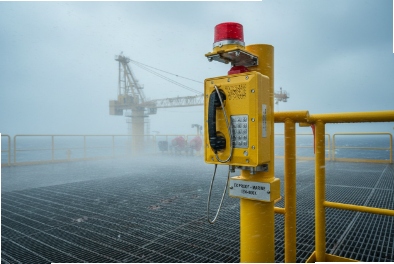
Salt air does not fail fast. It fails every seal, screw, and connector one day at a time. Then the phone looks “fine” but turns silent in an emergency.
Yes, explosion-proof telephones can be adapted for marine climates, but only when the full build targets corrosion, ingress, impact, and EMC. The Ex certificate alone does not prove marine durability.
What “marine-adapted” means for an explosion-proof telephone
Marine climate is a system problem, not a material problem
A 316L housing helps, but a marine site attacks the whole system. Salt mist creeps into threads. UV hardens seals. Temperature swings pump air in and out of the enclosure. Vibration loosens fasteners. Cleaning chemicals wash away greases. A phone lasts when every weak point is treated as a design input.
The four pillars that decide real service life
Marine-ready selection becomes clear when it is split into four pillars:
-
Corrosion control: 316L or duplex, correct surface finish, isolation from dissimilar metals, marine-grade glands, and stainless fasteners.
-
Ingress control: IP66 or IP67 at the assembly level, not only the empty enclosure. Cable entries 1 are the usual leak point.
-
Mechanical survival: IK impact rating, vibration tolerance, and stable mounting hardware.
-
Electrical survival: EMC and surge protection for long runs, noisy power, and lightning-prone areas.
A practical “marine-ready” checklist for tenders
| Item | What to ask for | Why it matters in ports and offshore |
|---|---|---|
| Housing | 316L or duplex + controlled finish | Slows pitting and crevice corrosion |
| Fasteners | 316 stainless, anti-galling practice | Bolts seize fast in salt air |
| Glands | Marine-grade, correct IP and Ex type | Cable entry is the failure hotspot |
| Seals | UV-stable elastomer + spare kits | Seals age faster in sun and salt |
| Ratings | IP66/67, NEMA 4X intent, IK10 | Water jets, storms, impacts |
| Ambient | -40 to +70°C (project-driven) | Prevents derating surprises |
| Proof | Salt-fog test report + acceptance rule | Stops “marketing IP” claims |
On marine projects, the goal is simple: keep water out, keep corrosion slow, and keep comms stable. That goal needs more than an Ex label.
If the next sections feel detailed, that is on purpose. Marine failures are rarely dramatic. They are small mistakes that add up.
What corrosion protections ensure longevity—316L/duplex steel, marine-grade glands, UV-stable seals, and salt-fog tests like ASTM B117 or ISO 9227?
Marine corrosion is not only rust. It is pitting, crevice attack, galvanic coupling, and stress on seals after repeated cleaning.
Longevity comes from a corrosion stack: 316L or duplex housing, matching 316 fasteners, marine-grade cable glands, UV-stable seals, and verified salt-fog performance with clear pass criteria.
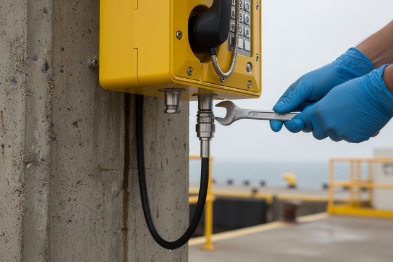
316L vs duplex in real installation choices
316L 2 is a common marine choice because it resists many chloride environments better than basic stainless grades. Duplex stainless can add higher strength and stronger pitting resistance in some cases. Still, duplex is not a magic shield. Surface condition, cleaning deposits, and crevices still matter.
A useful way to decide:
-
316L fits many ports, shipyards, and coastal terminals when the finish is good and dissimilar metals are controlled.
-
Duplex can fit harsher offshore splash zones, high chloride exposure, and places where higher strength helps.
A phone can be 316L and still fail early if:
-
A plated gland or carbon steel bracket touches the housing.
-
Salt sits under a gasket lip, visor edge, or nameplate.
-
Fasteners gall and seize, then maintenance breaks the gasket to “get it open.”
Simple design and site rules help:
-
Use 316L fasteners and avoid mixed metal stacks.
-
Use washers or isolators where dissimilar metals are unavoidable.
-
Specify a surface finish that is clean and easy to rinse.
-
Plan a cleaning method that does not destroy membranes and seals.
Seals and glands decide corrosion as much as the housing
Seals face UV, ozone, and chemical washdown. A “soft” seal can swell and leak. A “hard” seal can crack. This is why UV-stable materials and spare seal kits matter.
Cable glands must match the marine story:
-
Correct cable diameter range and correct tightening torque.
-
Salt-resistant material and stable compression parts.
-
Correct IP rating and correct Ex type for the zone.
Salt-fog tests: useful, but only with acceptance rules
Salt-fog tests 3 like ASTM B117 or ISO 9227 are common screening tools. The key is not the standard name. The key is what “pass” means. In procurement documents, it helps to define:
-
Duration (example: 240h, 500h, 1000h based on site severity).
-
What parts are tested (housing, fasteners, glands, brackets).
-
Acceptance: cosmetic change allowed or not, any red rust allowed or not, and functional checks after the test.
| Corrosion control item | Best practice for marine Ex telephones | Common field mistake |
|---|---|---|
| Housing | 316L or duplex + smooth finish | Rough finish traps salt |
| Fasteners | 316 stainless + anti-galling habit | Mixed fasteners seize or rust |
| Glands | Marine-grade + correct compression | “Any gland fits” thinking |
| Seals | UV-stable + spare kits | Reuse damaged gaskets |
| Proof | Salt-fog report + functional check | Only trusting brochures |
A phone survives marine years when corrosion is treated as a design system, not a single material choice.
Which ingress and impact ratings fit ports and offshore—IP66/67, NEMA 4X, IK10, and -40–70°C ambient with 316L fasteners?
Ports and offshore sites punish enclosures. Water hits sideways. Cleaning jets hit close. Impacts happen during loading and maintenance. Temperature swings pump air in and out of the box.
For ports and offshore, IP66 is the normal baseline and IP67 is a strong choice for flood or heavy splash risk. NEMA 4X intent helps in corrosive outdoor service, IK10 fits harsh handling, and wide ambient like -40 to +70°C avoids derating surprises when paired with 316L fasteners and stable seals.

IP66 vs IP67: pick by exposure, not by habit
-
IP66 matches strong water jets and heavy rain. It fits most outdoor walls, quays, and terminal structures.
-
IP67 adds a safety margin for temporary immersion. It fits low points, splash zones, and areas that can flood during storms.
IP68 sounds attractive, but it is only correct when the phone must stay underwater under defined depth and time. Many marine projects do not need that.
NEMA 4X: why North American specs use it
NEMA 4X speaks to outdoor hose-directed water and corrosion resistance expectations. It can be a clean way to express “this must survive coastal service,” especially when a project team is used to NEMA language. Even when the label is not used, the intent is still useful: corrosion-resistant enclosure and stable gaskets.
IK10: the real “harsh environment” switch
Impact ratings matter because ports and shipyards are busy. A phone gets hit by tools, carts, hoses, and even mooring lines. IK10 4 is a common target when the phone must keep working after a knock.
Ambient range: the silent spec that breaks projects
A wide ambient range like -40 to +70°C is often requested for offshore and exposed coastal sites. This is not only about “will it power on.” It affects:
-
Surface temperature limits tied to Ex temperature class 5.
-
Seal compression behavior at low temperature.
-
Long-term gasket aging at high temperature and sunload.
A clear rule helps: match the phone’s Ta range to the installation point, not to the city weather average.
| Site condition | Recommended rating target | What to verify on the product |
|---|---|---|
| Wind-driven rain + dust | IP66 | Full assembly IP with installed glands |
| Strong washdown jets | IP66 (and cleaning limits) | Jet test proof and membrane care rules |
| Flood-prone deck areas | IP67 | Orientation and cable entry sealing |
| Rough handling | IK10 | Front plate, handset cradle, visor strength |
| Corrosive outdoor service | NEMA 4X 6 intent + 316L | Fasteners, glands, and brackets also corrosion-ready |
| Extreme climates | Ta -40 to +70°C (project-driven) | Certificate Ta range and any conditions |
A marine site does not forgive weak details. IP, IK, ambient, and fasteners must match as one package.
What hazardous-area and marine approvals are needed—ATEX/IECEx Zone 1/2 plus ABS, DNV, and IEC 60945 EMC/safety?
Many buyers mix “marine approval” with “hazardous-area approval.” They solve different problems. A device can be perfect for Zone 1 and still fail marine EMC rules. It can pass EMC and still be illegal in a hazardous area.
For hazardous areas, the core approvals are ATEX and/or IECEx with correct Zone/EPL, gas or dust group, temperature class, and ambient range. For marine class projects, extra approvals may be needed, such as ABS or DNV type approval, and marine EMC/safety compliance like IEC 60945 when the equipment is treated as marine electronic equipment.

Hazardous-area approvals: the non-negotiables
For Zone 1 and Zone 2, the important parts are not the certificate logo. The important parts are the marking line and the scope:
-
Zone 1 normally means equipment with EPL Gb (or higher).
-
Zone 2 normally means equipment with EPL Gc (or higher).
-
Gas group IIA/IIB/IIC and dust group IIIA/IIIB/IIIC must match the site classification.
-
Temperature class (T1–T6) or dust max surface temperature must match the hazardous area file 7.
-
The Ta range on the certificate must match the actual ambient at the mounting point.
Marine class approvals: when ABS and DNV matter
ABS, DNV, and other marine class bodies often apply when:
-
The equipment is installed on classed vessels or offshore units.
-
The owner requires class acceptance for critical systems.
-
The project spec calls for type approval lists or class certificates.
Not every port or shipyard needs class approval. Many shore sites only need industrial compliance. Still, for offshore platforms and vessels, class approval can be a gating item.
IEC 60945: why it appears in marine tenders
IEC 60945 8 is often referenced for marine navigation and radiocommunication equipment and systems. In procurement language, it is used to express:
-
Marine EMC robustness.
-
Environmental endurance expectations for shipboard electronics.
-
Safety and performance under marine conditions.
Even when IEC 60945 is not mandatory, the test philosophy is useful. Shipboard power and comms environments are noisy. The phone and network gear must survive that noise.
| Approval need | Typical project type | What to check in documents |
|---|---|---|
| ATEX | EU installations | Marking, notified body info, certificate scope |
| IECEx | Global / non-EU standardization | CoC scope, marking, conditions of use |
| Zone/EPL fit | Zone 1/2 areas | Gb for Zone 1, Gc for Zone 2, correct group and T-class |
| ABS / DNV | Classed vessels and offshore units | Type approval status, model match, installation limits |
| IEC 60945 intent | Shipboard electronics environments | EMC performance, power quality tolerance, environmental claims |
A clean tender line reduces confusion: “ATEX/IECEx for Zone, plus class approval if required by vessel owner, plus marine EMC expectations for shipboard installation.”
How do SIP, PoE, PAGA, and surge protection integrate for shipyards and platforms—VLAN/QoS, 90W PoE budgets, and lightning/earthing practices?
Marine sites often have long cable runs, high EMI, shared power systems, and lightning exposure. Voice still must be clear and always available. The network design decides if the phone is “just another endpoint” or a safety tool.
SIP explosion-proof telephones integrate well in shipyards and platforms when the network is built for voice: VLAN separation, QoS for RTP, PoE power planning, and strong surge/earthing practice. PAGA and dispatch work best when SIP endpoints, paging servers, and gateways share a clear addressing and priority plan.

SIP in harsh networks: keep voice simple and protected
SIP is flexible, but marine networks can be chaotic. A stable approach is:
-
Put voice endpoints in a dedicated Voice VLAN.
-
Use QoS so voice RTP 9 gets priority. Many teams mark voice with common DSCP values and keep switching rules consistent end-to-end.
-
Keep multicast, broadcast, and storm control under watch, because noisy L2 domains can break call setup and paging.
-
Use redundant call servers or gateways if the project needs high availability.
PoE: power budgeting is not optional offshore
PoE is great in hazardous areas because it reduces local power wiring and simplifies maintenance. Still, the budget must be real:
-
Standard PoE levels are often referenced as 802.3af, 802.3at, and 802.3bt.
-
“90W PoE” is commonly tied to 802.3bt Type 4 at the PSE side. The delivered power at the device is lower because of cable loss.
-
Long marine cable runs add voltage drop. Cold starts, heaters, and high speaker volume can raise peak draw.
A useful field rule: plan PoE with headroom. Do not design at the edge of the switch budget.
PAGA and dispatch: treat paging like a safety service
PAGA paging often shares the same network and sometimes the same SIP core. To keep it reliable:
-
Define paging zones and priorities early.
-
Decide if paging is SIP-based, multicast-based, or via dedicated paging gateways.
-
Make sure the talk path from the dispatcher to the horn speaker or speaker station has a clear priority path.
If the site uses both emergency phones and paging horns, it helps to map alarm workflows. A phone call can trigger a paging event. A paging event can request a call back. This is where unified SIP design saves time.
Surge and lightning: protect the edge, bond the system
Ports and offshore steel structures attract lightning and switching surges. Protection must be layered:
-
Use Ethernet surge protectors where long copper enters buildings, cabinets, or exposed zones.
-
Use shielded cable when needed, and bond shields correctly. Bad shield bonding can create noise loops.
-
Keep equipotential bonding strong. Earthing practices must match the site grounding design, not personal habit.
-
Consider fiber uplinks for long outdoor runs. Fiber breaks surge paths by design.
A practical integration table for shipyards and platforms
| Integration topic | Recommended practice | Common failure mode |
|---|---|---|
| Voice VLAN | Separate VLAN for phones | Voice shares noisy OT traffic and breaks |
| QoS | Prioritize RTP and SIP where needed | Calls connect but audio drops |
| PoE budget | Size for peak draw + cable loss | Random reboots under load |
| 90W PoE use | Reserve for devices that need it | Oversizing switches without a plan |
| PAGA priority | Clear paging zones and priority rules | Paging works only sometimes |
| Surge protection | Layered SPD 10 at edges and cabinets | One storm kills many endpoints |
| Earthing | Site-standard bonding and shield plan | Ground loops and chronic noise |
In marine hazardous sites, a SIP phone is not only a device. It is part of a safety chain. Good VLAN/QoS, correct PoE planning, and serious surge bonding keep that chain unbroken.
Conclusion
Explosion-proof telephones can fit marine climates when corrosion, ingress, impact, approvals, and network power/surge design are handled as one complete system.
Footnotes
-
[Proper methods for installing cable glands to ensure seal integrity and prevent ingress.] ↩
-
[Low-carbon austenitic stainless steel with superior resistance to salt corrosion, widely used in marine environments.] ↩
-
[Standard method for salt spray testing to evaluate corrosion resistance of materials and coatings.] ↩
-
[Impact protection ratings defining how well an enclosure withstands external mechanical shocks.] ↩
-
[Hazardous area classification dictating the maximum allowable surface temperature of equipment.] ↩
-
[Standard specifying enclosures for electrical equipment to provide protection against corrosion and weather.] ↩
-
[Documents detailing the zones and risks of explosive atmospheres in a facility.] ↩
-
[International standard for maritime navigation and radiocommunication equipment performance and testing.] ↩
-
[Protocol for delivering audio and video over IP networks, requiring QoS prioritization.] ↩
-
[Devices designed to protect electrical equipment from voltage spikes and transients.] ↩








