
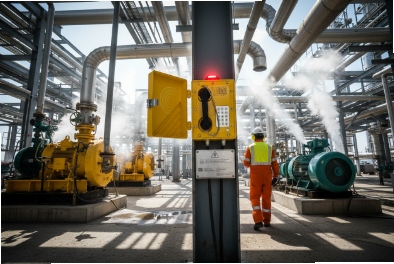
A refinery can be loud enough to hide alarms. A phone can also be loud enough to annoy crews. Both cases end with missed calls and missed response time.
Most explosion-proof telephones with built-in sounders sit near 100–110 dB(A) at 1 m. 120 dB(A) is possible, but it is usually a horn-style output or a special high-power sounder, not a “standard” handset phone.
A practical way to specify siren dB for Ex telephones
“dB at 1 m” is only useful when the test setup is clear
A supplier can print “110 dB” on a datasheet, and the field result can still disappoint. Sound pressure depends on tone, mounting, reflections, and direction. A-weighted numbers also reduce low-frequency energy because they follow human hearing sensitivity 1. That is fine for many alarms, but it can hide the real “feel” of a horn in a steel structure.
A clean spec should force clarity:
-
Distance: 1 m is standard for many sounder claims.
-
Weighting: A-weighted dB(A) for audibility comparisons.
-
Signal: tone type, frequency band, and duty cycle.
-
Direction: front axis and worst-case angle.
Built-in sounder vs external horn output
Explosion-proof telephones often use compact sounders inside the housing. That design balances size, power, and sealing. It is why 100–110 dB(A) at 1 m is common. A true 120 dB(A) product usually needs more acoustic volume, a horn path, or a higher power drive stage. That can raise PoE power needs and can tighten heat limits in hot climates.
The “right” siren level depends on ambient noise and worker behavior
In many plants, crews wear hearing protection 2. So sound alone may not be enough. A reliable design uses sound plus light and clear zoning.
This table helps align expectations early:
| Deployment goal | Practical target at 1 m | Why this works |
|---|---|---|
| Indoor corridor, moderate noise | 100 dB(A) | Strong alert without overkill |
| Outdoor process deck, high noise | 105–110 dB(A) | Better margin against machinery |
| Loading rack, extreme noise | 110–120 dB(A) + strobe | Sound plus light improves response |
| Site-wide alerting | Use PAGA horns 3 for coverage | One phone sounder cannot cover wide areas |
One real lesson from projects is simple. If the phone is the only alarm device, it will disappoint. If the phone is one part of a PAGA plan, it becomes very effective.
The next sections break down typical SPL values, proof standards, sizing rules for refineries, and the SIP control methods that make alarms reliable.
The goal is a siren that is loud enough to be heard, but not so loud that the site turns it off.
Which sound pressure rating is typical—100 dB, 110 dB, or 120 dB at 1 m A-weighted?
A sounder that is too weak becomes background noise. A sounder that is too strong becomes a complaint. Both problems end with operators ignoring alarms.
For most explosion-proof telephones, 100–105 dB(A) at 1 m is a realistic “standard” built-in sounder range, 110 dB(A) is common for heavy-industry variants, and 120 dB(A) is usually a high-power horn-style output or a special option rather than the default.

Why 100 dB(A) can be enough in many industrial zones
A 100 dB(A) sounder at 1 m is already loud for close-range warning. It works well for:
-
local call indication near the phone
-
entry gate alerts
-
indoor process corridors where ambient is not extreme
It also avoids pushing workers into discomfort at short distance. Some operators will stand close to the unit when they answer. So the alarm should not become a hearing risk during normal use.
Why 110 dB(A) is the “safe middle” for heavy industry
110 dB(A) gives more margin against:
-
pumps and compressors
-
wind noise on open decks
-
traffic noise in terminals
Many sites pick 110 dB(A) because it stays compact enough for an Ex phone enclosure, but still feels “serious” in outdoor conditions.
Why 120 dB(A) needs careful thinking
120 dB(A) at 1 m is very loud. It can be correct in extreme noise zones, but it also creates side effects:
-
higher power demand (often larger PoE budget)
-
more stress on membranes and sealing
-
higher risk of nuisance complaints and “disabled” alarms
-
stronger need for directional horns to avoid blasting the wrong areas
This table helps decide the target fast:
| Target SPL at 1 m | Best fit location | Risk if used in the wrong place |
|---|---|---|
| 100 dB(A) | Indoor or controlled outdoor points | Missed alert in high-noise decks |
| 110 dB(A) | Most refineries and terminals | Minor nuisance if too close to offices |
| 120 dB(A) | Loading racks and extreme noise zones | Worker discomfort and alarm disabling |
A practical trick is to treat the phone sounder as a local alert, then rely on horns and strobes for wide-area warning. That keeps the phone usable and keeps coverage predictable.
The next step is proof. Numbers are only valuable when a standard or lab method backs them up, and when performance stays stable across temperature extremes.
What standards verify sounders—EN 54-3, UL 464, IEC 60268 measurements, and tolerance at -40–70°C?
A vendor can claim “110 dB,” but the plant needs a report that proves how it was measured, and whether that output holds in cold mornings and hot sun.
Sounder performance is usually verified with fire-alarm sounder standards (EN 54-3 in many regions and UL 464 in North America) and with electroacoustic measurement methods like IEC 60268 for loudspeaker and sound system measurement. For harsh sites, the report should also show output tolerance after environmental exposure and across the declared operating temperature range.

EN 54-3: useful even when the site is not a building fire system
EN 54-3 4 is built for fire alarm sounders, but its language is helpful because it forces measurable sound level claims. It also controls extreme outputs. Many buyers use EN 54-3 logic as a reference point when they compare sounders.
For explosion-proof telephones with sirens, EN 54-3 is most useful as:
-
a measurement discipline reference
-
a sanity check that the sound level is not only marketing
UL 464: a common reference for horns and sirens in North America
UL 464 covers electrically operated bells, sirens, and similar audible signaling devices for alarm systems. It matters when the project needs a UL route, or when the customer wants a familiar “listed” sounder basis.
For harsh environments, it is smart to ask for output stability after exposure tests. A small drop can be normal, but a big drop means the device was not built for outdoor life.
IEC 60268: measurement method strength for audio equipment
IEC 60268 5 is an electroacoustic measurement family. It is useful when the sounder is treated like an audio transducer and the project wants:
-
defined measurement setup
-
frequency response information
-
output under a defined input condition
This is very helpful for SIP endpoints that generate multiple tones and paging audio, because it links “output” to a known test method.
Temperature tolerance: do not accept a dB number without a temperature story
Refineries and terminals often demand -40 to +70°C. Sounders can change with temperature because:
-
driver stiffness changes in cold
-
amplifier limits change in heat
-
PoE voltage drop can rise in long cable runs
A practical procurement table
| What to verify | What the vendor should provide | Why it matters |
|---|---|---|
| SPL at 1 m in dB(A) | Lab report with test setup notes | Makes the number repeatable |
| Tone and frequency | Tone list and measured output per tone | Different tones can change SPL |
| Temperature range | Operating range plus any derating 6 | Stops “works on paper” failures |
| Post-exposure output | Before/after delta in dB | Proves outdoor endurance |
Once standards and test evidence are clear, sizing becomes simple. The next section shows how to translate ambient refinery noise into a siren target without guessing.
How to size siren output for refineries—ambient 85–105 dBA, 10 dB margin, directional horns, and strobe syncing?
Many projects buy the loudest sounder and still fail acceptance tests. The reason is coverage, not raw dB.
A practical sizing rule is to aim for about 10 dB above the local ambient noise at the listener position, then use directional horns and strobes to handle line-of-sight limits and hearing protection. In refineries with 85–105 dBA ambient, a phone siren often needs 110 dB(A) local output, and wide-area warning should use PAGA horns instead of relying on the phone alone.

Step 1: measure ambient noise where people stand, not where the phone sits
Ambient sound near rotating equipment can jump fast. A phone mounted on a wall can be quieter than the work position. So the measurement point should match the operator’s location during normal work.
Many sites see ranges like:
-
85–95 dBA on many process decks
-
95–105 dBA near compressors, pumps, and loading arms
Step 2: apply a simple margin rule, then sanity-check with distance loss
A common rule is a 10 dB margin above ambient for clear notice. This is not perfect, but it is simple and it works as a first sizing step.
Then distance loss must be considered. Sound drops with distance in open air. Reflections can help or hurt. Steel structures can also create shadow zones. So it helps to treat the phone sounder as a local alert and let PAGA horns cover wider zones.
Step 3: use directional horns for high-noise zones
Directional horns can aim energy toward the work area and reduce spill into offices or corridors. That reduces complaints and keeps alarms active.
Step 4: sync a strobe for real-world response
Many workers wear hearing protection. A strobe sync helps:
-
provide a second channel of alert
-
reduce reliance on extreme sound levels
-
improve response in noisy or windy areas
A fast sizing table
| Ambient noise (dBA) | Target at listener (dBA) | What the design should do |
|---|---|---|
| 85 | 95 | 100 dB(A) phone siren often works locally |
| 95 | 105 | 105–110 dB(A) local siren + strobe |
| 105 | 115 | Phone siren + directional horn or PAGA horn coverage |
| Mixed zones | Varies | Zone-based horns, strobes, and paging priority 7 |
A short story from a loading rack project is useful here. The site first wanted “120 dB everywhere.” The crews complained in week one. The final solution used 110 dB local phone sirens plus directional horns plus synced strobes. Response time improved, and complaints dropped.
Once the acoustic plan is right, control is next. A siren is only useful when the SIP system can trigger it fast and with clear priority rules.
How do SIP features control alarms—multicast tones, DTMF trigger, dry-contact relay, priority paging, and PAGA integration?
A siren that cannot be controlled cleanly becomes a manual tool. Then it is late by default.
SIP explosion-proof telephones can control alarms through multicast paging tones, SIP call events, DTMF commands, and dry-contact relay outputs. The best designs also support priority paging and PAGA integration so alarms override normal calls and reach horn speakers and zones without delay.

Multicast paging: the fastest way to push tones to many endpoints
Multicast paging 8 is popular in plants because one trigger can reach many endpoints. It works well for:
-
zone-wide alert tones
-
broadcast voice instructions after the tone
-
scheduled tests with minimal call setup delay
A clear VLAN and QoS plan helps keep audio stable, especially when the network is shared with cameras and access control.
DTMF and event triggers: simple controls for dispatch and PBX
DTMF triggers 9 are useful when:
-
a dispatcher calls a phone or a group
-
the operator presses a code to start a siren, strobe, or relay
-
the system needs simple integration with older dispatch tools
The key is permission control. Only trusted extensions should be allowed to trigger alarms.
Dry-contact relay: the bridge to fire panels and industrial control
A dry-contact relay output can:
-
trigger a local beacon
-
trigger an external horn
-
signal a PLC input
-
integrate with a fire alarm interface in a controlled way
This is often the most reliable “last meter” control method, because it stays local even if the network is slow. It also allows clear cause-and-effect testing during commissioning.
Priority paging and PAGA integration: keep alarms above normal traffic
In a real emergency, paging should override normal calls. A clean design includes:
-
priority paging groups
-
preemption rules in the PBX or paging server
-
zone mapping that matches the site’s emergency plan
Comparison of common control methods
| Control method | Speed | Best use case | Key risk to manage |
|---|---|---|---|
| Multicast tone/paging | Very fast | Many endpoints at once | VLAN/QoS and multicast control |
| SIP call to group | Fast | Smaller groups or structured workflows | Call setup delay under congestion |
| DTMF trigger | Medium | Dispatch control and manual workflows | Access control and logging |
| Dry-contact relay | Local-fast | External horns, strobes, PLC links 10 | Wiring quality and contact rating |
| PAGA integration | Planned-fast | Wide-area warning and voice | Priority rules and zone mapping |
A strong project also plans failure modes. If the SIP core is down, local relay triggers and standalone horns still matter. That is why a phone should not be the only warning device in a high-risk zone. It should be one controlled endpoint inside a bigger alarm plan.
Conclusion
Most Ex phones deliver 100–110 dB(A) at 1 m. Use 120 dB(A) only for extreme noise zones, then prove it with test reports and control it with SIP priority and PAGA.
Footnotes
-
[Information on occupational noise exposure and recommended safe listening levels.] ↩
-
[OSHA guidelines for hearing conservation programs in high-noise workplaces.] ↩
-
[Public Address and General Alarm systems integrating voice and alarm capabilities for safety.] ↩
-
[European standard specifying requirements and testing methods for fire alarm sounders.] ↩
-
[International standard for sound system equipment, detailing measurement methods.] ↩
-
[Practice of operating components below their maximum ratings to extend lifespan and reliability.] ↩
-
[Configuration settings ensuring critical pages override standard calls in communication systems.] ↩
-
[Network method for sending audio streams simultaneously to multiple IP destinations.] ↩
-
[Signaling method using dual-tone frequencies for telecommunication control and dialing.] ↩
-
[Programmable Logic Controllers used for automation of industrial electromechanical processes.] ↩








