
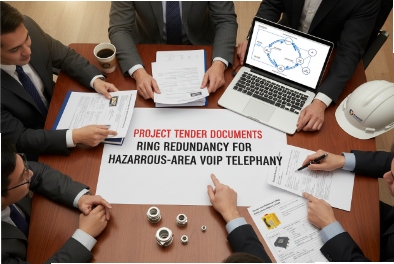
A single switch fault can kill emergency calling in seconds. In hazardous areas, that is not a small IT issue. It is a safety gap.
Explosion-proof SIP telephones can work in redundant ring networks, but the redundancy is usually handled by switches and topology. Some models offer dual LAN or bypass features, while protocols like ERPS or PRP are more often implemented in the network layer.
What “ring redundancy” really means for Ex telephones
Redundancy is a system feature, not only a handset feature
A rugged Ex telephone is only one node in a voice network. The ring behavior depends on switches, fiber links, and how fast the network converges after a fault. Many sites assume the phone must “support ERPS.” In real deployments, the switches run the ring protocol 1 and the phone just stays online.
Where failures actually happen in refineries and terminals
Most outages come from:
-
a broken fiber in pipe racks
-
a switch power loss in a local cabinet
-
a lightning event on copper uplinks
-
a loop misconfiguration that floods multicast
A phone can be perfect and still lose service if the ring reconverges slowly or if QoS is not enforced during the reconvergence window.
Dual LAN does not always mean “network redundancy”
Many industrial SIP endpoints have two RJ45 ports. Sometimes those ports are only a small internal switch for daisy-chain wiring. That helps reduce cabling, but it does not always provide true NIC failover. True redundancy needs clear behavior such as active/standby uplinks, link-state failover, or bypass that preserves ring continuity when the phone loses power.
The best way to write a procurement requirement
A strong requirement is measurable:
-
“Network reconvergence time ≤50 ms at ring level.”
-
“Phone call must not drop during single link failure.”
-
“SIP re-registration time after link loss ≤X seconds.”
-
“Multicast paging must remain stable during reconvergence.”
| Requirement item | What you should ask for | Why it matters |
|---|---|---|
| Reconvergence time | Ring protocol and tested switchover time | Predicts call stability |
| Endpoint uplink behavior | Dual LAN mode details and limits | Avoids false assumptions |
| Power resilience | Redundant PSU/UPS for ring switches | Stops cabinet outages |
| Voice protection | QoS, VLAN, IGMP snooping settings | Prevents packet loss spikes |
A ring network is a good idea for hazardous sites because it removes single points of failure. Still, the network must be engineered as a voice system, not only as an Ethernet diagram.
The next sections break down protocols, dual LAN behavior, switch and fiber requirements, and what happens to VLANs and multicast during reconvergence.
If you want reliable emergency calling, the target is simple. One cut, one switch fault, or one reboot should not stop voice.
Which redundancy protocols are supported—G.8032 ERPS, MRP, RSTP/MSTP, or PRP/HSR for hazardous sites?
A ring can look redundant and still recover too slowly. Then the phone stays “online” but the call drops and users lose trust.
In hazardous sites, G.8032 ERPS and RSTP/MSTP are the most common ring choices at the switch layer. MRP is common in some industrial automation environments. PRP/HSR is typically used in high-reliability power and substation networks, and it is rarely supported directly by SIP endpoints.
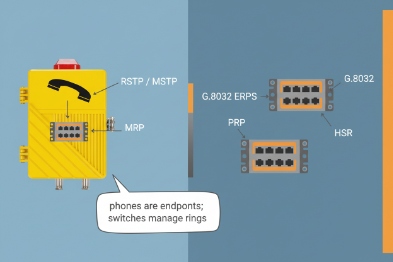
How these protocols usually show up in real projects
G.8032 ERPS
ERPS 2 is built for Ethernet rings and is popular in industrial switching. It can deliver fast recovery when configured correctly. In most deployments, ERPS runs on the switches. The phone does not need to run ERPS. The phone just needs stable link behavior and correct QoS markings.
RSTP/MSTP
RSTP is widely supported and easy to deploy. MSTP is used when multiple VLAN trees are needed. The tradeoff is convergence speed and complexity. In some plant networks, RSTP is “good enough” for voice when the topology is not large and priorities are set correctly.
MRP
MRP 3 is common in industrial automation circles. It can be used in rings built around certain vendor ecosystems. It is mainly a switch and controller story. SIP phones rarely need to speak MRP unless the phone is also acting as a managed ring node, which is uncommon.
PRP/HSR
PRP and HSR are used where “zero switchover” behavior is demanded. They often appear in IEC 61850 style networks. These methods require special endpoint capabilities or special network cards. Most Ex telephones are not built for PRP/HSR as an endpoint feature. In practice, a site that uses PRP/HSR still records voice at an SBC or gateway, and endpoints connect through the site’s network design rather than implementing PRP inside the phone.
What to request from a vendor and from a switch supplier
A practical request is:
-
ring protocol supported by the switches in the cabinet
-
measured reconvergence time under single link cut
-
voice call retention test during a cut
-
multicast behavior during ring healing
| Protocol | Typical owner | Common recovery target | Best fit areas | Notes for Ex voice |
|---|---|---|---|---|
| G.8032 ERPS | Switch | Sub-50 ms to low hundreds ms | Plant rings and fiber rings | Strong choice for industrial rings |
| RSTP | Switch | Hundreds ms to seconds (topology dependent) | Simple rings and mixed networks | Needs careful tuning for voice |
| MSTP | Switch | Similar to RSTP, depends on design | Multi-VLAN tree design | Adds planning complexity |
| MRP | Switch/controller | Fast in its ecosystem | Automation cells | Less common for VoIP rings |
| PRP/HSR | Endpoint + network | Near-zero | High-reliability power networks | Rare for SIP endpoints |
For hazardous sites, the simplest success path is often ERPS on industrial switches, then SIP phones on access ports with strict QoS. That keeps the ring fast and keeps endpoints simple.
Next, the dual LAN question must be answered clearly, because many buyers confuse “two ports” with “two independent network paths.”
How is dual LAN configured—active/standby NICs, LACP bonding, or hardware bypass for sub-50 ms switchover?
Many teams expect “dual LAN” to behave like a server NIC team. Then the phones are installed and failover takes seconds, not milliseconds.
Dual LAN on explosion-proof telephones is commonly one of three designs: a two-port internal switch for daisy-chain, an active/standby uplink failover mode, or a hardware bypass that keeps the ring path closed when the phone loses power. LACP bonding is rare on SIP endpoints and is more common on switches and servers.
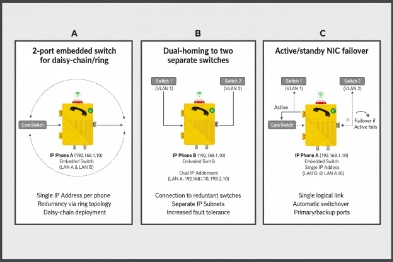
Active/standby uplinks: what “real redundancy” looks like
In an active/standby design, the phone can prefer Port A and switch to Port B when link is lost. This often protects against one cable cut. Still, the failover time can include:
-
link down detection
-
ARP refresh
-
DHCP or IP stack update if not static
-
SIP re-registration timing
This can be fast or it can be slow. The key is to request the behavior in seconds and to test it.
Two-port internal switch: good for wiring, not always for redundancy
Some phones provide two ports as a small unmanaged switch. This supports:
-
line topology wiring
-
fewer home runs
-
easier installs in pipe racks
Still, this does not automatically mean the phone can fail over between two upstream networks. It often just bridges traffic. Redundancy then depends on the upstream ring protocol, not on the phone itself.
Hardware bypass: a useful feature in daisy-chain rings
Hardware bypass 4 is a relay-style path that keeps Ethernet continuity when the phone loses power or fails. This is valuable for rings built through endpoints because one dead endpoint should not break the ring. The bypass design must be stated clearly:
-
bypass behavior when power is off
-
bypass behavior when the phone is in boot
-
impact on PoE and link negotiation
LACP bonding: why it is uncommon on endpoints
LACP is great for throughput and link resilience in network devices. Most SIP endpoints do not need it. Also, LACP can create complex failure cases if the endpoint implementation is not strong. For voice reliability, it is usually better to use simple access uplinks and let the switch ring provide path redundancy.
| Dual LAN mode | What it protects | Typical switchover behavior | Best fit use case | What to verify |
|---|---|---|---|---|
| Active/standby | One uplink failure | Often sub-seconds to a few seconds | Critical phones with two feeds | SIP re-register time and call drop behavior |
| Internal switch | Simplifies wiring | No endpoint failover concept | Daisy-chain installs | Loop risk and ring protocol design |
| Hardware bypass | Ring continuity if endpoint dies | Immediate physical pass-through | Endpoint-in-ring designs | Bypass works when power is off |
| LACP bonding | Link capacity + resilience | Depends on partner switch | Rare for phones | Vendor proof and interoperability |
If the project demands sub-50 ms behavior, it is usually achieved by the ring protocol on switches, not by endpoint uplink failover. The phone still matters because it must tolerate a short burst of loss and jitter.
Next, the ring is only as strong as the switch and fiber design. Hazardous sites also demand extended temperature and reliability.
What switch and fiber specs are required—industrial L2/L3, SFP modules, single-mode rings, and extended-temperature ratings?
A ring is not “just fiber.” The switch choices decide recovery time, survivability, and maintenance effort.
Hazardous-site voice rings typically use industrial L2/L3 switches with ERPS or tuned STP, SFP/SFP+ optics, and single-mode fiber for long pipe rack routes. The switches often need extended-temperature ratings, redundant power inputs, and strong EMC and surge protection practices in outdoor cabinets.
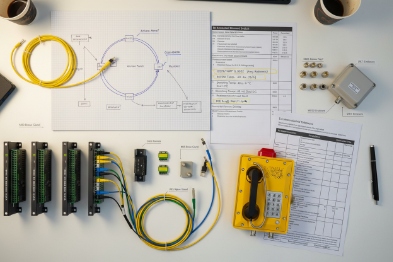
Industrial switch features that matter for voice
For ring redundancy with VoIP endpoints, the switch should support:
-
the chosen ring protocol (ERPS, RSTP, MSTP, or MRP)
-
fast failure detection methods
-
QoS with strict priority queues
-
VLAN tagging and per-port voice VLAN handling
-
IGMP snooping 5 and querier support for multicast paging
If the network is routed, L3 functions can help with segmentation. Still, many voice rings remain L2 at the edge with controlled trunks.
Fiber design: single-mode is common in large sites
Refineries and terminals often have long distances. Single-mode fiber 6 is often chosen because it supports longer runs and stable margins. In ports and offshore modules, fiber also reduces surge paths compared to long copper runs.
SFP modules should be selected for:
-
correct wavelength and distance budget
-
temperature rating that matches the cabinet
-
proper connector type and cable management plan
Environmental and power specs for cabinets
Outdoor cabinets see heat, cold, salt fog, and vibration. A switch spec should match that reality:
-
-40 to +75°C class or a suitable range for the site
-
dual DC inputs or redundant PSU options
-
alarm outputs for power loss and link loss
-
surge protection and proper bonding
In hazardous area practice, active switches are often placed in safe areas or in certified enclosures. That decision belongs to the site safety plan and the area classification 7 drawing.
| Spec item | Practical target | Why it matters for voice rings |
|---|---|---|
| Switch class | Industrial managed L2/L3 | Stable reconvergence and QoS |
| Ring support | ERPS or tuned RSTP/MSTP | Faster recovery after a cut |
| Optics | SFP for single-mode OS2 | Long runs and stable margin |
| Temperature | Extended range | Prevents summer reboot cycles |
| Power | Redundant inputs + UPS | Keeps phones alive during dips |
| Monitoring | SNMP/syslog + alarms | Fast fault isolation |
A strong switch and fiber plan reduces the need for “special phones.” The phone can be a standard SIP endpoint, and the network carries the redundancy. That is usually the most stable approach for multi-vendor projects.
Next, the hardest part is voice quality during reconvergence. A ring can recover fast, but packets can still drop during the change. QoS and multicast design decide whether users notice.
How are QoS, VLANs, and multicast maintained—voice priority, IGMP snooping, and jitter buffering during ring re-convergence?
Voice does not fail politely. It fails as clipped audio, one-way speech, and dropped calls. These are the failures that make operators stop trusting the system.
To keep QoS, VLANs, and multicast stable during ring reconvergence, switches must enforce voice priority (DSCP and queue mapping), keep VLAN trunks consistent, and control multicast with IGMP snooping and a stable querier. Phones also need jitter buffering that can absorb short bursts of delay and loss during a cutover.
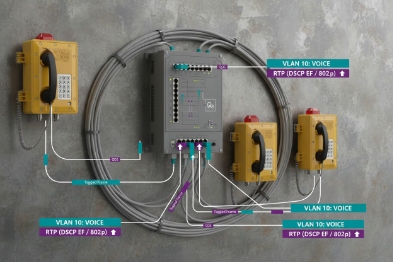
QoS: treat RTP like a safety service
Voice RTP should be prioritized end-to-end:
-
mark RTP with a high-priority DSCP value 8
-
map that DSCP into strict priority queues on switches
-
protect the uplinks so data bursts do not starve voice
In plant networks, CCTV and backups can create spikes. During ring reconvergence, the network can also flush MAC tables and create short microbursts. Strict voice priority prevents those bursts from turning into audible gaps.
VLANs: keep trunks consistent across the ring
Many voice issues in rings are caused by VLAN mismatches:
-
one trunk misses the voice VLAN
-
one port tags and the other expects untagged
-
MSTP instances do not match the VLAN layout
A simple rule is helpful:
-
define a voice VLAN and keep it consistent on every trunk
-
define a management VLAN and keep it consistent
-
document allowed VLAN lists and apply them as templates
Multicast: paging and alarms need control
Multicast paging is common in PAGA 9-style deployments. Without IGMP snooping, multicast floods the ring and competes with voice. During reconvergence, multicast flooding can spike even more.
A stable multicast plan includes:
-
IGMP snooping enabled
-
a clear IGMP querier in each VLAN that uses multicast
-
fast leave where appropriate
-
rate limiting for unknown multicast to avoid storms
Endpoint jitter buffering: the last line of defense
Even with a strong network, a ring cut can cause a brief delay change. Phones with adaptive jitter buffers 10 handle this better. The acceptance target should be realistic:
-
short burst of loss is acceptable if the call stays up
-
quick audio recovery is required
-
SIP registration should remain stable after reconvergence
| Control area | Switch setting | Phone behavior to expect | Acceptance test idea |
|---|---|---|---|
| Voice priority | DSCP mapping + strict queue | Minimal clipping during cut | Place a call, cut one link, listen for drop |
| VLAN stability | Consistent trunk VLAN lists | No re-registration storm | Cut and restore, verify no mass reboot |
| Multicast paging | IGMP snooping + querier | Paging works without flooding | Start paging, cut link, confirm paging continues |
| Jitter handling | Buffer not a switch setting | Audio recovers fast | Measure MOS or packet loss during cutover |
A practical commissioning method is simple. Run a live call. Cut a ring link. Restore it. Repeat it at different ring points. Then run multicast paging during the cut. This shows the real behavior, not only what the switch datasheet promises.
When these controls are in place, ring redundancy becomes a real safety benefit. It is not only an IT diagram. It is a tested behavior that operators can trust.
Conclusion
Explosion-proof SIP telephones can run on redundant rings when switches handle fast reconvergence, dual LAN behavior is clear, and QoS, VLANs, and multicast are engineered for voice stability.
Footnotes
-
[Protocol designed to prevent loops in Ethernet ring topologies and provide fast recovery.] ↩
-
[ITU-T standard defining Ethernet Ring Protection Switching for high availability.] ↩
-
[Media Redundancy Protocol used in industrial automation for ring network redundancy.] ↩
-
[Feature allowing network traffic to bypass a failed device to maintain connectivity.] ↩
-
[Switch feature that directs multicast traffic only to ports that request it, reducing congestion.] ↩
-
[Optical fiber designed to carry a single mode of light, ideal for long-distance transmission.] ↩
-
[Process of categorizing hazardous areas based on the likelihood of explosive atmospheres.] ↩
-
[Differentiated Services Code Point used to classify and prioritize network traffic for QoS.] ↩
-
[Public Address and General Alarm systems integrating voice and alarm functions in industrial plants.] ↩
-
[Buffer used to smooth out variations in packet arrival times in VoIP communications.] ↩








