
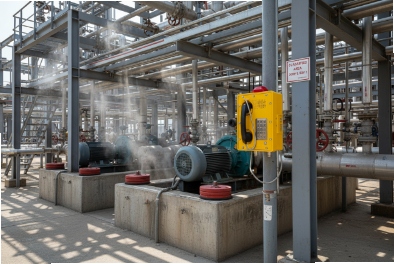
Refinery units get noisy, wet, and dangerous fast. A normal SIP phone can fail in steam washdowns, and it can be rejected in classified areas.
Yes. Explosion-proof SIP telephones are a strong fit for refinery processing units when the Ex rating matches the area classification, the enclosure survives washdowns and hydrocarbons, and the device integrates with PBX, PAGA, and safety signals.
A refinery-ready selection checklist that avoids site rejections
Start with the unit hazard reality, not the product brochure
A refinery is not one hazard. A crude unit, FCC, and hydrotreater can sit side by side, yet the gas group and temperature limits can differ. The safest buying habit is to map each phone location to the site’s hazardous area classification drawing and the area equipment schedule. That drawing decides Zone 1/2 or Class/Div, gas group, and temperature class.
Another field detail matters. Many phones are mounted near:
-
pump seals and sample points
-
analyzer shelters and local panels
-
heater platforms and furnace areas
-
unit battery limits where steam washdown is frequent
So the selection must cover both explosion risk and daily environmental stress.
Treat Ex compliance as a “system” that includes glands and bonding
Even the best Ex phone can fail inspection if the wrong gland is used or if the cable entry is not sealed correctly. In my projects, most compliance issues come from installation details:
-
incorrect Ex d gland type for cable construction
-
missing barrier sealing where required by the certificate and gas group
-
poor bonding to the equipotential network
-
wrong Ta range when the phone sits in sun or near hot equipment
A refinery selection should always include the phone plus the certified entry system and a clear mounting method.
Use a simple table to match unit areas to device ratings
| Refinery area | Typical classification approach | Practical Ex target for the phone | Notes that often get missed |
|---|---|---|---|
| Crude / CDU pump pads | Zone 1/2 depending on ventilation | Zone 1 Gb preferred at pump pads | Washdown, hydrocarbons on seals |
| FCC unit | Zone 2 common, Zone 1 near releases | Zone 2 Gc or Zone 1 Gb by location | Dust and catalyst fines can matter |
| Hydrotreater / H2 areas | Often more stringent gas hazards | IIC-capable device is the safer default | Hydrogen drives gas group choice |
| Heater platforms | Hot surfaces and radiant heat | Correct T-class + Ta margin | Keep distance from hot surfaces |
Build for uptime, not only for approval
Refinery phones fail from:
-
water ingress at cable glands
-
corrosion at fasteners and brackets
-
keypad and hookswitch wear in gloves
-
surge events on long outdoor cables
So the best solution is a balanced design: Ex rating + IP sealing + corrosion control + network policy.
If the device passes the classification and survives daily abuse, the next question becomes which certifications fit crude, FCC, and hydrotreater zones.
Keep reading because the “right Ex marking” is not one line. It is a full sentence on the nameplate.
Which ATEX/IECEx or NEC Class I Div 1/2 ratings fit crude, FCC, and hydrotreater areas?
Wrong zone rating is the fastest way to fail a refinery inspection. One phone installed in the wrong location can delay handover.
For crude, FCC, and hydrotreater areas, the safe path is to match the device to the local area classification and the worst credible gas group at the mounting point.
Zone vs Class/Div: choose the scheme your site enforces
Refineries outside North America often use ATEX/IECEx Zone classification. Many US and Canadian sites use NEC/CEC Class/Div. Some multinational owners accept Zone equipment with the right approvals, but many still require a recognized local listing. A purchase spec should reflect the site standard, not the EPC preference.
Practical rating guidance by unit type
Crude and FCC areas 2 often involve hydrocarbon vapors. These are commonly covered by gas group IIB or Class I Group D (gasoline-like vapors) depending on the scheme. Hydrotreaters introduce hydrogen risk. Hydrogen pushes toward IIC (Zone) or Group B (Class/Div).
A practical way to avoid under-rating is:
-
Use Zone 1 (EPL Gb) for pump pads, manifolds, and high-activity work areas.
-
Use Zone 2 (EPL Gc) for well-ventilated areas with low release probability.
-
Use IIC capability where hydrogen is present or where the owner standard treats the unit as hydrogen-capable by default.
Example requirement lines that procurement teams understand
| Unit area | Zone-style requirement line | Class/Div-style requirement line |
|---|---|---|
| Crude unit process deck | II 2G, Zone 1, Ex db/eb, IIB, suitable Ta | Class I Div 1 Group D |
| FCC local stations | Zone 2 Gc (or Gb where needed), IIB | Class I Div 2 Group D |
| Hydrotreater H2 zones | Zone 1 Gb, IIC, correct T-class | Class I Div 1 Group B (plus D if specified) |
FCC catalyst handling and some solid additives can create dust exposure. If the hazard study identifies combustible dust, the selection can require Ex tb 3 for dust, plus the correct dust group and surface temperature. Many refinery phone locations are gas-only, but it is safer to confirm at battery limits, catalyst transfer points, and enclosed solids handling areas.
This is the part of the process where a vendor should provide certificates that clearly show:
-
Zone or Division coverage
-
gas group coverage (IIB vs IIC)
-
Ta ambient range
-
T-class limits
Next, the phone must survive real refinery cleaning and weather. The Ex certificate does not guarantee that.
Will IP66/67, 316L, UV/chem-resistant enclosures survive hydrocarbons and steam washdowns?
A refinery phone can be approved and still die from washdown. Steam cleaning, foam, and chemicals find the weakest seal and the weakest fastener.
IP66/67 and corrosion-resistant construction can survive refinery washdowns when glands, seals, and surface finishes are chosen for hydrocarbons, UV, and hot water exposure.
IP66 vs IP67 in refinery terms
-
IP66 protects against powerful water jets. This fits most steam washdown patterns when the cleaning is not direct high-pressure jet at close range for long duration.
-
IP67 adds short-term immersion protection. It is useful where low points flood, where rainwater pooling happens, or where hosing is aggressive.
Many refinery users select IP66 as the baseline and add IP67 for exposed locations with standing water risk. What matters more than the label is the assembled condition:
-
correct cable gland torque
-
sealed unused entries with certified plugs
-
gasket compression intact after maintenance
316L and coatings: choose the right “corrosion strategy”
316L 4 is a strong baseline for refineries near the coast and in chemical washdown zones. It also helps at fasteners and brackets, where rust staining becomes a maintenance complaint fast. Duplex steel can be used in some designs, but the biggest wins usually come from good sealing geometry and hardware consistency.
If the enclosure is aluminum, a marine-grade powder coat can work well, but the coating system must be controlled. Thin or poorly cured powder coat fails at edges and holes first. For refineries, the “weakest part” is often the bracket and the gland locknut, not the main body.
Seals and windows: the chemical reality
Hydrocarbons, ozone, and UV attack elastomers over time. A refinery-grade phone should use gaskets that keep compression and resist swelling. It should also protect the keypad and window materials from yellowing and cracking in sun.
A materials-and-exposure table for selection
| Exposure type | What fails first | Better material/design choice | What to verify during FAT |
|---|---|---|---|
| Steam washdown | glands and gaskets | IP66/67 + chemical-resistant gaskets | post-wash functional test |
| Hydrocarbon splash | elastomer swelling | gasket compatibility + sealed keymat | visual + seal compression check |
| Coastal salt fog | fasteners, brackets | 316L hardware + corrosion plan | salt fog report 5 + hardware spec |
| UV on pipe racks | plastics and seals | UV-stable keymat and gasket | UV test evidence or material spec |
When the phone can survive washdown and weather, the next value is integration. A refinery buys communication as part of a safety workflow, not only as a dial tone.
Can phones tie into IP PBX, PAGA, ESD, and gas detection networks?
A refinery phone should not live alone. It should fit the same operations flow as radios, PAGA, alarms, and control room dispatch.
Ex SIP telephones can integrate well with IP PBX and PAGA systems, and they can interface to ESD and gas detection through relays, inputs, and event gateways when the design is planned with VLANs and alarm priorities.
IP PBX integration: keep it simple and reliable
Most refinery deployments use SIP endpoints registered to:
-
an on-prem IP PBX
-
or an SBC at the boundary between OT and IT
Key PBX features that refinery teams value:
-
hotline and speed-dial keys for control room
-
priority call routing for emergency numbers
-
multicast paging groups for PAGA trigger paths
-
call recording and audit logs with NTP-aligned time
PAGA integration: voice priority and multicast discipline
PAGA paging often relies on multicast or paging servers. That means the network must enforce:
-
VLAN separation for voice
-
QoS markings for RTP and paging
-
IGMP snooping and a stable querier
Without IGMP control, paging traffic can flood a ring network and cause jitter during reconvergence. A refinery paging system should treat emergency paging as higher priority than routine announcements.
ESD and gas detection: use clean, auditable interfaces
Directly wiring safety loops into a phone is not the right model. The safer model is:
-
phone provides dry-contact outputs to trigger local strobes or paging inputs
-
phone provides dry-contact inputs for alarm triggers or status monitoring
-
PLC/RTU or gateway maps those events to SCADA tags and safety dashboards
Gas detection typically drives alarms and paging through the fire & gas system or PLC logic. Phones can still support the workflow by:
-
auto-dialing a dispatch group when an input triggers
-
lighting local indicators
-
triggering a PAGA paging input through a relay
A practical integration map
| System | Best integration method | What it enables | What to control |
|---|---|---|---|
| IP PBX | SIP + templates | calls, groups, emergency routing | SRTP policy, call priority |
| PAGA 6 | multicast paging or relay to controller | plant-wide alerts | QoS, IGMP, VLAN |
| ESD | relay interface to PLC input | event logging and escalation | latching rules, test mode |
| Gas detection | alarm input via PLC/gateway | auto-dial, beacon trigger | alarm priority, audit logs |
The more the phone participates in safety workflows, the more important installation compliance becomes. Near heaters, gland selection and T-class decisions decide whether the device remains compliant after commissioning.
What Ex d glands, seal fittings, grounding, and T-class ensure compliance near heaters?
A refinery can approve the phone model and still fail the installation. This happens most often at cable entry and temperature limits near hot equipment.
Compliance near heaters depends on using the correct certified Ex d gland system, applying the right sealing method, bonding the enclosure properly, and selecting a T-class that stays safe at the worst ambient temperature and radiant heat exposure.
Ex d glands: match cable type and certificate instructions
Ex d enclosures depend on correct flamepath integrity 7 and correct cable entry sealing. The selection must match:
-
armored vs unarmored cable
-
sheath construction and diameter
-
whether barrier sealing is required by the certificate and gas group
Barrier glands are often used to prevent gas migration through cable bedding. This becomes more important in higher gas groups and in certain installation practices. The purchase spec should require glands that are certified for the same Ex protection concept and suitable for the local standard.
Seal fittings and conduit practices in Class/Div sites
In Class/Div installations, conduit sealing 8 fittings and separation rules can apply, especially near boundary points and where gas migration in conduit is a concern. The right approach is always site-driven:
-
follow the refinery electrical standard
-
use listed fittings and correct compound
-
document the seal location and inspection method
Grounding and bonding: make equipotential bonding easy
A phone should have a clear earth point, and the installer should bond it to the refinery equipotential network 9 with a short, robust conductor. This reduces:
-
ESD issues
-
surge damage risk
-
unpredictable noise behavior on long outdoor cables
Bonding should also be maintained across brackets and hinges if the design uses them as conductive paths. A simple continuity check during commissioning prevents many future service calls.
T-class near heaters: temperature margin beats optimism
Near furnaces and heaters, radiant heat and high ambient can push the device surface temperature up. A good selection method is:
-
choose a T-class that matches the area requirement
-
confirm the device Ta range includes the highest realistic local temperature
-
place the phone where it is not exposed to direct radiant heat when possible
A phone that is compliant at Ta +40°C may become questionable when the local microclimate reaches higher values. A stronger Ta margin reduces risk.
Installation checklist table for inspectors
| Item | What “good” looks like | What inspectors look for |
|---|---|---|
| Gland selection | certified Ex gland, correct type for cable | certificate match and torque marks |
| Sealing | barrier compound where required | no voids, correct cure, correct location |
| Unused entries | certified plugs | no open holes, correct threads |
| Bonding | clear earth stud + short bond | continuity and corrosion control |
| T-class 10/Ta | matches area schedule and local heat | nameplate matches location |
In refinery processing units, the fastest path to approval is a package approach: device certificate + correct glands + clear installation instructions + commissioning test records.
Conclusion
Explosion-proof SIP telephones fit refinery processing units when zone/class ratings match each location, IP66/67 and 316L survive washdown, and integration plus correct Ex d installation keeps compliance near heaters.
Footnotes
-
[Protocol used by switches to control multicast group membership and optimize traffic flow.] ↩
-
[Fluid Catalytic Cracking unit, a key refinery process for converting heavy oils into gasoline.] ↩
-
[Protection method preventing dust ingress and limiting surface temperature to avoid ignition.] ↩
-
[Low-carbon austenitic stainless steel offering superior corrosion resistance for harsh environments.] ↩
-
[Standard practice for operating salt spray (fog) apparatus to test corrosion resistance.] ↩
-
[Public Address and General Alarm systems integrating voice and alarm functions for safety.] ↩
-
[Critical gaps in Ex d enclosures designed to cool escaping gases and prevent external ignition.] ↩
-
[Fittings used to seal conduits entering explosion-proof enclosures to prevent gas migration.] ↩
-
[System connecting all metallic components to earth to prevent potential differences and sparks.] ↩
-
[Classification system defining the maximum surface temperature of equipment to prevent ignition.] ↩








