

LPG stations 1 move flammable gas every day. A normal phone can be rejected by inspectors, and a failed phone can delay an emergency response when a leak happens.
Yes. Explosion-proof SIP telephones are suitable for LPG filling stations when the device is certified for the station’s Zone 1/2 or Class I Div 1/2 areas, matches gas group needs for propane/butane, and is installed with certified glands, seals, and bonding.

LPG station reality: what the phone must handle
LPG sites have predictable hazard points
Unlike a large refinery, an LPG filling station has a few clear risk zones:
-
around dispensers and filling points
-
near storage tanks, vents, and pump/compressor skids
-
at truck loading/unloading points
-
in enclosed cabinets where gas can accumulate if ventilation is poor
The hazard study defines Zone 1 2 or Zone 2 (or Class/Div). The phone must match that classification, and it must remain sealed and functional after rain, washdown, and daily use with gloves.
The best safety phone design is simple and fast to restore
Most LPG sites do not have big maintenance teams. So MTTR depends on:
-
clear diagnostics (PBX 4 registration alarms, SNMP/syslog if needed)
-
simple wiring and safe cable entry
-
spare handset/cord kits for fast field repair
What “suitable” means at an LPG station
A suitable Ex SIP 5 phone should:
-
be approved for the classified area at the mounting point
-
withstand rain, dust, UV, and cleaning
-
provide loud alerting and optional beacons
-
integrate with PBX and local alarm triggers without complex wiring
-
be easy to test during commissioning and inspections
| LPG station need | What to prioritize | Why it matters |
|---|---|---|
| Classified area compliance | Zone/Class-Div + gas group + T-class | inspector acceptance |
| Outdoor durability | IP66/67 + UV-stable seals | keeps uptime in weather |
| Fast emergency response | hotline keys + loud ringer + strobe | reduces response delay |
| Integration | relay I/O + PBX routing | ties to alarms and ESD workflow |
| Safe installation | certified glands + bonding + seals | avoids rejections and failures |
With that baseline set, the next question is the one inspectors ask first: what rating is required for propane and butane locations?
Which Zone 1/2 or Class I Div 1/2, Gas Group IIA/IIB ratings are required?
LPG is mostly propane and butane. These gases are not the most demanding group like hydrogen, but they are still hazardous and need proper approval. The classification also depends on ventilation and activity at the point.
Many LPG dispenser and filling areas are treated as Zone 1 or Zone 2 depending on local code and station design. In Class/Div schemes, these are commonly Class I Div 1 near active release points and Div 2 in surrounding areas. Propane and butane typically fall under IIA or IIB in the Zone gas group framework, but the exact requirement must follow the station’s hazardous area classification and local standards.

Practical selection guidance that avoids under-rating
A safe procurement approach is:
-
Use Zone 1 (EPL Gb) equipment for dispensers, filling points, and tank manifold areas where gas release is possible during normal operation.
-
Use Zone 2 (EPL Gc) equipment for areas where gas is not expected in normal operation, but could appear if there is a fault.
-
Standardize on the stricter rating where the owner wants fewer SKUs and fewer placement mistakes.
For North America style:
-
Class I Div 1 is often used right at the source of potential release.
-
Class I Div 2 is often used around it.
Gas group IIA vs IIB: what it means for LPG
IIA and IIB are both common in fuel facilities. The station classification and owner standard decide what to require. Many buyers prefer to specify IIB capability as a comfortable baseline because it provides more coverage than IIA. If the phone is IIB, it generally covers IIA gas group needs, while still being practical in cost and availability.
A clear spec table for tender writing
| LPG location | Typical classification direction | Safer device requirement |
|---|---|---|
| Dispenser island | higher probability release | Zone 1 Gb, IIB (or site required group), correct T-class |
| Tank top / vent area | possible release | Zone 1/2 per study, IIB baseline |
| Perimeter and office wall | lower probability release | Zone 2 Gc or safe-area rugged phone |
| Truck loading | active connection/disconnection | Zone 1 Gb preferred at connection points |
The device certificate and nameplate must match these requirements line by line. If the project uses ATEX 6/IECEx 7, the marking must show protection type, gas group, T-class, EPL, and ambient range.
Once the Ex rating is correct, the next question is durability. LPG stations are outdoors and often cleaned. IP and material choice decide whether the phone stays sealed.
Will IP66/67 flameproof enclosures tolerate propane/butane and outdoor weather?
A phone can be Ex-rated and still fail from water ingress, UV aging, or chemical swelling. LPG sites do not have gentle indoor conditions.
Yes. IP66/67 flameproof enclosures can tolerate LPG environments when gaskets and cable entries resist hydrocarbons and when the enclosure materials and coatings are designed for UV and outdoor exposure. The installed condition matters as much as the product design.

IP66 vs IP67 for LPG stations
-
IP66 is usually enough for rain, hose-down, and water jets.
-
IP67 is helpful where pooling water or temporary immersion can happen, such as low mounting points or poor drainage areas.
If the station uses aggressive cleaning, IP66 with the correct gland system is often the baseline. IP67 adds a margin for unexpected pooling and storm conditions.
Hydrocarbon tolerance: focus on seals and keypad parts
Propane and butane are hydrocarbons. The enclosure metal usually survives, but seals and keypad materials can degrade if they are not chosen well. A refinery-grade approach works here too:
-
chemical-resistant gaskets
-
UV-stable elastomers for outdoor sun
-
stable labels and windows that do not crack or peel
Material and hardware choices that matter outdoors
A good outdoor LPG phone should include:
-
corrosion-resistant housing (316L or proven coated metal system)
-
stainless fasteners and brackets
-
correct drain and sealing geometry so water does not sit at seams
-
anti-galling practice for stainless threads
| Outdoor stress | Weak point | Better choice |
|---|---|---|
| Rain and washdown | glands and gaskets | certified glands + correct torque + IP test evidence |
| UV exposure | keypad and seals | UV-stable materials and coatings |
| Corrosion | hardware and brackets | stainless hardware + corrosion plan |
| Temperature swings | gasket compression | low compression-set gasket materials |
With durability covered, the next question is function. LPG sites often want the phone tied into emergency shutdown and alarm signaling near dispensers.
Can phones integrate with IP PBX, ESD, beacons, and gas detectors at dispensers?
A phone at a dispenser is often part of a safety workflow. It should call the right people fast and trigger visible indicators.
Yes. Ex SIP telephones can integrate with IP PBX for hotline and emergency routing, and they can link to ESD and gas detection workflows through dry-contact I/O, relay triggers for beacons, and event mapping through PLCs or gateways.
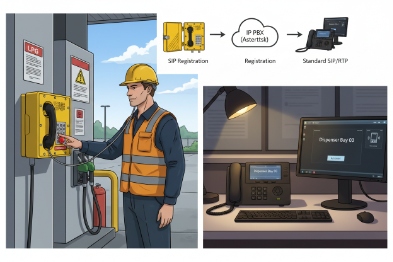
IP PBX integration that fits LPG operations
Useful PBX features for LPG stations:
-
hotline call to control room or central dispatch
-
speed dial to station supervisor and maintenance
-
priority call routing for emergency calls
-
call recording for incident review if required
-
NTP-synced logs to match alarm timelines
For small station networks, a hosted PBX can work. For high-safety sites, an on-prem PBX or SBC in a secure cabinet is often preferred.
Beacons and strobes: use relays in a controlled way
Phones can drive:
-
local beacons
-
strobes over the dispenser island
-
horn triggers (through a controller)
Best practice is to use the phone relay to trigger a control input or an interposing relay rather than driving high-current loads directly.
ESD and gas detection: keep life-safety logic in the safety system
ESD and gas detection systems should control shutdown logic. The phone should support the workflow, not replace it. A stable integration pattern is:
-
gas detector triggers alarm in the safety system
-
safety system triggers beacon and PAGA
-
phone receives an input trigger for auto-dial or local alarm indicator
-
phone can send “emergency active” status back via a relay to a PLC input
| System | Best interface | Purpose | Key note |
|---|---|---|---|
| PBX | SIP | emergency calls and routing | keep priority and failover rules |
| Beacon/strobe | phone relay to controller input | visual attention | confirm relay rating and wiring |
| ESD | PLC/safety system logic | safe shutdown | do not wire safety loop through phone |
| Gas detector | safety system + phone input trigger | escalation call | test latching and reset rules |
Now, none of these integrations will survive inspection if installation details are wrong. The last question is about conduit seals, bonding, and T-class choices.
What conduit seals, bonding, and T-class selections ensure safe installation?
Most “Ex phone problems” at LPG stations come from installation errors. Inspectors check glands, seals, and bonding first because those are the common failure points.
Safe installation uses certified Ex glands or conduit seals as required by the site scheme, strong equipotential bonding, and a T-class that remains compliant at the worst local ambient temperature and near any hot equipment.

Conduit seals and cable entry: match the local scheme
For Zone-style installations (ATEX/IECEx), cable entry is usually via certified glands. For Class/Div installations, conduit systems often require sealing fittings in defined locations to prevent gas migration through conduits. The correct method depends on:
-
local electrical code requirements
-
station engineering standard
-
the phone certificate installation instructions
A practical rule:
-
never mix “general industrial” glands with Ex enclosures
-
always match the gland to cable type and size
-
seal unused entries with certified plugs
-
apply barrier seals where required by the certificate and gas group
Bonding: keep the enclosure at the same potential
Bonding reduces:
-
static issues and ESD faults
-
surge damage risk
-
unpredictable noise behavior
A good station install uses:
-
a short bonding conductor from the phone earth stud to the equipotential network
-
corrosion-resistant bonding hardware
-
a continuity check recorded during commissioning
T-class: keep margin for sun and hot equipment
LPG stations can have hot surfaces near compressors and piping. Even a phone mounted in sun can see high surface temperatures. The selected device must satisfy:
-
required temperature class (gas) or max surface temperature
-
ambient range (Ta) that includes summer peak
A conservative move is to choose a wider Ta range and avoid mounting directly near hot equipment when possible.
Installation checklist table
| Installation item | What to do | What it prevents |
|---|---|---|
| Cable entry | certified gland matched to cable | water ingress and compliance failure |
| Conduit sealing | use required sealing fittings | gas migration through conduit |
| Bonding | short bond to equipotential bar | ESD issues and surge damage |
| T-class/Ta | verify nameplate vs location | non-compliance near hot points |
| Commissioning test | call test + alarm relay test | hidden faults before handover |
When these steps are followed, Ex SIP phones become a reliable safety tool at LPG dispensers and loading areas, not a constant maintenance problem.
Conclusion
Explosion-proof 8 SIP telephones suit LPG filling stations when Zone/Class-Div ratings match dispenser hazards, IP66/67 construction survives outdoors, integrations use clean relay/PLC interfaces, and glands, seals, bonding, and T-class are installed exactly to code.
Footnotes
-
LPG stations: Facilities for storing and dispensing Liquefied Petroleum Gas suitable for vehicles and cylinders. ↩
-
Zone 1: Area classification where explosive gas atmosphere is likely to occur in normal operation. ↩
-
IP66: International standard rating indicating a device is dust-tight and resistant to powerful water jets. ↩
-
PBX: Private Branch Exchange, a telephone network used within a company or organization. ↩
-
SIP: Signaling protocol used for initiating, maintaining, and terminating real-time voice and video sessions. ↩
-
ATEX: The EU directive certifying equipment intended for use in explosive atmospheres. ↩
-
IECEx: International certification system ensuring equipment meets standards for use in explosive atmospheres. ↩
-
Explosion-proof: Enclosure design capable of withstanding an internal explosion without igniting the surrounding atmosphere. ↩








