

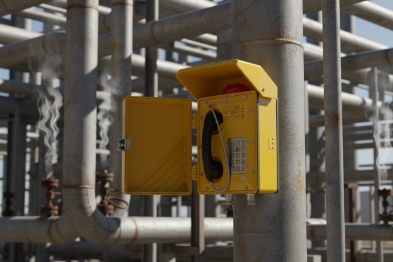
Pipe racks 1 look like simple structures. In reality, they are long ignition corridors with sun, vibration, and mixed utilities. When something goes wrong, crews need a working phone at the landing, not a device that fails in heat or gets rejected by inspectors.
Yes. Explosion-proof SIP telephones are suitable for pipe-rack corridor projects when the hazardous-zone rating matches the multi-product risk, the enclosure withstands UV and weather, and the installation follows segregation, bonding, and cable-tray rules for mixed utilities.

Pipe racks demand “corridor-grade” design, not only Ex approval
Pipe racks behave like long, open hazardous pathways
A pipe rack corridor is often the connective tissue between units:
-
crude and product lines
-
hydrogen, fuel gas, and flare headers
-
chemical dosing lines
-
steam, nitrogen, and instrument air
-
cable trays 2 for power and control
This mix creates two challenges for telephones:
1) Hazard classification can change along the corridor based on what lines run above and how releases can disperse.
2) Environmental stress is constant: sun, wind-driven dust, and vibration from pumps, compressors, and thermal expansion.
A phone that is “fine” in a sheltered process area can fail on a pipe rack because UV and heat are higher and access for repair is harder.
Most failures come from installation details
In corridor projects, the common failure points are:
-
cable gland leaks after thermal cycling
-
poor bonding that increases ESD and surge failures
-
wrong zone selection at the boundary between units
-
multicast paging issues due to shared network trunks
So the best tender spec treats the phone as part of a corridor safety system:
-
correct Ex rating and marking for the corridor segment
-
IP66/67 sealing with the exact gland system
-
UV-stable materials and corrosion strategy for brackets and fasteners
-
network design that protects voice during paging and reconvergence
-
clear segregation and bonding rules in tray routing
A practical “pipe-rack phone” requirement snapshot
| Corridor risk | What to specify | Why it matters |
|---|---|---|
| Zone variability | Zone 1/2 or Class/Div per segment | avoids wrong device in wrong bay |
| Sun and dust | IP66/67 + UV-stable seals | prevents seal hardening and ingress |
| Vibration and movement | rigid bracket + locking hardware | stops loosening and leaks |
| Mixed utilities | tray segregation + bonding discipline | reduces noise and inspection issues |
| Emergency workflow | PBX 3 + PAGA + E-stop interfaces | supports response at landings |
Now, the most important question is classification. A pipe rack may run through multiple risk regimes. The phone rating must match the most demanding credible hazard at its mounting point.
Which hazardous-zone ratings apply along multi-product pipe racks?
Corridors often carry multiple products. The hazard is not only “what is in the nearest line.” It is also what can be released and how it can disperse along the rack.
Hazardous-zone ratings along multi-product pipe racks depend on the site’s area classification study, but many pipe racks are treated as Zone 2 (or Class I Div 2) by default, with stricter zones (Zone 1 or Div 1) near known release sources such as valve manifolds, sampling points, relief devices, pump/compressor interfaces, and battery-limit tie-ins.

Why “mostly Zone 2” still needs careful placement
Many corridor designs assume good ventilation and open air, which supports Zone 2 or Div 2 classifications. Still, pipe racks include local features that increase release likelihood:
-
drain/vent headers and drip pots
-
block valve stations and pig launcher tie-ins
-
flanges at frequent maintenance points
-
unit tie-ins at battery limits
Phones mounted at landings near these features may need Zone 1 (Gb) rather than Zone 2 (Gc). The final answer must come from the hazardous area classification 4 drawing for each bay.
A practical approach: corridor tiers
Instead of guessing per meter, corridor projects often use a tier approach:
-
Tier A bays: near tie-ins, manifolds, or frequent operations → choose Zone 1/Div 1 capable phones.
-
Tier B bays: transit sections with low release likelihood → Zone 2/Div 2 phones may be acceptable.
-
Tier C areas: safe area corridors → rugged non-Ex phones may be allowed.
This makes procurement and installation easier while still respecting the hazard study.
Gas group and T-class considerations in corridors
Multi-product racks can include:
-
hydrogen or fuel gas headers
-
hydrocarbon products
-
solvents or specialty chemicals
So owners often standardize a conservative gas group rating to reduce wrong placement risk. T-class also matters because pipe racks can be hot:
-
sun heats metal
-
nearby hot lines radiate heat
-
wind changes cooling
A correct selection includes:
-
gas group coverage that matches the corridor standard
-
T-class and Ta range that remain compliant in summer peaks
| Pipe-rack segment | Typical classification tendency | Safer device choice |
|---|---|---|
| Transit rack sections | often Zone 2 / Div 2 | Zone 2 Gc with strong Ta margin |
| Near valve stations/tie-ins | may be Zone 1 / Div 1 | Zone 1 Gb preferred |
| Near hot process lines | temperature stress | correct T-class + wide Ta |
| Battery limits between units | variable | standardize on stricter rating |
Once the hazardous-zone rating is matched, the next question is durability. Pipe racks are exposed and often harder to service than ground-level stations.
Do IP66/67, UV-resistant enclosures withstand sun, dust, and vibration?
Pipe racks combine three slow killers: UV, dust, and vibration. These stresses do not show up in a short factory test if the system is not designed for them.
Yes. IP66/IP67 sealing and UV-resistant enclosures can withstand pipe-rack exposure when the materials are UV-stable, the glands and seals are installed correctly, and the mounting design resists vibration and thermal movement.
Sun and UV: protect elastomers and label systems
UV affects:
-
keypad and label films
-
gasket elasticity
-
cable jackets
A corridor-grade phone should use UV-stable materials and avoid unprotected plastics that yellow or crack. Coatings should resist chalking and maintain adhesion at edges.
Dust and wind: the importance of sealing geometry
Dust is not only cosmetic. It enters through:
-
poorly seated gaskets
-
cable glands sized wrong for the cable OD
-
unused entries without certified plugs
IP66 5 is a strong baseline for dust and jets. IP67 adds a safety margin for pooling water, which can happen on platforms and landings after storms.
Vibration and thermal expansion: mount and cable support matter
Pipe racks move. Thermal expansion can pull on cables and brackets. Vibration can loosen screws over time. A stable design uses:
-
316L brackets where corrosion and strength matter
-
M8/M10 bolts sized for the structure
-
locking washers or approved locking methods
-
strain relief and cable support within the last meter to the phone
| Stress type | Weak point | Better requirement |
|---|---|---|
| UV and heat | seals and keymat | UV-stable gasket and keypad materials |
| Dust storms | entry points | IP66/67 with correct glands |
| Vibration | bracket and fasteners | rigid bracket + locking method |
| Thermal movement | cable pull | cable support + slack loop plan |
If the phone can survive these stresses, it becomes a reliable corridor safety node. Next, it must tie into the communications and emergency workflow: PBX, PAGA, and emergency stop loops at landings.
Can units tie into IP PBX, PAGA, and emergency stop loops at landings?
Pipe-rack landings often become emergency gathering and control points. A phone there should not only call. It should help trigger alarms and coordinate response.
Yes. Explosion-proof SIP telephones can register to an IP PBX for hotline and group calling, integrate with PAGA via multicast paging or controller triggers, and interface with emergency stop workflows through dry-contact I/O into PLC or safety logic—without placing the phone inside the actual E-stop safety loop.

PBX integration: prioritize emergency calling
A corridor phone often needs:
-
one-touch call to control room
-
group call to emergency response team
-
clear visual call status feedback
-
stable operation on redundant network paths
Provisioning templates also help. If a unit is swapped, it can re-enroll and become operational quickly.
PAGA integration: keep multicast under control
PAGA 6 and paging are common along pipe racks because noise is high and visibility is limited. Two stable methods:
-
multicast paging with VLAN/QoS and IGMP snooping
-
relay trigger to a local paging controller input for predefined tones
The relay trigger method is often preferred for critical alarm tones because it is predictable and not sensitive to multicast flooding.
Emergency stop loops: keep safety integrity
Emergency stop 7 loops are safety functions. The phone should not be wired in series with E-stop circuits. The correct approach is:
-
E-stop remains a dedicated safety circuit
-
phone relay or input links to PLC 8/safety I/O only as a monitoring or trigger signal
-
PLC logic applies interlocks and logs events
This keeps the system auditable and compliant.
| Workflow | Interface | What it achieves | Key rule |
|---|---|---|---|
| Emergency calling | SIP 9 hotline | fast reach to control room | priority routing |
| Paging | multicast or relay trigger | wide-area alerts | QoS and IGMP discipline |
| E-stop status | PLC input | visibility and escalation | do not break safety loop |
| Beacon/strobe | relay output | guides responders | drive controller input |
Integration success depends on network and tray design. In corridor projects, cable routing is not a minor detail. Mixed utilities demand segregation and bonding discipline.
What cable trays, segregation, and bonding ensure safe multi-utility corridors?
In pipe-rack corridors, the biggest long-term issues are induced noise, surge damage, and inspection findings caused by poor segregation. Mixed utilities share space and create coupling.
Safe multi-utility corridors use segregated trays for power and communications, maintain separation distances per the site standard, bond trays and equipment to an equipotential network, and protect long cable routes with surge control and fiber backbones where possible.

Tray segregation: keep voice cables away from power
A common corridor rule:
-
keep Ethernet/voice in a dedicated tray or conduit path
-
keep it separated from high-power cables, VFD outputs, and motor feeders
-
cross power at 90 degrees when crossing is unavoidable
-
avoid sharing the same gland plate with high-power unless the standard allows and shielding is managed
This reduces induced noise and keeps EMC performance stable.
Bonding: treat the corridor as one equipotential structure
Bonding goals:
-
reduce ESD and static issues
-
provide a controlled surge path
-
stabilize shield termination behavior
Best practice includes:
-
bonding trays at intervals per site rule
-
bonding the phone bracket and enclosure to the local equipotential bar
-
using corrosion-resistant bonding hardware
-
measuring continuity during commissioning
Surge and lightning: fiber where it makes sense
Pipe racks are lightning targets. Long copper runs pick up induced surges. Strong designs use:
-
fiber ring backbone between cabinets and units
-
short copper drops to endpoints
-
PoE switches on UPS in local cabinets
-
Ethernet surge arresters at cabinet boundaries where long copper drops are unavoidable
A practical corridor installation checklist
| Item | What to do | Why it protects the system |
|---|---|---|
| Tray routing | separate comms from power | reduces induced noise |
| Shield strategy | define where shields bond | avoids ground loops |
| Bonding | short equipotential bond at each phone | reduces ESD and surge failures |
| Surge control | SPDs and fiber backbone | improves uptime during storms |
| Inspection records | photos + torque marks | speeds approvals and maintenance |
When these corridor rules are applied, Ex SIP phones become reliable call points that support emergency response along a long pipe rack system.
Conclusion
Explosion-proof SIP telephones fit pipe-rack corridor projects when zone ratings follow the classification bay by bay, IP66/67 and UV-stable materials survive exposure, integrations support PBX/PAGA/PLC workflows at landings, and tray segregation and bonding are engineered for mixed utilities.
Footnotes
-
Pipe racks: Structural frameworks used in industry to support pipes, conduits, and cable trays. ↩
-
cable trays: Mechanical support systems that provide a rigid structure for electrical cables and raceways. ↩
-
PBX: Private Branch Exchange, a telephone system within an enterprise that switches calls between users. ↩
-
hazardous area classification: Method of analyzing and classifying the environment where explosive gas atmospheres may occur. ↩
-
IP66: Ingress Protection rating indicating the enclosure is dust-tight and protects against powerful water jets. ↩
-
PAGA: Public Address and General Alarm system used for site-wide broadcasting and emergency notification. ↩
-
Emergency stop: Safety mechanism used to shut off machinery in an emergency situation. ↩
-
PLC: Programmable Logic Controller, an industrial digital computer adapted for control of manufacturing processes. ↩
-
SIP: Session Initiation Protocol, a signaling protocol used for initiating, maintaining, and terminating real-time sessions. ↩








