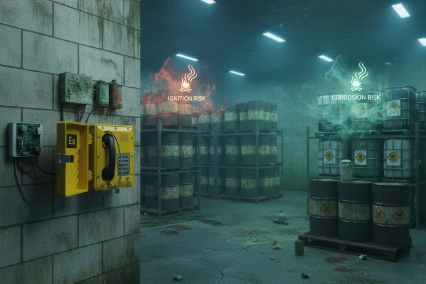
Acid and caustic zones destroy ordinary devices fast. When a leak happens, the phone is the first tool people reach for, and it must still work.
Yes. Explosion-proof SIP telephones can be suitable in acid and alkali storage areas, but only when the hazard classification is correct and the enclosure, gaskets, glands, and mounting details are chosen for chemical corrosion and washdown.
What matters most when choosing a SIP phone for corrosive chemical storage?
Separate “explosion risk” from “corrosion risk”
Acids and alkalis are not automatically flammable, so an “explosion-proof” label does not always mean the device is required. At the same time, corrosive mist can kill a standard phone even in a non-hazardous area. This is why I treat the decision as two parallel checks.
First, confirm if there is a flammable atmosphere 1 risk. That can come from nearby solvents, alcohols, hydrocarbons 2, or from process reactions that generate flammable gas. For example, some acid-metal reactions can release hydrogen. Some cleaning chemicals can release vapors. In many chemical warehouses, the real driver is not the acid itself. It is the mixed inventory and transfer work.
Second, check the corrosion and ingress 3 reality. Chemical storage often includes washdown, condensation, and salty air in coastal sites. Acid mist and caustic aerosols attack metal fast. They also attack the weak points: cable entries, keypad membranes, speaker grills, and nameplate markings.
Use location and activity to define the “worst case”
A phone mounted on a clean corridor wall is different from one mounted beside a fill station. The fill station is where splashes happen. It is also where vapors are more likely. I usually map the area into “zones of punishment,” even before talking about Zone 1 or Division 2.
Build the selection around real service conditions
A long-life build for these areas often needs: IP66/67 or NEMA 4X 4, corrosion-resistant housing and fasteners, PTFE 5 or other compatible seals, and glands that do not turn into white powder after a few months. The network side is also part of service life. A phone that constantly reboots from heat or moisture will fail the same way as a corroded one.
| Warehouse spot | Main threat | What to prioritize | Why it matters |
|---|---|---|---|
| Storage aisle | mist, condensation | NEMA 4X / corrosion resistance | slow corrosion still kills terminals |
| Fill / decant station | splashes, aerosols | gasket and gland chemistry | entries and seals fail first |
| Battery charging corner | hydrogen risk | correct hazardous rating if classified | gas build-up can change classification |
| Outdoor tank pad | sun, rain, salt | UV + corrosion + thermal rating | heat cycles break seals and labels |
A phone can be “explosion-proof” and still be a bad fit if it cannot survive the chemistry. The best choice is the device that matches the area classification and the chemical reality at the same time.
If the goal is a phone that passes inspection and stays reliable, the next step is to get the rating question correct for chemical warehouses.
A clean classification decision reduces cost and reduces wiring complexity.
Which Zone 1/2 or Class I Div 2 ratings fit chemical warehouses?
Chemical warehouses often get over-classified. That drives up cost and slows installs. They also get under-classified when people assume “acid is not fuel,” and ignore mixed storage and transfer points.
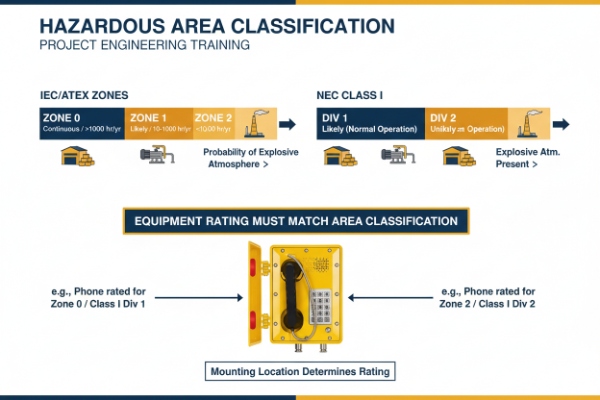
Most acid/alkali storage aisles are often non-hazardous if only non-flammable chemicals are present, while transfer points and mixed-chemical areas can be Zone 2 or Class I Div 2. Zone 1 or Class I Div 1 is usually reserved for places with frequent vapor release or poor ventilation.
%[Hazardous area classification chart comparing IEC ATEX zones and NEC Class I divisions](http://sipintercommanufacturer.com/wp-content/uploads/02-create-a-split-panel-infographic-comparing-iec-ate.jpg "ATEX Zone Guide")
Start with what is stored, not what the building is called
A warehouse can hold hydrochloric acid, sodium hydroxide, and also a pallet of solvent-based cleaners. One drum of a flammable solvent can change the classification in the same room. This is why a warehouse should be classified based on an updated chemical list, SDS 6 review, and how the chemicals are handled.
If a space only stores acids and alkalis that do not form flammable vapors under normal conditions, the area can be non-classified from a gas/vapor standpoint. In that case, “explosion-proof” is not required by the hazard. It can still be selected for ruggedness, but corrosion protection becomes the main reason.
If the space includes flammable liquids, or if operations create flammable gas, then Zone/Div ratings can apply. The highest-risk micro-areas are normally near:
- drum pumping and decanting
- mixing stations
- sump pits and poorly ventilated corners
- enclosed cabinets where vapors can build up
- battery charging areas if hydrogen accumulation is credible
How Zone 1/2 and Division 1/2 thinking fits warehouse behavior
Zone 2 7 and Class I Div 2 commonly fit areas where flammable vapors are not expected in normal operation, and would appear only under abnormal conditions such as a spill or container failure. That often matches a well-managed warehouse with closed containers and good ventilation.
Zone 1 or Class I Div 1 is more likely when vapor release can happen during normal tasks, or when ventilation is poor and vapors can linger. A frequent example is a decant station that is used all day, especially if it is semi-enclosed.
A simple “activity-based” mapping table
This table is not a code decision. It is a practical way to talk to HSE and electrical teams in the same language.
| Activity | Typical vapor chance | Rating direction to consider | Practical note for phone placement |
|---|---|---|---|
| Closed storage only | low | non-hazardous or Zone 2 / Div 2 if mixed inventory | mount away from floor drains and splash zones |
| Regular drum pumping | medium | Zone 2 / Div 2 often, tighter if enclosed | place phone upwind and slightly elevated |
| Open mixing / frequent opening | higher | Zone 1 / Div 1 near the source | use simple UI and glove-friendly keys |
| Spill response area | abnormal but possible | Zone 2 / Div 2 in many designs | consider “emergency hotline” button |
The best practical move is to mount phones outside the tightest classified boundary when possible, while still keeping them reachable. That reduces the cost of hardware and reduces restrictions on wiring.
Once the rating logic is clear, the next decision is survival. In chemical storage, survival is mostly about enclosures and seals.
Do IP66/67, NEMA 4X enclosures and PTFE gaskets resist corrosion?
Many buyers focus on “IP67” and stop there. In corrosive zones, the device can still die because the wrong gasket or gland material becomes the failure point.
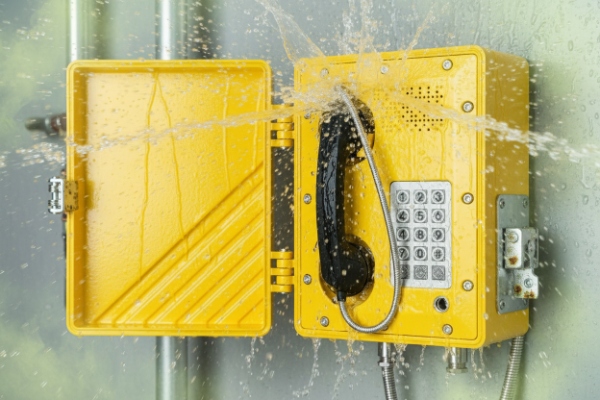
IP66/67 and NEMA 4X are strong starting points for chemical warehouses, and PTFE gaskets resist many acids and alkalis. Still, service life depends on the whole sealing system, including glands, fasteners, membranes, and how the enclosure handles temperature cycles and washdown.
%[Waterproof industrial emergency phone splashed with water, showing rugged keypad and handset](http://sipintercommanufacturer.com/wp-content/uploads/03-create-a-realistic-wall-mounted-explosion-proof-si.jpg "Waterproof Emergency Phone")
IP66/67 vs NEMA 4X: what each one protects
IP ratings mainly describe dust and water ingress performance. They do not directly promise corrosion resistance. NEMA 4X is commonly specified when corrosion resistance is part of the expectation, especially in outdoor, washdown, and chemical environments.
In practice, I treat them like this:
- IP66/67 helps keep water and dust out.
- NEMA 4X pushes the design toward corrosion-resistant materials and hardware choices.
- Neither one guarantees chemical compatibility of gaskets and cable entries.
PTFE gaskets: excellent chemical resistance, but watch the mechanics
PTFE has broad resistance to many acids and alkalis. That makes it attractive for chemical storage. The tradeoff is that PTFE can “creep” under long-term compression. If the enclosure relies on a soft gasket that must keep a tight seal for years, creep can reduce sealing force.
To avoid that, a good design often includes:
- gasket geometry that limits cold flow
- compression limiters or controlled torque
- periodic inspection for high-exposure locations
- a secondary sealing interface for cable entries
In heavy splash zones, it also helps to avoid gasket designs that trap liquid on the sealing line. Trapped liquid becomes a chemical bath. It shortens gasket life.
Housing material choices for acids and alkalis
316L stainless 8 is a common baseline because it resists many corrosion modes and stays stable outdoors. Still, some acids can be aggressive, and chloride-rich environments can create pitting or crevice corrosion. This is why some sites prefer higher alloys, protective coatings, or non-metallic housings in certain areas.
Alkali exposure also matters. Strong caustic can attack aluminum and can stress some plastics over time. A “chemical-resistant” front window and keypad membrane matter just as much as the housing metal.
A selection table for long service life
| Component | Better choice in acid/alkali storage | Why it lasts longer | Common weak choice |
|---|---|---|---|
| Housing | 316L stainless or chemical-grade GRP | resists corrosion and washdown | painted mild steel near splash zones |
| Gaskets | PTFE or compatible fluoropolymer options | broad chemical resistance | generic rubber that swells or cracks |
| Fasteners | stainless with anti-seize | avoids seizure and rust stains | mixed metals that corrode at joints |
| Front membrane | chemical + UV resistant | keeps keys readable and sealed | low-cost membrane that hardens |
| Cable entry | corrosion-rated, certified glands | stops entry corrosion and leaks | plated glands that pit and seize |
For warehouses with both acid and caustic, the safest approach is to specify a material set that is stable across both. That reduces the chance of “one corner of the warehouse” destroying parts faster than the others.
After the enclosure survives, the next question becomes operational. A phone in a chemical warehouse is often part of the alarm and paging workflow, not just a dial endpoint.
Can devices integrate with IP PBX, PAGA, beacons, and leak/gas alarms?
A phone that works only as a phone is not enough in many sites. Warehouse teams want paging, loud alerts, and fast call paths during spills.
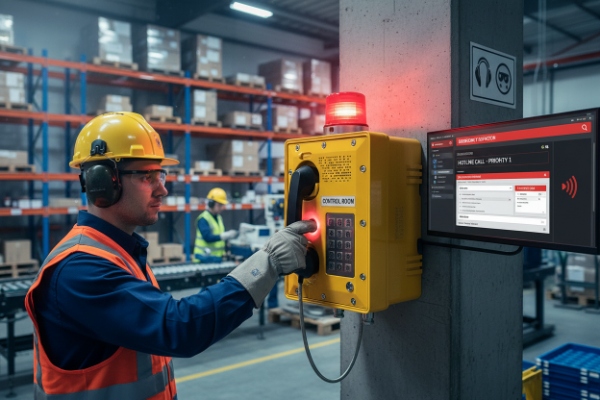
Yes. SIP telephones can register to an IP PBX, support paging for PAGA systems, and trigger beacons or respond to leak/gas alarms through relay I/O, SIP events, or PLC logic, as long as the interface plan is defined early.
%[Factory worker using wall-mounted industrial intercom phone with strobe beacon for emergency calls](http://sipintercommanufacturer.com/wp-content/uploads/04-illustrate-a-loud-ppe-heavy-warehouse-environment.jpg "Industrial Call Station")
IP PBX integration: keep it standard and resilient
Most SIP phones can register to standard IP PBX 9 platforms. In chemical warehouses, the practical needs are:
- hotline keys to security and EHS
- ring groups for spill response
- auto-recovery after power loss
- loud ringer and clear audio
A simple “spill hotline” button often does more than a long contact list. People do not browse directories during alarms.
PAGA and paging: choose a paging method that fits the site
Paging can be done through SIP paging calls, multicast paging, or a gateway that ties SIP to amplifiers and horns. A warehouse often uses horns because forklifts and ventilation fans are loud.
A reliable setup usually includes:
- paging priority rules so an emergency call is not blocked
- trusted source controls for paging
- test scripts that verify paging still works after network changes
Beacons and stack lights: control them through PLC or dry contact logic
Beacons are helpful when a leak alarm triggers and the area must be cleared. There are two common patterns:
1) Phone has a relay output that signals a PLC input, and the PLC drives the beacon.
2) Gas/leak panel or PLC drives the beacon directly, and the phone is used for voice and acknowledgements.
The second pattern is often cleaner for compliance and maintenance because it keeps the phone out of the safety decision chain. The phone becomes the communication tool, not the logic master.
Leak/gas alarms: align with the alarm system, not the phone brand
Most leak and gas alarms come from fixed detectors, sump sensors, or containment sensors. The normal route is detector → alarm panel/PLC → actions. Actions can include:
- paging announcement
- beacon activation
- automatic callout to a response group
- logging and escalation
A SIP phone can support this flow if the PBX or dispatch system can originate calls based on inputs, or if the PLC can trigger a call function through a supported interface.
| Integration target | Typical method | What to confirm before installation |
|---|---|---|
| IP PBX | SIP register + hotline + ring groups | failover behavior and network QoS |
| PAGA horns | SIP paging or multicast via gateway | paging priority and trusted sources |
| Beacons | PLC-driven, with phone as trigger option | relay ratings and wiring method |
| Leak/gas alarms | PLC/alarm panel triggers paging/callouts | event mapping and alarm logging |
Integration is smooth when the wiring and network plan is clear. It becomes messy when alarms are added after installation. Planning it early saves labor and reduces downtime.
The final piece is service life. In corrosive warehouses, service life is often won or lost at the cable entry and grounding details.
What acid-proof glands, sealing, and grounding extend service life?
The phone can be perfect on paper, and still fail early because the gland corrodes, the seal weeps, or the bonding path becomes unreliable.
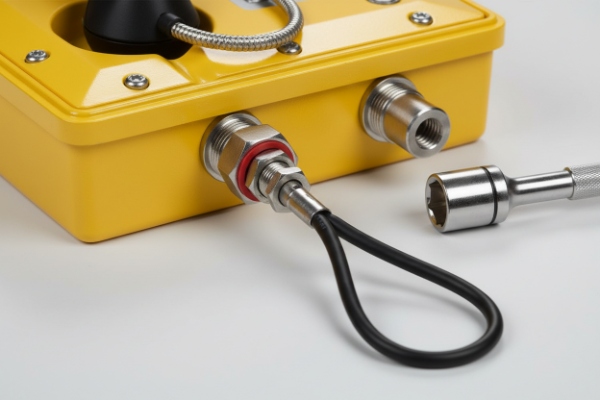
Use corrosion-resistant glands matched to the chemical environment, build a sealing strategy that prevents chemical pooling, and bond the device correctly to reduce faults and slow corrosion at joints.
%[Close-up of explosion-proof enclosure showing cable gland, sealed connector, and stainless fittings](http://sipintercommanufacturer.com/wp-content/uploads/05-create-a-close-up-high-detail-view-of-the-cable-e.jpg "Cable Gland Detail")
Choose glands for chemistry, not only for diameter
In acid and caustic storage, the gland often sees direct splash, vapor, and washdown. The best gland choice depends on the chemical and the cleaning method, but service life tends to improve when glands are:
- stainless steel in harsh chemical zones
- properly certified when installed in classified areas
- paired with a sealing insert compatible with the cable jacket and exposure
Plated glands can work in mild environments, but plating damage becomes a corrosion start point in harsh zones. Once threads corrode, maintenance becomes hard and sealing gets worse.
Build sealing details that prevent “chemical baths”
A common failure pattern is a device that traps liquid at the bottom edge or around the entry. A simple sealing strategy helps:
- mount with slight tilt or drainage path so liquid does not pool
- use drip loops on cables so liquids do not run into glands
- avoid mounting where direct splash is unavoidable, or add a small shield
- keep unused entries closed with matching corrosion-resistant plugs
PTFE gaskets help, but cable entry seals still do most of the daily work. If a phone has a breather, it should be chosen carefully, because some breathers do not like chemical vapors.
Grounding and bonding: support safety and reduce long-term problems
Grounding is usually discussed for electrical safety, and that is correct. In corrosive areas, grounding and bonding also matter for reliability because loose or corroded bonds lead to intermittent faults and strange behavior.
Good habits that extend service life:
- bond the phone using the dedicated earth point
- use corrosion-resistant lugs and hardware
- remove paint under bonding points when required, or use bonding hardware designed to pierce coatings
- avoid mixed-metal stacks that cause galvanic corrosion 10
- re-check bonding during routine warehouse inspections
Cable and jacket choices matter as much as the gland
A cable jacket that softens in chemical mist will fail even with a perfect gland. For chemical warehouses, it helps to specify industrial cable with a jacket suited for chemical exposure, plus UV resistance if outdoors. Mechanical protection also matters, because forklifts and pallet edges cut cables quickly.
| Item | Best practice | Why it extends service life |
|---|---|---|
| Glands | corrosion-rated, chemical-suitable materials | prevents entry failure and seized threads |
| Entry sealing | drip loops, shields, correct torque | stops chemical tracking and seal creep |
| Unused holes | matched plugs, same material family | avoids corrosion cells and leaks |
| Bonding | clear, inspectable, corrosion-resistant | prevents faults and reduces downtime |
| Cable jacket | chemical and UV resistant | avoids cracking and swelling over time |
In many warehouses, the fastest “upgrade” is not a new phone model. It is better glands, better mounting, and better cable routing. That is where service life is gained.
Conclusion
Explosion-proof SIP phones fit acid and alkali storage when the area is correctly classified and the enclosure, gaskets, glands, and grounding are chosen for real chemical exposure.
Footnotes
-
Official standards for electrical safety in hazardous locations. ↩
-
Chemical definition and properties of hydrocarbon compounds. ↩
-
International standards for enclosure protection against solids and liquids. ↩
-
National Electrical Manufacturers Association specifications for environmental protection. ↩
-
Properties and applications of Polytetrafluoroethylene in industrial sealing. ↩
-
Requirements and formats for chemical safety documentation. ↩
-
Guidelines for classifying hazardous areas with lower explosion risks. ↩
-
Characteristics of marine-grade stainless steel for corrosion resistance. ↩
-
Overview of Internet Protocol Private Branch Exchange systems. ↩
-
Explanation of electrochemical degradation between dissimilar metals. ↩