
Escape corridors look safe, but one hazardous boundary can turn a normal phone into a noncompliance risk right when people need it.
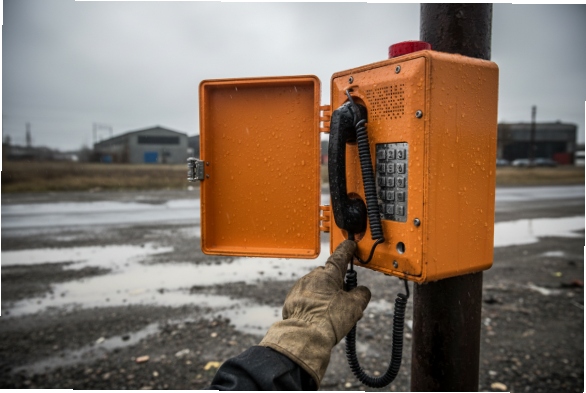
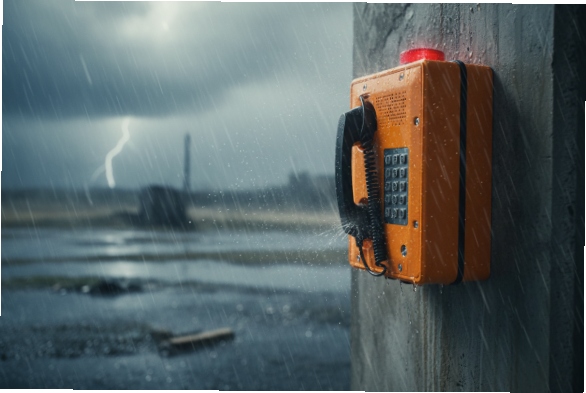
Explosion-proof SIP telephones are not automatically required on escape routes. They become required when the corridor is inside a classified hazardous area, or when the escape route’s call point is part of a mandated life-safety system that sits in that classified boundary.

The decision rule that keeps projects compliant and practical
Step 1: Ask one question first
The fastest way to decide is simple: Is the escape route corridor itself classified as a hazardous location (Zone 1/Zone 2 or Class I Div 1/Div 2)?
If the answer is no, then an Ex-rated phone is usually not required by hazardous-location rules 1. A rugged industrial SIP phone may be enough. The corridor still needs a reliable way to report emergencies, and that can be a phone, pull station, PA, or radio system, based on your site plan.
If the answer is yes, then every electrical device installed in that corridor must follow the hazardous-area rules. That is when Ex-rated call points or Ex-rated telephones become the safe and clean option. In some designs, the better option is to move the device just outside the classified boundary and keep it reachable from the escape flow.
Step 2: Separate “must provide communication” from “must be Ex-rated”
Many sites must provide a means to report emergencies. …OSHA 2 requires employers to define the preferred means of reporting emergencies (examples include manual pull box alarms 3, PA systems, radios, or telephones) and to post emergency phone numbers near telephones if telephones are used. …It also states that if a communication system serves as the employee alarm system, emergency messages must have priority over non-emergency messages. This is why SIP phones and paging often get tied together in plants.
That said, OSHA does not force “Ex phones on every corridor.” The hazardous-area classification does that when the corridor is inside the boundary.
Step 3: Use a short selection table
| Corridor status | Is an Ex-rated phone required? | Best practical move |
|---|---|---|
| Unclassified escape route | Usually no | Use rugged SIP phones, clear signage, and UPS-backed PoE |
| Corridor is Zone 2 / Class I Div 2 | Often yes for devices inside boundary | Place phones outside boundary if possible, or use Ex-rated call stations |
| Corridor is Zone 1 / Class I Div 1 | Yes for devices inside boundary | Use Ex d/approved equipment, limit the device count, simplify wiring |
| Corridor passes close to classified area | Depends on the drawing | Treat boundaries seriously and avoid “almost inside” installs |
A clean project uses the hazardous area drawing as the primary filter. It then uses the life-safety plan 4 as the second filter. This order prevents overbuy and prevents late inspection surprises.
Now it helps to talk about the corridor question directly, because this is where most confusion starts.
When do hazardous-area corridors mandate Ex-rated call points or telephones?
The wrong assumption here causes either a budget blowout or a failed inspection. Both outcomes are common.
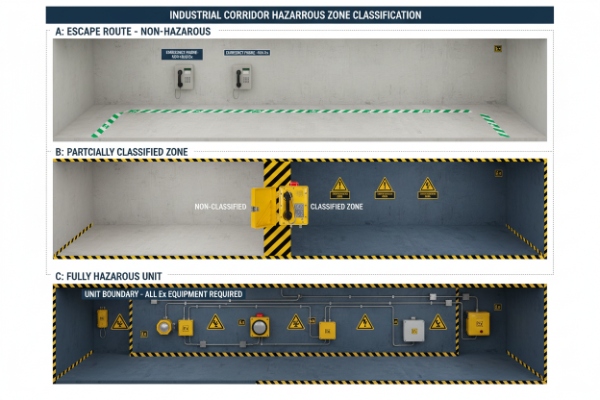
Hazardous corridors mandate Ex-rated call points or telephones when the corridor sits inside a classified Zone/Div boundary, or when the required emergency communication point is installed within that boundary. If the corridor is unclassified, Ex rating is usually optional, not mandatory.
Three real-world cases that trigger Ex in escape routes
1) The corridor is physically inside the classified envelope.
This happens in process plants where the only practical path runs along pipe racks, tank farms, or solvent handling areas. If the boundary lines cover the corridor, Ex-rated devices become the default.
2) The corridor is not classified, but the call point is mounted inside the classified edge.
I see this when teams mount a phone “right beside the door” on the process side, because conduit is already there. The safer move is to mount the station on the safe side of the wall, or on a stand that is outside the boundary.
3) The corridor includes required life-safety communication points.
In some buildings, codes require two-way communication at areas like areas of refuge or elevator landings. If those locations are inside a classified boundary in an industrial building, the required device must still meet the hazardous-location requirements.
What should be installed: call point, telephone, or both?
A corridor can have:
-
…a manual alarm call point (fire alarm box / manual call point),
-
…a two-way communication station,
-
a fixed emergency telephone,
-
or a single device that supports both alarm and voice workflow.
The best approach depends on how the site responds to incidents. If the site needs instant paging plus voice, a SIP call station with auto-dial and paging support often works well. If the site needs a formal fire alarm initiation device, that call point is usually part of a listed fire alarm system, not a “general phone.”
A decision table that keeps scope clean
| …Requirement | What normally satisfies it | If the location is hazardous |
|---|---|---|
| “Report an emergency” | phone, radio, PA, call point | device must be Ex-rated if installed in the classified boundary |
| “Initiate fire alarm” | listed manual alarm box/call point | use a suitable hazardous-rated/approved device or place outside boundary |
| “Two-way rescue assistance comms” | hands-free two-way station | same rule: if installed in hazardous boundary, use certified hazardous equipment |
Most teams win by designing the escape route to be unclassified when possible. When that is not possible, the simplest win is to standardize on Ex-rated call stations and keep wiring consistent.
Next comes the feature question. Escape-route devices must be usable when people are stressed, and the power may not be stable.
Should units have backup power, illuminated indicators, and hands-free auto-dial?
A corridor phone that goes dead during an outage is worse than no phone, because it creates false confidence.
Yes, these features should be treated as best practice for escape routes: UPS-backed power, clear visual indicators, and hands-free auto-dial to a staffed point. Many life-safety communication schemes also expect visible and audible confirmation that the call connected.
Backup power: design it at the network level first
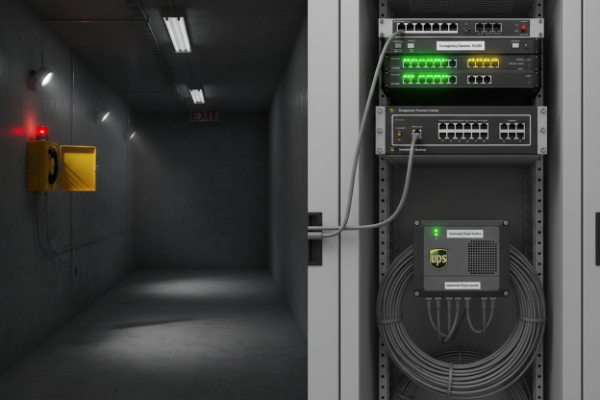
For SIP devices, the most stable backup design is:
-
PBX/dispatch servers on UPS (or redundant servers),
-
network core links with redundancy,
-
and battery-backed paging amps if paging is part of the emergency message.
Fire alarm systems commonly use standby battery sizing principles, and NFPA guidance often references 24 hours of standby plus alarm operation time (longer when voice is involved). Even when your SIP phones are not “the fire alarm system,” the same mindset makes sense: keep the emergency call path alive during a power event.
Illuminated indicators: reduce confusion in PPE and noise
In escape routes, people wear gloves, goggles, and respirators. The phone must confirm action fast. A good station uses:
-
a bright “Call Sent / Connected” LED,
-
a “Fault” or “Out of Service” indicator,
-
and a simple label that says who the call reaches.
If the corridor is loud, a visual indicator matters more than a ring tone.
Hands-free auto-dial: the fastest usable workflow
Hands-free auto-dial is not a luxury in escape routes. It is the best way to prevent “wrong number” mistakes during stress. A reliable workflow is:
-
press one button,
-
station auto-dials control room or security,
-
station also sends an alert to the dispatch screen,
-
…operator speaks hands-free.
In many rescue-assistance systems, hands-free two-way communication 6 and clear audible/visible confirmation are expected. That is the same experience that works best in industrial corridors.
A feature checklist table that maintenance teams can test monthly
| Feature | Why it matters | How to test it fast |
|---|---|---|
| UPS-backed PoE | keeps call path alive | power-off test at the switch, confirm phones stay registered |
| Auto-dial | reduces human error | press button, confirm it reaches the right group |
| Visual “connected” LED | confirms call succeeded | verify LED changes state on connect |
| Local loudspeaker | supports noisy corridors | place a test call during normal operations |
| Health monitoring | prevents silent failures | alert when device drops offline or loses registration |
The goal is not “more features.” The goal is fewer ways to fail during an emergency.
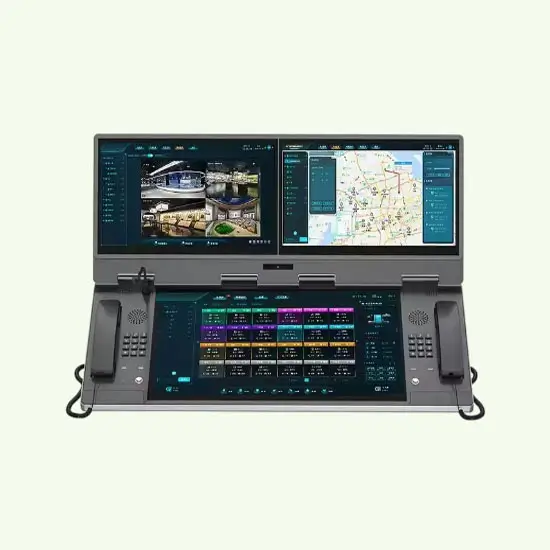
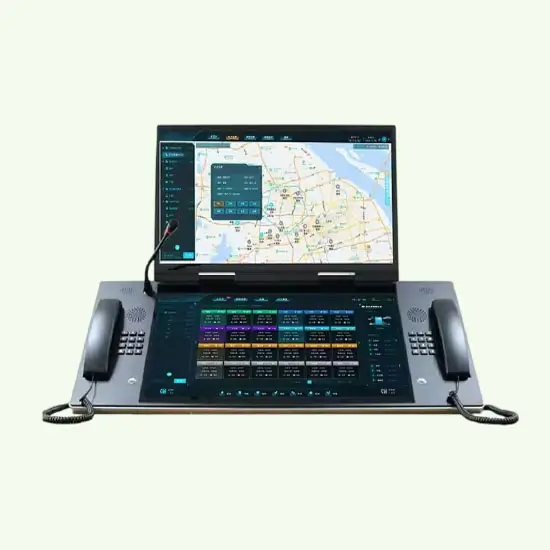
After reliability, integration becomes the next big requirement. Most sites do not want standalone corridor phones. They want one system that ties into paging, dispatch, and safety panels.
Can devices integrate with site-wide PAGA, SOS panels, and IP PBX?
A phone that cannot join the site workflow becomes a wall ornament. A phone that integrates badly becomes a nuisance source.
Yes. Ex-rated SIP telephones and call stations can register to IP PBX, trigger or receive paging via PAGA, and exchange alarm events with SOS panels through PLC or network interfaces. The clean design keeps safety logic in the safety system and uses SIP for communication and escalation.
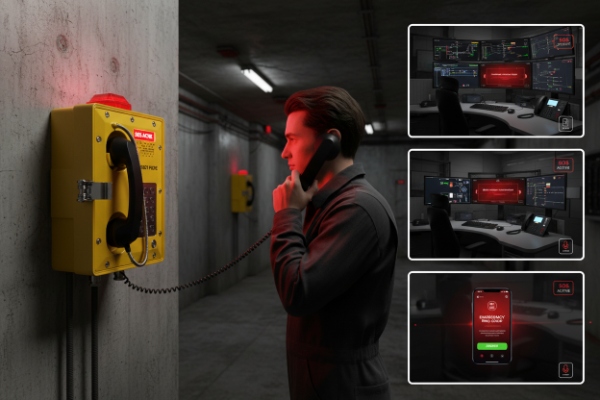
A simple integration model that works in plants
A stable plant architecture looks like this:
-
SIP endpoints (phones/call points) in corridors and hazardous zones
-
IP PBX or dispatch server in a safe IT/OT room
-
PAGA/paging gateways that turn SIP paging into horn speaker audio
-
SOS/alarm panels or PLC that own hardwired alarms and trip logic
-
beacons driven by PLC outputs (not by the phone directly)
This design keeps the phone in its best role: voice + event notification.
PAGA integration: make paging a controlled function
For escape routes, paging is often as important as calling. …Two common paths work:
-
PBX makes a paging call to a paging gateway that feeds amplifiers and horns.
-
A dispatch system triggers multicast paging to horn endpoints.
In both cases, emergency messages must have priority. That matches what OSHA expects when the communication system also serves as an alarm messaging path.
SOS panels and SCADA: use simple interfaces
Many sites want the corridor call station to:
-
send a dry-contact input to an SOS panel,
-
receive a dry-contact input (like “gas alarm active”) and light an indicator,
-
or publish status to SCADA for maintenance visibility.
A clean rule is: the phone can announce and escalate, but it should not be the device that trips safety functions. Let the safety system trip. Let the phone tell people what happened and connect responders.
Integration table for typical escape-route use cases
| Use case | Best owner system | What the SIP station does |
|---|---|---|
| “Emergency call for help” | IP PBX / dispatch | auto-dial + location ID on the operator screen |
| “Evacuate now” paging | PAGA / dispatch | receive auto-answer paging and play it loud |
| “Gas alarm active” | gas panel / PLC | show a red indicator and optionally auto-call group |
| “Door forced / security” | access control | send alert call to security ring group |
When the integration is simple, the site can test it and trust it. That trust matters more than any feature list.
Now the last part is physical deployment. Mounting height, signage, and cable protection decide whether people can actually use the device, and whether it survives real plant life.
What mounting heights, signage, and cable protection meet safety codes?
A phone that is too high, hidden, or unprotected will not be used. In an emergency, people do not “search.” They reach for what is obvious.
Use accessible mounting heights, standard emergency signage, and mechanical cable protection suited to the corridor hazards. In many jurisdictions, pull stations and call points follow specific height bands and must be conspicuous and unobstructed.
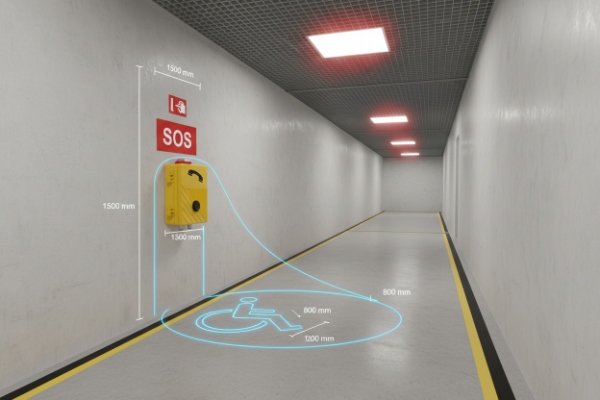
Mounting height: aim for accessibility first
In many US fire alarm installations, the operable part of a manual pull station is typically installed between 42 inches and 48 inches above the finished floor. That range fits general accessibility needs and is widely referenced in practice.
For emergency call boxes and hands-free stations, many owners target the 48-inch reach limit for the main button and keep instructions in the same band. ADA guidance [^9] also ties operable parts to accessible reach ranges, and 48 inches is a common max for a forward reach in many layouts.
For EU-style manual call points, many vendors reference a typical mounting height around 1.4 m (with tolerance), and escape routes often follow that convention.
Signage: mark the device so it is found in seconds
Clear signs do more than satisfy audits. They reduce panic time. Good practice includes:
-
a standard emergency telephone symbol sign above the device,
-
a short label that says who answers (Control Room / Security / Muster),
-
…posted emergency numbers when telephones are used for reporting emergencies,
-
and lighting that keeps the station visible during an outage.
ISO 7010 7 includes an emergency telephone pictogram (commonly referenced as E004). Many sites use it because it is simple and widely recognized.
Cable protection: build for impact and survivability
Escape routes often run where people, carts, and forklifts move fast. Cable protection should match that reality:
-
run conduit or armored cable where impact is likely,
-
avoid low wall runs that get hit by pallets,
-
…protect entries with strain relief and guards,
-
and keep glands and junctions accessible for inspection.
If the station is part of a life-safety communication system, many AHJs also expect pathway survivability. This can drive protected routing, fire-resistive construction, or other survivability measures for circuits that must stay alive during an event.
A deployment checklist table that reduces rework
| Item | Practical target | Why it helps |
|---|---|---|
| Button height | 42–48 in band (or 1.4 m local standard) | improves reach and consistency |
| Visibility | line-of-sight from corridor flow | people find it under stress |
| Sign type | emergency telephone pictogram + simple text | reduces language barriers |
| Location | near exits, changes of direction, muster access | matches human behavior in evacuation |
| Cable protection | conduit/armored, guarded entry, drip loop | prevents damage and water tracking |
The best escape-route station is simple, visible, reachable, and hard to break. When that is achieved, Ex-rated selection becomes just one part of a complete safety communication plan.
Conclusion
Ex-rated SIP telephones are required on escape routes only when the route is inside a hazardous classification; the best deployments add UPS power, clear indicators, simple auto-dial, strong signage, and protected cabling.
Footnotes
-
Detailed guide on hazardous area classification zones. ↩
-
OSHA 1910.165 standard for employee alarm systems. ↩
-
Understanding manual fire alarm box requirements. ↩
-
Overview of life safety system components. ↩
-
Importance of UPS for PoE network devices. ↩
-
Explanation of two-way emergency communication systems. ↩
-
ISO 7010 E004 emergency telephone safety sign. ↩