
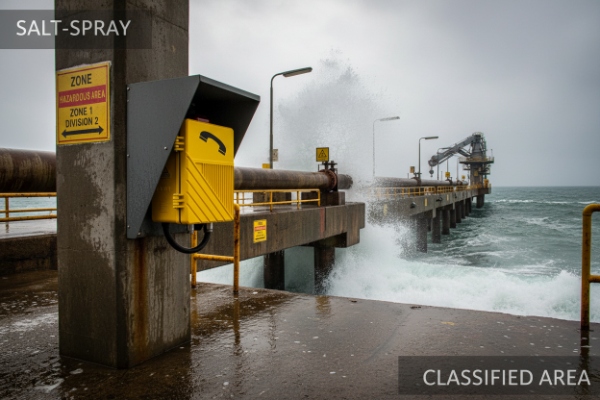
Salt fog does not “wear” devices. It eats them. When a pier phone fails, the problem is never only one call. It is downtime, safety risk, and repeated replacements.
Yes. Explosion-proof SIP telephones can be suitable for coastal salt-spray sites when the Ex certification is correct and the corrosion system is designed for salt fog, UV, and constant wet-dry cycling.
What actually kills Ex SIP phones on the coast?
Salt fog is a cycle, not a single event
The coast is harsh because of repetition. Salt lands on the surface. Moist air wets it. Sun dries it. The salt concentration rises. That cycle drives pitting, crevice corrosion 1, and fastener seizure. It also drives seal shrink and “breathing” condensation inside enclosures.
Corrosion starts at the smallest interfaces
Even with a 316L body, the weak points are usually:
-
cable glands and thread adapters
-
handset cords and strain reliefs
-
mounting brackets and dissimilar metal joints
-
keypad edges and speaker/mic membranes
-
door latches and hinge pins
If those parts are not marine-ready, the housing alloy alone will not save the unit.
“ASTM B117 hours” is useful, but it is not the coastline
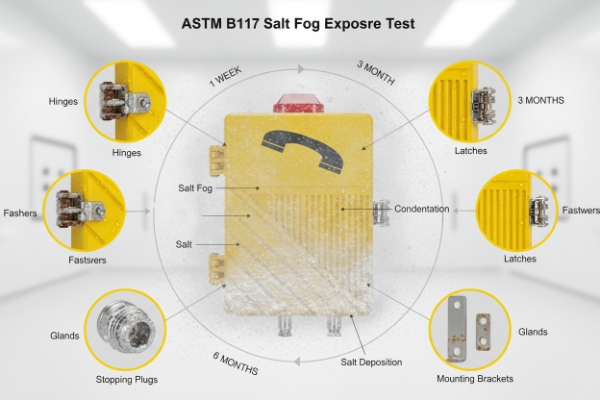
Many buyers ask for “1,000 hours B117.” That can be a helpful screening tool, but it is not a real field-life guarantee. In practice, B117 is best used to compare coatings and hardware under the same test, not to predict exact years on a pier.
| Coastal failure mode | What it looks like | What prevents it |
|---|---|---|
| Pitting on stainless | small rust spots that grow into pits | better alloy choice, smooth finish, rinse plan |
| Crevice corrosion | corrosion under clamps and brackets | reduce crevices, isolate joints, seal edges |
| Seized fasteners | “cannot open” during service | anti-galling practice, correct stainless grade |
| Seal fatigue | water tracks into entry | correct glands, drip loops, controlled torque |
| Condensation inside | fogged window, audio crackle | certified pressure equalization strategy, desiccants |
This is why I treat “coastal suitability” as a system spec, not a single checkbox.
Now it helps to go straight into the first question most teams ask, because it drives procurement language: 316L, NEMA 4X, coatings, and ASTM B117.
Do 316L/NEMA 4X housings and marine coatings resist salt fog per ASTM B117?
Coastal buyers often assume “316L + NEMA 4X = solved.” Then the first winter arrives and the glands rust.
316L and NEMA 4X are strong coastal baselines, and marine coatings can improve life, but ASTM B117 results should be treated as comparative screening, not a direct field-life promise.
What NEMA 4X really gives on a pier
NEMA 4X 2 is a solid target for piers because it is built for hose-directed water and adds corrosion resistance expectations compared with basic outdoor enclosures. Still, it does not guarantee that every internal part is marine grade. A phone can meet the enclosure type and still use non-marine glands, plated brackets, or mixed fasteners.
316L is good, but chloride pitting is still real
316L 3 is widely used for marine hardware, yet chloride-rich droplets can still drive pitting and crevice corrosion, especially where salt concentrates as water evaporates. On piers, that means trouble at:
-
bracket interfaces
-
cable clamps
-
under gaskets where salt paste stays wet
So the real 316L question is not “is it stainless?” The real question is “is the design minimizing crevices and using consistent materials across the whole assembly?”
What ASTM B117 can and cannot tell you
B117 is a controlled salt fog 4 environment used to compare corrosion resistance of metals and coatings. It is very useful to rank options. It is weak when it is used alone to predict natural field performance. A good purchasing move is to ask vendors for:
-
coating system details (primer/topcoat chemistry)
-
surface preparation method
-
edge coverage and thickness targets
-
how they treat cut edges, screws, and thread roots
A practical coastal spec set for Ex phones
| Item | Better coastal choice | Why it matters |
|---|---|---|
| Housing | 316L or higher alloy where exposure is extreme | reduces pitting risk |
| Finish | smoother finish, fewer traps | less salt retention |
| Coating | marine-grade coating or passivation strategy | slows corrosion at edges and hardware |
| Hardware | stainless throughout, minimal dissimilar metals | avoids galvanic couples |
| Glands | stainless glands and plugs | entry corrosion is the #1 failure |
When these are aligned, 316L + NEMA 4X becomes a real coastal solution, not a brochure line.
Next comes the sealing question. Salt fog does not need a big leak. A tiny leak plus pressure breathing is enough.
Will IP66/IP67 seals, anti-UV plastics, and sealed keypads endure corrosion?
A pier has two enemies at once. Salt tries to get in, and sun tries to break polymers down.
Yes, IP66/IP67 sealing and UV-stable materials can endure coastal duty when the sealing path includes glands, membranes, and keypad design, and when the unit avoids paint-trap crevices where salt paste forms.

IP66/IP67 protects against water, not against salt chemistry
IP66/IP67 5 is important because it blocks windblown salt mist and washdown. But corrosion still attacks from the outside. Salt collects around:
-
keypad edges
-
speaker grills
-
cable entry shoulders
-
latch seams
So a coastal phone needs an easy-clean face and protected acoustic ports. If the speaker grill is a salt trap, the audio fails before the electronics.
Sealed keypads: choose designs that do not trap paint or salt paste
A sealed keypad can survive, but the design matters:
-
continuous membrane with bonded edges is easier to rinse
-
individual buttons with poor edge sealing trap salt at the button skirt
-
laser marking survives better than printed ink in sun and salt
If operators clean the phone with solvent or strong detergents, the seal material must match those chemicals too. Many coastal failures are “cleaning failures,” not only “salt failures.”
Anti-UV plastics: a small part can end the whole system
Even with a metal housing, there may be a window, gasket, or keypad film that sees full sun. In coastal sites, UV and salt together accelerate aging. That is why I prefer:
-
UV-stabilized 6 polycarbonate or similar outdoor-grade plastics
-
stainless or UV-stable cable jackets
-
covers or small sun hoods on fully exposed poles
Sealing details that matter more than IP labels
A coastal install lasts longer when it includes:
-
drip loops before cable entry
-
downward-facing entry orientation when possible
-
double O-ring or compression sealing at glands
-
no unused holes (or sealed with matching material plugs)
| Seal area | Common coastal failure | Better design habit |
|---|---|---|
| Cable entry | salt creep into threads | stainless gland + correct torque + drip loop |
| Keypad edge | membrane lifting | UV-stable membrane + chemical-matched adhesive |
| Speaker/mic port | salt crust blocks sound | protected acoustic membrane + rinse access |
| Door seam | salt paste in the seam | smooth lip + controlled compression |
When these details are right, IP66/IP67 becomes meaningful in the real coastal cycle.
Now the system value question. A pier phone is often part of a bigger alarm and paging story. Integration decides whether people actually use it.
Can units integrate with IP PBX, marine horns, and beacon strobes on piers?
A phone that only calls is helpful. A phone that also triggers horns and strobes is the one people trust during night shifts and storms.
Yes, SIP telephones can register to IP PBX, page marine horns through SIP paging or multicast, and interface with beacon strobes via PLC logic or relay I/O, while keeping safety logic in the control system.
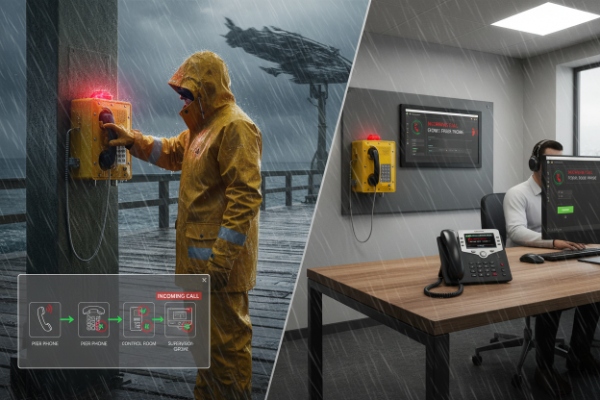
IP PBX: keep calls simple and location-clear
On a pier, the most useful PBX functions are basic:
-
hotline keys to security and control room
-
ring groups that always have coverage
-
clear station naming like “Pier 3 North Ladder”
-
auto-recovery after PoE or switch reboot
If the pier has multiple berths, station labels and call logs matter more than fancy directories.
Marine horns: two clean paging paths
Paging to horns usually works in two patterns:
1) PBX sends a SIP paging call to a paging gateway that feeds amplifiers and horns
2) A dispatch server uses multicast paging to IP horn speakers
Both can work on piers. The key is priority:
-
emergency announcements should override routine pages
-
emergency calls should not be blocked by paging audio
Beacon strobes: let the PLC own power switching
A common and reliable design is:
-
phone sends a dry contact to a PLC input (or a network event to a controller)
-
PLC drives the strobe circuit and logs the event
-
PBX triggers the call and optional paging announcement
This avoids running high-power beacon switching through the phone. It also keeps the alarm behavior consistent across the site.
Network design on piers
Piers often have long cable runs, lightning exposure, and salt intrusion into cabinets. A good network approach uses:
-
fiber uplinks to pier switches
-
PoE switch on UPS in a protected cabinet
-
surge protection at pier entry points
-
simple VLAN/QoS rules so paging and calls stay stable
| Integration target | Simple method | Why it works on piers |
|---|---|---|
| Voice calling | SIP 7 to PBX | predictable response workflow |
| Paging horns | SIP paging or multicast | reaches crews in open air |
| Strobes | PLC output | reliable switching and event logging |
| SOS panels | PLC/alarm panel interface | keeps safety actions auditable |
Once integration is stable, the last step is what decides years of service life: maintenance habits and corrosion management at mounts and joints.
What maintenance, desiccants, and sacrificial anodes extend service life?
Coastal failures are slow until they are sudden. A small maintenance routine often doubles life more than a new model does.
A coastal life-extension plan uses routine freshwater rinse, inspection of glands and fasteners, controlled moisture management inside cabinets, and corrosion control on mounting steel. Sacrificial anodes help when a true electrolyte path exists, but they must be applied carefully.
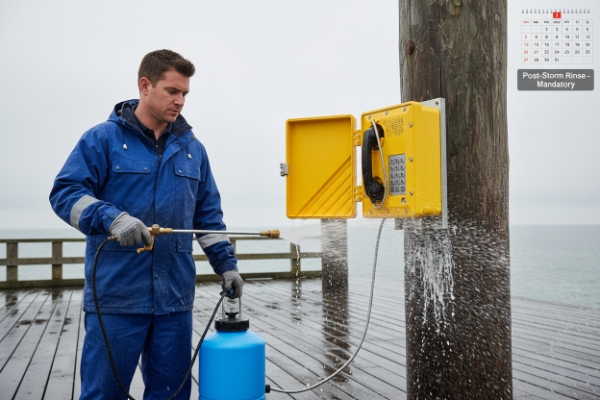
Maintenance that actually works on salt-spray equipment
A simple routine is effective:
-
rinse exterior with fresh water on a schedule (weekly or monthly, based on exposure)
-
inspect cable glands for rust staining, loosening, and cracked inserts
-
check door latches and hinge pins for seizure
-
confirm bonding straps are tight and clean
-
verify audio ports are not crusted with salt
Salt is easier to remove before it becomes a hard crust. That one habit is a big difference maker.
Desiccants and pressure equalization: stop “breathing water”
Even well-sealed enclosures can pull in moisture as they heat and cool. Many pier cabinets benefit from:
-
enclosure drain/breather devices that let condensation escape and help equalize pressure
-
desiccant packs inside cabinets or junction boxes, replaced on schedule
For explosion-proof devices, any venting or breather choice must follow the device certification rules. Modifying a flameproof enclosure in the field is not a good idea. The safer approach is to manage moisture in the upstream junction box or cabinet that feeds the phone, and keep the phone enclosure as the certified assembly.
Sacrificial anodes: useful, but mostly for mounting steel, not the phone body
Sacrificial anodes 8 work best when the protected metal is in an electrolyte, like seawater splash zones, and when there is solid electrical connection. On a pier, they can help protect:
-
carbon-steel mounting poles
-
brackets that see constant wetting
-
pier-side frames near the tide line
On a small stainless phone housing, anodes are usually not the main lever. They can also create galvanic side effects if applied incorrectly. A safer “anode mindset” on phone stations is:
-
use hot-dip galvanized or well-coated carbon-steel supports
-
isolate dissimilar metal joints with washers and pads
-
keep stainless-to-carbon joints from trapping salt paste
A simple coastal service-life plan
| Action | Interval | What it prevents |
|---|---|---|
| Freshwater rinse | weekly to monthly | salt concentration and crust formation |
| Gland torque and seal check | quarterly | entry leaks and thread corrosion |
| Bonding continuity check | semi-annual | floating metal and fault surprises |
| Cabinet desiccant replacement | per humidity indicator | internal condensation damage |
| Bracket and fastener inspection | semi-annual | seizure and crevice corrosion |
| Coating touch-up on supports | annual | fast rust spread from small chips |
When this plan is in place, coastal Ex SIP phones become reliable field assets, not repeat replacements.
Conclusion
Explosion-proof SIP telephones can thrive on coastal piers when corrosion control covers housing, glands, seals, UV parts, and maintenance, not only the Ex certificate. This often requires careful integration with an IP PBX 9 for reliable communication and multicast paging 10 systems for wide-area alerts.
Footnotes
-
A form of localized corrosion occurring in confined spaces to which the access of the working fluid from the environment is limited. ↩
-
A NEMA standard for enclosures that are watertight and resistant to corrosion, often used in marine environments. ↩
-
A low-carbon grade of stainless steel highly resistant to corrosion, widely used in marine applications. ↩
-
A standardized test method used to check corrosion resistance of materials and surface coatings. ↩
-
A rating standard defining the level of protection an enclosure provides against dust and water ingress. ↩
-
A material property that prevents degradation such as chalking or cracking when exposed to ultraviolet radiation from the sun. ↩
-
A signaling protocol used for initiating, maintaining, and terminating real-time sessions that include voice, video and messaging applications. ↩
-
A highly active metal used to prevent a less active material surface from corroding. ↩
-
A telephone system that switches calls between VoIP users on local lines while allowing all users to share a certain number of external phone lines. ↩
-
A method of sending data to multiple destinations simultaneously, often used for efficient group paging in networks. ↩








