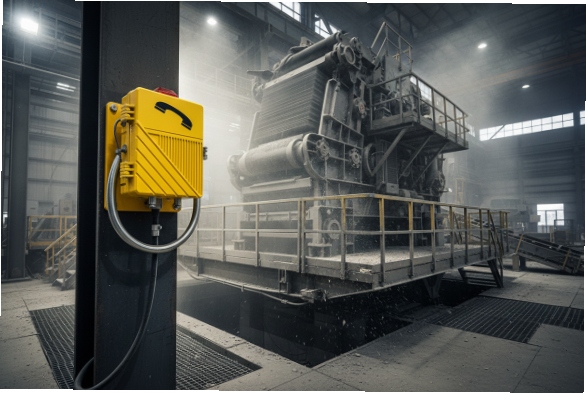
Dust ruins normal devices fast, then one hot surface or static spark can turn a routine shift into a shutdown.
Yes. Explosion-proof (dust-certified) SIP telephones can be suitable in sand and dust environments when the area is truly a combustible-dust hazard, the device has the right dust rating (Zone 21/22 or Class II Div 1/2), and the sealing, bonding, and maintenance plan are done right.
Dust areas need a different selection method than gas areas
Not all “dusty” places are explosive
A quarry can be full of nuisance dust that is not combustible. Silica and sand dust are a big health hazard, but they are not usually treated as combustible dust 1 in the same way as flour, coal, sugar, sulfur, or certain metal dusts. This matters because “explosion-proof” hardware is not always required, and sometimes it is the wrong spend. The right starting point is always the site hazardous area classification and the dust explosibility data for the real material.
Combustible dust drives three device requirements
When the dust is combustible and the area is classified, a phone must do three things at the same time:
-
Keep dust out so it does not build up inside and cause overheating or tracking.
-
Limit surface temperature so a dust layer cannot ignite on the enclosure.
-
Control static so non-metal parts do not become a charge source.
This is why the best “dust” phone spec looks different than the best “gas” phone spec. The marking changes (Zone 21/22 or Class II Div), the temperature marking changes (max surface temp for dust), and the entry hardware selection becomes stricter.
A quick reality check table before you buy
| Question | If the answer is “yes” | What it means for the phone |
|---|---|---|
| Is the dust combustible? | flour, sugar, coal, sulfur, aluminum, etc. | dust-rated equipment may be required |
| Can dust be airborne during normal work? | bagging, conveyors, crushers | higher classification (Zone 21 / Div 1) near sources |
| Can dust layers build up on equipment? | poor housekeeping, enclosed corners | surface temperature control becomes critical |
| Are there non-metal parts exposed? | plastic keypads, windows | static control becomes a design requirement |
A dust-hazard site can use SIP 2 phones successfully, but the spec must be written for dust realities, not copied from a gas project.
Next comes the rating question, because Zone 21/22 and Class II Div 1/2 are often misunderstood and over-applied in quarries.
Which Class II Div 1/2 or Zone 21/22 ratings fit dust-hazard sites?
Dust classifications are about likelihood. The mistake is to label the whole plant as “Div 1” because it feels dusty.
Zone 21 (or Class II Div 1) typically applies where combustible dust is likely to be present in the air during normal operation. Zone 22 (or Class II Div 2) typically applies where combustible dust is not likely in the air under normal operation, but can occur under abnormal conditions or short events.
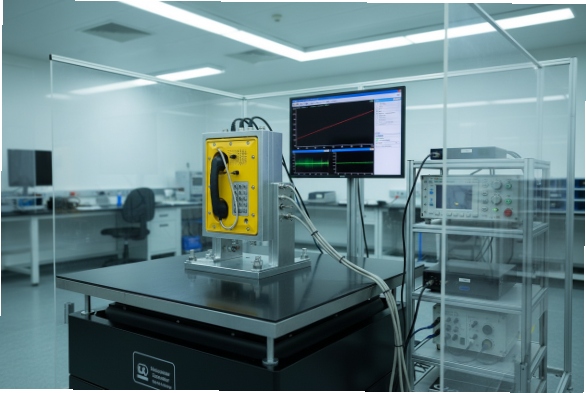
How to think about Zone 21/22 in real plant terms
Zone 21 is usually around dust release sources that operate every day: a crusher transfer point, a bagging station, a bucket elevator head, or a screen with constant fines. Zone 22 is often the surrounding area where dust can settle and occasionally become airborne, but it is not expected to be a continuous cloud.
A quarry can have both in the same building. A bagging line can be Zone 21 near the spout and Zone 22 in the walkways. Outside, the classification can shrink fast if there is open air and good housekeeping, but some sites still classify close to sources because wind can recirculate dust.
How to think about Class II Div 1/Div 2 and dust groups
In NEC 3 language, Class II locations are combustible dust. Div 1 is where dust is in the air under normal conditions or where equipment produces dust clouds. Div 2 is where dust is not normally airborne but can be due to abnormal operations, or where dust accumulations are present.
The dust “group” also matters. Different dusts behave differently:
-
Conductive metal dust can create tracking risks.
-
Carbon/coal dust behaves differently than grain dust.
-
Some dusts cake and hold heat on surfaces.
A dust-rated phone choice should match the real dust group on the drawing, not a generic “dust proof” label.
Dust temperature marking: the most ignored requirement
For dust, the temperature limitation is often written as a maximum surface temperature rather than a classic gas T-class. Dust layers insulate. A phone that stays “cool enough” in clean air can get much hotter under a thick dust layer. This is why dust-rated equipment must be selected with surface temperature margin and installed where housekeeping prevents thick buildup.
A rating selection table for typical dusty industrial spots
| Location | Dust behavior | Typical rating direction (confirm by drawing) | Phone placement tip |
|---|---|---|---|
| Bagging / filling spout | frequent dust clouds | Zone 21 / Class II Div 1 near source | mount slightly away, keep line of sight |
| Crusher transfer point | constant fines | Zone 21 close-in, Zone 22 outside | avoid direct dust blast path |
| Walkway and corridor | dust settles, less airborne | Zone 22 / Class II Div 2 often | keep reachable on escape route |
| Outdoor open yard | dust disperses | often unclassified or limited Zone 22 | prefer rugged IP phones if not classified |
A phone is “suitable” when the rating matches the real boundary. If the boundary is not clear, the safest move is to mount the phone outside the classified zone and use horns/strobes to keep it noticeable.
Once the rating is correct, the next question is sealing. In dust service, sealing is not only about water. It is about stopping fine powder from getting into every gap.
Do IP66/IP67, dust-tight glands, and anti-static housings prevent ingress?
Dust finds weak points faster than rain. A device can be IP66 on paper and still fail if the entry hardware and membranes are wrong.
Yes. IP66/IP67 and a dust-tight (IP6X) sealing strategy can prevent ingress, but only if glands, plugs, keypad membranes, and acoustic vents are designed for dust and maintained properly. Anti-static housings reduce static risk, but bonding still matters.
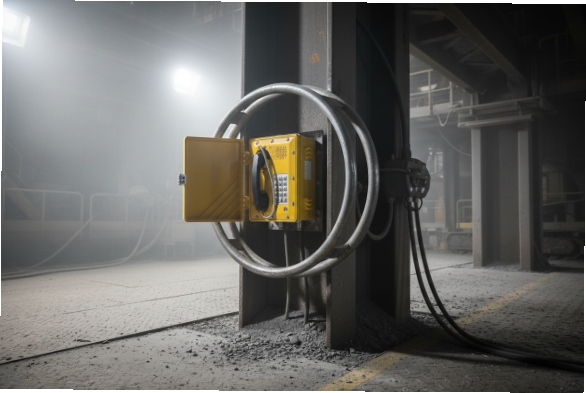
IP66/IP67 is necessary, but “IP6X behavior” is the real dust goal
For dust environments, the key is the “6” in IP6X. That is the dust-tight concept. IP66 4/IP67 includes a dust-tight first digit, but field reality depends on:
-
gasket compression staying stable over time,
-
glands gripping the cable jacket correctly,
-
and all unused entries being sealed with the correct plugs.
In quarries, vibration and thermal cycling loosen hardware. So torque discipline and lock methods matter more than people expect.
Glands are the #1 dust entry failure point
A dust-rated enclosure can still ingest dust through the cable entry if:
-
the gland size does not match the cable OD,
-
the cable jacket is too hard or too soft for the insert,
-
the gland is not certified for the same protection concept,
-
or the entry is pointed upward and collects dust paste.
A good dust gland strategy includes:
-
certified dust-rated glands matched to the phone certification,
-
stainless glands in corrosive or coastal quarries,
-
correct strain relief so movement does not work the gland loose,
-
and sealed stopping plugs for all unused entries.
Anti-static housings: reduce charge, do not replace bonding
Anti-static or static-dissipative housings help, especially for non-metal parts. Still, the simplest and most reliable static control is good bonding of all metalwork and consistent equipotential grounding. If a phone uses a metal housing, bond it. If it uses non-metal parts, keep them within the limits of the product certification and avoid adding unapproved covers or films that change surface behavior.
Dust and audio: protect the mic and speaker paths
Dust kills speech quality when it blocks acoustic ports. A dust-ready design often uses:
-
sealed acoustic membranes,
-
labyrinth paths that reduce direct dust blast,
-
and a maintenance plan that cleans without forcing dust into the membrane.
Sealing and ingress table
| Weak point | What fails in dusty plants | Better control |
|---|---|---|
| Cable gland | fine dust tracks into enclosure | certified gland + correct insert + drip loop + guard |
| Unused hole | “temporary plug” left in place | certified stopping plug, same material family |
| Keypad edge | dust packs under membrane | fully sealed keypad, smooth faceplate |
| Mic/speaker port | clogged audio path | protected acoustic membrane + gentle cleaning plan |
| Mounting seam | dust paste holds moisture | smooth geometry + avoid dust traps |
When sealing is done right, the phone stays clean inside and the electronics live longer. The next question is operational value. In quarries, people are spread out and noise is high, so integration with paging and beacons often matters more than a ring tone.
Can systems connect to IP PBX, PAGA horns, and beacon strobes in quarries?
A quarry phone system fails when it acts like office telephony. The workflow is different. The environment is louder, distances are longer, and response must be simple.
Yes. SIP phones and call stations can register to an IP PBX, support paging to PAGA horns through SIP paging or multicast, and interface with beacon strobes through PLC or alarm modules. The clean design keeps high-power switching and safety logic in the PLC, while SIP handles voice and escalation.
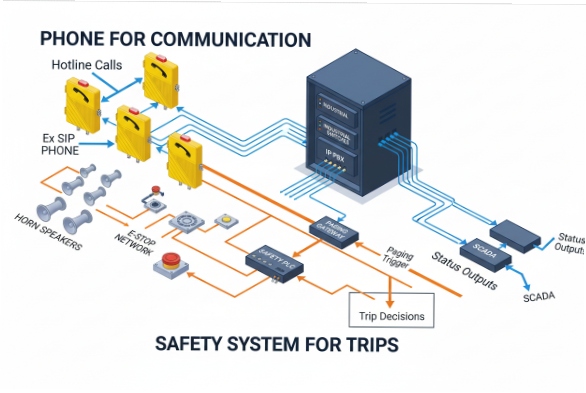
IP PBX: keep calling simple and location-clear
In dusty sites, operators wear PPE and move between zones. A phone should use:
-
hotline keys to dispatch or control room,
-
ring groups with escalation,
-
and clear station naming like “Crusher #2 North Walkway.”
If the PBX 5 shows station identity instantly, response time improves. If the system relies on manual dialing, it fails during real events.
PAGA horns: paging is the real attention tool
Quarries can be loud. Fans, crushers, and mobile equipment mask normal ringers. PAGA 6 horns and speaker systems solve this when they are integrated correctly:
-
SIP paging from PBX to paging gateways feeding horn amplifiers, or
-
multicast paging to IP horn endpoints.
A stable quarry design sets priority:
-
emergency paging overrides routine announcements,
-
emergency calls are not blocked by paging audio,
-
and only trusted sources can trigger auto-answer paging.
Beacon strobes: let a controller drive power
Beacon strobes are great for dusty visibility and high noise. Still, the phone should not be the power switch for a high-current strobe circuit inside a hazardous area. A safer method is:
-
phone contact output triggers a PLC input,
-
PLC drives strobes and logs events,
-
PBX triggers paging and callouts.
This keeps wiring clean and keeps inspections simple.
Network design tips that prevent dusty-site outages
A quarry network often benefits from:
-
fiber backbones between buildings to avoid lightning and long copper runs,
-
sealed outdoor cabinets with filtered breathers,
-
and simple VLAN/QoS rules so paging and voice stay stable.
Integration table for quarry workflows
| Function | Best owner system | What to implement |
|---|---|---|
| Emergency voice | IP PBX | hotline + ring group + station ID |
| Area alert | PAGA / paging gateway | SIP paging or multicast to horns |
| Visual alert | PLC/alarm panel | PLC drives beacons; phone triggers input if needed |
| Maintenance visibility | NMS/SCADA | online status, registration status, PoE alarms |
Integration is the easy part when the physical device survives dust. The survival is driven by maintenance and bonding habits, because dust hazards are not only about ingress. Dust layers can hold heat and static can become a risk when bonding is sloppy.
What filter, cleaning, and bonding practices maintain safety?
A dust-rated phone can still become unsafe if dust layers insulate it, or if cleaning creates airborne clouds, or if bonding is broken. The best plants treat cleaning as a safety control, not as housekeeping.
Use gentle, scheduled cleaning that prevents dust layers, maintain bonding and continuity checks, and manage filters and membranes without blowing dust into the device. Keep modifications within certification limits.

Cleaning: remove layers without making a dust cloud
In combustible dust areas, aggressive compressed-air blowdown can create airborne dust clouds. That can increase risk. A safer approach is usually:
-
vacuum with a grounded, anti-static hose where needed,
-
damp wiping when compatible with the device and area rules,
-
and avoiding brushing that lifts dust into the air.
The goal is to prevent thick dust layers from sitting on the enclosure. Thick layers insulate and can raise surface temperature. They also trap moisture and accelerate corrosion at seams.
For phones, focus cleaning on:
-
the top surface where dust settles,
-
the keypad edges,
-
the speaker/mic port area (gently),
-
and the gland shoulder where dust paste forms.
Filters and membranes: maintain airflow without opening the enclosure
Dust-rated phones often use sealed acoustic membranes. If the membrane clogs, audio quality drops. The fix should be gentle and planned:
-
clean external surfaces regularly,
-
replace membranes on a schedule if the model supports it,
-
and avoid poking or scraping the membrane.
If the phone is fed from an upstream junction box or cabinet, that cabinet may use a breather or filter. Keep those parts maintained so the cabinet does not trap moisture and “breathe” dust into cable paths.
Bonding: treat it like a safety barrier
Bonding keeps metalwork at the same potential and reduces static build-up. In dusty plants, vibration loosens lugs and corrosion creeps under washers. Good bonding practice includes:
-
a dedicated bonding point on the phone bracket or housing,
-
corrosion-resistant lugs and hardware,
-
paint removed under bonding points when required,
-
and continuity checks as part of routine inspections.
For non-metal housings, follow the device rules. Do not add films, covers, or paint that changes the surface behavior.
Routine inspection: catch the slow failures
Dust failures are slow. A simple inspection routine prevents surprises:
-
check gland tightness and cable strain relief,
-
check unused entries and plug condition,
-
check bonding continuity,
-
check for dust layers and clean before they get thick,
-
and perform a monthly test call and paging test.
Maintenance table for long-term safety
| Routine | Interval | What it prevents |
|---|---|---|
| Vacuum/damp wipe surfaces | weekly to monthly | dust layer insulation and clogged ports |
| Gland and plug inspection | quarterly | ingress through loosened entries |
| Bonding continuity check | semi-annual | static and fault issues |
| Paging and call test | monthly | silent failures and routing mistakes |
| Membrane/port check | quarterly | poor intelligibility and blocked audio |
Dust-hazard sites can run reliable SIP communications, even in quarries, when the device is rated correctly and the plant treats sealing, cleaning, and bonding as part of the safety system.
Conclusion
Explosion-proof SIP phones can work in sand and dust environments when the area is truly combustible-dust classified, the device is Zone 21/22 or Class II Div rated, and sealing, bonding, and cleaning prevent dust layers and ingress.
Footnotes
-
Fine particles that present an explosion hazard when suspended in air in certain conditions. ↩
-
Session Initiation Protocol: A signaling protocol used for initiating, maintaining, and terminating real-time sessions. ↩
-
National Electrical Code: A standard for the safe installation of electrical wiring and equipment in the United States. ↩
-
Ingress Protection code: A rating system that classifies the degree of protection provided against intrusion, dust, accidental contact, and water. ↩
-
Private Branch Exchange: A private telephone network used within a company or organization. ↩
-
Public Address/General Alarm: A system used in industrial settings to broadcast voice messages and alarm tones. ↩
-
Power over Ethernet: A technology that passes electric power along with data on twisted pair Ethernet cabling. ↩