
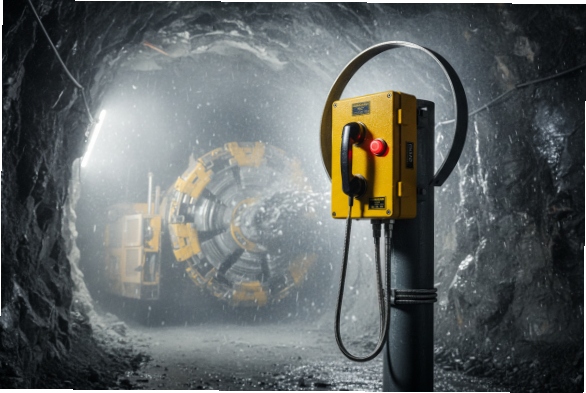
Tunnel construction is one of the most hazardous engineering frontiers, fraught with risks ranging from sudden methane pockets to massive water ingress and rockfalls. In these confined, deafening environments, a lost connection isn’t just an inconvenience; it can be a fatal point of failure. Can modern VoIP technology truly replace robust legacy systems in the headings?
Yes, explosion-proof SIP telephones are critical safety assets for tunnel construction. Designed to meet Group I (Mining) and Zone 1 standards for methane environments, they offer superior voice clarity over fiber backbones. Their IP67/IK10 ratings withstand hydraulic spray and blasting shock, while seamless integration with leaky-feeder and PAGA systems ensures unified site-wide communication.
The Digital Shift Underground
Tunneling has evolved from brute force excavation to high-tech precision engineering using Tunnel Boring Machines 1 (TBMs) and roadheaders. Yet, the environment remains hostile. High humidity, conductive dust, and the constant threat of "firedamp" (methane) make standard electronics a liability.
At DJSlink, we’ve observed a massive shift from analog "magneto" phones to SIP 2-based IP telephony in underground projects. Why? Because tunnels now run on fiber optics. The same cable backbone managing the TBM’s telemetry and CCTV can now carry high-definition voice traffic.
However, bringing a phone into a tunnel heading requires more than just an Ethernet port. It requires certification against the unique physics of underground disasters.
| Hazard Category | Tunnel Specific Risk | Solution Spec |
|---|---|---|
| Atmosphere | Methane (CH4) / Coal Dust | Group I (Mining) / Zone 1 |
| Physical | Shotcrete Overspray / Water | IP67 Sealing |
| Mechanical | Blasting / Rock Impact | IK10 3 High Impact Housing |
Which Zone 1/2 or methane/coal dust ratings apply in headings?
The "heading" or face of the tunnel is the most volatile area. Here, the rock is freshly cut, liberating trapped gases.
For tunneling, specifically in gassy conditions (coal seams or organic rock), equipment must usually meet "Group I, Category M1 or M2" standards (Mining). In non-mining civil tunnels with potential gas, Zone 1 (Gas) and Zone 21 (Dust) ratings are standard. The device must be certified "Ex d" (Flameproof) or "Ex ia" (Intrinsically Safe) to prevent igniting methane.
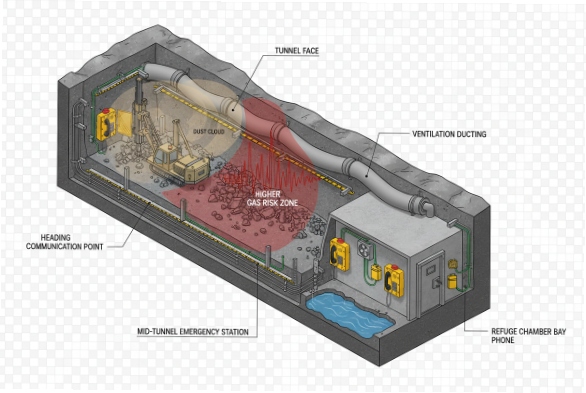
It is crucial to distinguish between surface industry (Group II) and underground mining (Group I) certifications.
- Group I (Mining): This is specific to underground mines susceptible to firedamp 4 (methane) and combustible dust. Equipment here is rated M1 (remains energized in explosive atmosphere) or M2 (must be de-energized). For critical SOS phones, M1 is preferred so communication remains active even during a gas alarm.
- Group II (Civil Tunnels): For utility tunnels or subway construction where coal is not present but methane might seep from soil, Zone 1 (Gas) certification is typically sufficient.
- The T Rating: Methane ignites at relatively high temperatures, but coal dust can smolder. A T6 rating (surface temp < 85°C) is the safest bet to cover all bases.
Will IP67, IK10 phones survive water spray, shock, and mucking vibration?
A tunnel is essentially a wet, vibrating pipe. Phones are sprayed with shotcrete, doused by groundwater, and rattled by heavy machinery.
Absolutely. IP67 ratings guarantee the phone withstands high-pressure water jets and temporary submersion—vital for areas prone to flooding. An IK10 impact rating means the 316L stainless steel or GRP housing can survive a 20-joule direct hit, such as debris from a mucking loader or accidental tool strikes.
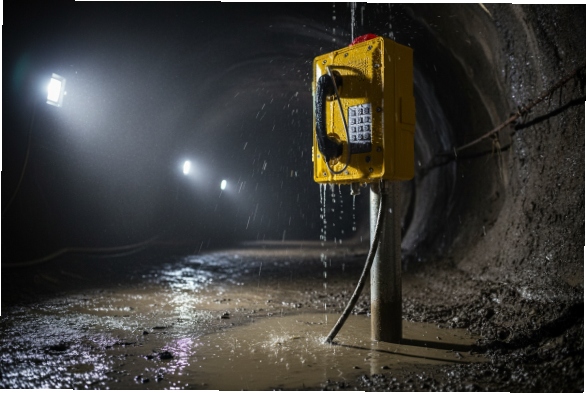
Surviving the "Mucking" Phase
"Mucking" (debris removal) is brutal on infrastructure.
- Water & Slurry: Tunnels are wet. Whether it’s drilling fluid or natural seepage, water is everywhere. An IP66 phone might survive rain, but an IP67 5 phone survives being submerged in a rising puddle if a pump fails.
- Corrosion: Tunnel water is often acidic or saline. Stainless Steel 316L housings are mandatory here. Aluminum will pit and corrode within months.
- Vibration: The constant rumble of the TBM or drill-and-blast shockwaves can loosen internal ribbons. Our phones utilize "potted" electronics and screw-terminal connections (not just friction clips) to ensure the circuit remains intact during blasting.
Can units tie into IP PBX, PAGA, leaky-feeder, and SOS call boxes?
A tunnel phone cannot be an isolated island. It must bridge the gap between the wired and wireless worlds.
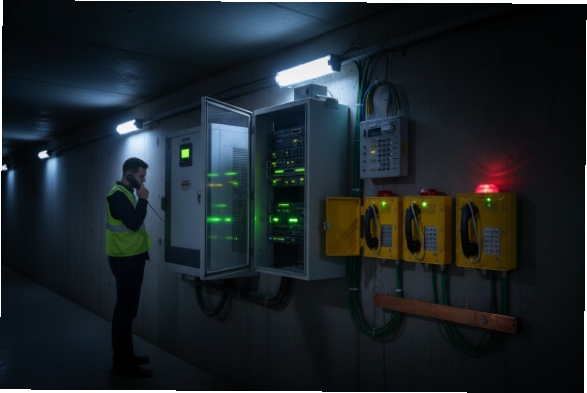
Yes, SIP phones seamlessly register to the site’s IP PBX. Through Radio-over-IP (RoIP) gateways, they can communicate directly with handheld radios on the "leaky-feeder" network. They also function as PAGA nodes, driving external strobe-horns to alert workers who are not carrying radios, effectively acting as fixed SOS stations.
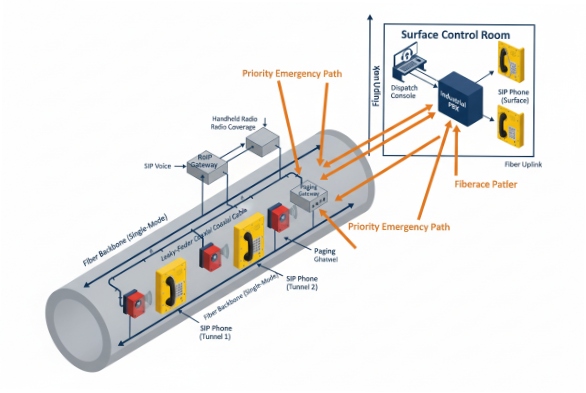
The Unified Comms Backbone
In a modern tunnel, the "Leaky Feeder" (a coaxial cable acting as an antenna) handles mobile radios, while fiber handles data. The SIP phone bridges these.
- Leaky-Feeder Interface: A supervisor on the surface using a SIP desk phone can dial a code that patches them through to the walkie-talkie channel underground.
- PAGA (Public Address): In a noisy TBM backup train, a ringer is useless. The SIP phone’s auxiliary relays trigger a 110dB Sounder/Beacon. The phone itself becomes a PA speaker, allowing the control room to broadcast evacuation orders.
- SOS Functionality: These phones are often configured as "Hotlines." Lifting the handset immediately dials the Safety Officer. Programmable buttons can trigger specific emergency workflows, like "Medical Emergency" or "Fire."
What intrinsically safe barriers and emergency power are required?
Safety runs on power. When the main lights go out, the phone must stay on.
For "Ex ia" (Intrinsically Safe) installations, an isolated safety barrier is required in the safe zone (switchgear room) to limit energy on the Ethernet line. However, most robust tunnel phones are "Ex d" (Flameproof), which contain the explosion internally. Regardless of type, the network switch must be backed by an industrial UPS to ensure communication persists during power cuts.
The Power of PoE (Power over Ethernet)
One of the biggest advantages of SIP phones in tunnels is PoE 6.
- Centralized Backup: You don’t need batteries inside every phone (which are a hassle to replace). You simply put a large UPS (Uninterruptible Power Supply) at the network switch. If the tunnel power is cut, the phones stay alive via the Ethernet cable.
- Cable Protection: In Zone 1 areas, the Ethernet cable must be armored or run in conduit to prevent physical damage that could cause a spark.
- Couplers: For "Ex d" phones, specialized explosion-proof RJ45 couplers are used. These allow for maintenance without needing to open the heavy flameproof enclosure, exposing the electronics to humidity.
Conclusion
Tunnel construction demands communication gear that is as tough as the rock being excavated. By specifying Group I/Zone 1 certified SIP telephones with IP67/IK10 stainless steel housings, you ensure a lifeline that survives water, impact, and gas hazards. At DJSlink, we help you integrate these rugged devices into your leaky-feeder and fiber backbones, ensuring that when the environment gets tough, your team stays connected.
Footnotes
-
A machine used to excavate tunnels with a circular cross section through a variety of soil and rock strata. ↩
-
Session Initiation Protocol: A signaling protocol used for initiating, maintaining, and terminating real-time sessions that include voice, video and messaging applications. ↩
-
An international numeric classification for the degrees of protection provided by enclosures for electrical equipment against external mechanical impacts. ↩
-
Flammable gas found in coal mines, primarily consisting of methane. ↩
-
Ingress Protection Code: A standard that classifies and rates the degree of protection provided against intrusion, dust, accidental contact, and water. ↩
-
A technology for wired Ethernet LANs that allows the electrical current necessary for the operation of each device to be carried by the data cables rather than by power cords. ↩








