
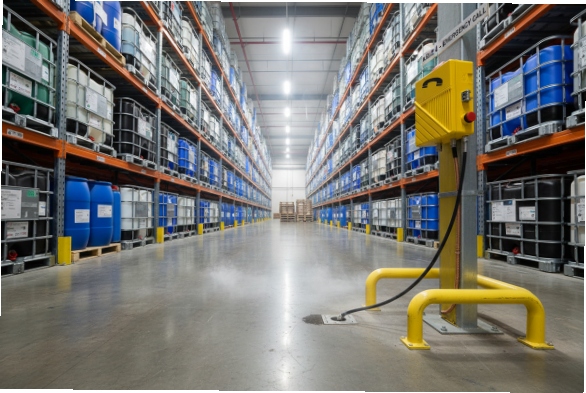
Chemical logistics is a high-stakes game. A forklift puncturing a drum of acetone or a seal failing on a volatile solvent container can instantly transform a quiet storage aisle into a flammable vapor cloud. In such a scenario, using a standard mobile phone or desk phone could trigger a catastrophic explosion.
Yes, explosion-proof SIP telephones are often required and highly recommended for hazardous chemical warehouses. While packaged storage is typically classified as Zone 2 or Class I Division 2 (where hazards are accidental), the potential for leaks necessitates equipment that cannot ignite vapors. They provide a critical, permanent emergency link that resists solvent corrosion and integrates with leak detection systems.
The Silent Risk in Storage
Unlike a refinery with roaring flares, a chemical warehouse is quiet. But the danger is latent. Volatile Organic Compounds (VOCs) like benzene, toluene, and ethers are commonly stored in Intermediate Bulk Containers (IBCs) or 55-gallon drums.
In my experience auditing logistics facilities, I’ve seen a common misconception: "Everything is sealed, so we don’t need Ex gear." This is dangerous thinking. A "perfectly sealed" warehouse doesn’t exist. Valves weep, drums dent, and accidents happen. When a spill occurs, the concentration of vapors near the floor (where heavier-than-air gases settle) can quickly reach the Lower Explosive Limit 1 (LEL).
Standardizing on explosion-proof SIP technology ensures that your emergency communication system works during the emergency, not just before it.
| Storage Type | Hazard Scenario | Typical Classification |
|---|---|---|
| Sealed Drums/IBCs | Accidental Puncture/Leak | Zone 2 / Class I Div 2 |
| Dispensing/Sampling | Open Transfer of Liquid | Zone 1 / Class I Div 1 |
| Flammable Solids | Dust from damaged bags | Zone 22 / Class II Div 2 |
When do Zone 1/2 or Class I Div 2 ratings apply to packaged storage?
The distinction usually lies in whether you are just storing or actively opening containers.
For purely packaged storage of sealed containers, Class I Division 2 (or Zone 2) applies, assuming the risk is limited to accidental rupture. However, if the warehouse includes a dispensing room or sampling area where liquids are transferred, that specific section elevates to Class I Division 1 (or Zone 1), requiring stricter equipment certification.

The "Accidental Release" Rule
-
Zone 2 2 / Class I Div 2:** This is the standard for most modern chemical warehouses. It assumes that explosive gases are not present under normal operation but could exist if a container fails or ventilation breaks down. Equipment here must be "Non-Incendive" or fully Explosion-Proof.
-
Zone 1 / Class I Div 1: Safety managers often upgrade to this rating for "Red Label" stores (highly flammable liquids like diethyl ether 3) to provide a safety margin.
-
Ventilation Factor: A warehouse with poor ventilation might be de-rated to a more hazardous zone because vapors from minor leaks aren’t cleared effectively.
Will IP66/67, antistatic enclosures withstand solvent vapors and sprinklers?
Chemical compatibility is just as important as the explosion rating.
Yes. We utilize IP66/IP67 enclosures made from antistatic Glass Reinforced Polyester (GRP) or 316L Stainless Steel. GRP is loaded with carbon to prevent static discharge (a major ignition source for solvents) and is immune to chemical attack. The high IP rating ensures the phone survives drenching from activated fire sprinkler systems.

Material Science for Solvents
-
Antistatic GRP: Plastic can build up a static charge 4 (like rubbing a balloon). In a solvent vapor cloud, a static spark is deadly. Our GRP housings are conductive enough to bleed off charge to earth, preventing sparks.
-
Chemical Resistance: Solvents like MEK (Methyl Ethyl Ketone) or Acetone can dissolve standard ABS plastics used in office phones. GRP and Stainless Steel are inert to these chemicals.
-
Water Damage: If a fire starts, the sprinklers will activate. A non-waterproof phone will short out instantly. Our IP67 rating 5 ensures the line stays open even when water is pouring down, allowing staff to coordinate the evacuation.
Can units connect to IP PBX, PAGA, gas/leak detectors, and fire alarms?
In a warehouse, the phone is a remote sentry.
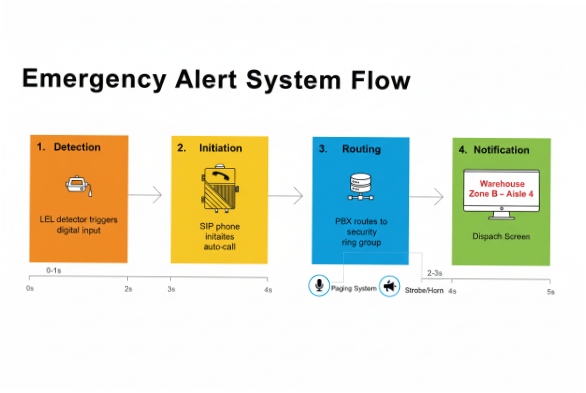
Absolutely. These SIP phones register to your corporate IP PBX (Cisco, Avaya, etc.). They feature Digital Inputs (DI) to interface directly with local gas/leak detectors—if a sensor detects a spill, the phone can auto-dial security. They also function as PAGA endpoints to broadcast evacuation instructions over the noise of fire alarms.
Automated Safety Responses
-
Leak Detection: A liquid sensor in the bund 6 (secondary containment) can be wired to the phone. Upon detecting liquid, the phone sends a SIP message to the facility manager: "Spill Detected in Aisle 4."
-
Man-Down/Lone Worker: Warehouses often have lone workers on night shifts. The phone can be configured with a timer; if the worker doesn’t press a button every hour, or if a "tilt switch" on a wearable panic button (linked via Bluetooth/RF) is triggered, the phone calls for help.
-
Fire Alarm Integration: When the main fire alarm triggers, it’s loud. The phone can boost this by flashing its integrated strobe beacon and broadcasting a clear voice message: "Fire in Zone B, Evacuate to Assembly Point 1."
What ventilation, T-class, and wiring methods pass audits?
Passing a safety audit requires attention to the "invisible" details.
Audits look for adequate air exchanges (6-12 per hour) to maintain Zone 2 status. Equipment typically requires a T-Class of T3 or T4 (auto-ignition temp >135°C/200°C) to cover most industrial solvents. Wiring must be mechanically protected (rigid conduit or armored cable) to survive forklift impacts.

The Auditor’s Checklist
-
Mechanical Protection: The #1 cause of failure in warehouses is forklifts. Cables must be run in rigid metal conduit or high-impact trays to prevent crushing.
-
T-Class (Temperature): Some chemicals, like Carbon Disulfide 7, have very low auto-ignition temperatures. While T3 covers 90% of chemicals, a universal T6 rating (surface temp <85°C) is the safest choice to ensure you never have to replace the phone if the stored inventory changes.
-
Seals: Even in Zone 2, cable entries must be properly glanded. Using a standard plastic stuffing gland is an immediate audit failure. Use certified Ex e or Ex d glands.
Conclusion
In hazardous chemical warehouses, the risk is often hidden in a drum or a valve. Installing Zone 2/Div 2 compliant, antistatic SIP telephones safeguards your workforce against accidental releases. By integrating these robust devices with leak detection and fire systems, you transform a passive communication tool into an active safety barrier, ensuring compliance and peace of mind.
Footnotes
-
The lowest concentration of a gas or vapor in air capable of producing a flash of fire in presence of an ignition source. ↩
-
A hazardous area classification where an explosive atmosphere is not likely to occur in normal operation but, if it does occur, will persist for a short period only. ↩
-
A colorless, highly volatile flammable liquid used as a solvent. ↩
-
An imbalance of electric charges within or on the surface of a material. ↩
-
Ingress Protection ratings defined by IEC standard 60529. ↩
-
A retaining wall around storage tanks designed to contain spills. ↩
-
A volatile liquid used in the manufacture of viscose rayon and cellophane. ↩








