
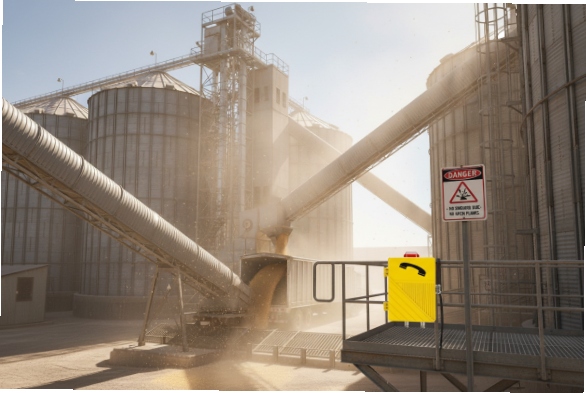
While everyone fears gas explosions in oil refineries, combustible dust is a silent killer in food processing, pharmaceuticals, and woodworking. A simple spark in a grain silo can trigger a blast powerful enough to level a building. If your facility deals with powder, flour, sugar, or metal shavings, you don’t need "flameproof" gas protection—you need Ex t dust protection.
Ex t protection is appropriate for environments defined as Zone 21 or Zone 22, where combustible dust clouds or layers are present (e.g., grain silos, sugar refineries, textile mills). It relies on a dust-tight enclosure (minimum IP6X) to prevent ingress and strictly limits the maximum surface temperature to prevent igniting settled dust.
The Underrated Hazard: Dust vs. Gas
At DJSlink, we often see clients over-specifying Ex d (Gas) phones for dusty environments, or worse, assuming an Ex d phone is automatically safe for dust. This is a dangerous assumption. Gas and Dust behave differently.
- Gas penetrates everywhere and ignites easily.
- Dust settles in layers, creating thermal insulation that can cause equipment to overheat and catch fire.
Ex t (Protection by Enclosure) is the specific standard (IEC 60079-31) designed to combat this. It doesn’t focus on containing an explosion (like Ex d); it focuses on keeping the fuel out.
Do Ex t enclosures address combustible dust layers/clouds?
A common misconception is that dust is only dangerous when it’s a cloud. In reality, the layers of dust accumulating on top of a hot telephone are often the ignition source.
Yes, Ex t enclosures are designed to handle both hazards. They prevent combustible dust clouds from entering the device (preventing internal ignition) and manage the external surface temperature to ensure that accumulated dust layers do not heat up to their smoldering point.
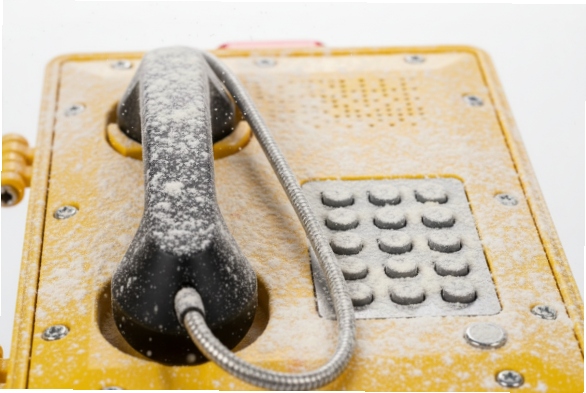
The Dual Threat Mechanism
-
The Cloud (Explosion): If dust enters the phone and touches a spark (from a relay or switch), it can explode. Ex t uses high-quality gaskets and seals to make the unit "Dust-Tight."
-
The Layer (Fire): Dust acts like a blanket. If a phone generates heat (e.g., from the power supply), a thick layer of dust prevents that heat from escaping. The temperature rises until the dust starts to smolder. Ex t certification involves rigorous thermal testing with dust layers applied.
DJSlink Critical Design: Our Ex t phones use oversized cooling fins and low-power electronics to ensure the case stays cool, even under a blanket of sawdust.
Which IP rating is required for Ex t marking?
You cannot have an Ex t product without a high Ingress Protection (IP) rating. The two are inextricably linked.
For Ex t certification, the enclosure must meet at least IP6X (Dust-Tight). The second digit (water protection) varies, but the standard requirement for industrial telephones is typically IP66 (Dust-tight and protected against powerful water jets), ensuring the device remains sealed even during wash-downs.
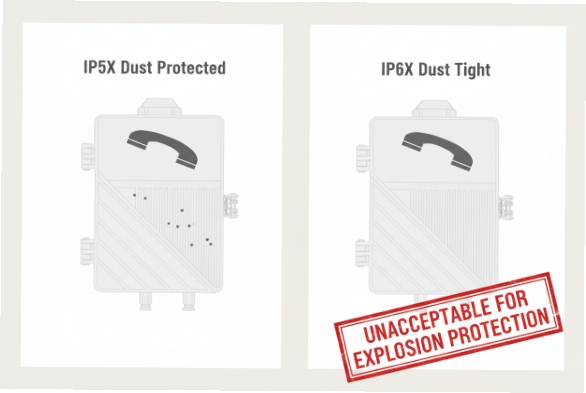
Why IP5X Is Not Enough
-
IP5X 1 (Dust Protected): Allows some dust to enter, provided it doesn’t interfere with operation. This is unacceptable** for explosion protection.
-
IP6X (Dust Tight): Zero dust ingress allowed under vacuum test conditions.
The "Db" and "Dc" Levels
-
Ex tb (Zone 21): High protection. Requires IP6X.
-
Ex tc (Zone 22): Normal protection. Technically allows IP5X in some dry/clean setups, but reputable manufacturers like DJSlink standardize on IP66 for all models to eliminate risk.
What surface temperature classes apply in dust?
Gas uses "T-Classes" (T1-T6). Dust uses actual temperature values. This distinction is vital because a "T6" (85°C) gas rating doesn’t tell you the whole story about dust layer behavior.
Dust certification does not typically use T-Codes (T1-T6) alone; it explicitly states the Maximum Surface Temperature in degrees Celsius (e.g., T85°C or T135°C). This value must be lower than the ignition temperature of the specific dust cloud and at least 75°C lower than the smoldering temperature of a 5mm dust layer.
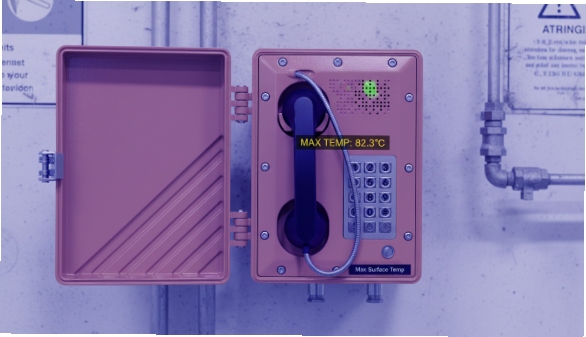
The Calculation You Must Know
When selecting a phone for a sugar refinery:
-
Cloud Ignition Temp: Sugar dust cloud ignites at ~370°C.
-
Layer Ignition Temp: Sugar layer (5mm) smolders at ~400°C.
-
The Safety Margin:
-
For Cloud: $2/3 \times T_{cloud}$
-
For Layer: $T_{layer} – 75^\circ C$
-
-
Result: You need a device rated significantly below these limits. A T85°C or T100°C rating is the safest bet for almost all agricultural and food dusts.
DJSlink Labeling: Our labels explicitly show Ex tb IIIC T85°C Db. This tells the safety officer exactly what the thermal limit is without needing a lookup table.
Are dust-tight glands and purges necessary?
You bought an IP66 Ex t telephone. Then your installer punched a hole in the bottom and used a cheap plastic gland. You have just voided the certification and endangered the facility.
Yes, certified Ex t cable glands (or dual-certified Ex d/Ex t glands) are mandatory to maintain the IP6X rating of the enclosure. While "purging" (Ex p) is an alternative protection method, it is complex and rarely used for telephones; simple, high-quality compression glands are the standard solution.
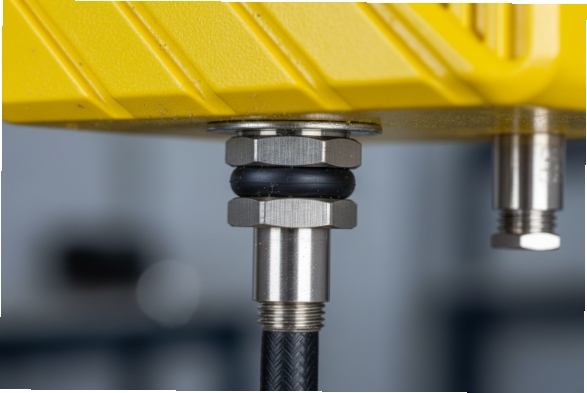
The Weakest Link
The cable entry is always the vulnerability.
-
The Gland: Must be marked
Ex torEx tb. It uses a compression seal (usually a rubber ring) that tightens around the cable to block dust. -
The Thread: Parallel threads (Metric) usually require a sealing washer (IP washer) between the gland and the housing to ensure the IP rating. Tapered threads (NPT) might seal on the threads themselves, but thread sealant is recommended.
-
Unused Entries: Must be closed with Ex t certified stopping plugs, not shipping caps.
DJSlink Advice: We supply our Ex t phones with the glands pre-installed or in the box. We strongly advise against using generic electrical glands found at a local hardware store. They may look the same, but they will not pass a combustible dust inspection.
Conclusion
Ex t protection is the shield for the world’s dusty industries—agriculture, food processing, and textiles. By relying on robust IP6X enclosures and strictly controlling surface temperature, these devices prevent catastrophic dust explosions. Remember, an Ex d gas certificate does not automatically cover dust; always look for the specific Ex tb IIIC T… marking and ensure your installation uses proper dust-tight glands to keep the seal intact.
Footnotes
-
Ingress Protection ratings defined by IEC 60529. ↩








