In the grain, sugar, and metal processing industries, dust is often underestimated. Yet, a fine layer of flour can be just as deadly as a gas leak. Mixing up "Da" and "Db" ratings isn’t just a compliance formality—it’s the difference between equipment that can survive being buried in combustible powder and equipment that might overheat and trigger a silo explosion.
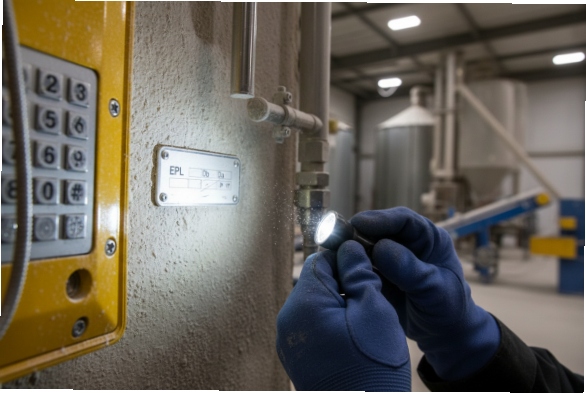
The distinction lies in the Zone and risk duration: Da (Very High Protection) is required for Zone 20 where dust is present continuously (e.g., inside a silo), protecting against two faults. Db (High Protection) is required for Zone 21 where dust is likely to occur occasionally (e.g., near a bagging station), protecting against one fault. You can identify them by the suffix on the label (e.g., Ex tb IIIC T85°C Db).
EPL: The Shield Against the Invisible Enemy
Dust is tricky because it has weight. Unlike gas, it settles. This creates two distinct hazards: the cloud (explosion) and the layer (fire/overheating). The Equipment Protection Level 1 (EPL)**—Da, Db, or Dc—tells you how well the device handles these stresses.
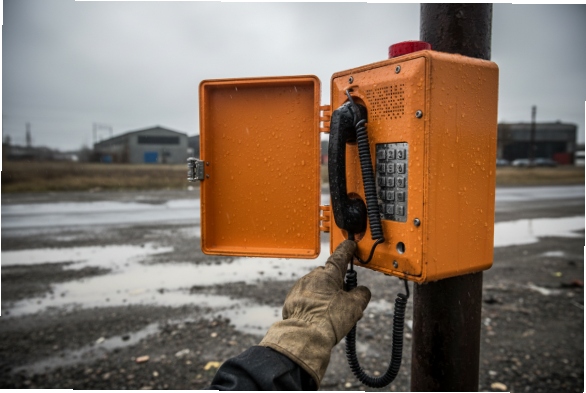
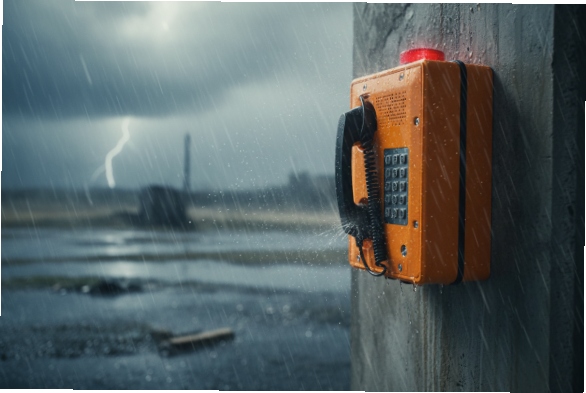
At DJSlink, we manufacture our telephones primarily to the Db standard. Why? Because while Da is the "Gold Standard" for safety, it is practically impossible to use a telephone inside a dust cloud where you can’t see or breathe. Db allows for robust protection in the working areas around the hazard.
Which Zones require Da versus Db equipment?
You must map the equipment to the environment. Installing a Db phone in a Da zone is a direct violation of safety codes like IEC 60079-14** 2.
Zone 20 (Continuous Dust) mandates Da equipment. Zone 21 (Occasional Dust) mandates Db equipment (or Da). Zone 22 (Rare Dust) mandates Dc equipment (or Da/Db).
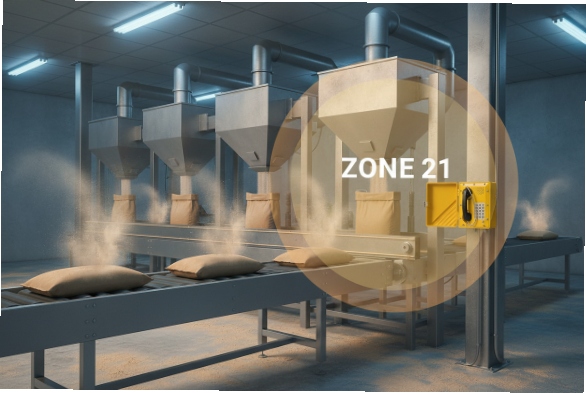
The Dust Zone Hierarchy
| Zone | Hazard Presence | Frequency | Required EPL | ATEX Category |
|---|---|---|---|---|
| Zone 20 | Continuous | Long periods (>1000 hrs/yr) | Da | 1D |
| Zone 21 | Occasional | Likely to occur (10-1000 hrs/yr) | Db | 2D |
| Zone 22 3 | Abnormal | Short periods (<10 hrs/yr) | Dc | 3D |
- Da Context: Think "Inside the bag filter" or "Inside the mixer." The device is submerged in dust.
- Db Context: Think "Next to the conveyor belt." Dust kicks up when the machine starts.
- Dc Context: Think "The warehouse floor." Dust only appears if a bag breaks.
Are Da devices mandatory inside silos or filters?
This is a common question from facility managers upgrading their comms systems.
Yes, if you must install equipment literally inside the storage volume of a silo or a dust collector filter housing, Da (Zone 20) certification is mandatory. However, for telephones, the best practice is to mount the device outside the silo in Zone 21 or 22, avoiding the need for expensive and rare Da-rated communication hardware.
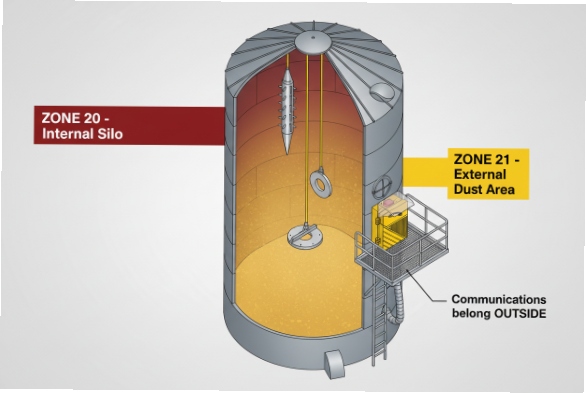
The "Inside-Out" Strategy
I always advise my clients: "Don’t make a phone call from inside a grain bin."
- Availability: There are almost no "Ex ta" (Zone 20) telephones on the market. The requirements for "Two Fault Tolerance" under 500mm of dust are extreme.
- The Solution: Mount the DJSlink Ex tb (Zone 21) telephone on the catwalk outside the silo access hatch. This area is typically classified as Zone 21 or 22, where our standard IP66 4 dust-tight phones perform perfectly.
How are surface temperatures determined for dust?
In gas, a "T6" rating is just a code. In dust, the temperature is a literal limit that prevents the device from turning into a hotplate that ignites the flour sitting on it.
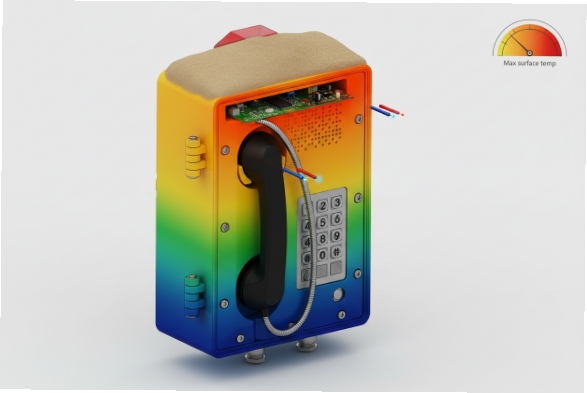
Surface temperature ratings (e.g., T85°C) are determined by testing the device under a specified layer of dust (usually 500mm for Da, or 5mm for Db) to ensure the maximum surface temperature never exceeds the ignition point 5 of the dust, even when the device’s own heat is trapped by the dust layer.**
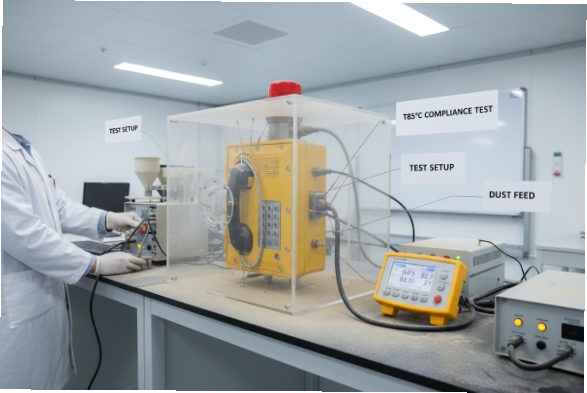
The "Thermal Blanket" Effect
Dust acts as insulation.
- Test: We run the phone at full power.
- Add Dust: For Da/Db testing, we cover it in dust.
- Measure: We measure how hot the case gets when the heat can’t escape.
- Rating: If the case stabilizes at 80°C, we mark it T85°C.
Critical Rule: You must select a device where the marked temperature is:
- 75°C lower than the dust layer smoldering temperature ($T_{5mm}$).
- 2/3 of the dust cloud ignition temperature ($T_{cloud}$).
DJSlink Labeling: Our labels explicitly show Ex tb IIIC T85°C Db. This tells the safety officer exactly what the thermal limit is without needing a lookup table.
What cleaning intervals maintain Da/Db integrity?
Certification assumes you are maintaining the facility. If you let 50cm of dust bury a Zone 22 (Dc) phone, you have physically changed the zone to Zone 20 conditions, which the phone is not designed to handle.
Regular cleaning is vital to maintain the "Db" or "Dc" integrity. Standard Db ratings typically assume a maximum dust layer depth of 5mm. If dust accumulation exceeds this, the thermal insulation increases, potentially invalidating the T-rating and causing ignition. You must establish a cleaning schedule to keep layers below 5mm.
The "X" Condition: Clean Me!
Many certificates carry an "X" suffix (e.g., IECEx … 001X). For dust equipment, this almost always refers to:
- "Potential Electrostatic Charge Risk – Clean only with a damp cloth." (Dry wiping creates static sparks** 6).
- "Do not allow dust layers to accumulate above 5mm."
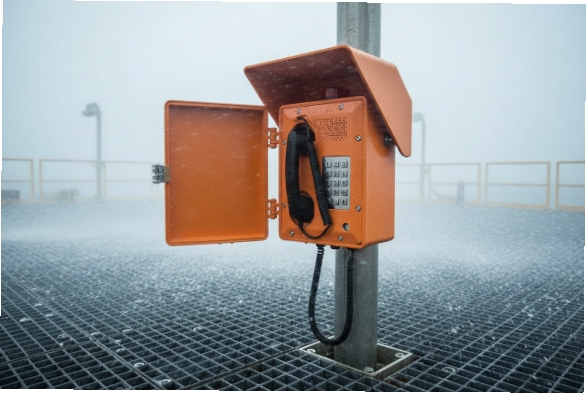
DJSlink Maintenance Tip: In high-dust environments like flour mills, we recommend installing our phones with sloped protective hoods. This prevents dust from piling up on the top surface of the phone, passively keeping the layer thickness down between cleaning cycles.
Conclusion
Distinguishing Da and Db is about understanding the intensity of the dust exposure. Da is for the heart of the dust cloud (Zone 20), while Db is for the working areas (Zone 21). Since telephones are for people, and people shouldn’t be inside silos, Db (Zone 21) is the industry standard for voice comms. However, you must respect the physics of dust: keep the units clean (under 5mm) and ensure your surface temperature rating stays well below the smoldering point of your specific product.
Footnotes
-
A guide to the marking of electrical equipment for explosive atmospheres. ↩
-
International standard for electrical installations design, selection and erection in explosive atmospheres. ↩
-
Health and Safety Executive guide to hazardous area classification. ↩
-
Ingress Protection ratings defined by IEC standard 60529. ↩
-
The lowest temperature at which a substance spontaneously ignites in a normal atmosphere without an external source of ignition. ↩
-
An imbalance of electric charges within or on the surface of a material. ↩