
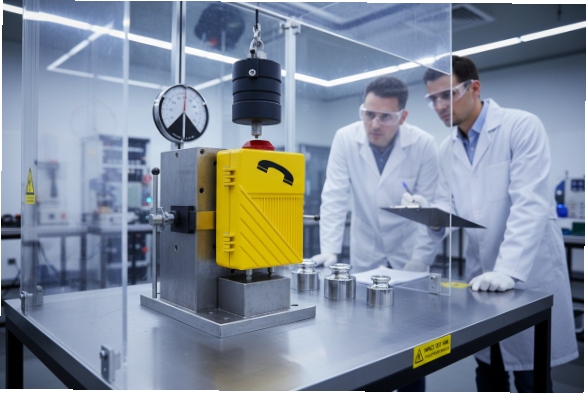
In heavy industrial environments, a telephone isn’t just a communication device; it’s a target for swinging tools, flying debris, and accidental impacts. A cracked housing in a hazardous area isn’t just cosmetic damage—it’s a breach of the explosion-proof enclosure that could lead to a catastrophic ignition.
For oil and gas, mining, and heavy manufacturing, the recommended rating is IK10. This ensures the device can withstand a direct impact of 20 Joules (equivalent to a 5kg mass dropped from 40cm) without compromising the enclosure’s integrity or the IP sealing required for safety.
The Armor of Industrial Comms
At DJSlink, we design our phones to take a beating. We know that on a drilling rig, equipment gets hit. The IK Rating (defined by IEC 62262) is the standard metric for "mechanical impact protection." While office phones have no rating, industrial safety gear must be armored.
Many buyers overlook this, focusing only on the "Ex" rating. But if a wrench falls on a plastic Ex phone and cracks the casing, that "Ex" rating is instantly void. The IK rating is your insurance policy against mechanical abuse.
What do IK08, IK09, and IK10 mean under IEC 62262?
The IK code is a simple scale, but the energy difference is exponential. Understanding the jump from 08 to 10 helps justify the investment in rugged hardware.
IK08 represents protection against 5 Joules of impact. IK09 doubles that to 10 Joules. IK10 doubles it again to 20 Joules. In practical terms, IK08 survives a hammer blow, while IK10 survives a sledgehammer impact or a heavy steel pipe falling on the unit.
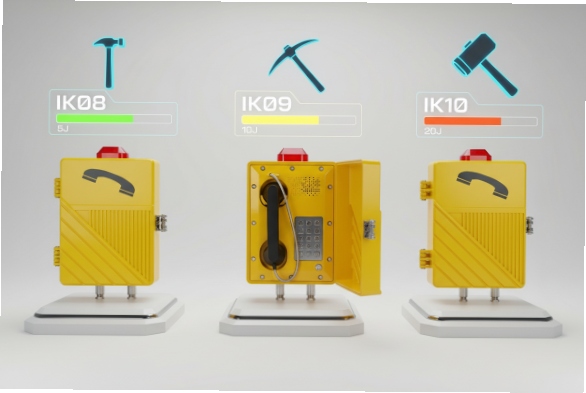
The Energy Scale (IEC 62262)
The test involves dropping a specific mass from a specific height directly onto the weakest point of the device.
| IK Code | Impact Energy | Test Equivalent | Protection Level |
|---|---|---|---|
| IK07 | 2 Joules | 0.5kg from 40cm | Vandal Resistant (Light) |
| IK08 | 5 Joules | 1.7kg from 30cm | Standard Industrial |
| IK09 | 10 Joules | 5.0kg from 20cm | High Protection |
| IK10 | 20 Joules | 5.0kg from 40cm | Maximum Vandal/Impact Proof |
Critical Insight: Most "robust" commercial electronics stop at IK07 or IK08. For a hazardous area where a cracked screen means a potential spark escape, DJSlink engineers for IK10 on the housing and at least IK09 on the handset receiver.
Which IK rating suits oil and gas or mining sites with harsh impacts?
In a mining tunnel or on an offshore deck, impacts are violent and frequent. A "standard" industrial phone will not survive the first week of maintenance operations.
Oil and gas platforms and mining sites should strictly specify IK10. These environments involve heavy machinery, vibration, and the constant risk of falling objects (dropped objects hazard). IK10 provides the necessary safety margin to ensure the flamepath remains intact even after a significant accidental blow.
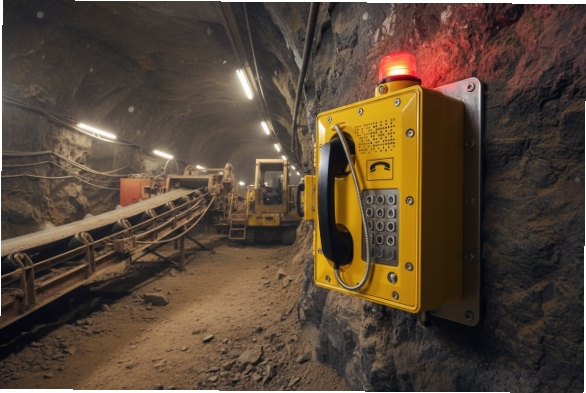
Why IK10 is Non-Negotiable in Heavy Industry
-
The "Dropped Object" Standard: Offshore safety protocols obsess over dropped objects. If a rigger drops a shackle from the deck above, it hits with tremendous force. IK10 gives the phone a fighting chance to survive without exposing live circuits.
-
Mining Abuse: In mines, equipment is often struck by vehicles or blasted rock. IK08 housings (often polycarbonate) can shatter.
-
Vandalism: In remote unmanned stations, vandalism is a real threat. IK10 makes the device nearly impossible to destroy without power tools.
DJSlink Recommendation: For heavy industry, accept nothing less than IK10 for the main enclosure. We also reinforce the handset cord (armored stainless steel) to resist pulling forces, which is a different kind of mechanical stress.
How do IK ratings relate to ATEX/IECEx certification and IP66/67 sealing?
The IK rating is not just about keeping the phone looking good; it’s about keeping the "Ex" protection valid. If the case deforms, the IP seal breaks. If the IP seal breaks, gas enters.
ATEX/IECEx standards (IEC 60079-0) include their own mandatory impact tests (typically 7 Joules for "High Risk"), which roughly equates to IK09. However, the IK rating is a separate test. Crucially, to maintain certification, the device must maintain its IP66/67 1 water sealing after sustaining the impact. If a test impact cracks the seal, the device fails both IK and Ex tests.**
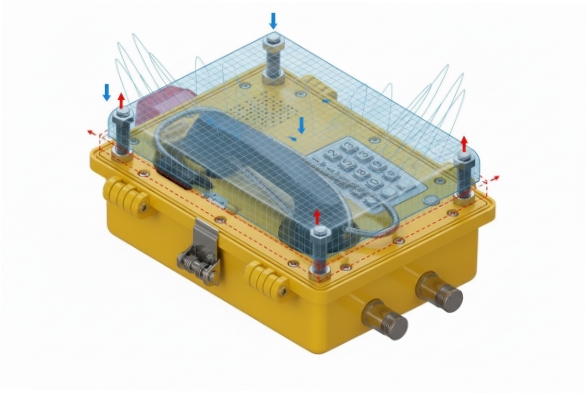
The "Survival" Criteria
When we test a DJSlink phone for IK10:
- Strike It: We drop the 5kg mass.
- Check Integrity:
- Ex d: The flameproof joint 2 must not be deformed. The gap cannot increase.
- Ex e/i: The IP seal must still hold water out.
- Function: The phone must still work.
- The Interdependency: You cannot claim "IP66" if an IK10 impact warps the lid and creates a gap. High-end engineering ensures the housing is rigid enough to absorb the shock without transferring deformation to the sealing gasket.
What materials and mounting methods help achieve IK10 in explosion-proof phones?
Achieving 20 Joules of protection requires smart material science. You either bounce the energy back (elasticity) or absorb it (rigidity).
To achieve IK10, manufacturers typically use thick-walled Cast Aluminum (durable but heavy), Stainless Steel 316L (strongest), or Glass Reinforced Polyester (GRP 3 – resilient). GRP is excellent because it has "memory" and bounces back without permanent denting. Secure, flat surface mounting is essential to prevent the housing from cracking under stress.**
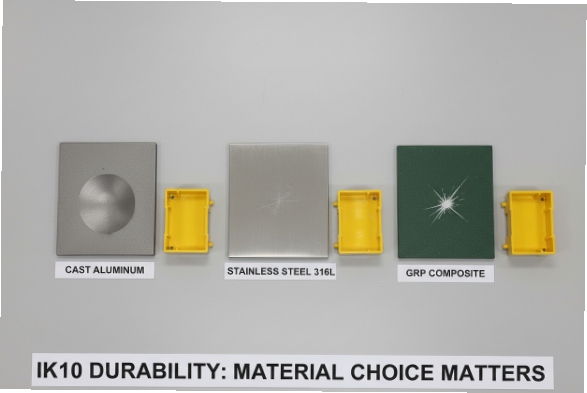
Material Pros & Cons for IK10
| Material | Impact Behavior | IK10 Feasibility | Weight |
|---|---|---|---|
| Aluminum (Cast) | Absorbs energy; may dent. | High | Medium |
| Stainless Steel 316L | Extremely rigid; resists deformation. | Very High | Heavy |
| GRP (Polyester) | Elastic; bounces back. No corrosion. | High | Light |
Mounting Matters:
If you mount an IK10 phone on an uneven wall, you pre-stress the casing. When it gets hit, that pre-stress causes a crack.
- DJSlink Installation Tip: Always use the provided mounting plate or ensure the wall is flat. Use washers to distribute the load on the mounting ears. A properly mounted phone transfers the impact energy into the wall; a poorly mounted one absorbs it all and breaks.
Conclusion
For explosion-proof telephones, IK10 (20 Joules) is the standard of choice for oil, gas, and mining. It goes beyond the minimum ATEX requirements 4 to ensure that inevitable industrial accidents don’t turn into safety disasters. Whether you choose GRP or Stainless Steel for its rigidity, ensuring your device can withstand the blow while keeping its water seal (IP66) and flamepaths intact is critical for long-term safety.
Footnotes
-
Ingress Protection ratings defined by IEC standard 60529. ↩
-
The interface between two parts of an enclosure that prevents the transmission of an internal explosion. ↩
-
Glass Reinforced Plastic, a composite material made of a plastic matrix reinforced by fine fibers of glass. ↩
-
The European Regulatory Framework for Manufacture, Installation and Use of Equipment in Explosive Atmospheres. ↩








