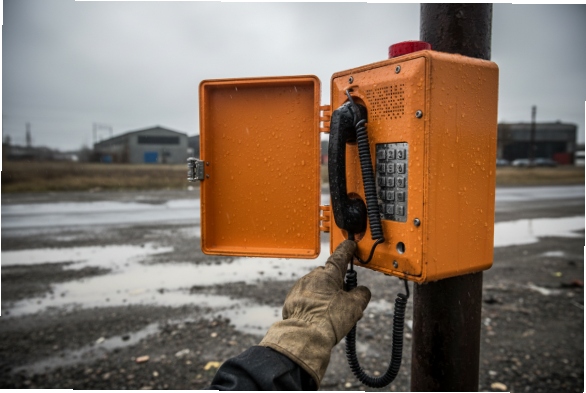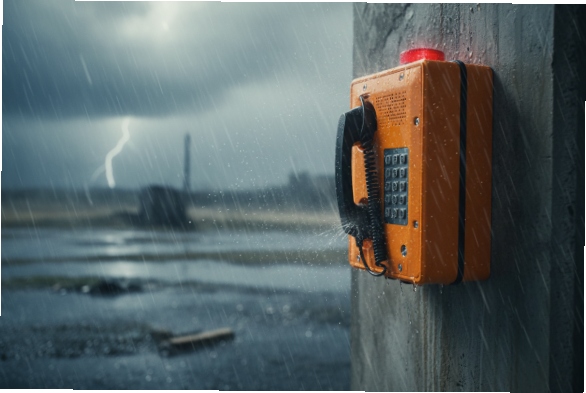
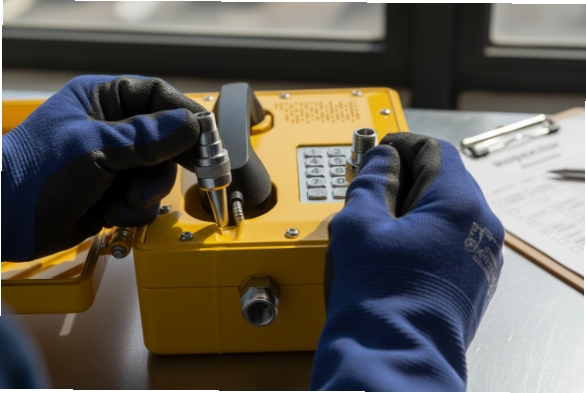
Wrong cable entry threads turn a certified explosion-proof telephone into a liability. The gland will not seat, water creeps in, and inspectors start asking hard questions.
NPT is an inch-based tapered thread that seals by thread interference; metric (usually Mx1.5) is a straight ISO thread that seals with a gasket or O-ring on the gland. The right choice is the one listed on the device and gland certificates and accepted by your local electrical code.
How NPT and metric cable entries behave in Ex enclosures
Thread geometry decides how it seals
NPT (National Pipe Taper 1) uses a taper. As the male thread goes in, the flanks press tighter. That interference is part of the seal. Metric cable entries on Ex equipment are most often ISO metric 2 parallel threads like M20×1.5, M25×1.5, or M32×1.5. Parallel threads do not “wedge” to seal. They usually rely on a seal outside the thread, like an O-ring, a flat gasket, or a shoulder washer on the gland or adaptor.
This matters more on explosion-proof (Ex d 3 / flameproof) telephones than on ordinary boxes. The entry is not only about water. It also touches compliance, flamepath 4 design, and mechanical strength.
“Explosion-proof” is not one global rule
North America often leans on NEC/CEC 5 practices where NPT is common in hazardous locations. Many IECEx/ATEX 6 projects default to metric glands. But the real rule is not geography alone. It is the marking, the certificate, and the installation standard your site uses.
Practical comparisons that prevent field mistakes
| Topic | NPT (tapered) | Metric ISO (usually parallel) | What it means on site |
|---|---|---|---|
| Units | Inch-based | Millimeter-based | Pitch gauges and taps differ |
| Typical entry sizes | 1/2" NPT, 3/4" NPT | M20×1.5, M25×1.5 | “Close” is not compatible |
| Sealing method | Thread interference + sealant | Gasket/O-ring at face/shoulder | Don’t expect metric to seal on threads |
| Feel during install | Gets tighter fast | Tightens to a shoulder | Over-tightening risks damage |
| Field risk | Cross-threading in soft metals | Missing gasket/O-ring | Each fails differently |
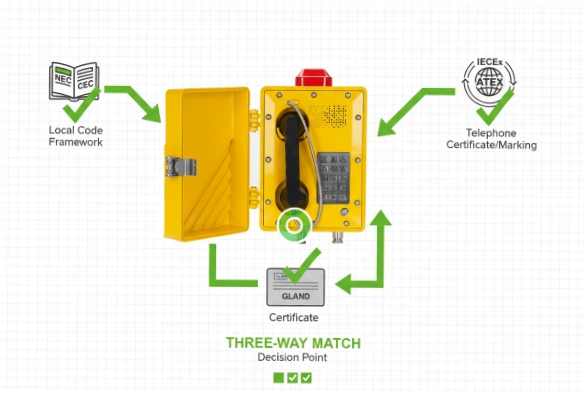
A safe habit is simple: treat the cable entry as a certified interface, not a convenience hole. When I support integrators, the fastest way to prevent rework is to lock three items together early: entry thread type, certified gland type, and local code preference.
Now the key question becomes selection and compliance, not just “which is better.”
So the next sections break down the decisions that most often cause rejected inspections or water ingress returns.
Which thread type matches local codes and certified glands?
If the thread does not match the local code and the gland certificate, the best telephone on paper becomes a problem in the field. That usually shows up on the first inspection.
Match the thread to the hazardous-area framework used on the site (NEC/CEC vs IEC/EN), then match it again to what is stated on the telephone certificate and the cable gland certificate. If any one of those three conflicts, choose a different entry or a different certified gland, not a “close enough” substitute.
Start from the site’s compliance language
Most sites fall into one of two working styles:
-
NEC/CEC style (often used in the US and Canada): NPT entries are common, and inspectors expect compatible conduit and fittings.
-
IEC/EN style (often used in Europe, Middle East projects, and many global EPC specs): metric glands are common, and the paperwork is often built around IECEx/ATEX component certificates.
This is not a hard border, but it is a strong pattern. The safe move is to check the project documents first: hazardous area classification method, installation standard called out, and what the client’s approved vendor list uses for glands.
Then read the device certificate and marking
Explosion-proof telephones are certified as a system. The certificate usually lists:
-
entry thread options (for example, M20×1.5, M25×1.5, 1/2" NPT, 3/4" NPT)
-
permitted accessories (like stopping plugs, adaptors, reducers)
-
limits (such as number of entries, minimum engagement, or required sealing parts)
If the certificate lists only metric entries, using an NPT adaptor just because the installer has NPT glands in the truck is a compliance risk. The reverse is also true.
Make sure the gland is certified for the same protection concept
A gland 7 is not “Ex” in general. It is certified for a concept, such as Ex d, Ex e, Ex t, and for cable types and temperature ranges. This is where many mismatches happen.
| Selection checkpoint | What to verify | Common field failure |
|---|---|---|
| Hazardous-area system | NEC/CEC vs IECEx/ATEX approach | Picking the “usual” thread without checking project basis |
| Telephone entry option | Listed thread type(s) on marking/cert | Using an unlisted adaptor or reducer |
| Gland certificate | Ex concept, thread type, cable type | Ex e gland used where Ex d barrier gland is required |
| Environmental needs | IP rating, UV, salt fog | Correct Ex but wrong corrosion class |
In my day-to-day support, the cleanest path is to standardize entries per region: provide metric entries for IEC-driven projects and NPT entries for NEC-driven projects, then keep gland brands consistent. It reduces mistakes, and it speeds up spare parts planning.
Do adaptors preserve IP/Ex ratings and flamepath integrity?
A small adaptor can look harmless, but it can change the certified interface. In hazardous areas, “mechanically fits” is not the same as “still certified.”
Adaptors can preserve IP and Ex performance only when they are themselves certified for the same protection concept, installed exactly as permitted by the equipment certificate, and they do not alter flamepath requirements like thread engagement, fit, or enclosure wall thickness. If any of those are unknown, assume the rating is compromised.
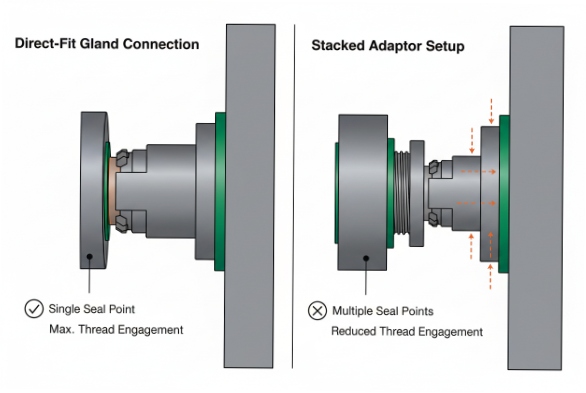
The big idea: an Ex d entry is not just a hole
For Ex d / explosion-proof (flameproof) enclosures, the entry threads can be part of a flamepath design. The fit, length, and engagement are not random. If an adaptor changes:
-
how many threads fully engage,
-
the material pairing and wear behavior,
-
the wall thickness around the entry,
-
the effective flamepath length,
then it can step outside what the certification covered.
IP rating is easier to break than people expect
Even when Ex compliance is still valid, IP can drop fast if:
-
the adaptor does not have an O-ring or sealing face where needed,
-
the gasket is missing, cut, or installed dry,
-
the adaptor bottoms out before the seal compresses,
-
the adaptor shoulder does not sit flat on the enclosure.
Parallel metric systems often rely on a face seal. If someone swaps to an adaptor that seals only on threads, it can pass a quick visual check and still leak under washdown.
When adaptors are acceptable in practice
These are the conditions that keep adaptors in the “safe” lane:
-
The adaptor is certified for the same hazardous concept and temperature range.
-
The equipment certificate or instructions allow adaptors/reducers.
-
The adaptor uses the correct sealing method for the entry type (face seal vs taper seal).
-
Thread engagement is not reduced below what the manufacturer requires.
-
Stopping plugs and unused entries remain certified and correctly installed.
| Adaptor type | Typical use | Key risk | Safer control |
|---|---|---|---|
| Metric-to-metric reducer | Standardizing gland size | Reduced thread engagement | Use listed reducer and verify full engagement |
| NPT-to-metric adaptor | Converting to local gland stock | Wrong sealing method | Use certified adaptor with correct gasket/O-ring |
| Entry extension | Clearance for armor or bend radius | Added leverage on threads | Use support clamps and approved components |
My default recommendation is simple: avoid adaptors unless the certificate and the adaptor certification both support the setup. If the project must use adaptors, treat them as engineered parts, not installer creativity. That mindset prevents most IP failures and paperwork fights.
What torque specs prevent thread galling and leaks?
Most entry failures are not dramatic. They are slow leaks, cracked coatings, or threads that seize during maintenance. Torque is where those problems start.
Use the cable gland manufacturer’s torque chart for the exact gland model and thread size, then follow the enclosure maker’s limits. Use correct lubrication rules for the material pair, and tighten to achieve seal compression, not “as tight as possible.” Over-torque causes galling, stripped threads, and seal damage.
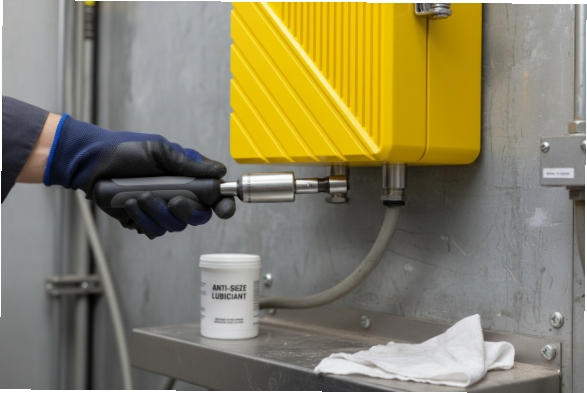
Why “one torque number” is a trap
Torque depends on many variables:
-
thread size and pitch,
-
taper vs parallel design,
-
gland body material (brass, stainless, nickel-plated brass),
-
enclosure material (aluminum, stainless, painted steel),
-
lubrication and surface finish,
-
sealing method (O-ring compression vs thread sealant).
So the only defensible torque spec is the one from the gland and enclosure documentation. If a field team needs a rule-of-thumb, it should be a process rule, not a universal torque number.
A practical tightening process that works in the field
-
Confirm thread type with a gauge before starting. Cross-threading is common when people assume.
-
For metric parallel entries, make sure the O-ring/gasket is present and clean. Lightly lubricate the seal if the gland maker allows it.
-
Tighten by hand until the sealing face seats. Then use a torque wrench on the flats to reach the specified value.
-
For NPT tapered entries, stop chasing torque. Focus on engagement and sealing method approved for the gland and enclosure. Use the approved thread compound if required, and keep compound out of the enclosure interior.
-
After tightening, do a quick mechanical check: the gland should not rock, and the seal should be compressed evenly.
Galling control is mostly about material pairing
Stainless-on-stainless is the classic galling case. For that pairing:
-
Use an anti-seize compound approved for the environment and the installation rules.
-
Avoid repeated dry assembly and disassembly.
-
Use controlled torque and smooth motion, not impact tools.
| Risk | Cause | Prevention |
|---|---|---|
| Galling (seizing) | Stainless-on-stainless, dry threads, high speed tightening | Approved anti-seize, slow tightening, correct torque |
| Stripped threads | Over-torque, soft enclosure (often aluminum) | Follow enclosure limits, use correct thread engagement |
| Leaks on metric entries | Missing O-ring, uneven seating | Replace seals, ensure flat seating, torque to spec |
| Leaks on NPT | Wrong sealant or too little engagement | Use approved compound, confirm engagement depth |
In factory support cases, the most reliable fix is not “tighten more.” It is “tighten correctly, with the right seal parts, and with the right lubrication.” That is what keeps both the Ex interface and the IP rating 8 sealing stable over time.
Are stainless or plated brass entries better for corrosion control?
Corrosion is not only about the gland body. It is also about galvanic pairs, coatings, salt deposits, and maintenance cycles. Picking the wrong metal can turn a sealed entry into a frozen one.
Nickel-plated brass is often the best balance for general industrial and marine atmospheres because it resists corrosion and reduces galling risk. Stainless steel (usually 316) can be better for aggressive chemicals and high-chloride exposure, but it raises galling and galvanic concerns, especially with aluminum enclosures. The best choice is the one that matches the site’s corrosion class and the enclosure material.

What corrosion looks like in real projects
In coastal sites, corrosion is often crevice and salt-driven. In chemical plants, it can be acid or solvent exposure. In tunnels and wastewater, it can be humidity plus sulfides. Each environment punishes different materials.
Brass, plated brass, and stainless each have a “best use”
-
Nickel-plated brass: strong general-purpose option. The plating adds corrosion resistance, and brass threads reduce galling. Many integrators like it for mixed indoor/outdoor installs.
-
DZR brass (dezincification resistant): better than standard brass in some warm, wet, chloride-heavy conditions where dezincification is a concern.
-
316 stainless: high resistance to many corrosives and chlorides, so it can win in marine and chemical zones. But stainless threads can seize without correct assembly practice.
-
Stainless on aluminum: watch galvanic corrosion. If the enclosure is aluminum, the joint can become a galvanic couple, especially in salty moisture. Isolation washers or approved barrier coatings help.
A simple selection matrix that prevents early failures
| Site condition | Common best pick | Watch-outs | Add-on controls |
|---|---|---|---|
| General industrial outdoor | Nickel-plated brass | Scratched plating | Use proper tools, avoid pipe wrenches on plated parts |
| Coastal / marine air | 316 stainless or plated brass | Stainless galling 9 | Use anti-seize and controlled torque |
| Chemical splash zones | 316 stainless (sometimes special alloys) | Seal compatibility | Confirm gasket material and cable jacket compatibility |
| Aluminum enclosure projects | Plated brass often safer | Brass in harsh chemicals | Consider DZR brass, use protective coatings |
Corrosion control is also sealing control
Corrosion products can lift seals, block drain paths, and lock threads. So corrosion control is not cosmetic. It protects IP performance and serviceability.
When supplying explosion-proof telephones, the cleanest approach is to offer entry options that match both compliance and environment. In many projects, that means stocking M20/M25 and 1/2" NPT variants, and pairing them with gland materials that match the site’s corrosion class. At DJSlink, that is how most repeat buyers reduce installation risk and reduce spare part confusion.
Conclusion
Choose the entry thread that your code and certificates allow, use certified glands and adaptors only when permitted, tighten to documented torque, and pick metals that match the corrosion reality on site. This attention to detail prevents galvanic pairs 10 and ensures long-term safety.
Footnotes
-
U.S. standard for tapered threads used in pipes and fittings. ↩
-
The worldwide standard for general-purpose parallel screw threads. ↩
-
Protection method capable of withstanding internal explosions. ↩
-
Designated interface gap to cool escaping hot gases. ↩
-
Primary electrical safety standards used in North America. ↩
-
International standards for equipment in explosive atmospheres. ↩
-
Device designed to attach and seal the end of a cable. ↩
-
Standard defining levels of sealing effectiveness against dust and water. ↩
-
Form of wear caused by adhesion between sliding surfaces. ↩
-
Corrosion caused by electrical contact between dissimilar metals. ↩