
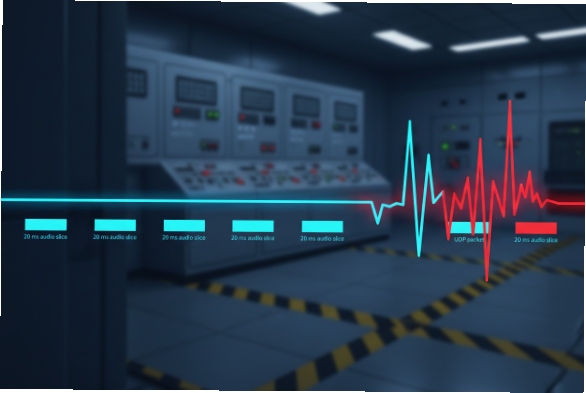
In a quiet office, a little static on a call is annoying. In a noisy refinery control room, a dropped syllable can mean the difference between shutting down a valve or causing a spill. "Robotic" or choppy audio isn’t just a nuisance; it’s a communication breakdown that compromises the safety integrity of your hazardous area.
An explosion-proof SIP phone generally requires packet loss to be maintained below 1% for toll-quality voice. Loss between 1% and 3% results in noticeable "robotic" artifacts, while loss exceeding 5% often renders speech unintelligible. Tolerance varies significantly based on the audio codec (e.g., Opus vs. G.711) and the effectiveness of the device’s Packet Loss Concealment (PLC) algorithms.
The Fragility of Voice over IP in Industry
At DJSlink, we build hardware to survive explosions, but we rely on your network to survive the data transmission. Voice over IP 1 (VoIP) uses UDP (User Datagram Protocol), which is "fire and forget." If a packet drops, there is no time to resend it. It’s gone forever.
In industrial environments, where networks are often stretched over long fiber runs or congested wireless links, maintaining a pristine data stream is challenging. When packets vanish, the phone’s processor has to guess what the missing sound was. This guessing game is where quality dies.
What packet loss percentage typically causes choppy or robotic audio on SIP voice calls?
Engineers often ask me for a "hard number" to put in their Service Level Agreement (SLA). While it depends on the ear of the listener, the industry standards are clear.
Ideally, packet loss should be 0%. In practice, loss below 1% is imperceptible. At 3% loss, the audio becomes "metallic" or "robotic" as the DSP struggles to bridge the gaps. Above 5% loss, entire words drop out ("clipping"), and above 10%, the conversation is typically impossible to sustain.

The "Robotic" Effect
Why does it sound robotic?
-
The Gap: A packet usually contains 20ms of audio. If it’s lost, there is a 20ms silence.
-
The Fix (PLC): To prevent clicking sounds, the phone’s Packet Loss Concealment 2 (PLC) algorithm repeats the last sound or interpolates the wave.
-
The Result: When too many packets drop, this stretching and repeating creates that synthetic, metallic alien voice.
DJSlink Critical Threshold: For emergency PA broadcasts over SIP, we recommend designing the network for <0.5% packet loss. You cannot afford for an evacuation instruction to be misunderstood.
How do codec choice and jitter buffer settings change packet-loss tolerance?
If your network is imperfect, you can sometimes save the call by choosing a smarter "language" (codec) or a bigger "bucket" (buffer).
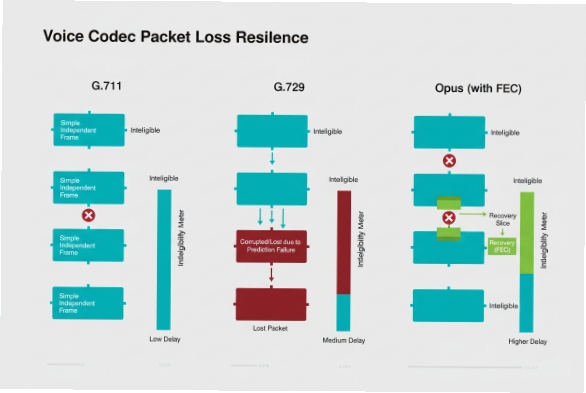
Modern codecs like Opus or G.722 often feature built-in Forward Error Correction (FEC) which can recover lost data, making them resilient up to 5-10% loss. Older codecs like G.729 are highly compressed, meaning a single lost packet destroys more audio information. Adaptive jitter buffers can help by smoothing out irregular arrival times, preventing "late" packets from being discarded as "lost."
The Codec Hierarchy
-
G.711 (PCMU/PCMA): The standard "uncompressed" codec. High bandwidth (64kbps), but decent tolerance because losing one packet doesn’t corrupt the next one.
-
G.729: High compression (8kbps). Saves bandwidth, but terrible with packet loss. If you lose a packet, the decoder loses track of the predictive model. Avoid this on poor networks.
-
Opus: The modern king. Variable bitrate and built-in Forward Error Correction 3 (FEC). It can send redundant data so that if packet A is lost, packet B carries a "mini-copy" of A to fill the gap.
Jitter Buffer Settings:
-
Fixed: Dangerous. If jitter 4 exceeds the fixed size, packets drop.
-
Adaptive: The DJSlink standard. The phone automatically expands the buffer (e.g., up to 300ms) when the network is jittery, trading slightly higher delay for smoother audio.
Which QoS and network design practices reduce packet loss in hazardous-area industrial sites?
You cannot treat voice traffic the same as CCTV data. If a camera drops a frame, video skips. If a phone drops a packet, the message is lost.
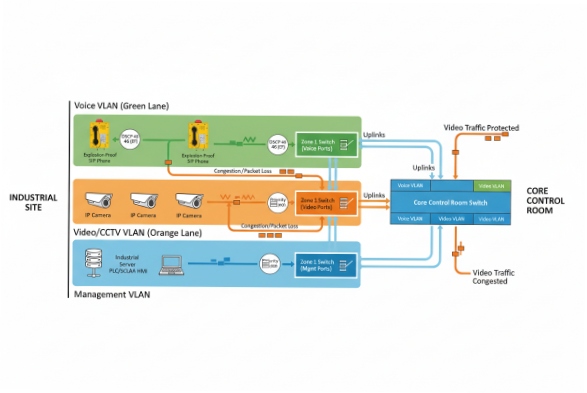
To minimize loss, voice traffic must be tagged with DSCP 46 (EF – Expedited Forwarding) and prioritized via QoS queues across all switches and routers. Physically, Industrial Ethernet cables should be shielded (STP) to prevent EMI from motors causing bit errors, and voice traffic should be segregated into a dedicated Voice VLAN to avoid contention with high-bandwidth CCTV streams.
The Industrial Bottlenecks
-
The Uplink: The most common point of failure is the uplink from the Zone 1 switch to the main control room. If 50 HD cameras and 20 phones share a 1Gbps link without QoS 5, the video will strangle the voice.
-
EMI/RFI: Large Variable Frequency Drives (VFDs) generate massive electromagnetic noise. If you run unshielded Ethernet (UTP) next to a VFD power cable, the interference will corrupt packets. Always use S/FTP cables in plants.
-
Duplex Mismatch: A simple configuration error (one side Half Duplex, one side Full) causes massive collisions and packet loss. Always hard-code or verify Auto-Neg settings.
How can packet loss, jitter, and MOS be verified during FAT/SAT and ongoing monitoring?
Don’t guess—measure. A "good" call is subjective; a "MOS 4.2" is objective.
During Factory Acceptance Tests (FAT), use network impairment emulators to prove the phone handles simulated loss. During Site Acceptance Tests (SAT), utilize the phone’s RTCP-XR (Extended Reports) to view real-time metrics. Ongoing monitoring should leverage SIP OPTIONS "heartbeats" and RTCP analysis tools to alert IT if the Mean Opinion Score (MOS) drops below 3.5.

The Verification Toolkit
-
Wireshark: The ultimate truth. Capture the call. Go to Telephony > RTP > Stream Analysis. It will show you exactly how many packets were lost and the max jitter.
-
Web Interface: DJSlink phones have a "Network Status" page. Log in during a call to see live "Lost Packet" counters.
-
MOS (Mean Opinion Score):
-
5: Perfect.
-
4: Toll Quality (Target > 4.0).
-
3: Fair (Cell phone quality).
-
<3: Unacceptable.
-
DJSlink SAT Protocol: We require a 24-hour "Burn-in" where phones make automated calls. We check the logs. If any phone shows >1% average loss, we reject the cabling installation for that node.
Conclusion
Packet loss is the silent killer of voice quality. While DJSlink phones are ruggedized against physical blows, they cannot fix a broken network. By maintaining packet loss < 1%, using resilient codecs like Opus, and strictly enforcing QoS (DSCP 46), you ensure that when the emergency button is pressed, the message comes through loud and clear.
Footnotes
-
Technology for delivering voice communications and multimedia sessions over Internet Protocol networks. ↩
-
Technique used in VoIP to mask the effects of packet loss by generating replacement audio. ↩
-
Error control method where the sender adds redundant data to allow recovery of lost information. ↩
-
Variation in the delay of received packets which can disrupt real-time audio and video. ↩
-
Mechanisms to prioritize specific network traffic to ensure performance for critical applications. ↩








