
In a deafening industrial plant where ambient noise levels exceed 95dB, a standard telephone ringer is useless. If an operator misses a control room call during an emergency shutdown, the consequences can be catastrophic. Relying solely on audio cues in a high-noise hazardous area is a failure of safety planning.
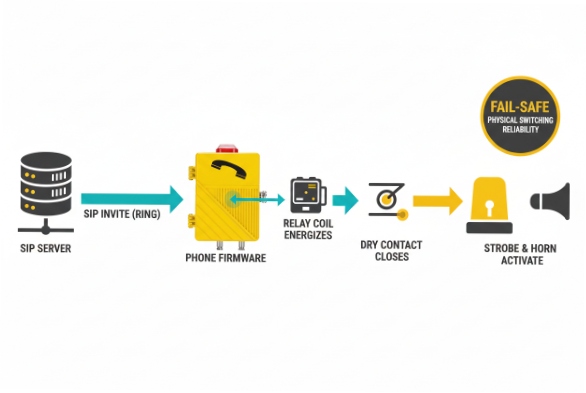
Yes, explosion-proof telephones are designed to interlock seamlessly with audio-visual (AV) alarms. This is typically achieved via built-in dry contact relays that physically switch on external beacons and horns when the phone rings, or through digital SIP triggers and Multicast paging that activate network-connected alarm systems across specific zones.
The Critical Role of Visual Signaling
At DJSlink, we understand that a telephone in an oil refinery or steel mill is not just for talking; it is a primary alerting node. When the phone rings, the entire workstation needs to know. This concept is called "Call Indication" or "Interlocking."
The integration transforms a passive communication device into an active warning system. When a call comes in, the phone acts as a relay station, triggering high-intensity strobe lights (usually Blue or Amber) and 110dB+ horns. This ensures that even if the operator is wearing double ear protection and facing away from the unit, the flashing light will catch their peripheral vision.
This interlocking capability is mandatory in many Oil & Gas specifications (like NORSOK or Aramco standards). It requires a blend of hardware engineering (relays) and software intelligence (SIP/Multicast) to ensure reliable operation without creating false alarms.
Do relay I/O or SIP events trigger beacons and horns?
The method of triggering depends on your infrastructure age and flexibility. The "Old School" hardware method is robust, while the "New School" software method offers infinite scalability.
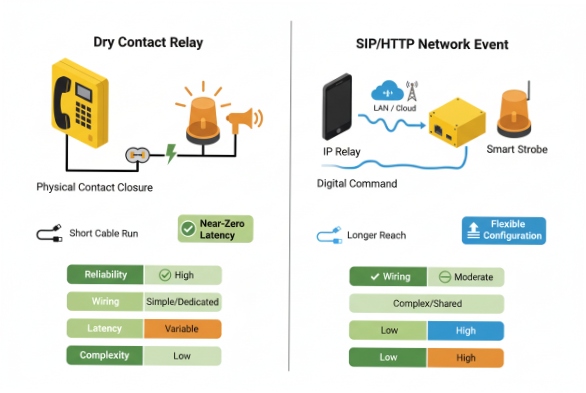
Both methods are widely used. Hardwired dry contact relays provide a fail-safe physical switch for local devices, ideal for standalone stations. SIP events or HTTP commands allow for sophisticated, software-based triggering of remote network relays or smart IP strobes, offering greater flexibility for complex integration.
The Hardware Approach: Built-in Relays
Most DJSlink industrial phones come equipped with at least one internal relay (Dry Contact, usually rated 3A @ 250VAC).
-
Logic: When the phone receives a SIP
INVITE(Ring), the firmware energizes the relay coil. The contact closes. -
Result: Power flows from an external source to the Strobe/Horn.
-
Pros: Extremely reliable. No network latency. Works even if the PBX is lagging.
-
Cons: Requires physical wiring between the phone and the light. Limited amperage (cannot drive a massive siren directly).
The Software Approach: SIP & HTTP
Modern VoIP phones can act as controllers.
-
SIP Forking: The PBX rings both the Phone Extension (101) and the Strobe Extension (102) simultaneously.
-
Action URL: When the phone rings, it sends an HTTP GET command to a smart WiFi relay across the plant to turn on a light.
-
Pros: No physical wire needed between phone and light. Infinite distance.
-
Cons: Relies on network stability.
Feature Comparison
| Feature | Dry Contact Relay | SIP / Network Event |
| :— | :— | :— |
| Reliability | High (Physical connection) | Medium (Network dependent) |
| Wiring | Heavy (Power cable to phone) | Light (Ethernet only) |
| Latency | Near Zero | Variable |
| Flexibility | Local only (1-5 meters) | Global (Anywhere on LAN) |
| Complexity | Low (Electrician skill) | High (IT Admin skill) |
Is multicast paging synchronized across zones?
When you need to evacuate a zone, you can’t have one speaker shouting "Evacuate" half a second after another. That creates a garbled echo that makes instructions unintelligible.
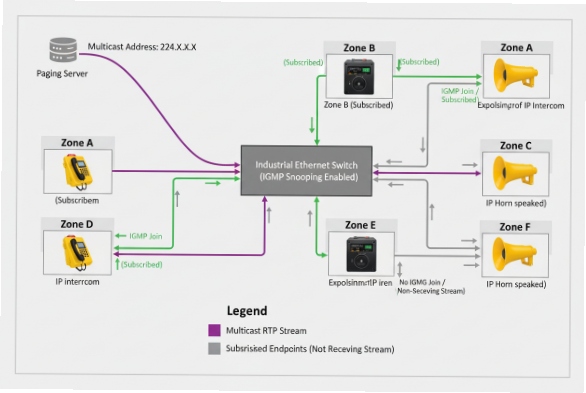
Yes, Multicast paging allows for synchronized broadcasting. By sending a single stream of Real-Time Transport Protocol (RTP) packets to a specific Multicast IP address, all subscribed telephones and intercoms play the audio simultaneously, minimizing latency and "echo" effects common with traditional unicast SIP paging.
The Power of Multicast in Safety
Multicast is the standard for industrial Public Address 1 (PA) and General Alarm (GA) systems integrated into telephony.
-
Bandwidth Efficiency: In a Unicast (SIP) call to 100 phones, the server sends 100 distinct streams. This crashes networks. In Multicast, the server sends one stream. The network switches copy it to the 100 ports. Bandwidth usage is negligible.
-
Zone Control: DJSlink phones can listen to multiple "Channels" (IP addresses).
-
224.0.0.1: All Call (Emergency) -
224.0.0.2: Zone A (Drilling Floor) -
224.0.0.3: Maintenance Team
-
-
Synchronization: Since every device receives the packet at virtually the same microsecond (depending on switch hops), the audio output is tightly synchronized. This drastically improves intelligibility in open halls where you might hear audio from two different speakers.
DJSlink Critical Note: Multicast requires IGMP Snooping 2 to be configured correctly on your industrial switches. If not, the multicast traffic will flood every port like a broadcast storm, potentially taking down your PLC 3 network.
Can alarm states be logged and acknowledged remotely?
If an alarm goes off in an unmanned pump house, who knows about it? And if someone investigates, how do they tell the system "I’m here"?
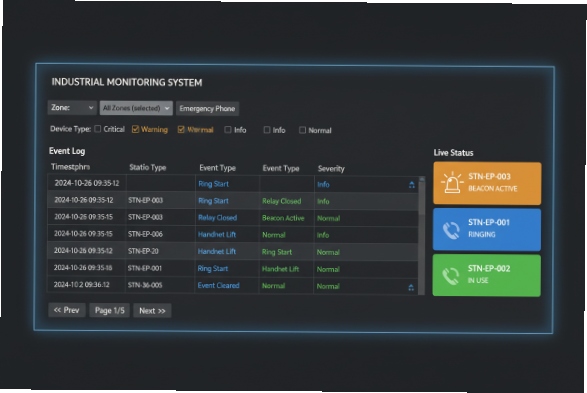
Modern systems support comprehensive logging via Syslog and SNMP traps sent to the central control system. Acknowledgement can be performed locally by lifting the handset or pressing a keypad code (DTMF), which can stop the beacon and log the "Event Cleared" status in the server’s history.
The Feedback Loop
An alarm system is only as good as its audit trail.
-
Logging: Every trigger event—"Ring Start," "Relay Open," "Relay Close," "Handset Lift"—is timestamped. This is crucial for post-incident investigations.
- Example: "Why was the pressure alarm ignored?" The logs might show the phone rang, the beacon activated, but nobody answered.
-
Remote Monitoring (SNMP): The phone can act as a sensor. If the external beacon bulb burns out (and the circuit has current monitoring), the phone can send an SNMP trap to IT: "Beacon Failure at Station 5."
-
Acknowledgment:
-
Scenario: A gas alarm triggers a multicast alert. The strobes are flashing everywhere.
-
Action: A supervisor walks to the DJSlink phone, dials a code (e.g.,
*99). -
Reaction: The system accepts the code, stops the strobes in that zone, and logs "Alarm Acknowledged by User X."
-
What Ex-rated drivers and power supplies are required?
You can’t just wire a standard 12V strobe to an explosion-proof phone. The interface itself must be safe.
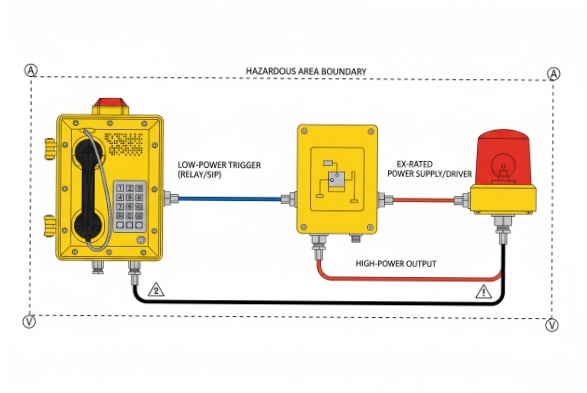
The driving interface must utilize Ex-certified components. If the phone powers the alarm directly via PoE+, the load is limited (typically <12W). For higher loads, an external Ex d relay box or an Ex-rated power supply is required to safely switch mains voltage to the explosion-proof beacon without compromising the hazardous area certification.
The Power Constraint
A common mistake is assuming the phone can power a massive searchlight.
-
PoE+ Limits: A PoE+ (802.3at) switch port provides ~25W. The phone consumes ~5W. That leaves ~20W for accessories.
-
Feasible: A small LED Ex beacon (5W) and a 10W horn.
-
Impossible: A rotating Halogen beacon (50W) or a motor siren.
-
-
The Relay Solution (Ex d): To drive high-power alarms, the phone’s internal relay switches an external power circuit.
- Danger: You cannot bring 220V unarmored cable into the phone just because the relay is rated for it. You must use Ex d cable glands and appropriate armored cable.
-
The Driver Box: For complex setups, DJSlink provides an external "Ex Driver Interface Box." It contains heavy-duty contactors and terminal blocks, keeping the high-current switching away from the sensitive VoIP electronics.
Conclusion
Interlocking explosion-proof telephones with AV alarms is the industry standard for ensuring calls and alerts are never missed. Whether using simple dry contacts for reliability or Multicast for synchronized zone paging, the system transforms your telephony network into a safety broadcasting grid. Always ensure your power calculations respect the PoE limits and use Ex-certified drivers for high-power external signals.








