
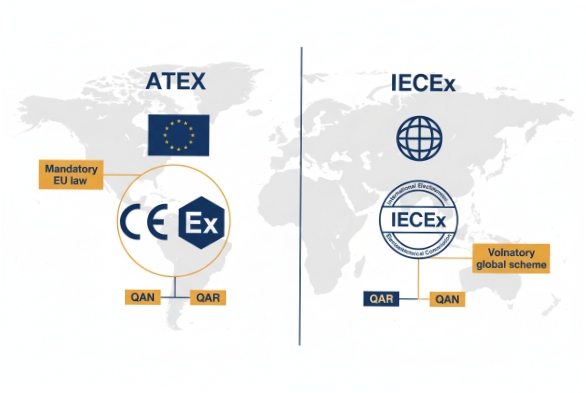
Navigating the alphabet soup of hazardous area certifications can feel like decoding a secret language. Choosing the wrong certification scheme—ATEX or IECEx—can result in your expensive explosion-proof telephones being seized at customs or rejected by a site safety inspector, costing you thousands in delays.
The primary difference is that ATEX is a mandatory EU directive (law) requiring the CE mark and a Quality Assurance Notification (QAN), while IECEx is a voluntary global certification scheme based on IEC standards requiring a Quality Assessment Report (QAR). ATEX uses "Categories" (e.g., 2G) valid in Europe, whereas IECEx uses "Equipment Protection Levels" (e.g., Gb) recognized internationally.
The DNA of Safety: Law vs. Standard
At DJSlink, we manufacture thousands of explosion-proof telephones for clients ranging from North Sea oil rigs to Australian mines. A frequent point of confusion is assuming "Ex is Ex." While the engineering underneath is often identical, the legal wrapper is completely different.
ATEX 1 (Atmosphères Explosibles) is EU law. It is not optional. If you want to sell a product in France, Germany, or anywhere in the EEA, it must comply with Directive 2014/34/EU. It focuses on the "free movement of goods" and safety within the EU.
IECEx 2 (International Electrotechnical Commission System for Certification to Standards Relating to Equipment for Use in Explosive Atmospheres) is a voluntary UN-endorsed scheme. Its goal is a single global standard to facilitate international trade. It is generally considered more rigorous because it does not allow for "self-certification" (which ATEX allows for lower-risk Zone 2 equipment).
| Feature | ATEX (EU Directive) | IECEx (International Scheme) |
|---|---|---|
| Nature | Mandatory Law (2014/34/EU) | Voluntary Standard |
| Primary Region | European Union (EU) + EFTA | Global (Australia, Middle East, etc.) |
| Marking | CE Mark + Hexagon Ex Symbol | IECEx Certificate Number |
| QA Requirement | QAN 3 (Quality Assurance Notification) | QAR 4 (Quality Assessment Report) |
| Self-Certification | Allowed for Zone 2 (Category 3) | Never Allowed (3rd Party always required) |
Critical Thinking: If you are buying for a global project (e.g., a skid built in Italy for use in Dubai), you ideally want Dual Certification. This ensures the skid is legal to build in the EU (ATEX) and legal to operate in the UAE (IECEx).
Which regions legally recognize IECEx versus ATEX?
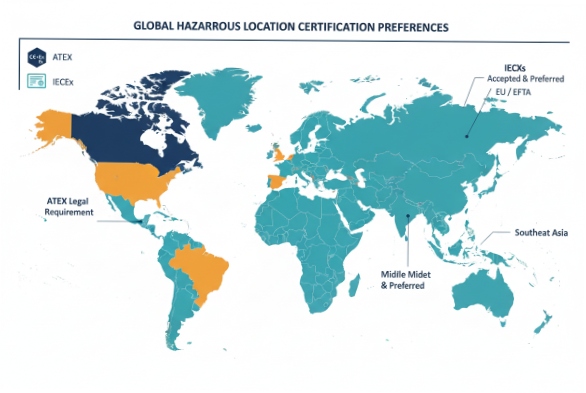
Your project’s geographical location determines which piece of paper matters. Sending an ATEX-only phone to a site in Singapore might lead to rejection, just as sending an IECEx-only phone to Germany is illegal.
ATEX is the sole legal requirement for the European Union and EFTA countries (Norway, Switzerland, etc.). IECEx is legally accepted in countries like Australia, New Zealand, and Singapore, and is the preferred standard in the Middle East and parts of Africa. IECEx is also the basis for "Fast-Track" local approvals in Brazil (INMETRO), China (CCC), and Korea (KCs).
The Global Passport vs. The Local Visa
Think of IECEx as a "Global Passport" and ATEX as a "Euro Visa."
-
The EU Fortress: You cannot import goods into the EU without ATEX. IECEx is not a substitute.
-
The IECEx Advantage:
-
Australia/New Zealand: They accept IECEx directly. In fact, they often prefer it over ATEX.
-
Middle East (UAE, Saudi Arabia): While they accept ATEX, they strongly prefer IECEx because it is English-language native and standardized.
-
National Adaptations: Countries like Brazil and China have their own laws, but they accept IECEx Test Reports (ExTRs) to bypass months of testing. ATEX reports are often rejected or require re-testing.
-
DJSlink Strategy: We advise global EPC contractors to specify "IECEx + ATEX" for all telephony equipment to ensure the assets remain mobile and compliant anywhere in the world.
Do markings, CoC formats, and file numbers differ?
You can tell the difference just by looking at the label. The visual language of the two schemes is distinct, and knowing how to read them is essential for site inspections.
Yes, markings differ significantly. ATEX requires the "CE" mark, the "Ex" hexagon, and a Category code (e.g., II 2 G). IECEx labels do not use the CE mark or Categories but rely on Equipment Protection Levels (e.g., Gb). The ATEX document is an "EU Declaration of Conformity," while IECEx uses an "IECEx Certificate of Conformity" stored on a public online database.
Decoding the Label
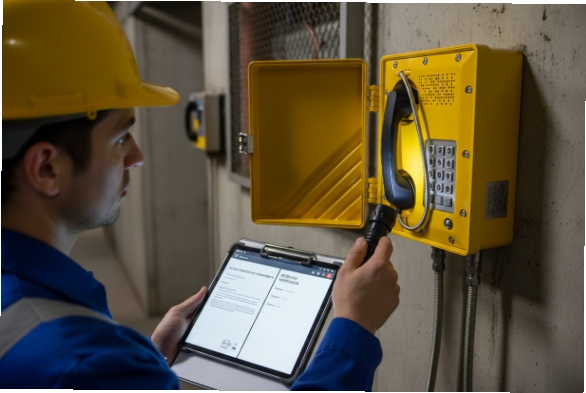
When you inspect a DJSlink phone, here is what you will see:
-
ATEX Line:
CE 1234 <Ex> II 2 G Ex db IIC T6 Gb-
CE 1234: Notified Body 5 ID.
-
II 2 G: Equipment Group (Surface) + Category (Zone 1) + Gas.
-
-
IECEx Line:
IECEx NB 20.0001X Ex db IIC T6 Gb-
IECEx NB…: The certificate number.
-
Gb: Equipment Protection Level 6 (High).
-
Documentation Differences
-
IECEx CoC: This is digital-first. You verify it on the iecex.com website. It lists the standards and the QAR reference.
-
ATEX DoC: This is a paper document signed by the manufacturer (Jason Mark). It references the Notified Body certificate but is a self-declaration of compliance with the law.
How do QAR/QAN audits compare across schemes?
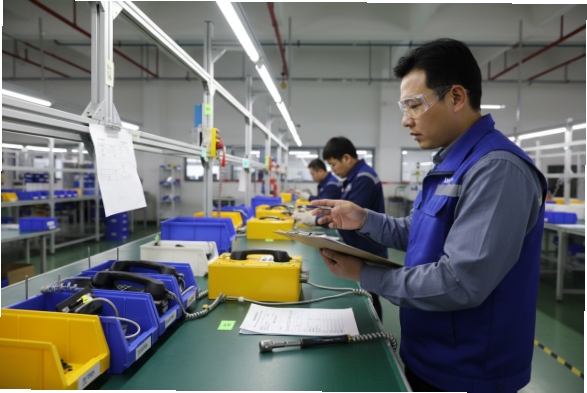
Certification isn’t just about the product prototype; it’s about the factory. Both schemes require auditors to visit our manufacturing lines, but the acronyms differ.
Both schemes require an annual factory audit to ensure production quality matches the tested prototype. For ATEX, this is called a Quality Assurance Notification (QAN) issued by a Notified Body. For IECEx, it is a Quality Assessment Report (QAR). While the audit criteria (ISO 80079-34) are virtually identical, the documents are legally distinct and non-interchangeable without a conversion process.
The Manufacturing Reality
-
The Standard: Both audits are based on ISO/IEC 80079-34 7 (Application of quality systems for Ex equipment).
-
The Synergy: Since DJSlink holds both certifications, we typically schedule one "Joint Audit." The auditor (e.g., from TUV or SGS) spends two days inspecting our facility and issues both the QAN and QAR reports based on that single visit.
-
The Check: As a buyer, you should ask for the QAN/QAR summary. If a vendor has a valid Type Certificate but an expired QAN/QAR, they cannot legally manufacture the phone.
Can one certificate support the other’s approval path?
If you have one, is it easy to get the other? This is the "Golden Path" for efficient certification.
Yes, an IECEx Test Report (ExTR) is commonly used to support an ATEX certification application, significantly reducing time and cost ("The IECEx-First Approach"). However, the reverse is rarely true; ATEX documentation is generally not accepted for IECEx certification because IECEx does not recognize the EU-specific legal self-declarations or regional variations.
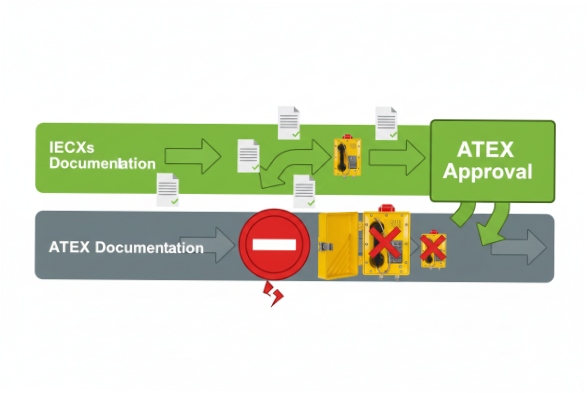
The "One-Way Street" of Certification
-
IECEx First (Recommended):
-
ATEX First (Difficult):
-
We test for ATEX only.
-
If we later want IECEx, we often have to re-test everything because the ATEX report might cite "EN" standards instead of "IEC" standards, or include self-declared elements that IECEx forbids.
-
Conclusion
While ATEX and IECEx share the same technical DNA (IEC 60079 standards), they serve different masters: ATEX is for EU legal compliance, and IECEx is for global trade facilitation. For the most versatile solution, always specify Dual-Certified telephones (ATEX + IECEx). This ensures your equipment carries the "CE" mark for Europe and the "IECEx" passport for the rest of the world, protecting your investment against regulatory roadblocks no matter where your project is located.
Footnotes
-
The key European Union legislation regulating equipment for use in explosive atmospheres. ↩
-
International certification system ensuring equipment meets uniform global standards for explosive environments. ↩
-
Mandatory quality system audit for manufacturers producing Category 1 and 2 ATEX equipment. ↩
-
Report confirming a manufacturer’s quality management system complies with IECEx requirements. ↩
-
An organization designated by an EU country to assess the conformity of certain products. ↩
-
A system of classifying equipment based on its likelihood of becoming a source of ignition. ↩
-
International standard specifying requirements for quality management systems for Ex equipment manufacturing. ↩
-
Series of international standards covering equipment for explosive atmospheres. ↩








