Industrial environments are electrically hostile. Installing a standard VoIP phone next to a megawatt variable frequency drive (VFD) often results in dropped packets, phantom rings, or fried circuitry.
Explosion-proof telephones must typically meet EN 61000-6-2 (Generic Immunity for Industrial Environments) and EN 61000-6-4 (Generic Emission for Industrial Environments). Key immunity tests include EN 61000-4-2 (ESD), 4-3 (Radiated RF), 4-4 (EFT), 4-5 (Surge), and 4-6 (Conducted RF), ideally tested to Level 3 or 4 to ensure reliability in harsh zones.
The Invisible Hazard: EMI in Hazardous Areas
We often focus on the "explosion" part of explosion-proof—ensuring the device doesn’t ignite gas. But in my 15 years at DJSlink, I’ve seen more phones fail due to Electromagnetic Interference 1 (EMI) than mechanical damage. A chemical plant is a soup of RF noise. Large motors, high-voltage switching gear, and walkie-talkies all generate massive electrical disturbances.
If your Ex phone isn’t hardened against this, the best-case scenario is audio crackle. The worst-case scenario is a watchdog reset during an emergency broadcast.
Compliance isn’t just about ticking a box for the CE mark; it’s about functional survival. The EN 61000 2 series is the bible for this. Unlike office equipment which follows the "Residential/Commercial" standards (EN 61000-6-1/3), industrial equipment must meet the much stricter "Industrial" standards (EN 61000-6-2/4).
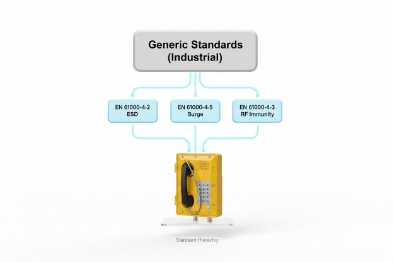
Here is the hierarchy of standards we apply:
| Standard Type | Standard Number | Application |
|---|---|---|
| Generic Immunity | EN 61000-6-2 | Mandatory. Defines how much noise the phone can take without failing. |
| Generic Emission | EN 61000-6-4 | Mandatory. Defines how much noise the phone is allowed to create. |
| Basic Standards | EN 61000-4-x | The specific test methods (Surge, ESD, etc.) called out by the Generic standards. |
Which EN 61000 parts are typically referenced for industrial Ex telephones?
There is often confusion between "Product Standards" and "Generic Standards." Since there isn’t a specific "EMC for Hazardous Area VoIP Phones" standard, we default to the rigorous industrial generics.
The primary reference is always EN 61000-6-2 for immunity, which acts as the parent standard calling upon specific EN 61000-4-x test methods. EN 61000-6-4 is the counterpart for emissions, ensuring the phone doesn’t pollute the spectrum used by sensitive plant sensors.
The Industrial Baseline
When you look at a DJSlink datasheet, you won’t just see "CE Certified." You will see a list of specific EN 61000 parts. This is because "Industrial" covers everything from a quiet warehouse to a smelting plant.
EN 61000-6-2 3 (Immunity) is the toughest hurdle. It assumes the device is near heavy industrial equipment. If a manufacturer only lists EN 55032 (Multimedia Equipment), be careful—that is an office standard. It might survive on a desk, but not next to a 480V pump.
EN 61000-6-4 4 (Emission) is also critical but for a different reason. In a refinery, you have sensitive gas detectors and 4-20mA instrumentation loops. If your SIP phone radiates too much RF noise (EMI), it could cause a gas detector to false alarm, triggering a plant shutdown. We design our shielding to keep our noise inside the box.
Which EN 61000 immunity tests should be included and which levels fit harsh sites?
This is the meat of the testing. A "pass" at Level 1 is useless in a factory. You need equipment that can withstand Level 3 or 4 events.
The essential immunity suite includes ESD (4-2), Radiated RF (4-3), EFT (4-4), Surge (4-5), and Conducted RF (4-6). For harsh industrial sites, we recommend testing to at least Level 3 (e.g., 2kV Surge, 10V/m RF) to prevent failure during lightning storms or heavy inductive switching.
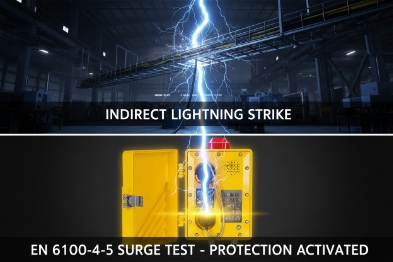
The "Big Five" Tests for Reliability
At DJSlink, we don’t settle for the bare minimum. We test to limits that exceed the standard because we know what happens in the real world. Here is the breakdown of the tests that matter most for an Ex SIP phone:
| Test (EN 61000-4-x) | Phenomenon | Min. Level (Ind.) | Recommended Level | Real World Source |
|---|---|---|---|---|
| 4-2: ESD 5 | Static Shock | 4kV Contact / 8kV Air | 6kV / 8kV | Operator touching keypad in dry winter. |
| 4-3: Radiated RF 6 | Radio Waves | 10 V/m | 10 V/m | Walkie-talkie keyed right next to the handset. |
| 4-4: EFT/Burst 7 | Switching Noise | 2kV (Power) / 1kV (Data) | 2kV / 2kV | Relays or contactors opening nearby. |
| 4-5: Surge 8 | Lightning/Spikes | 1kV (L-L) / 2kV (L-E) | 2kV / 4kV | Indirect lightning strike on the cable tray. |
| 4-6: Conducted RF 9 | RF in Cables | 10 V | 10 V | High-power broadcast transmitters. |
Voltage Dips (4-11/4-29): For PoE devices, this is less critical as the switch handles the power, but for 24V DC powered beacons/horns, this test ensures the device reboots cleanly after a brownout.
How should EN 61000 testing be configured for PoE/Ethernet ports?
Testing an explosion-proof device is tricky because you cannot easily access the internals once it’s sealed, and the heavy metal casing changes the grounding dynamics.
Testing must be performed on the fully assembled unit with shielded Ethernet cables grounded to the metal housing to simulate real-world installation. PoE ports require specific surge protection (TVS diodes) tested between pairs and to earth, ensuring the energy is shunted to the casing (PE) without breaching the Ex d/Ex e protection concept.
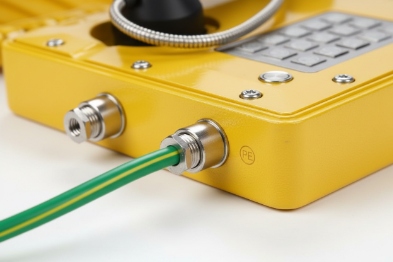
The Grounding Paradox
In an office, the "Ground" on your Ethernet jack is often floating or loosely coupled. In an Ex zone, the Protective Earth (PE) is a safety lifeline. The heavy cast-aluminum housing of a DJSlink phone acts as a massive Faraday cage, which is great for Radiated Immunity (4-3) but challenging for Surge (4-5).
When we apply a 2kV surge to the PoE line, that energy has to go somewhere. If we don’t provide a low-impedance path to the PE screw on the casing, the voltage will arc across components, destroying the PCB or, worse, creating a spark risk.
Configuration Tips:
-
Shielded Cabling (STP/FTP): Always perform EMC tests with shielded cables. Unshielded cables will act as antennas, causing you to fail Radiated Emissions (6-4).
-
Cable Length: Use the standard length (usually 3m or 10m) specified in the 6-2 setup, but be aware that in the field, 90m runs pick up more noise.
-
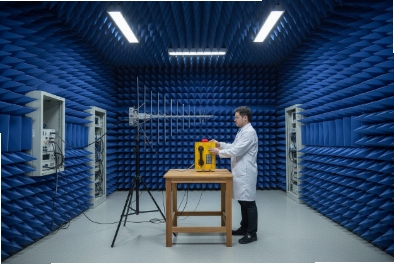
Port Loading: The Ethernet port must be active (pinging) during the test. We use fiber-optic converters inside the test chamber to isolate the monitoring equipment from the surge being applied to the phone.
What EN 61000 documentation is needed for CE/UKCA acceptance?
You can’t just say "it passed." The paperwork trail is vital, especially when CE compliance overlaps with ATEX quality assurance.
You must compile a Technical Construction File (TCF) containing the full EMC test reports from an ISO 17025 accredited lab, photographs of the specific test setup (showing cable layout), and a Declaration of Conformity (DoC). Crucially, any component change to solve an EMC issue must go through strict Change Management to ensure it doesn’t invalidate the ATEX/IECEx certificate.
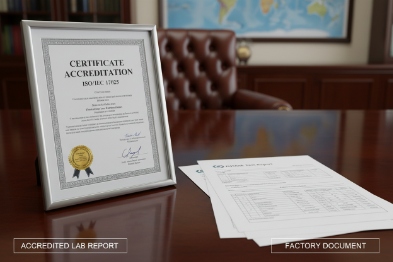
The Paperwork Shield
For a manufacturer like DJSlink, the Declaration of Conformity (DoC) is our pledge. It lists the specific standards (e.g., EN 61000-6-2:2019) we claim compliance with.
However, for the System Integrator or Distributor, the Test Report is what you should ask for. Check these three things:
-
Dates: Is the standard current? (Old standards are withdrawn).
-
Configuration: Did they test the model with the handset and horn attached? (Accessories change the RF footprint).
-
Performance Criteria: Did it pass with "Criteria A" (continued operation) or "Criteria B" (temporary loss of function)? For a safety intercom, Criteria A is preferred for immunity tests.
Warning on Updates: If we change a capacitor to pass the Surge test, we have to verify that this new capacitor doesn’t exceed the capacitance limits for Intrinsic Safety (Ex i) or thermal limits. EMC and Ex are tied at the hip.
Conclusion
EMC compliance for explosion-proof telephones is not just about avoiding static noise; it’s about ensuring life-safety communications survive in the harshest electrical environments on earth. By strictly adhering to EN 61000-6-2 and pushing for Level 3+ immunity, DJSlink ensures that when you press the emergency button, the call goes through—regardless of the electrical storm raging around it.
Footnotes
-
The ability of a device to operate in its electromagnetic environment without introducing intolerable disturbances. ↩
-
Series of international standards on Electromagnetic Compatibility (EMC). ↩
-
Generic EMC immunity standard for industrial environments. ↩
-
Generic EMC emission standard for industrial environments. ↩
-
Standard defining immunity requirements and test methods for electrostatic discharge (ESD). ↩
-
Standard defining immunity requirements for radiated, radio-frequency, electromagnetic fields. ↩
-
Standard defining immunity requirements for electrical fast transient/burst. ↩
-
Standard defining immunity requirements for surge caused by overvoltages from switching and lightning transients. ↩
-
Standard defining immunity to conducted disturbances, induced by radio-frequency fields. ↩