Downtime often starts with a small mistake: a phone that “works” in the office, then fails in heat, dust, or a classified area when an alarm happens.
Select the right explosion-proof telephone by locking four things in order: hazardous-area classification and matching Ex marking, platform choice (SIP/VoIP vs analog vs hybrid), rugged features for your environment, and compliance documents plus factory controls for approval.
A practical selection framework that avoids rework
Start with the failure mode, not the model number
On most sites, the phone is not the problem. The mismatch is the problem. A phone gets approved for “hazardous” in a general sense, but the marking does not match the real zone, gas group, dust group, or temperature limits. Then the project stalls in review. I have seen this happen after installation plans were already printed, which is painful and expensive.
A safer way is to treat the selection like a gate process:
1) Confirm the area classification and the required Ex marking.
2) Confirm how the call will be carried (SIP, analog, or both).
3) Confirm the environment damage risks (water, salt, impact, noise, temperature).
4) Confirm documentation and production controls, so procurement can sign off.
Map your stakeholders to each gate
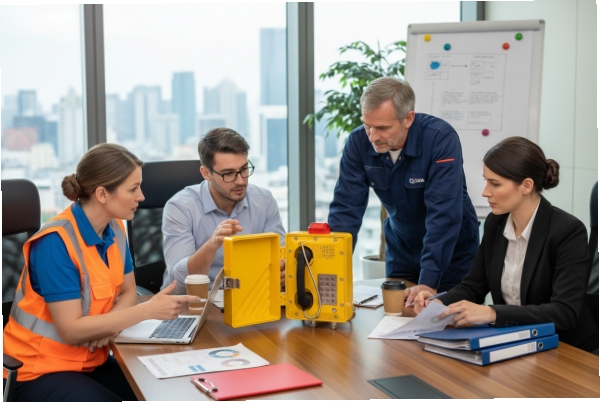
A phone decision touches several teams. EHS owns zoning and ignition risk. IT owns IP and security. Maintenance owns long-term uptime. Procurement owns paperwork. If these teams join late, the phone becomes a “last-minute” item, and last-minute items create non-compliance.
Build a short, auditable checklist
The best checklist is short enough to use, but strict enough to reject the wrong device.
| Gate | Owner (typical) | What must be true | What usually breaks the plan |
|—|—|—|—|
| Hazardous classification | EHS / Safety | Zone / Group / Temp limits are clear | Wrong zone (gas vs dust) or missing T-class / max surface temp |
| Voice platform | IT / Telecom | PBX, network, and power match the phone | No PoE, no UPS plan, VLAN/QoS missing |
| Ruggedization | Maintenance / Engineering | IP, corrosion, impact, noise, temp fit reality | Coastal corrosion, washdown, or high-noise not considered |
| Compliance | Procurement / QA | Certificates + factory QA controls are complete | Expired certs, wrong annex, or no change-control process |
This approach keeps the project stable. It also makes vendor comparisons fair, because every supplier answers the same questions.
The next step is to go gate by gate, starting with classification, because every other decision depends on it.
Which hazardous-area classification should I confirm first—Zone 1/2 or Zone 21/22—and what Ex marking must match it?
Wrong classification creates the fastest rejection. A phone can be “explosion-proof,” but still be wrong for your area and fail approval.
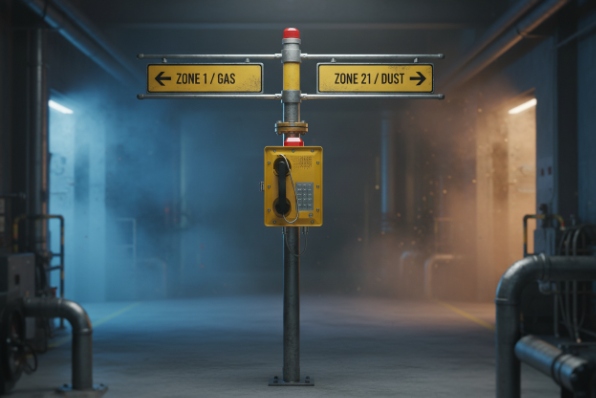
Confirm the hazard type first: gas/vapor uses Zones 0/1/2, dust uses Zones 20/21/22. Then match Ex marking to the zone (equipment category/EPL), group (IIC or IIIC), and temperature limits (T-class or max surface temperature).
Decide whether you are in a gas/vapor area or a dust area
This is the first fork. Many sites have both, but not in the same locations.
-
Gas/vapor classification uses Zone 0 / Zone 1 / Zone 2.
-
Combustible dust classification uses Zone 20 / Zone 21 / Zone 22.
If the area is mixed or unclear, treat it as a design risk. The safest move is to confirm with your hazardous area dossier, area classification drawing, or EHS report. A “Zone 1 gas phone” does not automatically cover dust. A dust marking is separate, and it has its own surface temperature limits.
Match the zone to the Equipment Protection Level (EPL) and category
A simple way to sanity-check:
-
Zone 1 (gas) usually requires EPL Gb and often Category 2G.
-
Zone 2 (gas) usually requires EPL Gc and often Category 3G.
-
Zone 21 (dust) usually requires EPL Db and often Category 2D.
-
Zone 22 (dust) usually requires EPL Dc and often Category 3D.
Your spec should state the exact need, not just “ATEX.” The marking must match the zone requirement in your document set.
Confirm group and temperature limits, not just “Ex”
Gas areas also need gas group (often IIA/IIB/IIC, where IIC is the most demanding). Dust areas need dust group (often IIIA/IIIB/IIIC, where IIIC is the most demanding).
Temperature also splits:
-
Gas often uses T-classes (example: T6).
-
Dust often uses a maximum surface temperature (example: T85°C), because dust layers can insulate and trap heat.
Practical decoding examples you can use in reviews
These are common patterns you will see. The exact string must match your certified documents.
| Area type | Typical zone need | What to look for in Ex marking (pattern) | Notes to confirm |
|—|—|—|—|
| Gas/Vapor | Zone 1 | “… 2G … Gb … IIC … T*” | Confirm T-class vs your gas ignition temp limits |
| Gas/Vapor | Zone 2 | “… 3G … Gc … IIC … T*” | Often used in less severe areas, but still needs correct group |
| Dust | Zone 21 | “… 2D … Db … IIIC … Txx°C” | Confirm max surface temp with dust cloud/layer assumptions |
| Dust | Zone 22 | “… 3D … Dc … IIIC … Txx°C” | Watch for cleaning and dust accumulation patterns |
In procurement reviews, I prefer to attach the classification drawing page that names the zone next to the certificate page that shows the marking. That one-page pairing prevents most arguments.
Should I choose SIP/VoIP, analog, or hybrid explosion-proof phones based on my existing PBX, network, and power availability?
Many phone projects fail on “invisible” infrastructure. The device is ready, but the site has no PoE, weak network paths, or an analog-only PBX.
Choose SIP/VoIP when you have reliable IP, VLAN/QoS, and power (PoE or DC) plus a clear cybersecurity plan. Choose analog when you need simple, long-distance copper and minimal IT. Choose hybrid when you are migrating or need analog fallback.
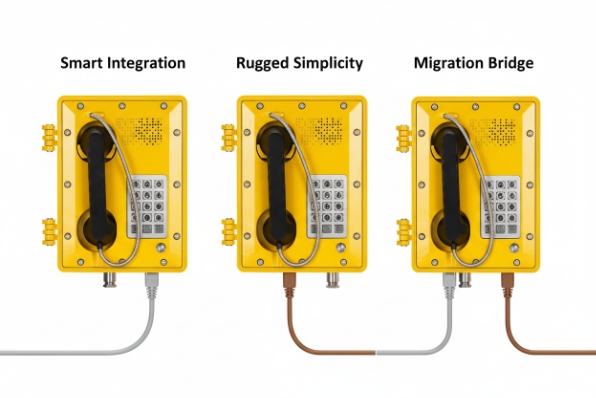
Decide based on what you already operate, not what is trendy
SIP is the cleanest for unified communications, remote management, and platform integration. Analog is still strong for simple point-to-point or legacy PBX environments. Hybrid is often the lowest-risk choice for phased upgrades.
In my deployments, the winning option is usually the one that matches the maintenance skill set on the site. If your technicians can troubleshoot Ethernet and VLANs, SIP becomes easy. If they are trained on copper pairs and line testing, analog keeps uptime high.
SIP/VoIP: best for management and integration
SIP explosion-proof phones make sense when you need:
-
Central provisioning and monitoring
-
Integration with IP PBX, SIP servers, or dispatch systems
-
Features like call groups, paging, directory, and event reporting
-
Easier scaling across sites
But SIP needs:
-
Stable network paths (often redundant)
-
QoS for voice, and a plan for congestion
-
Cyber rules (passwords, certificates, firmware control)
-
Power design (PoE budget or local DC, plus UPS if needed)
Analog: best for simplicity and harsh network limits
Analog phones fit when you have:
-
Legacy PBX ports already available
-
Long cable runs where Ethernet is hard
-
Minimal IT support in the plant
-
A need for “always works” behavior with basic testing
Analog limits:
-
Fewer management tools
-
Less integration with modern platforms
-
Scaling can become wiring-heavy
Hybrid: best for migration and risk control
Hybrid usually means one of these patterns:
-
Dual interface phone (SIP + analog), or
-
SIP phone plus an analog gateway strategy (FXS/FXO), or
-
Parallel deployment with a defined cutover plan
| Condition on your site | SIP/VoIP is strong when… | Analog is strong when… | Hybrid is strong when… |
|—|—|—|—|
| PBX situation | IP PBX / SIP server is standard | PBX has many analog ports | You are moving from analog to SIP |
| Network | Redundant LAN, QoS, managed switches | LAN is limited or not trusted | LAN exists but not everywhere |
| Power | PoE budget or reliable DC + UPS | Line power or simple local power | Mixed power sources across areas |
| Uptime strategy | Monitoring, remote logs, fast reconfig | Simple fault isolation on copper | Need fallback during transition |
A small personal note: I once walked a site where the “network was ready,” but the field switch cabinets had no UPS. The phones were fine. The power plan was not. That lesson stays.
What ruggedization features matter most—IP rating, corrosion resistance, operating temperature, noise handling, and vandal resistance—for long-term uptime?
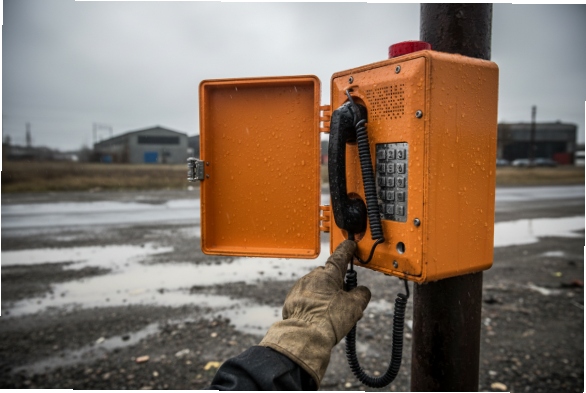
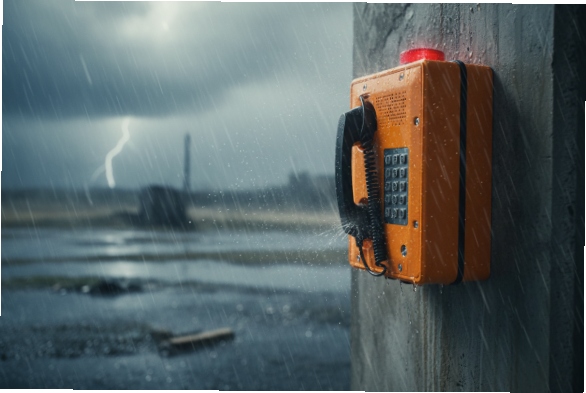
Most industrial phones die slowly. Water enters through glands. Salt eats fasteners. Heat hardens seals. Noise makes calls useless. Then people stop trusting the system.
Prioritize ruggedization based on your actual abuse: IP sealing for washdown and storms, corrosion protection for coastal and chemical exposure, wide temperature range for outdoor and desert, strong audio for high-noise zones, and anti-vandal design for public or unsupervised areas.
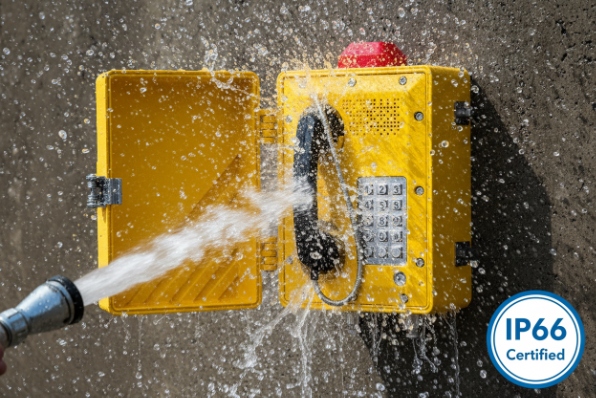
IP rating is the daily survival feature
For outdoor and industrial areas, IP rating 1 is not a marketing line. It is the life of the device. The common targets are:
-
IP66 for heavy rain and strong water jets
-
IP67 for short-term immersion risk
-
Higher ratings can matter for severe washdown, but only if cable entry and installation match the rating
In the field, the weak point is often the cable gland and the installer’s sealing method. A great enclosure with a poor gland choice still leaks.
Corrosion resistance is a design choice, not a coating promise
If you have coastal air, offshore platforms, fertilizer plants, or chemical exposure, corrosion decides the lifecycle. Look for:
-
316L stainless 2 or high-grade alloys where it matters
-
Proper surface treatment for aluminum if used
-
Anti-corrosion fasteners, and isolated dissimilar metals to reduce galvanic corrosion
-
Evidence of salt spray testing or real-world references
Temperature range must match the worst case, not the average day
Phones fail in cold mornings and hot afternoons. Check:
-
Operating temperature range of the whole unit
-
Display and keypad behavior in cold
-
Seal materials that do not crack or soften
-
Internal heat rise in direct sun
Noise handling decides if the phone is “usable”
In high-noise areas, the call can connect and still be useless. Strong options include:
-
Noise-canceling 3 microphone design
-
High output speaker, or headset support
-
Optional beacon and horn for ringing awareness
-
Sidetone and echo control tuned for industrial acoustics
If the phone is in public-facing areas, corridors, or remote yards:
-
Reinforced handset and cord (or cord-free design)
-
Tamper-resistant screws
-
Strong hookswitch design
-
Impact resistance (often tracked with IK ratings)
| Environment risk | What to specify | What to verify during evaluation |
|—|—|—|
| Washdown / storms | IP66/IP67, sealed glands, drain/vent strategy | Gland type, gasket design, install method |
| Coastal / chemical | 316L, corrosion-proof fasteners, coating system | Material list, salt spray evidence, field references |
| Extreme heat/cold | Wide operating range, UV resistance | Low-temp keypad test, high-temp soak behavior |
| High noise | High SPL, noise canceling, beacon/horn options | Real test in the area, not in a quiet room |
| Vandal/public | Reinforced handset, tamper screws, impact design | Pull tests, cord strain relief, housing thickness |
Long-term uptime is not one feature. It is the sum of small protections that match your site reality.
Which documents and factory controls should I verify—ATEX/IECEx certificates, QAN/QAR, EMC/RoHS reports, and change-control—for procurement approval?
Many projects get blocked after the technical choice is done. The reason is simple: the paperwork does not match the purchase order, or the factory control story is weak.
Verify certificates first (ATEX and/or IECEx) and confirm the marking matches your zone. Then verify the production quality system (ATEX QAN and IECEx QAR where applicable), plus EMC and environmental compliance reports, and a strict change-control process with traceability.
Certificates must match the exact model and marking
For hazardous-area equipment, procurement should demand:
-
The certificate for the exact product model family
-
The full Ex marking line on the certificate, not only on the label
-
The schedule/annex that lists critical components and conditions of use
-
Validity status and issuing body details
A common failure is a certificate that looks right, but covers a different housing variant, a different temperature range, or a different protection concept.
Understand QAN vs QAR in simple terms
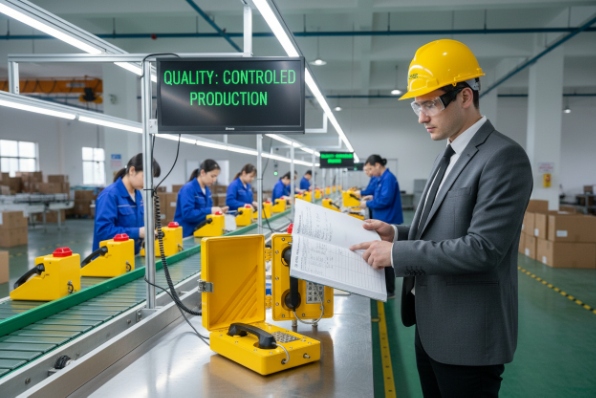
Certification is not only testing. It is also controlled production.
-
ATEX QAN 4 (Quality Assurance Notification) supports the production quality system for ATEX equipment under the appropriate module.
-
IECEx QAR 5 (Quality Assessment Report) covers the factory’s quality system under IECEx.
Both matter because they show the factory can build the certified design the same way every time.
EMC, RoHS, and other approvals still matter outside the “Ex bubble”
Explosion protection does not replace other compliance needs:
-
EMC: the phone should not create interference, and should resist interference
-
Sometimes REACH 7, WEEE, or local telecom requirements, depending on where the phone ships
For long projects, parts change. Suppliers change. Firmware changes. Without change-control, you can end up with a phone that no longer matches the certificate file. A strong supplier should provide:
-
Engineering change notices (ECN) or product change notifications (PCN)
-
Revision control for hardware and firmware
-
Traceability (serial number tracking, batch records)
-
Control of critical components listed in the certificate
-
Incoming inspection and routine tests tied to the Ex design
As a manufacturer focused on SIP communication products since 2010, our internal rule is simple: if a change touches a certified safety path, it triggers a controlled review and documentation update. That mindset is what procurement wants to see.
| Item to verify | What “good” looks like | Red flags |
|—|—|—|
| ATEX / IECEx certificate | Correct model, correct marking, annex included | Different model name, missing annex, unclear limits |
| Marking vs your zone | Zone, group, temp limits align | “Close enough” marking or mixed gas/dust confusion |
| ATEX QAN / IECEx QAR | Current, covers the factory site and scope | Expired, different factory, or vague scope |
| EMC report | Clear standards listed, pass results | No report, or only partial pages |
| RoHS report | Declared to relevant directive/version | No material declaration or unclear scope |
| Change-control | PCN/ECN process, revisions, traceability | “We will inform later,” no documented process |
If procurement needs one sentence: buy the phone that can prove it will be the same phone, next year, with the same compliance and the same behavior.
Conclusion
The right explosion-proof phone is chosen by matching classification, platform, rugged features, and verifiable factory controls, so the device stays approved and reliable for years.
Footnotes
-
Standard rating system defining levels of sealing effectiveness against intrusion, dust, and water. ↩
-
A grade of stainless steel known for its high corrosion resistance, particularly against chlorides. ↩
-
A method for reducing unwanted ambient sound using active noise control. ↩
-
Quality Assurance Notification, a mandatory audit for manufacturers producing Category 1 and 2 ATEX equipment. ↩
-
Quality Assessment Report required for manufacturers of IECEx equipment. ↩
-
EU directive restricting the use of hazardous substances in electrical and electronic equipment. ↩
-
EU regulation concerning the Registration, Evaluation, Authorisation and Restriction of Chemicals. ↩