
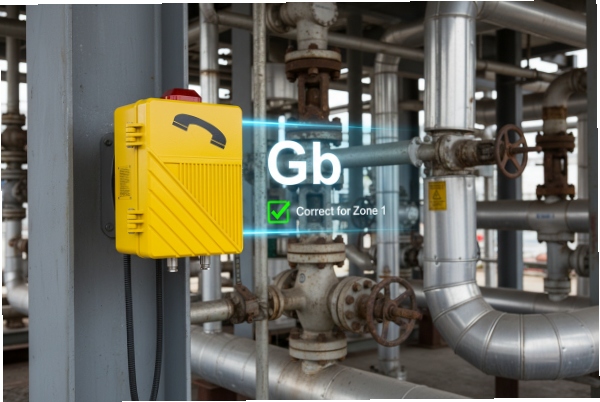
A phone can look “Ex-rated” and still be wrong for the zone. That gap usually comes from one small code on the nameplate: Gb.
“Gb” is the Equipment Protection Level (EPL) for gas atmospheres that indicates a high level of ignition protection, normally suitable for Zone 1, and also acceptable for Zone 2 when the rest of the marking matches.
EPL Basics: What “Gb” Signals in Real Installations?
“Gb” is a protection level, not a protection method
On explosion-proof telephones, “Gb” does not tell the full story by itself. It tells the level of protection against ignition in a gas atmosphere. The protection method is shown elsewhere on the marking, like Ex db (flameproof), Ex ib (intrinsic safety), or Ex eb (increased safety). A common field mistake is treating “Gb” like a standalone approval. It is not. It works only with the full Ex marking package, the certificate, and the installation rules.
The letters inside “Gb”
“G” means the rating is for gas explosive atmospheres. The “b” is the protection level, which sits between “a” and “c”. In plain language:
-
Ga = very high protection
-
Gb = high protection
-
Gc = enhanced protection
This is why a Zone 0 1 project will usually push for “Ga” equipment. Zone 1 can use “Gb”, and Zone 2 can use “Gc” or higher.
Why this matters for explosion-proof telephones
A telephone is not a passive device. It has electronics, ringing circuits, a handset cord, and cable entry glands. If the phone is installed where gas can be present often (Zone 1), the design must stay safe in normal use and also during expected problems. That is what “Gb” is trying to communicate at a high level.
In my own support cases, the quickest way to prevent a rejected inspection is to teach the team to read “Gb” as a gatekeeper, not a finish line. The finish line is always the full marking plus the certificate list of conditions.
| EPL | Protection level | Typical zone fit | Simple field meaning |
|—|—|—|—|
| Ga | Very high | Zone 0 (also 1, 2) | Safe in normal use and rare faults |
| Gb | High | Zone 1 (also 2) | Safe in normal use and expected faults |
| Gc | Enhanced | Zone 2 | Safe in normal use, limited fault scope |
If a nameplate shows “Gb” but the rest of the marking is missing or unclear, treat it like an incomplete label and stop before installation.
The next step is to compare “Gb” directly with “Ga” and “Gc”, because the differences are more practical than they look on paper.
If this feels like paperwork, it is. But it is the kind of paperwork that prevents a phone from becoming the weakest link in a hazardous-area communications plan.
How is EPL “Gb” different from “Ga” and “Gc” in gas hazardous-area ratings?
A site can pass commissioning and still fail the next audit. That often happens when “Gb” is assumed to mean “safe everywhere except Zone 0,” without checking the real gap versus Ga and Gc.
Ga, Gb, and Gc are EPL steps for gas risk. Ga is the highest and aligns with Zone 0 needs. Gb aligns with Zone 1 needs. Gc aligns with Zone 2 needs. Higher EPL can be used in less hazardous zones, but not the other way around.
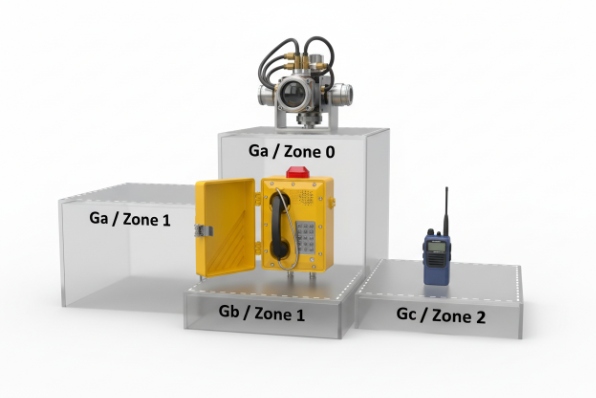
The difference is fault tolerance, not only frequency of gas
Zones describe how often explosive gas atmospheres may be present. EPL 2 describes how likely equipment is to become an ignition source. These are linked, but they are not the same.
A practical way to view it:
-
Ga assumes the equipment must stay non-igniting even with rare faults. It targets the most demanding gas conditions.
-
Gb assumes the equipment must stay non-igniting in normal use and during expected malfunctions. This is the typical Zone 1 intent.
-
Gc assumes the equipment must stay non-igniting in normal use. It is intended for Zone 2 style risk, where explosive gas is not expected in normal operation or exists only briefly.
For telephones, this difference shows up in design and certification scope. A “Gb” telephone may use Ex db flameproof construction, or it may use Ex ib intrinsic safety circuits, or a combination. The EPL reflects the overall protection level of the equipment assembly, not one single feature.
Why “Gb” is common on heavy-duty Ex telephones
Explosion-proof telephones often live in Zone 1 process areas, loading bays, and chemical handling zones. “Gb” is a strong match because it supports Zone 1 usage with a high level of protection, while still being deployable in Zone 2 without downgrading safety.
Use a simple comparison table during selection
| Topic | Ga | Gb | Gc |
|—|—|—|—|
| Gas zone intent | Zone 0 | Zone 1 | Zone 2 |
| Protection expectation | Normal + expected + rare faults | Normal + expected faults | Normal operation |
| Typical use case | Inside tanks, continuous risk | Process skids, pump areas | Perimeter areas, well-ventilated spaces |
| Common telephone strategy | Special design, tighter limits | Most Ex d / IS telecom solutions | Often not chosen for harsh industrial phones |
A short story from the field fits here: a contractor once tried to “upgrade” a Zone 1 phone by swapping only the label artwork to show Ga, because the enclosure looked identical. That created a compliance issue instantly. The reason is simple: EPL is not branding. It is proven by testing, documentation, and controlled manufacturing.
Next, the real install question: what zones does “Gb” cover, and what does “allowed” mean when the site is Zone 2?
Which zones does “Gb” cover, and can a Gb-rated phone be installed in Zone 1 or Zone 2?
A phone can be certified and still be installed in the wrong place. The zone boundary is where mistakes happen, especially when equipment is moved during plant expansions.
“Gb” is intended for Zone 1 gas atmospheres, and equipment rated Gb is generally acceptable for Zone 2 as well, because it is a higher level of protection than Gc. It is not intended for Zone 0.
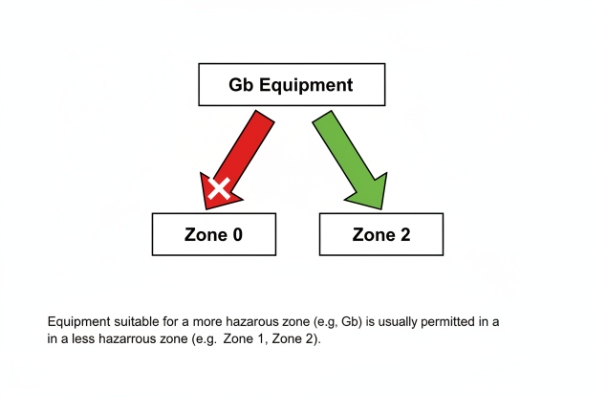
Zone fit: the safe direction is always “higher to lower”
A clear rule helps teams move fast:
-
Equipment suitable for a more hazardous zone is usually permitted in a less hazardous zone.
-
Equipment suitable only for a less hazardous zone is not permitted in a more hazardous zone.
So:
-
Ga equipment can usually go in Zone 0, 1, or 2.
-
Gb equipment can usually go in Zone 1 or 2.
-
Gc equipment is typically for Zone 2 only.
That is the selection logic most inspectors expect to see, as long as the protection concept and gas group match the site conditions.
“Can install” still depends on the rest of the marking
A Gb-rated phone can be installed in Zone 1 or Zone 2 only if:
-
the gas group rating matches the site gas (IIA, IIB, or IIC),
-
the temperature class meets the ignition temperature constraints (T1–T6),
-
the ambient temperature range on the certificate fits the local climate,
-
the cable glands and stopping plugs are certified and installed correctly,
-
the installation standard (ATEX/IECEx rules plus site practices) is followed.
For example, a phone marked for IIB is not a safe substitute for an IIC location. A Zone 1 area with hydrogen needs IIC-rated equipment. A Zone 2 area might still need IIC if hydrogen is possible, even if gas presence is rare.
Use a zone decision checklist for telephones
| Checkpoint | What to confirm | Why it blocks mistakes |
|—|—|—|
| Zone | 0 / 1 / 2 | Sets minimum EPL target |
| Gas group | IIA / IIB / IIC | Matches the most severe gas on site |
| Temp class | T1–T6 | Controls max surface temperature |
| Protection type | Ex db / Ex eb / Ex ib, etc. | Confirms the method used to achieve EPL |
| Installation parts | glands, plugs, reducers | These can break IP and Ex if mismatched |
When a client asks whether a Gb phone is “OK for Zone 2,” the answer is yes in principle, but only after the full marking and the certificate conditions line up.
Next comes the nameplate itself. “Gb” should never appear alone. The marking needs other elements that explain how the safety is achieved and where it applies.
What Ex marking elements should appear with “Gb”, such as protection type, gas group, and temperature class?
A label that only says “Gb” creates false confidence. A correct Ex label reads like a short technical sentence, and every part has a job.
With “Gb,” the nameplate should also show the Ex symbol, the protection concept (like Ex db), the gas group (IIA/IIB/IIC), and a temperature class (T1–T6 or a certified range). On ATEX products, group/category and CE/Notified Body details also appear.
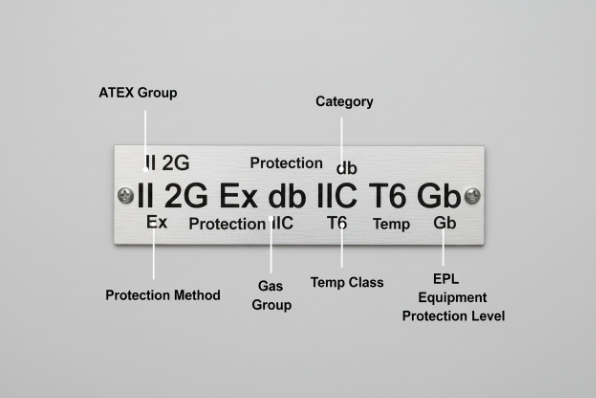
The core IECEx-style marking pieces
A common example format looks like:
- Ex db IIC T6 Gb
This decodes as:
-
Ex: explosion-protected equipment marking
-
db: flameproof enclosure 3 “d” with level “b”
-
IIC: gas group (hydrogen/acetylene level, the most severe group for Group II gases)
-
T6: maximum surface temperature class 4
-
Gb: equipment protection level for gas, suitable for Zone 1 (and also usable in Zone 2 when appropriate)
Explosion-proof telephones often use Ex db when the goal is ruggedness and high power handling. Some designs also combine protection types or include both gas and dust markings, especially for outdoor petrochemical sites where dust may also be present.
What ATEX adds on the nameplate
ATEX marking often includes:
-
CE mark and sometimes a Notified Body number related to production control
-
Equipment group (usually Group II for surface industries)
-
Category (1G, 2G, or 3G)
-
The G for gas (and D for dust, if applicable)
A typical ATEX string may look like:
- II 2G Ex db IIC T6 Gb
That “II 2G” part helps the EU compliance chain connect zone expectations to the equipment.
A quick “complete label” table for audits
| Marking element | Example | What it answers |
|—|—|—|
| Ex symbol | Ex | Is it Ex-certified equipment? |
| Protection type | db / eb / ib | How ignition is prevented |
| Gas group | IIA / IIB / IIC | Which gases are covered |
| Temp class | T4, T5, T6 | Max surface temperature limit |
| EPL | Gb | Which zone risk level is covered |
| ATEX group/category (if ATEX) | II 2G | EU zone/category linkage |
| Certificate reference | IECEx/ATEX certificate no. | Where to verify details |
If any of these are missing, the label is hard to defend during inspection.
Now the final piece is the part most OEM/ODM projects struggle with: keeping “Gb” true over time, across factory changes, branding changes, and feature changes.
How can Gb labeling be verified against ATEX/IECEx certificates, factory audits, and change-control for OEM/ODM modifications?
A label can be printed in one day. Real compliance takes years of controlled design and controlled manufacturing. OEM/ODM work makes this harder because small changes can touch Ex-critical parts.
Verify “Gb” by matching the exact nameplate marking to the ATEX/IECEx certificate “Marking” section, confirming valid factory audit coverage (IECEx QAR or ATEX QAN), and enforcing change-control so any design or process change triggers a certification impact review.

Step 1: Match the nameplate to the certificate, word for word
For IECEx, the Certificate of Conformity lists the approved marking format. For ATEX, the EU-type examination certificate and related documentation do the same. A strong internal rule is: the nameplate must match the certificate marking line exactly, including:
-
protection type symbols (db, eb, ib, etc.)
-
gas group (IIA/IIB/IIC)
-
temperature class or temperature range
-
EPL (Gb)
-
special conditions “X” if present
-
ambient range if required by the certificate
If the certificate says “Ex db IIC T6…T4 Gb” then the label must follow that logic, not a simplified version.
Step 2: Confirm manufacturing audit coverage is valid and current
IECEx relies on Quality Assessment Reports 5 (QARs) for ongoing manufacturing control, unless the product uses unit verification. A QAR is tied to specific manufacturing locations, and it sits under surveillance audits. For OEM/ODM, this matters because production may shift to a different line or subcontractor without the commercial team noticing.
ATEX has a similar concept through quality assurance modules and Notified Body involvement for certain categories. This is why large buyers often ask for both the product certificate and proof of valid production quality coverage.
Step 3: Enforce change-control like it is part of the design
Explosion protection is sensitive to “small” changes:
-
enclosure material or wall thickness
-
gasket material
-
PCB layout and component substitution
-
connector changes
-
cable entry thread changes and gland strategy
-
coating system changes
-
speaker or handset changes that affect surface temperature
A practical OEM/ODM change-control flow that works:
-
Engineering change request is raised with a clear reason and affected parts list.
-
Ex technical review checks whether the change can affect protection concept, temperature rise, creepage/clearance, flamepaths, or ingress.
-
If risk exists, the certifying body is consulted and a variation process is triggered before release.
-
Production instructions and inspection points are updated, and traceability is kept.
In my own OEM/ODM programs, the safest habit is to treat any change that touches the enclosure, glands, wiring paths, or thermal profile as “Ex-impacting” until proven otherwise. That one habit prevents accidental certificate drift.
A verification checklist buyers can use
| Verification item | What to collect | Pass condition |
|—|—|—|
| IECEx CoC / ATEX certificate | Current issue + annex | Marking matches nameplate |
| QAR / QAN evidence | Audit coverage for factory | Manufacturing location is covered and in date |
| Change-control records | ECO log + approvals | Ex-impacting changes have formal assessment |
| Incoming part control | approved supplier list | Ex-critical parts are locked or re-approved |
| Label control | artwork revision + QA sign-off | No label edits without compliance review |
If the supplier cannot show this chain, “Gb” becomes a marketing claim instead of a controlled compliance statement.
Conclusion
“Gb” means high protection for gas hazards, typically for Zone 1 and usable in Zone 2 when the full Ex marking and certificates match, and when manufacturing and changes stay under control.
Footnotes
-
A hazardous area classification where an explosive gas atmosphere is present continuously or for long periods. ↩
-
Levels of protection assigned to equipment based on its likelihood of becoming a source of ignition. ↩
-
A type of protection where the enclosure can withstand an internal explosion of a flammable mixture. ↩
-
Classification system defining the maximum surface temperature an equipment can reach to prevent ignition. ↩
-
A report confirming that a manufacturer has a quality system that complies with IECEx requirements. ↩








