
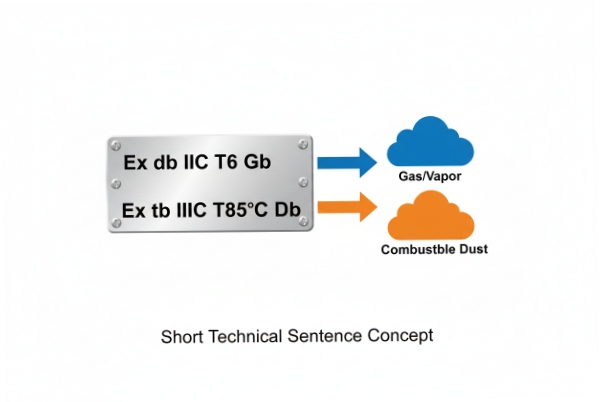
Many Ex telephone selection mistakes start with one wrong letter. The unit gets installed, then the inspector asks for the zone basis and the certificate. The project stops.
“G” marks suitability for explosive gas/vapor atmospheres, while “D” marks suitability for combustible dust atmospheres. The correct choice depends on your site’s classified zones and the exact Ex marking line shown on the phone’s nameplate and certificates.
Read Ex marking like a short technical sentence
First, separate “atmosphere type” from “protection method”
On a telephone nameplate, “G” and “D” are not decoration. They tell the type of explosive atmosphere the certification covers:
-
“G” relates to gas/vapor explosive atmospheres
-
“D” relates to combustible dust explosive atmospheres
Then the protection method sits next to “Ex”, like Ex db, Ex ib, Ex eb (gas side) or Ex tb (dust side). Many site teams mix these two ideas. A quick rule helps: G/D tells the atmosphere. Ex d / Ex i / Ex e / Ex t tells how the product stays safe.
Second, identify whether the label is ATEX-style, IECEx-style, or both
Most industrial Ex telephones show either:
-
an ATEX “Group/Category” line (like II 2G or II 2D) plus the Ex marking, or
-
an IECEx 1 marking line that often emphasizes EPL 2 (Ga/Gb/Gc for gas and Da/Db/Dc for dust).
Both approaches can appear together on the same nameplate. This is normal for global projects, but it means the buyer must check the full line, not one symbol.
Third, look for temperature format differences
Gas markings usually show temperature class (T1–T6). Dust markings usually show maximum surface temperature in °C (for example T85°C). A fast field clue is:
-
If you see T6, it is part of a gas-style temperature limit.
-
If you see T85°C, it is part of a dust-style temperature limit.
A simple “spot the letter” table
| What to look at | Gas/Vapor rating clue | Dust rating clue | What it tells you |
|---|---|---|---|
| Atmosphere letter | “G” | “D” | What hazard the certificate covers |
| Zone family | Zone 0/1/2 3 | Zone 20/21/22 4 | Where it can be installed |
| Protection type examples | Ex db, Ex ib, Ex eb | Ex tb, Ex tc | How ignition risk is controlled |
| Temperature limit format | T1–T6 5 | Tmax in °C (e.g., T85°C) | How hot the surface can get |
This is the fast visual check. After that, the safe step is always the same: match the nameplate string to the certificate “Marking” section. That is how a site avoids the common mistake of buying a “gas-rated” phone for a dusty grain handling area, or buying a “dust-rated” phone for a solvent tank farm.
If the site has both hazards, the next steps become more serious. It is no longer “pick G or D.” It becomes “confirm both ratings are present and consistent.”
That leads into the first detailed question: what “G” actually indicates and how it maps to gas zones.
A clear understanding here also makes it easier to specify cable glands and installation practices, because the required accessories can differ between gas and dust protection concepts.
What does “G” indicate for gas/vapor atmospheres?
A phone can survive weather and abuse but still be unsafe in gas areas if the protection concept is wrong. That gap is hidden when a buyer only sees “Ex” without reading the full line.
“G” indicates the equipment is certified for explosive gas or vapor atmospheres, and it should be paired with gas EPL (Ga/Gb/Gc) and a gas protection concept such as Ex db, Ex ib, or Ex eb, plus a gas group and temperature class.
What “G” covers in real industrial terms
Gas/vapor atmospheres include hydrocarbons, solvents, hydrogen, and other flammable vapors that can mix with air. In these areas, the risk is often an explosive mixture forming around equipment. A certified Ex telephone controls ignition sources such as sparks, hot surfaces, and arcs inside the device.
A gas-certified nameplate line typically includes:
-
Protection concept: Ex db (flameproof), Ex ib (intrinsic safety), Ex eb (increased safety), or combinations
-
Gas group: IIA, IIB, IIC (IIC is the most demanding)
-
Temperature class: T1 to T6 (T6 is cooler than T4, and so on)
-
EPL: Ga, Gb, or Gc (often visible on IECEx-style markings)
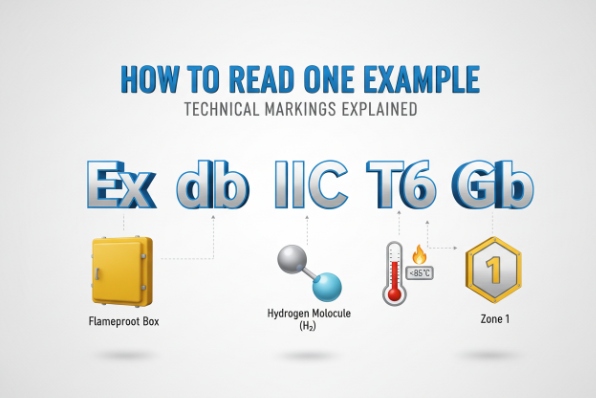
How to read one example
Example style:
- Ex db IIC T6 Gb
This tells:
-
it is an Ex product for gas,
-
it uses flameproof enclosure “db”,
-
it is suitable up to gas group IIC,
-
it limits surface temperature to T6,
-
it provides gas EPL Gb.
Practical buying checks for “G”
| Check | What to confirm | Why it matters |
|---|---|---|
| Gas group | IIA/IIB/IIC matches site gas | IIB is not a safe substitute for IIC |
| Temperature class | T-class fits ignition temp limits | A hotter device can ignite a vapor |
| Protection concept | Ex db / Ex ib / Ex eb fits the design | “Ex” alone is not enough |
| EPL | Ga/Gb/Gc aligns with zone risk | Wrong EPL can fail audit and safety |
In my project reviews, the fastest way to reduce confusion is to keep gas selection tied to the hazard study. If the site classification says Zone 1 and the gas group is IIB, then the phone should show a marking line that clearly covers Zone 1 intent, usually via Gb or an equivalent ATEX category that matches the zone requirement.
Now dust is different. It behaves differently and it is marked differently. So the next section focuses on “D” and what it means for combustible dust atmospheres.
What does “D” indicate for combustible dust atmospheres?
Dust hazards look quiet until they are not. Dust can create clouds during normal work, and dust layers can trap heat on a device surface. That is why dust marking is not just a copy of gas marking.
“D” indicates the equipment is certified for combustible dust atmospheres, and it should be paired with dust EPL (Da/Db/Dc), dust protection type (commonly Ex t), a dust group (IIIA/IIIB/IIIC), and a maximum surface temperature stated in °C.
Why dust marking includes “Ex t” and surface temperature in °C
For dust, many industrial telephones rely on protection by enclosure 6 (Ex t). The goal is to prevent dust ingress to a defined level and to control external surface temperature. Dust can also insulate surfaces. That means the same power dissipation can produce a higher surface temperature when dust layers build up.
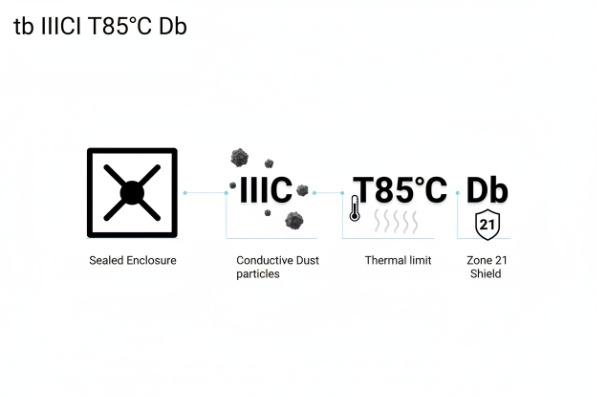
That is why dust marking often looks like:
- Ex tb IIIC T85°C Db
This tells:
-
it is an Ex product for dust,
-
it uses enclosure protection level “tb”,
-
it covers dust group IIIC (often the most demanding),
-
it limits maximum surface temperature to 85°C,
-
it provides dust EPL Db.
Dust groups matter as much as gas groups
Dust group is a real selection factor:
-
IIIA: combustible flyings
-
IIIB: non-conductive dust
-
IIIC: conductive dust
A phone marked IIIC usually covers the widest dust severity range, but the certificate still sets conditions. For example, gasket materials, cable entry sealing, and IP level can become critical.
Practical buying checks for “D”
| Check | What to confirm | Why it matters |
|---|---|---|
| Dust group | IIIA/IIIB/IIIC matches site dust | Conductive dust needs stricter controls |
| Max surface temperature | °C value fits dust ignition and layer assumptions | Dust layers can raise surface temperature |
| Protection type | Ex tb / Ex tc and enclosure IP method | Dust ingress breaks the protection concept |
| EPL | Da/Db/Dc aligns with dust zone | Wrong EPL can fail compliance |
For many sites, dust is present in one building and gas is present in another. It is tempting to standardize on one “Ex telephone” model. That works only when the device is certified for the hazards present in each location. So the next section maps “G” and “D” to the zone families and gives a simple way to choose for a specific site.
How do “G” and “D” map to zones—Zone 0/1/2 versus Zone 20/21/22—and how should I choose for my site?
Most wrong purchases come from skipping the zone map. Teams see “Ex” and assume it covers the whole plant. Zone mapping makes that assumption visible.
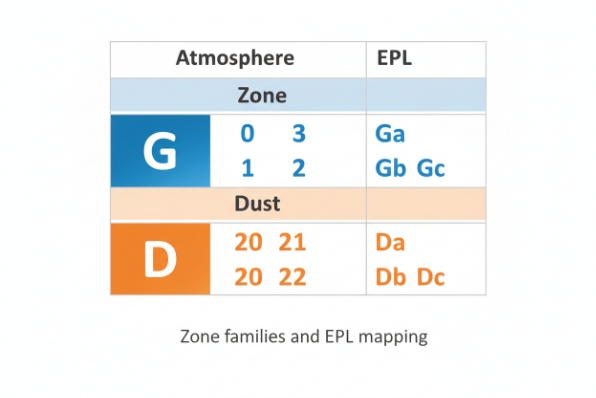
“G” ratings map to gas Zones 0/1/2 and use EPL Ga/Gb/Gc. “D” ratings map to dust Zones 20/21/22 and use EPL Da/Db/Dc. Choose based on the area classification at the exact mounting point, not the general site label.
Zone families and EPL mapping
Gas zones:
-
Zone 0: explosive gas atmosphere present continuously or for long periods
-
Zone 1: likely in normal operation
-
Zone 2: unlikely in normal operation, or only for a short time
Dust zones:
-
Zone 20: dust cloud present continuously or frequently
-
Zone 21: likely in normal operation
-
Zone 22: unlikely in normal operation, or only briefly
A practical EPL map:
| Atmosphere | Zone | Typical EPL | Typical “level letter” |
|---|---|---|---|
| Gas (G) | Zone 0 | Ga | “a” |
| Gas (G) | Zone 1 | Gb | “b” |
| Gas (G) | Zone 2 | Gc | “c” |
| Dust (D) | Zone 20 | Da | “a” |
| Dust (D) | Zone 21 | Db | “b” |
| Dust (D) | Zone 22 | Dc | “c” |
Higher protection can usually be used in less hazardous zones. The reverse is not acceptable.
How to choose for a site without guessing
A simple selection flow works well:
1) Start from the area classification drawing and confirm the zone at the phone location.
2) Confirm whether the hazard is gas, dust, or both in that location.
3) Identify the gas group or dust group that applies.
4) Confirm temperature limits:
-
gas uses T-class
-
dust uses max surface temp in °C
5) Check environmental needs:
-
corrosion level
-
washdown
-
UV exposure
-
expected dust layers
A decision table for common site scenarios
| Site area | Typical hazard | Zone family | What to look for on phone |
|---|---|---|---|
| Solvent pump skid | Gas/vapor | Zone 1 | “G” rating with Gb, correct gas group, T-class |
| Grain conveyor | Dust | Zone 21 | “D” rating with Db, dust group, Tmax in °C |
| Tank roof near vents | Gas/vapor | Zone 2 | “G” rating with Gc or higher, correct gas group |
| Packaging area with occasional dust | Dust | Zone 22 | “D” rating with Dc or higher, correct Tmax |
| Mixed hazard process building | Gas + Dust | Both | Combined G + D coverage on nameplate and certificate |
From my support side, the best practice is to standardize on a phone that matches the most demanding areas where it will be installed, but only if the phone truly carries both approvals when needed. That leads directly to the next question: can one explosion-proof telephone be certified for both “G” and “D,” and what combined marking should be visible?
Can one explosion-proof telephone be certified for both “G” and “D”, and what combined marking should I look for?
Many plants have both vapor hazards and dust hazards. In those sites, buying two different phone types increases spares, training, and installation errors. A dual-certified model can solve that, but only when the marking is complete.
One Ex telephone can be certified for both gas and dust, but it must show both marking sets, often as two lines: one gas line (with gas group and T-class) and one dust line (with dust group and Tmax in °C), each with its own EPL (Gb and Db, for example).
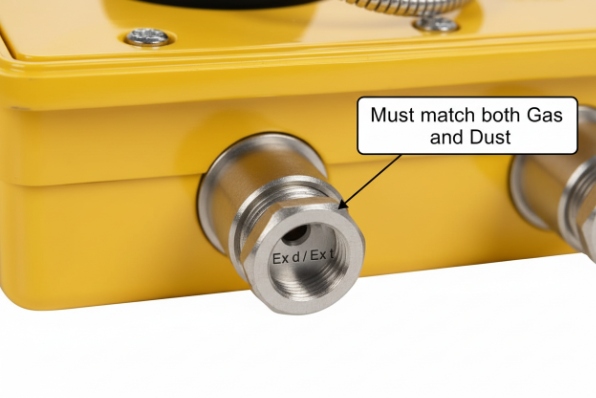
What combined marking usually looks like
A common combined approach is to show two statements on the nameplate, for example:
-
Gas: Ex db IIC T6 Gb
-
Dust: Ex tb IIIC T85°C Db
On ATEX-style labels, it may also include category lines such as:
-
II 2G (gas, category 2)
-
II 2D (dust, category 2)
So, a combined ATEX marking can look like a paired set:
-
II 2G Ex db IIC T6 Gb
-
II 2D Ex tb IIIC T85°C Db
The exact format depends on the certificate, but the key idea stays the same: both hazards must be explicitly covered.
What “dual certified” is not
Dual certified does not mean:
-
a gas phone with a high IP rating is automatically dust approved,
-
a dust phone with Ex t is automatically safe for gas,
-
a marketing brochure that says “gas and dust” without the full nameplate line is acceptable.
Each hazard type has its own test focus and its own marking details. Dust certification needs dust group and Tmax. Gas certification needs gas group and T-class. A real dual certification includes both.
A quick combined marking checklist
| Item | Gas side must show | Dust side must show |
|---|---|---|
| Protection concept | Ex db / Ex ib / Ex eb (as certified) | Ex tb / Ex tc (as certified) |
| Group | IIA/IIB/IIC | IIIA/IIIB/IIIC |
| Temperature limit | T1–T6 | Tmax in °C |
| EPL | Ga/Gb/Gc | Da/Db/Dc |
When a dual-certified phone is used, the cable glands and stopping plugs must also match both the hazard type and the installation rules. In mixed hazards, it is common to require certified glands that maintain the protection concept and ingress control.
Now the last step is verification. Buyers often trust the label, but audits trust the certificate. The next section lists the documents that should confirm the correct “G/D” rating and shows a simple consistency check process.
Which documents should confirm the correct “G/D” rating—ATEX/IECEx certificates, scope of use, and nameplate consistency checks?
A compliant phone is a chain: certificate → controlled production → correct nameplate → correct installation parts. If any link breaks, the rating becomes hard to defend.
Confirm the correct “G/D” rating by matching the phone’s nameplate marking to the ATEX/IECEx certificate marking section, checking the certificate scope and special conditions, and confirming the supplier’s production quality assurance coverage and change-control for any OEM/ODM modifications.
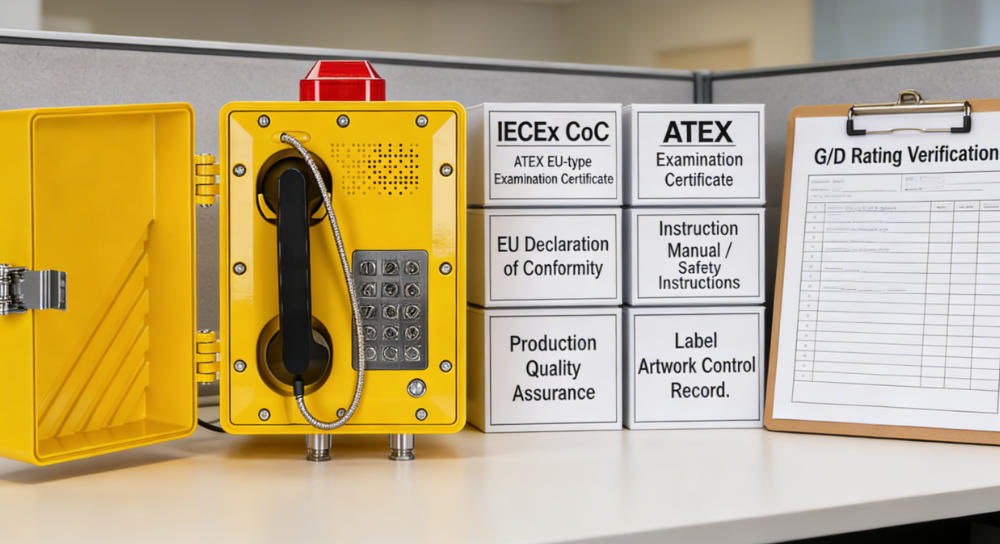
Documents that should be in the approval package
For a professional procurement file, these documents usually matter most:
-
IECEx Certificate of Conformity 7 (CoC), if IECEx is used
-
ATEX EU-type examination certificate, if ATEX is used
-
EU Declaration of Conformity 8 (DoC) for ATEX shipments
-
Instruction manual / safety instructions tied to the certificate (often includes “special conditions”)
-
Production quality assurance evidence, tied to the manufacturing site and scope
-
Label artwork control record (important for OEM/ODM branding projects)
The buyer does not need to become a certifier. The buyer only needs a simple match-and-check routine.
A nameplate consistency check that works during incoming inspection
1) Read the nameplate and write down the full marking lines for gas and dust.
2) Open the certificate and find the Marking section.
3) Confirm exact matches:
-
protection concept symbols
-
gas group and dust group
-
temperature class and dust Tmax
-
EPL letters
-
ambient range (Ta) if shown
-
any “X” conditions if present
4) Confirm the certificate scope includes the exact model variant, including:
-
cable entry threads
-
enclosure material
-
optional parts that affect heat or sealing
5) Check the supplier’s production QA coverage is valid for the factory and product family.
OEM/ODM change-control: the part that silently breaks “G/D”
OEM/ODM work often includes changes like:
-
different logo plates or label layouts,
-
new handset cords,
-
different speakers or amplifiers,
-
coating color changes,
-
different cable entry thread options.
Some of these changes can affect Ex safety. Color can change surface temperature under sun. Cable entry changes can affect sealing. Speaker changes can affect heat rise. That is why a supplier must have controlled change management. A safe buyer requirement is: no Ex-impacting change without a documented compliance review and, when needed, a certificate variation.
A compact verification table for procurement teams
| Verification item | What to compare | Pass condition |
|---|---|---|
| Certificate vs nameplate | Marking lines | Exact match, no missing symbols |
| Scope of use | Model and options | Variant is covered, including entries |
| Special conditions | “X” notes | Installation and parts can meet them |
| Production QA coverage | Factory and scope | Current and relevant to the product |
| Change-control | ECO/ECR records | Ex-impacting changes are reviewed and approved |
This approach keeps the “G” and “D” decision tied to facts. It also reduces the common risk of receiving a phone that is correct on the datasheet but wrong on the nameplate, or correct on the nameplate but built with uncontrolled substitutions.
Conclusion
“G” is for gas/vapor zones 0/1/2 and “D” is for dust zones 20/21/22. Choose by site classification, then confirm both the certificate marking and the nameplate match exactly.
Footnotes
-
International certification scheme for equipment used in explosive atmospheres. ↩
-
Levels of protection assigned to equipment based on its likelihood of becoming a source of ignition. ↩
-
Hazardous area classification where an explosive gas atmosphere is present continuously or for long periods. ↩
-
Hazardous area classification where an explosive dust atmosphere is present continuously or for long periods. ↩
-
Classification system defining the maximum surface temperature an equipment can reach to prevent ignition. ↩
-
Type of protection where the enclosure prevents dust ingress and limits surface temperature. ↩
-
Document issued by an IECEx Certification Body verifying compliance with IECEx standards. ↩
-
Official document stating that a product meets all relevant requirements of applicable EU directives. ↩








