Many Ex telephones fail acceptance for one boring reason. The label looks “right,” but one symbol is missing or misread. Then the install stops.
Identify the complete Ex marking by reading the full nameplate line(s) as a structured code: protection type + atmosphere (G/D) + group + temperature limit + EPL, then match it word-for-word to the ATEX/IECEx certificate marking section and scope.
A practical “full-marking” reading method that works in the field
Treat the Ex label as a checklist, not a slogan
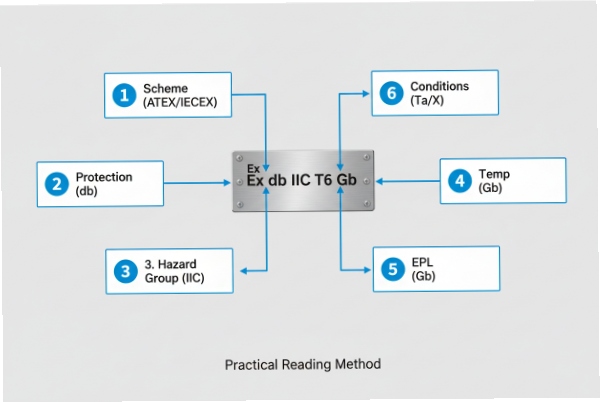
On an explosion-proof telephone, the Ex nameplate is not a marketing badge. It is a compressed compliance statement. The safest way to identify the complete format is to read it in the same order every time:
1) Scheme and legal layer: ATEX (often includes Group/Category and CE/Notified Body details) and/or IECEx (often includes IECEx certificate number and EPL language).
2) Protection concept: the “how” (for gas, examples include Ex protection type 1, Ex eb, Ex ib; for dust, Ex tb/Ex tc under Ex t).
3) Hazard group: gas group 2 (IIA/IIB/IIC) and/or dust group (IIIA/IIIB/IIIC).
4) Temperature limit: gas uses temperature limit 3 (T1–T6), dust uses maximum surface temperature in °C.
5) EPL: for gas Ga/Gb/Gc, for dust Da/Db/Dc EPL 4 markings provide zone clarity.
6) Conditions and ranges: ambient range 5 (Ta), IP rating 6, and any “X” special conditions.
Use a “two-line” mindset when gas and dust both apply
Many telephones that cover gas and dust show two marking lines. One line is for gas. One is for dust. That layout prevents mixing gas T-class with dust Tmax, which is a common site error.
One table procurement can keep beside the PO
| Item on nameplate | Gas marking example | Dust marking example | What it proves |
|---|---|---|---|
| Protection type | Ex db | Ex tb | How ignition risk is controlled |
| Group | IIC | IIIC | Severity of gas or dust covered |
| Temperature limit | T6 | T85°C | Max surface temperature limit |
| EPL | Gb | Db | Zone intent level |
| Ambient range | Ta -40°C to +60°C | Ta -40°C to +60°C | Where it is allowed to run |
| Special suffix | …0001X | …0001X | Conditions of safe use exist |
This method keeps the work simple. The label is read. The certificate is opened. The strings must match. If the strings do not match, the phone should not be installed. That single rule saves more time than any argument on site.
When I support integrators on mixed projects, this is also how installation parts stay correct. Cable glands, stopping plugs, and threads must match the certified configuration. The label and certificate tell that story.
Now the details matter. The next sections walk through the mandatory nameplate elements, how ATEX and IECEx formats differ, the misreads that happen most often, and the verification steps procurement teams can run without slowing shipments.
If the team learns one habit, it should be this: never approve a telephone by a photo of the front panel. Approve it by a clear photo of the nameplate and a matching certificate marking line.
Which mandatory Ex nameplate elements should be checked, including protection type, gas/dust group, temperature class, and EPL?
A label can look complete but still miss one key element. That missing piece usually appears later as a failed audit or a wrong-zone installation.
Mandatory Ex checks on a telephone nameplate are: Ex protection type, atmosphere coverage (G and/or D), gas or dust group, temperature limit (T-class or °C), EPL, ambient range, and a valid certificate reference that matches the approved marking line.
Start with the “core four,” then expand
For fast screening, use the core four:
-
Protection type (the method): Ex db / Ex ib / Ex eb for gas, and Ex tb / Ex tc under Ex t for dust.
-
Group: IIA/IIB/IIC for gas, IIIA/IIIB/IIIC for dust.
-
Temperature: gas T-class, dust Tmax in °C.
-
EPL: gas Ga/Gb/Gc, dust Da/Db/Dc.
Then expand to the items that often cause rejection:
-
ATEX Group/Category if ATEX is claimed (often II 2G, II 2D, or II 2GD).
-
Ambient range (Ta). This is critical for outdoor phones in hot sun or cold regions.
-
Ingress protection (IP). This matters for Ex t dust concepts and harsh washdown.
-
Certificate number and suffix. An “X” means special conditions exist. A “U” means component certification, not standalone equipment.
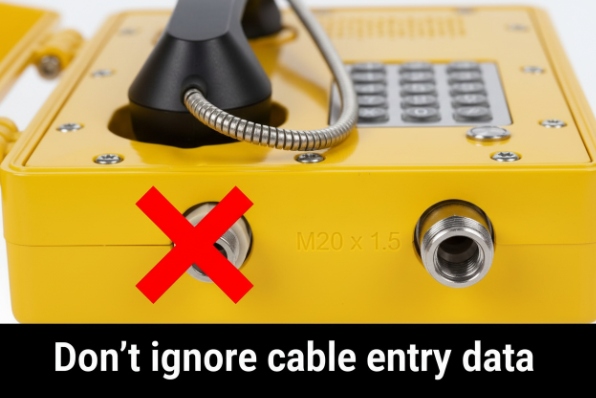
Don’t ignore cable entry data
Explosion-proof telephones fail in real life at cable entries. That is why a complete procurement check also captures:
-
entry thread type (NPT vs metric)
-
approved gland types and sealing method
-
permitted stopping plugs for unused entries
If the telephone certificate allows only specific thread sizes or accessories, the label should not be treated as flexible. A mismatched gland can break IP, and it can break compliance.
Use one table for both engineering and receiving
| Nameplate element | Why it is mandatory | What procurement should do |
|---|---|---|
| Protection concept | Defines the safety method | Match exactly to certificate marking line |
| G/D atmosphere | Tells gas vs dust coverage | Confirm it matches the site hazard study |
| Gas/Dust group | Matches gas type or dust conductivity | Block substitutions (IIB is not IIC) |
| Temperature limit | Prevents hot-surface ignition | Compare to site ignition constraints |
| EPL | Maps to zone intent | Check against Zone 0/1/2 or 20/21/22 |
| Ta range | Controls climate suitability | Reject if range does not fit site |
| Certificate ref + suffix | Enables verification | Ensure no “U” for finished equipment |
At DJSlink, this checklist is also the base for OEM/ODM control. Branding can change. The Ex marking cannot change unless the certificate changes. That is why the label artwork and the certificate marking line must be locked together.
The next risk is misreading formats. ATEX and IECEx can look similar on a crowded nameplate, but the numbers and references follow different patterns. That difference matters when buyers try to validate certificates.
How can ATEX versus IECEx marking formats be distinguished to avoid misreading certificate numbers and standards references?
Teams often mix ATEX and IECEx details into one mental model. Then certificate numbers get typed wrong, and a valid unit looks invalid.
ATEX marking often includes “II” group/category language and CE/Notified Body details, while IECEx marking centers on the IECEx certificate number format and EPL usage. Distinguish them by the presence of ATEX category codes (like II 2G/2D) versus an IECEx CoC number line (like IECEx XXX 00.0000X).
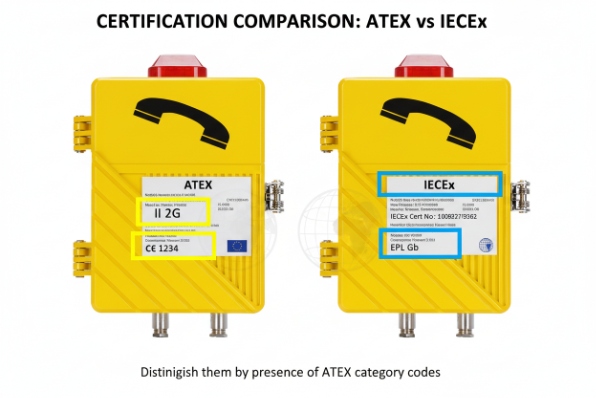
What ATEX tends to show on the nameplate
ATEX is tied to EU legal requirements. Many ATEX plates show:
-
Equipment group and category such as II 2G, II 2D, or II 2GD
-
CE mark and often a Notified Body 7 number linked to production control
-
an ATEX certificate 8 number that looks different from IECEx numbering
-
the same technical marking string (Ex db IIC T6 Gb / Ex tb IIIC T85°C Db)
ATEX category language helps map equipment to zone needs, but it is still not enough by itself. The certificate “Marking” section is still the source of truth.
What IECEx tends to show on the nameplate
IECEx is an international certification system. IECEx plates often show:
-
an IECEx certificate 9 number with a clear IECEx prefix
-
the Ex marking string, often including EPL
-
sometimes the standards series references in the manual or certificate package
IECEx validation is usually done through the IECEx certificate and the manufacturer’s quality assessment coverage tied to the scheme.
A table that prevents number-format mistakes
| What you see | Likely scheme | What not to do | Safe check |
|---|---|---|---|
| “II 2G” or “II 2D” | ATEX | Don’t search IECEx database with an ATEX number | Use ATEX certificate + EU DoC |
| “IECEx …….X” | IECEx | Don’t assume CE/Notified Body applies | Use IECEx CoC and marking section |
| “X” suffix | Both can use it | Don’t ignore it | Read special conditions in the certificate |
| “U” suffix | Component certificate | Don’t accept it as finished equipment | Require an equipment certificate |
A simple habit helps: store certificates in the vendor file under two folders, ATEX and IECEx. Then train the team to compare only within the same scheme. This stops most “false non-compliance” events during receiving.
Now for the mistakes that keep repeating. Combined G/D markings, ambient ranges, and “X/U” special conditions create confusion even in experienced teams. The next section lists the common misreads and how to avoid them.
What common misinterpretations occur with combined G/D markings, ambient temperature ranges, and “X/U” special conditions?
Misreads do not look like mistakes at the start. They look like “close enough.” Then they show up as leaks, wrong glands, wrong zone installs, and paperwork disputes.
Common misinterpretations are: mixing gas and dust marking into one line, confusing gas T-class with dust Tmax in °C, treating Ta ambient range as optional, and ignoring “X” special conditions or accepting a “U” component certificate as if it were certified equipment.
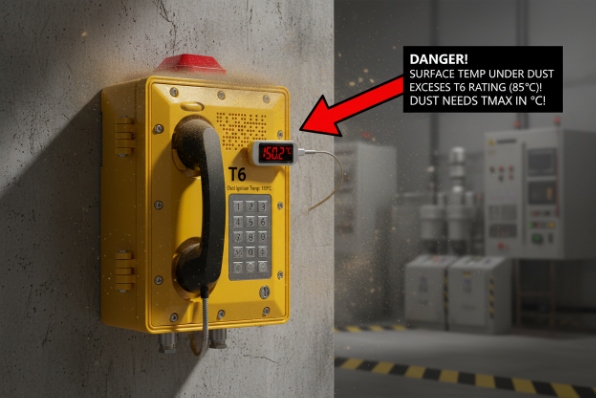
Combined G/D: the “single-line trap”
In dual-certified phones, the marking often splits into two lines: one for gas, one for dust. The mistake happens when teams assume the gas T-class (like T6) also means the dust surface temperature is low. Dust layers insulate. A T6 gas rating does not guarantee a safe dust Tmax if layers accumulate. The correct way is to read the dust line separately: look for Txx°C and the dust group.
Ambient range (Ta) is not a suggestion
Standard industrial range is -20°C to +40°C. Many outdoor phones are rated -40°C to +60°C or +70°C. If a phone is installed in direct desert sun where the enclosure hits +80°C, the certification is void. The ambient range printed on the nameplate is a hard limit. Exceeding it can compromise seals, electronics, and T-class safety.
“X” vs “U”: the suffixes that matter
-
“X” means Specific Conditions of Use 10. It is not a failure; it is an instruction. It might mean “clean only with a damp cloth” (electrostatic risk) or “protect from impact.” If the installer ignores the X, the install is non-compliant.
-
“U” means Ex Component. It is not equipment. You cannot install a “U” certified keypad by itself in a zone. It must be part of a larger certified assembly.
A misinterpretation prevention table
| Label element | Common misread | Correct interpretation |
|---|---|---|
| Gas vs Dust line | “It says T6 so it’s safe for dust” | Read the dust line for Tmax in °C and dust group |
| Ta ambient range | “It works in the lab so it’s fine” | Ta range is a safety limit for materials and T-class |
| “X” suffix | “Just a standard marking” | Read certificate for mandatory installation/use rules |
| “U” suffix | “It has a certificate number” | It is a component, not a finished device for zone use |
The safest path is to treat every element on the label as a requirement. If the label says Ta +60°C, then +61°C is a safety violation.
Finally, verification. A nameplate is only trustworthy if it matches the certificate and the factory quality system. The last section outlines a simple cross-check process for procurement and QA teams.
How can nameplate data be cross-checked with certificates and factory QA records to verify authenticity?
A correct label on a non-compliant phone is a counterfeit risk. Or it might just be an uncontrolled production run. Either way, verification connects the physical object to the legal paper.
Verify authenticity by matching the exact nameplate marking line to the ATEX/IECEx certificate marking section, confirming the certificate validity on official databases (IECEx/Notified Body), and checking that the supplier holds current production quality assurance (QAN/QAR) for the manufacturing site.

Step 1: Match the marking string to the certificate
Open the certificate PDF. Find the “Marking” or “Ex marking” section. Compare it character for character with the nameplate photo.
-
Does the protection type match?
-
Does the group match?
-
Does the T-class match?
-
Does the ambient range match?
If the certificate lists options (e.g., T4/T5/T6 depending on power), confirm the nameplate reflects the specific configuration ordered.
Step 2: Validate the certificate status online
For IECEx, go to the IECEx online database. Search by certificate number.
-
Is the status “Current”?
-
Is the issue number the latest?
-
Does the manufacturer name match the nameplate?
For ATEX, check the Notified Body’s validity or ask the supplier for a current copy. ATEX certificates are not always in a single public database, so document control is key.
Step 3: Check production quality assurance (QAN/QAR)
A type certificate covers the design. A QAN (ATEX) or QAR (IECEx) covers the factory.
-
Ask for the QAN/QAR summary or notification.
-
Check the expiry date.
-
Check the manufacturing location address. It should match the address on the nameplate (or the “manufactured by” logic).
-
Check the scope. Does it cover “Telephones” or “Communication equipment” and the protection concepts used (d, e, i, t, m)?
A verification summary table
| Verification step | What to compare | Pass signal |
|---|---|---|
| Marking consistency | Nameplate vs Certificate text | Exact match of Ex string and Ta range |
| Certificate status | Online database (IECEx) or issuer check | Status is “Current” and not suspended |
| Factory control | QAN/QAR document | Valid date, correct address, correct scope |
| Change control | Revision history | Major changes have updated certificate issues |
This process closes the loop. It confirms the phone was designed safely, certified correctly, and built in a controlled factory.
Conclusion
Identify the complete Ex marking by reading the full structured code (protection + atmosphere + group + temp + EPL), separating gas from dust lines, respecting ambient limits and “X” conditions, and verifying it against valid certificates and factory QA records.
Footnotes
-
IECEx system overview for understanding protection concepts in hazardous environments. ↩ ↩
-
Detailed information on gas groups and their ignition characteristics in explosion-proof design. ↩ ↩
-
Guide to temperature classes and surface temperature limits for safe operation. ↩ ↩
-
Explanation of Equipment Protection Levels (EPL) and their relationship to hazardous zones. ↩ ↩
-
Technical requirements for ambient temperature ranges in hazardous area certification. ↩ ↩
-
Standards for enclosure protection against water, dust, and mechanical ingress. ↩ ↩
-
Database of organizations designated to assess equipment compliance under EU directives. ↩ ↩
-
Official EU portal for the ATEX directive regulating equipment in explosive atmospheres. ↩ ↩
-
Global database and system for international certification of equipment for explosive atmospheres. ↩ ↩
-
Detailed explanation of the ‘X’ suffix and requirements for safe equipment installation. ↩ ↩