

Many sites add a beacon or sounder to a hazardous-area phone and assume “same enclosure, same safety.” That shortcut often fails in inspection.
Ex t 1 is dust protection by enclosure. A phone-plus-beacon setup only stays compliant when each device is correctly certified for the zone/dust group, the surface temperature is marked in °C, and every cable entry preserves the required IP level.
The practical Ex t baseline for warning devices on Ex telephones
What Ex t really protects, and what it does not
Ex t is built around two controls: dust ingress control (IP) and surface temperature limitation. It does not automatically control arcs, sparks, or energy in wiring. That matters because many warning add-ons are powered devices with drivers, LEDs, and sounder electronics. So the core question is always: is the beacon/sounder a certified Ex device on its own, or is it covered as part of the telephone assembly certificate?
When the beacon is outside the phone enclosure, it is normally treated as a separate Ex product. It needs its own marking and certificate for the same dust zone where it is installed. If it is inside the enclosure and the product is sold as an option, it must be inside the certified bill of materials and the certificate scope for that exact configuration.
Ex t marking must use Tmax (°C), not gas T-class
For dust, the marking uses a maximum surface temperature value in °C. That is what inspectors look for. Gas T-class 2 (T1–T6) belongs to the gas marking line. Mixing these two temperature systems is one of the fastest ways to get rejected.
Ex t also assumes IP is kept in the real installation
A test sample can be IP66 in a lab, but your installed system can drop to “unknown” if:
-
a gland is substituted,
-
an unused hole is closed with a non-certified plug,
-
a gasket is pinched,
-
a cable is out of the gland’s OD range.
Ex t lives or dies at the cable entry.
A simple “system view” table
| Part of the system | What must be true under Ex t | Typical mistake |
|---|---|---|
| Telephone enclosure | Marked Ex t (if dust rated) with Tmax and EPL | Treating IP as “optional” |
| Beacon/sounder | Certified for the same dust zone, or included in phone certificate | Using a general industrial beacon |
| Cable entry | Glands and plugs keep required IP | Thread mismatch or wrong seal |
| Documentation | Certificates match nameplates and configuration | Only a datasheet is provided |
If these basics are set, the rest of the work becomes clean procurement and clean installation. Next is the most common buyer question: do the beacon and sounder need to “match” the phone’s Ex t and IP rating?
A clear answer prevents costly over-spec and avoids under-spec that fails commissioning.
Small differences in marking can create big confusion. Installers see “Ex” and assume all parts are equal.
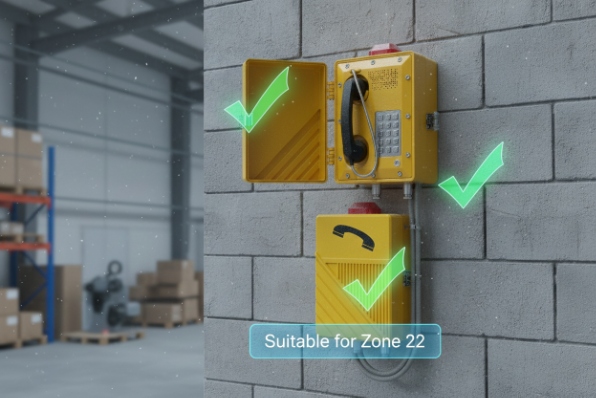
Beacons and sounders do not need to have identical markings to the telephone, but each device installed in the dust zone must have an Ex rating that is suitable for that exact zone, dust group, and temperature limit, and must meet the IP requirement linked to its Ex t level.
“Same rating” is not the same as “same suitability”
A telephone could be rated:
Ex tb IIIC T80°C Db IP66
while a beacon could be rated:
Ex tc IIIC T90°C Dc IP66
These are not identical, but both can be suitable in different dust zones. The real rule is the zone requirement at the mounting point:
So a Db phone can be used in Zone 22, and a Dc beacon can be used in Zone 22, but that Dc beacon should not be used in Zone 21.
IP is tied to Ex t and dust group, not to marketing
Ex t has minimum dust ingress protection based on the dust group 5:
-
IIIC typically drives IP6X for dust ingress protection.
-
IIIB/IIIA can allow IP5X in certain Ex t levels.
In real purchasing, I prefer a conservative approach in powder plants: if IIIC is possible, standardize to IP6X-capable products and lock glands and plugs tightly.
How to choose “harsh site” suitability
Harsh sites are not only “more dust.” They include:
-
washdown + dust,
-
vibration that loosens glands,
-
public access (impact on lenses),
-
sticky powders that build layers and trap heat.
In these sites, a beacon with a higher IP and higher mechanical rating can be smart even if the zone only requires Dc.
A quick decision table
| Installation zone | Minimum dust EPL | Typical Ex t level | Practical note |
|---|---|---|---|
| Zone 21 | Db | Ex tb | Stronger sealing expectations |
| Zone 22 | Dc | Ex tc | Still must keep IP via glands |
| Zone 22 (standardization) | Db | Ex tb | Often reduces wrong installs |
The key takeaway: matching is about suitability, not about identical letters. The next question is temperature marking, because warning devices often create heat, and dust marking must show surface temperature clearly.
How do I mark temperature for external warning devices?
Many teams correctly mark the phone, then forget that the beacon has its own temperature limits and its own Ta assumptions.
External beacons/sounders in dust zones should be marked with Ex t and a maximum surface temperature value in °C (Tmax). If gas is also relevant, they also need a gas T-class on the gas marking line.
Dust uses Tmax (°C) and may include dust-layer assumptions
For dust, the marking uses a maximum surface temperature like:
T85°C,T90°C,T120°C, etc.
Some standards guidance also discusses how marking can differ depending on whether the equipment was tested with a dust layer or without a layer. This is exactly why the safest habit is to copy the marking from the certificate “Marking” section word-for-word. The certificate schedule is where special temperature conditions are documented.
Gas-and-dust combined devices need two temperature languages
If your beacon is certified for both gas and dust, it will often show two lines:
-
Gas line: includes T-class (T1–T6)
-
Dust line: includes Tmax in °C
This avoids mixing systems. It also helps commissioning teams check both hazards in mixed plants.
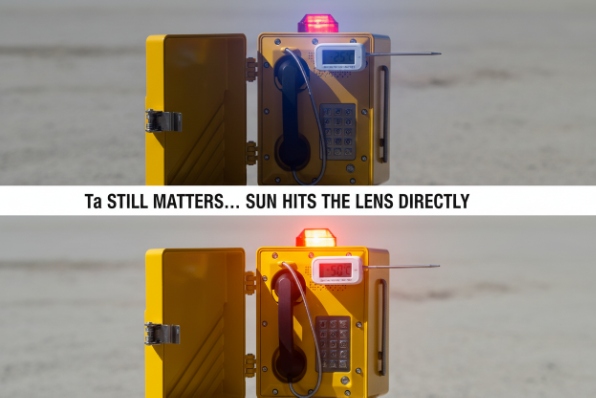
Ta still matters for warning devices
A beacon can run hotter when:
-
ambient is high,
-
sun hits the lens directly,
-
the sounder runs continuously,
-
the device is driven at max duty cycle.
So Ta belongs on the device nameplate or in its certificate marking text. If Ta is narrower for the beacon than for the phone, the system is only as strong as the weakest Ta in the chain.
How to verify “maximum surface temperature vs process heat”
A practical method on site:
1) Confirm the certified Ta range for both phone and beacon.
2) Check proximity to hot pipes, steam tracing, or hot walls.
3) Check sun exposure and airflow.
4) If the point is high-risk, do a simple surface temperature spot check during worst-case operation.
If process heat adds significant radiant heating, it effectively raises the “local ambient” seen by the device. In that case, relocating the beacon a short distance often solves the problem without changing product category.
A marking clarity table
| Device | Temperature marking to show | Common mistake |
|---|---|---|
| Gas-only phone | T-class (T1–T6) + Ta range | Treating T-class as ambient |
| Dust-only beacon | Tmax (°C) + Ta range | Printing gas T-class on dust line |
| Dual G/D beacon | T-class on gas line + Tmax on dust line | Combining into one confusing value |
Once temperature marking is clean, wiring and cable entry become the next main failure point. Ex t depends heavily on preserving enclosure integrity.
What wiring and cable-gland rules apply for Ex t circuits?
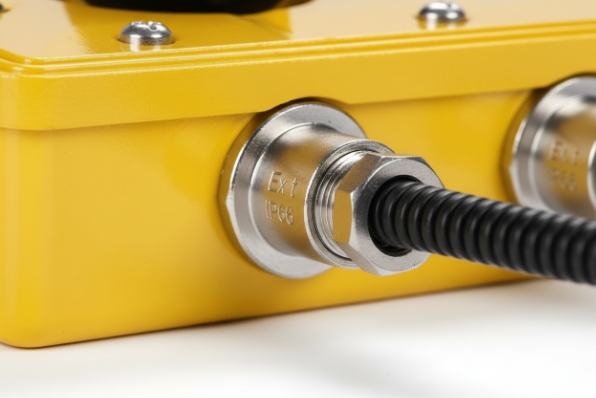
Most “Ex t failures” in the field are not electronics failures. They are entry failures: wrong gland, wrong seal, wrong torque, or wrong plug.
For Ex t systems, wiring must maintain enclosure integrity and required IP. Cable glands and seals must match the entry thread, cable OD, temperature range, and be suitable for hazardous areas. Unused entries must be correctly plugged to preserve dust ingress protection.
Treat the cable entry as part of the protection concept
Ex t is “protection by enclosure.” That means the entry system is part of the protection, even if the internal circuit is simple. In procurement, I lock these items:
-
thread type and size,
-
gland part number and certificate,
-
sealing method (compression seal, washer, O-ring),
-
permitted cable OD range,
-
stopping plug part number for unused holes.
This avoids the field substitution problem where the contractor uses what is on the truck.
Wiring approach depends on the product architecture
Two common architectures exist:
1) Separate certified beacon mounted externally
The beacon has its own Ex marking. The wiring between phone and beacon is a normal power/control circuit, but it must be installed using hazardous-area wiring rules and suitable glands for each enclosure.
2) Beacon included as a certified option on the phone
The phone certificate schedule will often list the beacon option and any limits (duty cycle, Ta impact, wiring method). In this case, internal wiring and terminal chamber rules matter a lot. Configuration control is critical.
If the phone provides only a relay contact output, the beacon power circuit still needs to be safe for the area. Ex t does not magically make the external circuit “safe.” The beacon must be certified, or the circuit must use an appropriate protection concept (like Ex i 6) if that is the chosen method.
Gland and sealing priorities for powdery environments
Powdery plants need:
-
tight compression seals (no loose cable fit),
-
stable materials (seals compatible with chemicals and cleaning),
-
strain relief that prevents cable movement from working the seal loose.
For conductive dust group IIIC, I push for IP6X-capable sealing performance and strict installation workmanship.
A field checklist for entries
| Check item | What “good” looks like | What fails audits |
|---|---|---|
| Gland selection | Correct Ex/IP gland PN for the enclosure | Random industrial gland |
| Thread fit | Full engagement, correct thread type | Metric/NPT mismatch |
| Seals | Cable OD inside gland range, seal not twisted | Under/over compression |
| Unused entries | Correct certified plug and seal | Open hole or generic plug |
| Strain relief | Cable is supported and not pulling | Cable weight on gland |
After wiring and glands, the last piece is documentation. Auditors do not approve “a system story.” They approve traceable certificates and controlled configurations.
How do I document combined phone-plus-beacon certification?
Many procurement teams accept a phone certificate and a beacon certificate, then discover later that the configuration or mounting is not covered.
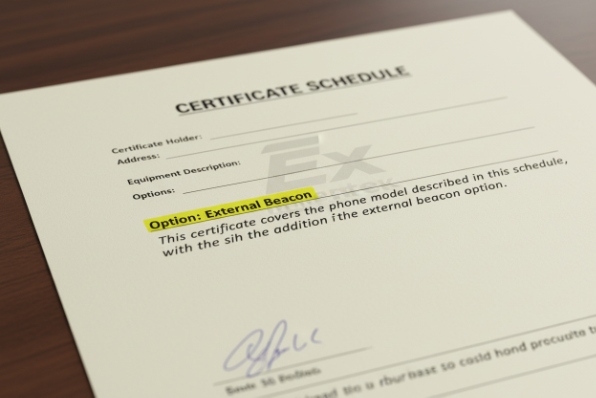
Document combined phone-plus-beacon compliance by providing certificates for each Ex product (or one combined certificate if the beacon is part of the phone scope), plus the certificate schedules, approved accessory lists, nameplate photos, installation drawings, and change-control records for OEM/ODM builds.
Two acceptable certification models
1) Separate certificates (most common)
-
Phone has its own IECEx CoC / ATEX certificate.
-
Beacon/sounder has its own IECEx CoC / ATEX certificate.
-
The system is acceptable when both are suitable for the same zone/dust group and installed per their manuals.
2) Single certificate covering the phone with beacon option
-
The phone certificate schedule lists the beacon option as part of the certified configuration.
-
The marking section may include the same for the configured assembly.
-
This is often the cleanest path for OEM/ODM projects because configuration is controlled.
What auditors typically ask for
A complete procurement pack usually includes:
-
IECEx CoC and/or ATEX EU-type examination certificates for each device
-
Certificate schedules/annexes showing:
-
marking text,
-
Ta range,
-
Tmax for dust,
-
IP statements where relevant,
-
any “X” conditions
-
-
Installation manuals showing approved glands, plugs, and wiring limits
-
Nameplate photos of phone and beacon (so the marking can be matched to certificates)
-
Factory quality documents:
-
OEM/ODM change-control records:
-
drawing revisions,
-
BOM control for glands, seals, lenses,
-
ECO history for any enclosure or PCB changes.
-
A procurement-ready table
| Document | Phone-only | Beacon-only | Phone + beacon system file |
|---|---|---|---|
| Certificate | Required | Required | Required, matched to nameplates |
| Schedule/annex | Required | Required | Required, with options and “X” notes |
| Manual | Required | Required | Combined install method statement |
| Gland list | Required | Required | Locked part numbers and threads |
| Configuration control | Optional | Optional | Mandatory for OEM/ODM assemblies |
When the project is global, I also keep the same naming convention across phone and beacon documents. It saves time in audits because inspectors can map each enclosure to its certificate fast.
Conclusion
Ex t warning add-ons are safe when each enclosure is correctly certified, Tmax and Ta are clear, entries keep the required IP, and procurement includes certificates, schedules, manuals, and OEM/ODM change control.
Footnotes
-
Protection method where the enclosure prevents dust ingress and limits surface temperature. ↩
-
Classification system defining the maximum surface temperature an equipment can reach to prevent ignition. ↩
-
Hazardous area classification where an explosive dust atmosphere is likely to occur in normal operation. ↩
-
Hazardous area classification where an explosive dust atmosphere is not likely to occur in normal operation. ↩
-
Classification of dust based on its conductive properties and particle size. ↩
-
Protection technique for safe operation of electrical equipment in hazardous areas by limiting energy. ↩
-
Report confirming that a manufacturer has a quality system that complies with IECEx requirements. ↩
-
Quality Assurance Notification, a mandatory audit for manufacturers producing Category 1 and 2 ATEX equipment. ↩








