
Connecting industrial safety equipment to modern VoIP networks can feel like navigating a minefield. You need to ensure your hazardous area telephones can talk to your digital control room without risking safety or signal loss.
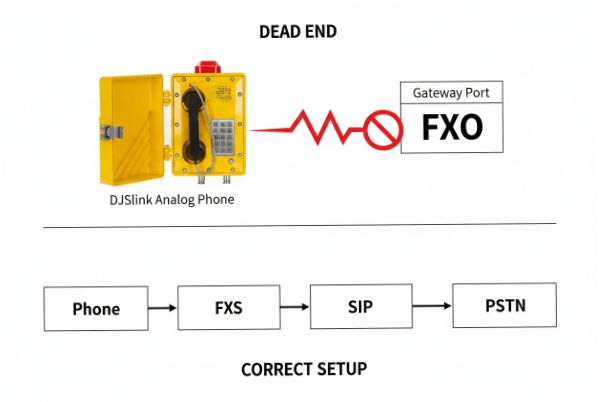
Explosion-proof analog telephones are fully compatible with FXO gateways, provided you connect them to the gateway’s FXS port. These phones behave like standard analog endpoints. They require a gateway that supplies standard line voltage (-48V), ringing current, and loop current to function correctly within the VoIP infrastructure.
Understanding the Connection Between Analog Ex Phones and VoIP
There is a common confusion in our industry regarding "FXO" 1 and "FXS" 2 ports. I hear this from system integrators almost every week. The title of this article asks about "FXO gateways," but we need to be precise about the physics of the connection.
An explosion-proof analog telephone acts as an "FXO interface" device. This means it expects to receive a dial tone and power. Therefore, it must physically connect to an FXS (Foreign Exchange Subscriber) port on your gateway. The gateway itself might be called an "FXO Gateway" because it bridges your local network to the public telephone line (PSTN), but for the phone to work, you plug it into the port labeled "Phone" or "FXS".
The compatibility relies on the gateway’s ability to emulate a traditional telephone line. Industrial sites often have long cable runs. A standard office gateway might not push enough voltage down 2 kilometers of copper cable to ring a heavy-duty bell in a noisy factory. You must check the "REN" 3 (Ringer Equivalence Number) load. Our DJSlink phones are designed to work with standard ATA (Analog Telephone Adapter) specifications, but we always recommend testing the loop length.
Safety is another layer. The gateway belongs in the "Safe Area" (the control room). Only the 2-wire copper line goes into the hazardous zone (Zone 1 or Zone 2). If you are using an Intrinsically Safe 4 (IS) telephone, you must place an IS barrier between the gateway and the phone. The gateway sends voltage; the barrier limits it to prevent sparks. If you skip this, the gateway’s standard voltage could ignite the atmosphere.
| Component | Role in System | Location |
|---|---|---|
| Ex Telephone | Endpoint (User Interface) | Hazardous Area (Zone 1/2) |
| Copper Cabling | Signal Transport | Runs between Zones |
| IS Barrier | Safety Limiter (Voltage/Current) | Safe Area (Control Cabinet) |
| VoIP Gateway | Analog to Digital Converter | Safe Area (Server Room) |
| FXS Port | Provides Power & Dial Tone | On the Gateway |
Which PBX/FXO Brands and Regions Have Been Validated?
System integrators often ask me if our specialized hardware plays nicely with the big names in the PBX world. Compatibility issues here can delay a project by weeks.
We have validated our explosion-proof telephones with major global gateway brands like Grandstream, Yeastar, and Cisco. These tests confirm that our analog endpoints function correctly across different regional standards, ensuring reliable dial tone detection, ringing, and voice transmission in diverse markets from North America to the Middle East.
Ensuring Global Interoperability
When we export to over 100 countries, we cannot rely on a single standard. A gateway in the US acts differently than one in Germany. This is why validation matters. We test our phones against the most common VoIP gateways.
Grandstream and Yeastar are very popular in the cost-effective industrial sector. We have confirmed that our analog circuits open and close correctly with their FXS ports. The timing of the "off-hook" signal is critical. If the phone’s switch is too slow or too fast, the gateway might ignore it. Our testing ensures that when you lift the receiver in an emergency, the gateway knows immediately.
Region plays a huge role in compatibility. The US uses FCC 5 standards, while Europe follows ETSI 6. This affects how the gateway sends ring tones and busy signals. Our mainboards are tuned to handle these variations. For example, the ring frequency in the US is typically 20Hz, while in some parts of Europe, it can be 25Hz or 50Hz. A validated pairing means the phone rings loudly regardless of the frequency sent by the PBX.
We also look at Cisco and Avaya ecosystems. These are common in large oil and gas enterprise networks. While these systems are complex, the analog interface remains simple. As long as the Cisco ATA provides a standard loop current (usually 20mA to 25mA), our phones will operate. We provide documentation to help you configure the "gain" or volume settings on these specific gateways to match our industrial speaker/microphone sensitivity.
| Brand | Typical Market | Validation Status | Key Configuration Note |
|---|---|---|---|
| Grandstream | SMB / General Industry | Fully Validated | Adjust loop current for long cable runs. |
| Yeastar | Mid-Market Security | Fully Validated | Compatible with default impedance settings. |
| Cisco | Enterprise / Oil & Gas | Compatible via ATA | Requires gain adjustment for noisy areas. |
| Avaya | Large Enterprise | Compatible via Gateway | Ensure port is set to "Analog Station". |
Do Polarity Reversal and CPC Disconnect Signals Work Reliably?
A "hung line" is a nightmare in an emergency system. If a phone does not hang up properly, that line is dead for the next person who needs help.
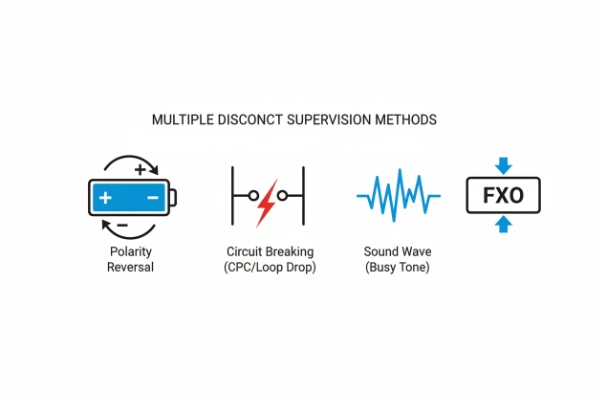
Our industrial telephones are engineered to detect both polarity reversal and Calling Party Control (CPC) signals. These disconnect signals are essential for automated systems to recognize when a call has ended, releasing the line immediately and preventing "busy" signals during critical safety operations.
Solving the "Hung Line" Problem
In the old days, people manually hung up phones. In industrial automation, we often have auto-dialers or PAGA 7 systems. If the other side hangs up, your industrial phone needs to know.
CPC (Calling Party Control) is a brief drop in line voltage. The gateway drops the voltage to 0V for about 500 milliseconds to say "the call is over." Standard home phones might miss this. Our DJSlink mainboards are sensitive to this drop. We ensure that the phone releases the channel instantly. This is vital for "Hotline" configurations where the phone auto-dials a security center. If the security guard hangs up, the phone must reset for the next emergency.
Polarity Reversal is another method. Some gateways flip the positive and negative voltage to signal a connect or disconnect event. We see this often in billing systems or precise call logging. Our hardware supports this. It prevents the system from recording a 5-hour call just because someone forgot to place the handset back perfectly on the cradle.
Reliability here is about safety. Imagine a fire alarm trigger that dials out. If it does not detect the disconnect, it might stay off-hook and fail to dial the secondary number. We design our circuits to prioritize these signals. We recommend you check your gateway settings to enable "CPC disconnect" or "Loop Current Drop." Often, this feature is disabled by default on factory-reset gateways.
| Signal Type | Function | Why It Matters in Industry |
|---|---|---|
| CPC (Loop Drop) | Signals "Call Ended" | Prevents line blockage after emergency calls. |
| Polarity Reversal | Signals "Call Connected/Ended" | Used for accurate billing and logging. |
| Busy Tone Detection | Signals "Line Busy" | tells the auto-dialer to try the next number. |
| Silence Detection | Failsafe Hangup | Disconnects if no audio is heard for X seconds. |
Are Caller ID Standards Bellcore/ETSI Supported on FXO?
Knowing where a call comes from saves lives. In a large refinery, a call from "Extension 101" is meaningless without the location data displayed on the receiving end.
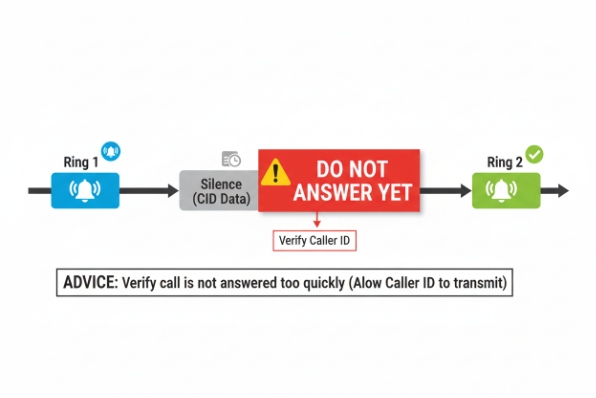
Yes, our explosion-proof telephones support both Bellcore (FSK) and ETSI Caller ID standards. While the phone itself primarily sends voice, it allows the gateway’s FXS port to pass Caller ID data through to the receiving display, ensuring that security teams can instantly identify the specific location of a distress call.
Identifying the Caller in Global Deployments
There are two main ways Caller ID data travels down a wire: FSK (Frequency Shift Keying) and DTMF (Dual Tone Multi-Frequency). Different parts of the world stick to their own standards. North America and parts of Asia use Bellcore FSK. Europe often uses ETSI FSK or DTMF.
Our phones are passive in this regard. We ensure our specialized industrial handsets and displays (if equipped) can decode these signals. If you are using a DJSlink phone with an LCD display, it will show the number provided by the gateway. If you are using a heavy-duty model without a screen, this question is still relevant for the receiving end.
The FXO gateway sends the ID. Our phone’s impedance matching ensures this data signal is not distorted. If the impedance is wrong, the FSK data packet (which sounds like a short modem burst) gets corrupted. The result is "Unknown Caller" on your screen. We test to ensure the signal passes cleanly.
This is crucial for SOS systems. When a button is pressed at "Tank Farm Zone B," that data must reach the control room. We advise integrators to name the FXS port on the gateway clearly (e.g., "North_Gate_SOS"). Even if the phone is a simple analog device, the gateway pushes this ID to the SIP network. The integrity of the analog connection preserves this data.
| Standard | Region | Signal Type | Compatibility Note |
|---|---|---|---|
| Bellcore (GR-30) | USA, Canada, Australia, China | FSK | Most common default on Gateways. |
| ETSI | Europe, South America | FSK / DTMF | Requires gateway region setting "EU". |
| DTMF | Some Asian/European Legacy | Audio Tones | Slower, but robust on poor lines. |
| NTT | Japan | V.23 FSK | Specific to Japanese deployments. |
What Impedance Options (600Ω, Complex) Are Available?
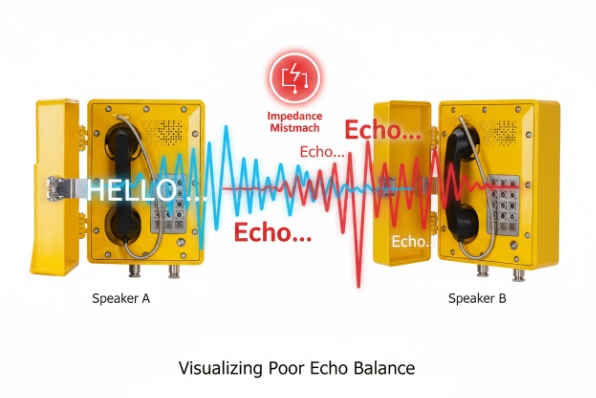
Audio quality is not a luxury; it is a necessity. If the impedance between the phone and the gateway is mismatched, you get echo, low volume, or screeching feedback.
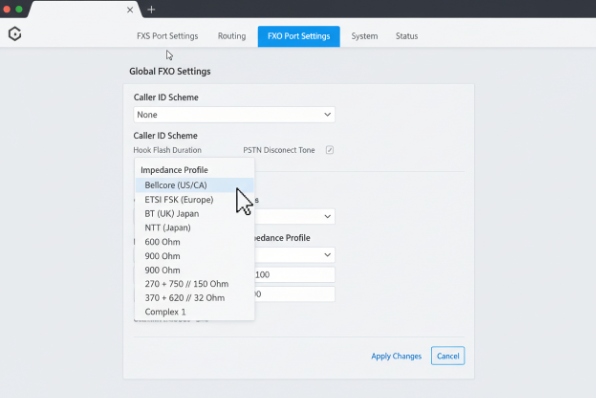
We provide switchable impedance options on our mainboards, supporting both the standard resistive 600Ω and complex impedance (European CTR21). This flexibility allows you to match the telephone’s audio characteristics to the specific gateway or country standard you are using, eliminating echo and maximizing volume in noisy industrial environments.
Tuning Audio for Harsh Environments
The standard impedance for telephone lines in the US and many international markets is 600 ohms resistive. If you buy a default gateway, it expects to see a 600-ohm device on the other end. However, in Europe (and countries following TBR21 standards), the line is "complex." This means it has both resistance and capacitance.
If you plug a 600-ohm phone into a complex line, you get a signal reflection. In a quiet office, this is a faint echo. In a factory with 100dB background noise, it is a disaster. The echo canceller in the gateway fails, and communication breaks down.
Our industrial phones have jumpers or software settings (depending on the model) to switch between these modes. This is a feature usually found only in high-end testing gear. We include it because we know our phones go into difficult places.
We also allow for gain adjustment. Sometimes the impedance is correct, but the line loss is high due to old cabling. You can boost the microphone output or the speaker sensitivity. This "fine-tuning" capability separates professional industrial equipment from cheap consumer modifications. We help you get the clearest sound possible, regardless of the gateway or cable quality.
| Option | Technical Spec | Best Used For | Effect of Mismatch | |
|---|---|---|---|---|
| Resistive | 600Ω | US, Asia, Standard VoIP Gateways | Low volume, "Hollow" sound. | |
| Complex | 270Ω + (750Ω | 150nF) | Europe (Germany, France, UK) | Echo, Sidetone issues. |
| High Z | >10kΩ (On Hook) | Monitoring / Snooping | Phone fails to disconnect line. | |
| Adjustable | Hardware Jumper | Mixed / Unknown Environments | Flexibility to fix audio onsite. |
Conclusion
Explosion-proof telephones are fully compatible with FXO gateways when connected to FXS ports. By verifying supported protocols, disconnect signaling, and impedance settings, you ensure a safe, reliable integration.
Footnotes
-
Port that receives the analog line, essentially functioning as the device (like a phone or fax). ↩
-
Port that delivers the analog line to the subscriber, providing power and dial tone. ↩
-
Measure of the load a device places on a telephone line, determining how many devices can ring simultaneously. ↩
-
Protection technique for safe operation of electrical equipment in hazardous areas by limiting energy. ↩
-
Federal Communications Commission, regulating interstate and international communications in the US. ↩
-
European Telecommunications Standards Institute, producing globally applicable standards for ICT. ↩
-
Public Address and General Alarm system used for emergency broadcasting. ↩








