

Industrial communication systems demand absolute reliability, but integrating rugged devices with modern servers often raises compatibility fears. You might worry that specialized explosion-proof hardware lacks the standard codec support found in office phones.
Yes, explosion-proof telephones universally support G.711 (both A-law and µ-law) as their primary, uncompressed voice codec. This ensures seamless interoperability with standard SIP 2.0 platforms, legacy PSTN gateways, and virtually all IP-PBX systems used in hazardous industrial environments.
The Backbone of Industrial VoIP: Why G.711 Matters
When we talk about Voice over IP 1 (VoIP) in hazardous areas—whether it’s an oil rig or a chemical processing plant—clarity is not just a luxury; it is a safety requirement. In my years at DJSlink manufacturing industrial communication hardware, I have seen specs for countless projects. Without fail, the first requirement for any SIP endpoint is support for G.711. This codec is the digital equivalent of the traditional telephone network audio we have used for decades. It samples audio at 64 kilobits per second (kbps), providing uncompressed, high-fidelity voice quality.
For our customers, who are often system integrators connecting a mix of new and old equipment, G.711 is the "safe harbor." While modern codecs like Opus 2 or G.722 3 offer wider frequency ranges, and G.729 4 offers bandwidth savings, G.711 remains the baseline standard. It is the language that every piece of VoIP equipment speaks fluently.
Interoperability and Legacy Integration
The real value of G.711 in explosion-proof telephones lies in its ability to bridge the gap between the IP world and the analog world. Many industrial sites still rely on legacy PSTN 5 lines or FXO 6 gateways to interface with the public telephone network. Because G.711 provides a raw stream of audio without complex compression algorithms, it passes through these gateways without degradation.
I often remind clients that while the housing of the phone is built to withstand explosions (Ex d 7) or increased safety (Ex e 8), the internal SIP stack must perform like a standard office phone. If a device listed for a Zone 1 hazardous area did not support G.711, it would be virtually unusable in 90% of enterprise environments. This is why manufacturers like Eaton and J&R Technology list G.711 prominently alongside specialized features like beacon control.
| Feature | G.711 (A-law/µ-law) | G.729 | G.722 |
|---|---|---|---|
| Bitrate | 64 kbps | 8 kbps | 64 kbps |
| Compression | None (PCM) | High | None (Wideband) |
| CPU Load | Very Low | High | Low |
| Audio Quality | Toll Quality (Standard) | Mobile Quality | HD Voice |
| Latency | Negligible | Moderate | Low |
In my experience, using a royalty-free, well-known codec like G.711 simplifies long-term support. You do not have to worry about licensing fees or obscure firmware bugs that can plague proprietary compression algorithms. It simply works, which is exactly what you need when an alarm is ringing and you need to broadcast an evacuation order.
Now that we have established that G.711 is the standard, let us look at the specific configurations that affect how you deploy these devices.
Are μ-law and A-law both selectable per trunk?
Regional signaling differences can cause nightmares for telecom engineers, leading to one-way audio or static. You need to know if a single explosion-proof device can adapt to different geographical standards without a hardware swap.
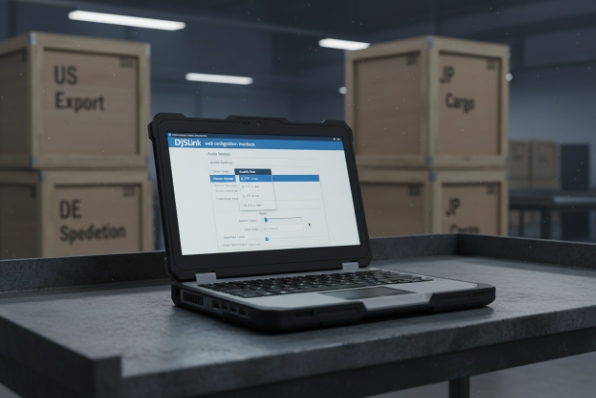
Yes, modern explosion-proof SIP phones allow you to select either μ-law (North America/Japan) or A-law (Europe/Rest of World) via the web interface. This selection can typically be set globally or per SIP account, allowing one hardware model to be deployed worldwide.
Global Deployment Flexibility
One of the most common questions I get from distributors involves SKU management. They want to know if they need to stock a "US version" and a "European version" of our explosion-proof phones. The answer is almost always no. The choice between μ-law (Mu-law) and A-law is entirely software-defined within the SIP stack of the phone.
Technically, both variations use the same 64 kbps bitrate, but they quantize the audio signal slightly differently to optimize the dynamic range. North America and Japan historically adopted μ-law, while the rest of the world standardized on A-law. In a pure IP environment, this matters less, but as soon as the call hits a gateway to the public network, a mismatch can cause significant audio distortion.
Configuration Best Practices
In the web interface of an explosion-proof phone, you will usually find a "Preferred Codec" list. You can drag and drop codecs to set the priority. For a site in Texas, I would configure the device to prioritize G.711 μ-law (PCMU) as the first choice. For a site in Germany, I would set G.711 A-law (PCMA) as the primary.
If you are managing a complex network where the phone might register to a local PBX for internal calls and a cloud provider for external calls, some advanced firmware allows for "per-trunk" settings. This means Account 1 (Internal) could use G.722 for HD audio, while Account 2 (External) is locked to G.711 A-law to match the local telecom provider.
| Region | Standard Variant | SIP Mime Type | Dynamic Range Optimization |
|---|---|---|---|
| North America | µ-law | PCMU | Better for low-level signals |
| Europe | A-law | PCMA | Better overall signal-to-noise |
| Japan | µ-law | PCMU | Same as NA |
| International | A-law | PCMA | Standard for most ITU 9 regions |
This flexibility is crucial for OEM manufacturers like us. It allows us to build a single "Ex" certified mainboard and simply instruct the integrator on how to configure it during commissioning.
So, we have the right dialect of G.711 selected. But what about the timing of the data packets themselves?
Can packetization time be set to 10/20/30 ms?
Network jitter and latency can destroy voice quality in industrial networks shared with SCADA systems. You might be wondering if you can tune the data transmission rate to balance smoothness against network overhead.
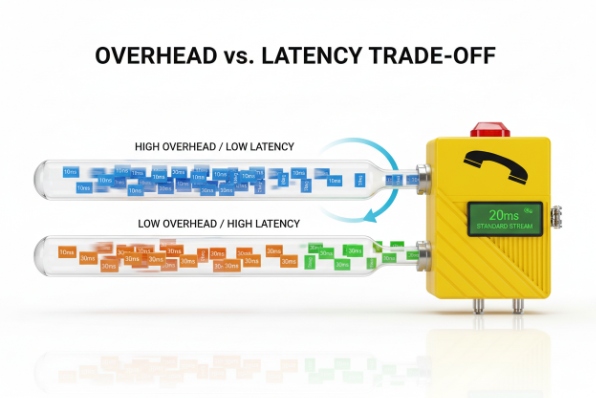
Yes, the packetization time (ptime) is a configurable parameter in the SIP settings of explosion-proof telephones. You can typically choose between 10ms, 20ms (the industry default), and 30ms to optimize audio delivery based on your network’s specific latency profile.
Balancing Overhead and Latency
Packetization time determines how much audio data is crammed into a single IP packet before it is sent. The standard setting is 20ms. This means the phone collects 20 milliseconds of audio, wraps it in IP/UDP/RTP headers, and sends it off. This happens 50 times per second.
In a pristine office network, you rarely touch this. But in an industrial facility, you might face unique challenges. If you are running voice traffic over a congested Wi-Fi link to a hazardous area, or a long-distance wireless bridge, you might want to adjust this.
-
10ms ptime: This sends smaller packets more frequently (100 times/second). It reduces the delay (latency) because the phone waits less time to fill a packet. However, it doubles the header overhead, putting more strain on the router’s CPU. I recommend this only if you have plenty of bandwidth but need extremely low latency.
-
30ms ptime: This sends larger packets less frequently (33 times/second). It is more bandwidth-efficient because you are sending fewer headers. However, if you lose one packet, you lose a larger chunk of audio (30ms), which is very noticeable to the human ear.
The Impact on Reliability
For explosion-proof phones, which are often installed in remote corners of a plant, reliable audio is key. I generally advise my clients to stick to the default 20ms unless they have a specific reason to change it. If you set the packetization time to 30ms to save bandwidth, you must ensure your network has very low packet loss. Conversely, if you use 10ms, your network switches must be able to handle the high packet-per-second rate.
| Setting (ptime) | Packets Per Second | Bandwidth (w/ Headers) | Latency (Delay) | Packet Loss Impact |
|---|---|---|---|---|
| 10 ms | 100 pps | ~87-95 kbps | Ultra Low | Low artifacting |
| 20 ms (Default) | 50 pps | ~80-84 kbps | Low (Standard) | Standard |
| 30 ms | 33.3 pps | ~75 kbps | Moderate | High (Noticeable glitches) |
Being able to tweak this setting proves that these rugged phones are not just "dumb" terminals; they are fully capable network appliances.
Speaking of bandwidth, let’s look at what G.711 actually costs you in terms of network capacity.
What bandwidth impact occurs on constrained links?
Industrial sites often rely on satellite or low-bandwidth radio links to connect remote hazardous areas. You need to know if the uncompressed nature of G.711 will clog your limited data pipes.
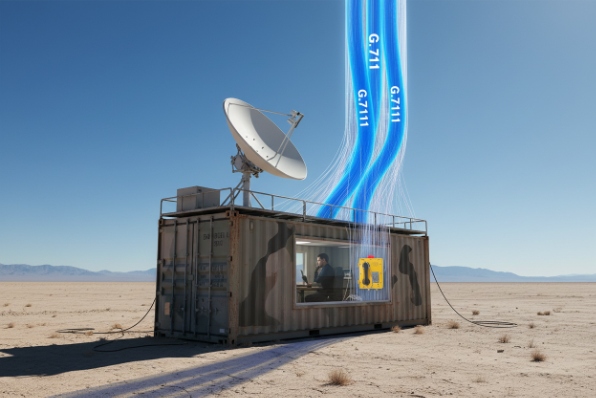
G.711 requires significantly more bandwidth than compressed codecs, consuming roughly 80-90 kbps per call when overhead is included. On constrained links, this can be substantial, often requiring Quality of Service (QoS) implementation or a fallback to G.729 if the link cannot sustain the throughput.
The True Cost of "Uncompressed"
When we say G.711 is a 64 kbps codec, we are talking about the raw audio payload. But we do not send raw audio over the internet; we send packets. Each packet needs a header so it knows where to go. This includes the IP header, UDP header, and RTP header.
My team often has to explain this "IP tax" to network engineers planning a deployment for an oil rig. A 64 kbps stream actually consumes closer to 87 kbps at the Ethernet level (using standard 20ms packetization). If you have a satellite uplink with only 256 kbps of upload speed, three simultaneous G.711 calls will saturate the link, leaving no room for data or control signals.
Mitigation Strategies
In these scenarios, explosion-proof phones offer a few solutions. First is QoS 10 (Quality of Service). These phones support VLAN tagging (802.1Q) and DiffServ (ToS). This allows you to tag voice packets so the network routers know to process them first. Even if the link is busy, the voice data gets "VIP treatment."
The second strategy is Codec Negotiation. In the phone’s configuration, we often list G.711 as the first priority and G.729 (which uses only ~30 kbps total) as the second. If the network negotiation determines that bandwidth is restricted (though this is usually a manual setting on the PBX side), or if the call is routed over a specific low-bandwidth trunk, the system can force the phone to use G.729.
However, I always argue that G.711 is the baseline expectation. If you design your network to support G.711, you will have a robust safety margin. Relying solely on high-compression codecs like G.729 can make voices sound robotic, which is not ideal during an emergency coordination call.
| Component | Bandwidth Contribution (G.711) | Bandwidth Contribution (G.729) |
|---|---|---|
| Voice Payload | 64.0 kbps | 8.0 kbps |
| L2/L3 Headers | ~23.2 kbps | ~23.2 kbps |
| Total Bandwidth | ~87.2 kbps | ~31.2 kbps |
| 3 Simultaneous Calls | ~261.6 kbps | ~93.6 kbps |
The bandwidth impact is real, but for the clarity it provides, it is a cost most safety managers are willing to pay.
Finally, voice isn’t the only thing traveling over these lines. What about fax?
Is fax pass-through or T.38 interop verified?
It might seem outdated, but fax machines are still vital for transmitting work permits and manifests in industrial zones. You need to confirm if these IP phones can handle analog fax signals without scrambling the data.
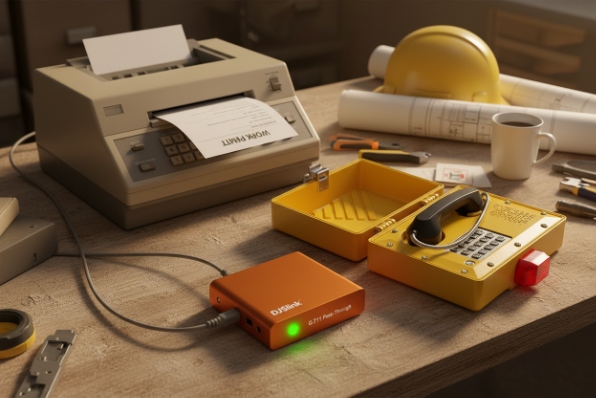
Yes, G.711 is the standard mechanism for "Fax Pass-Through," allowing analog fax signals to be digitized and sent over IP reliably. Most explosion-proof phones also support T.38 protocol for optimized fax transmission, with G.711 acting as the robust fallback verification method.
The Role of G.711 in FoIP (Fax over IP)
Fax machines are incredibly sensitive to timing. They communicate using audio tones. If those tones are compressed by a codec like G.729, the fax machine at the other end will hear garbage and drop the connection. This is where G.711 shines.
Because G.711 is uncompressed, it preserves the integrity of the fax audio tones. This method is called Fax Pass-Through. The VoIP phone simply digitizes the squeals and beeps of the fax machine just like it would a human voice. In my experience with DJSlink products, this is the most reliable way to connect a legacy fax machine to an explosion-proof ATA (Analog Telephone Adapter) or IP phone with an auxiliary port.
T.38 vs. G.711
While T.38 is a specific protocol designed to "packetize" fax data (turning the image data directly into packets rather than audio), it is not always supported by every carrier or PBX. When T.38 negotiation fails, the system must have a backup plan. That backup plan is G.711.
We verify our equipment to ensure that if a T.38 handshake doesn’t happen, the phone immediately and seamlessly switches to G.711 mode. This ensures the document gets through. For short documents or on high-quality networks (LANs), G.711 Pass-Through is often faster than T.38 because it eliminates the overhead of protocol conversion.
| Feature | Fax Pass-Through (G.711) | T.38 (Fax Relay) |
|---|---|---|
| Mechanism | Sends audio of fax tones | Sends digital image data |
| Bandwidth | High (~87 kbps) | Low (Variable) |
| Network Tolerance | Low (needs stable jitter) | High (tolerates jitter) |
| Compatibility | Universal | Dependent on Carrier/PBX |
| Setup Complexity | Plug & Play | Requires Config |
So, not only is G.711 great for voice, but it is also the unsung hero that keeps the paper trail moving in hazardous industries.
Conclusion
To answer the core question: Yes, explosion-proof telephones absolutely support the G.711 codec. It is the industry standard for a reason. Whether you are dealing with selectable A-law/µ-law encoding for global compatibility, tuning packetization times for network performance, managing bandwidth on constrained links, or ensuring legacy fax support, G.711 is the versatile foundation of industrial VoIP. It ensures that when you pick up that heavy-duty handset in a Zone 1 area, the person on the other end hears you loud and clear.
Footnotes
-
Technology for delivering voice communications and multimedia sessions over Internet Protocol networks. ↩
-
Versatile audio codec designed for interactive speech and music transmission over the Internet. ↩
-
ITU-T standard for a wideband speech codec operating at 48, 56, and 64 kbps. ↩
-
ITU-T standard for audio data compression algorithm for voice that compresses digital voice in packets of 10 milliseconds. ↩
-
Traditional circuit-switched telephone network used for voice communication. ↩
-
Interface that receives the analog line, functioning as the device (phone/fax). ↩
-
Protection method where the enclosure can withstand an internal explosion without igniting the external atmosphere. ↩
-
Protection method ensuring no arcs, sparks, or excessive temperatures occur in normal operation. ↩
-
International Telecommunication Union, responsible for global telecommunications standards. ↩
-
Mechanisms to prioritize traffic and manage network resources to ensure performance. ↩








