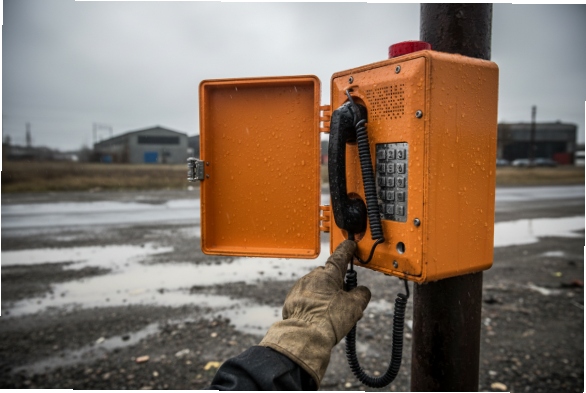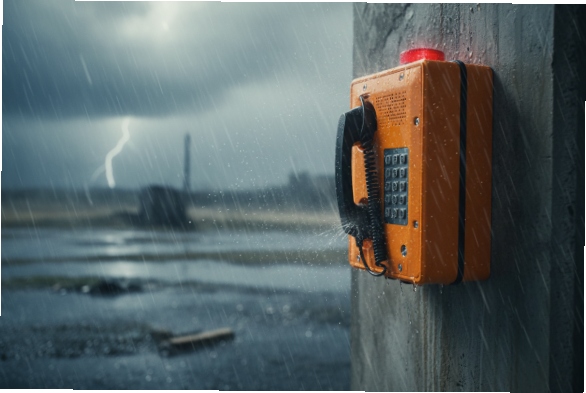
Gas hazardous areas—found in LNG plants, hydrogen production facilities, and offshore drilling rigs—are the most volatile industrial environments. An invisible leak can turn the atmosphere into a bomb, waiting for a single millijoule of spark energy. In these zones, standard communication devices are potential ignition sources and are strictly prohibited.
Yes, explosion-proof SIP telephones are specifically designed and certified for gas hazardous areas. They utilize "Flameproof" (Ex d) or "Intrinsically Safe" (Ex i) protection methods to prevent ignition of Gas Groups IIA, IIB, and IIC, making them safe for use in Zone 1 and Zone 2 atmospheres containing everything from propane to hydrogen.
The Physics of Prevention
As a representative of DJSlink, I ensure our clients understand that "explosion-proof" doesn’t mean the phone withstands an external bomb blast; it means the phone won’t cause one. In gas zones, the danger is omnipresent. A standard phone ringer or hook switch creates sparks. Our devices eliminate this risk through containment and energy limitation.
Suitability Snapshot
| Feature | Function |
|---|---|
| Ex d (Flameproof) | Contains any internal explosion so it doesn’t propagate outside. |
| IIC Rating | Safe for Hydrogen and Acetylene (the most easily ignited gases). |
| SIP / PoE | Uses low-voltage cabling, reducing the potential spark energy in the network. |
Which protection types apply in Zone 1/2 gas atmospheres?
Different zones require different engineering strategies. Zone 1 1 is a high-risk area where gas is likely present (e.g., near valve manifolds), while Zone 2 is lower risk (e.g., storage areas).
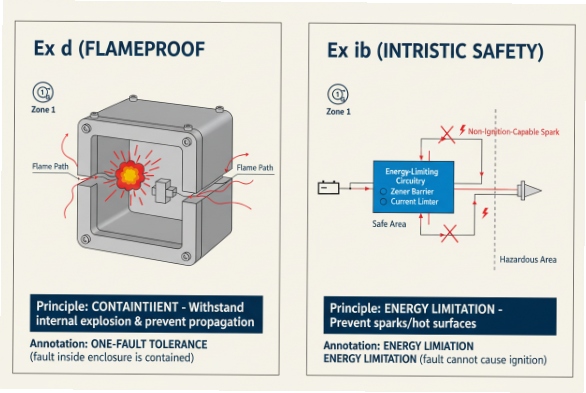
For Zone 1, the primary protection types are "Flameproof" (Ex d), which contains explosions, and "Intrinsically Safe" (Ex ib), which limits electrical energy below ignition levels. For Zone 2, "Non-Sparking" (Ex nA/Ex ec) is cost-effective, but most facilities standardize on Zone 1 equipment (Ex d) across the board for maximum safety margins.
Protection Methods Explained
1. Ex d (Flameproof) – The Heavy Lifter
- Concept: "If gas gets in and explodes, contain it."
- Construction: Heavy cast aluminum or stainless steel housings with thick walls and long, tight flame paths 2.
- Best For: SIP Telephones with high-power features like beacons or 30W amplifiers.
2. Ex ib (Intrinsic Safety) – The Energy Limiter
- Concept: "Never create enough heat or spark to ignite anything."
- Construction: Electronic current limiters and Zener barriers 3.
- Best For: Low-power handsets or headsets. Note: Fully IS SIP phones are rare because Ethernet/PoE requires more power than IS typically allows; usually, the handset is IS, but the body is Ex d.
3. Ex e (Increased Safety) – The High Standard
- Concept: "Make sure no arcs or sparks ever happen."
- Construction: High-quality terminals, impact-resistant materials. Often used for the junction box attached to the phone.
Do models meet Gas Groups IIA/IIB/IIC requirements?
Gases are grouped by how easily they ignite. A phone safe for Propane (IIA) might blow up a Hydrogen (IIC) plant.
Yes, high-end explosion-proof SIP phones are typically certified for Gas Group IIC, the strictest rating. This makes them universally suitable for Group IIA (Propane/Methane), Group IIB (Ethylene), and Group IIC (Hydrogen/Acetylene), simplifying site-wide standardization.
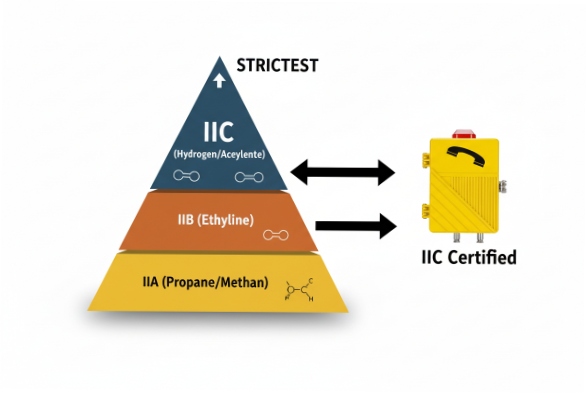
The Hierarchy of Safety
- Group IIC (Hydrogen): requires the tightest flame paths (smallest gaps) because hydrogen flames travel incredibly fast. If a phone is rated IIC, it is automatically safe for IIB and IIA.
- Group IIB (Ethylene): Common in petrochemical crackers.
- Group IIA (Propane): Common in general heating and fuel storage.
DJSlink Recommendation: Always specify IIC. It costs marginally more but ensures you can move the phone anywhere on site without worrying about the specific gas hazard.
What T-class limits apply near heaters and flare pits?
Near flare stacks, boilers, or process heaters, the ambient temperature is high. If the phone’s surface gets hotter than the gas’s auto-ignition temperature, it will cause an explosion without a spark.
T-Class ratings limit the maximum surface temperature of the device. Near heaters and flares, a T-rating of T4 (135°C) or T3 (200°C) is usually sufficient for most hydrocarbons. However, for volatile gases like Carbon Disulfide, a stricter T6 (85°C) rating is required. The phone’s rating must always be cooler than the gas’s auto-ignition temperature.
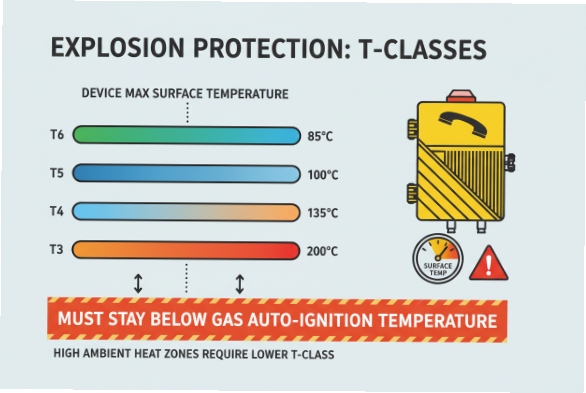
Matching the T-Class
- T6 (85°C): The gold standard. The phone never gets hot. Safe for almost everything.
- T4 (135°C): The industrial standard. Safe for Hydrogen 4 (560°C auto-ignition) and Methane (537°C), but not for Carbon Disulfide (90°C).
Warning: High ambient heat affects the T-rating. If you mount a T6 phone next to a 400°C flare pit wall, the external heat may push the phone’s temp beyond its certified limit. Heat shields are mandatory in these zones.
Can devices integrate with gas detection and ESD systems?
In a gas leak scenario, seconds count. A phone should be part of the automated response.
Yes, SIP phones act as critical nodes in the safety system. They can receive inputs from local LEL (Lower Explosive Limit) gas detectors to trigger automatic dial-out alerts and can interface with the Emergency Shutdown (ESD) system to broadcast evacuation alarms or confirm process shutdowns via SIP signaling.
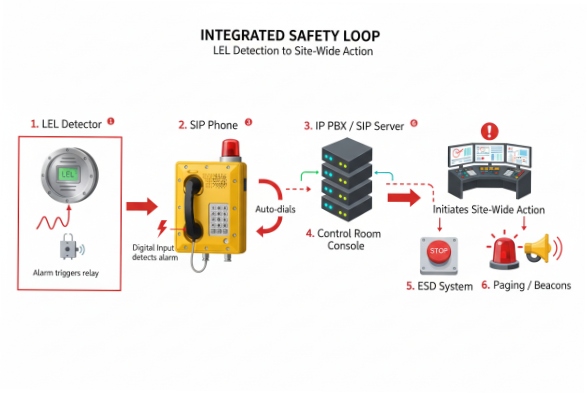
The Integrated Safety Loop
-
Local Detection (The Trigger):
- An LEL Gas Detector mounted near the phone detects a 20% methane leak.
- It closes a relay connected to the phone’s Digital Input.
-
Immediate Notification (The Call):
- The phone instantly dials the Safety Control Room.
- It plays a pre-recorded message: "Gas Alarm: Zone 4 Compressor Station."
-
Site-Wide Action (The ESD):
- The Control Room confirms the leak and triggers the ESD 5 (Emergency Shutdown)**.
- The SIP server 6 sends a command to all phones in the sector.
- The phones activate their external beacons (Red Strobe) and sirens to initiate evacuation.
Conclusion
For gas hazardous areas, there is no room for compromise. Explosion-proof SIP telephones rated Ex d IIC T6 offer the highest level of protection, covering every common industrial gas from Methane to Hydrogen. By integrating these devices with your gas detection network, you ensure that a leak is detected, reported, and acted upon before it becomes a disaster.
Footnotes
-
A hazardous area classification where an explosive atmosphere is likely to occur in normal operation. ↩
-
The interface between two parts of an enclosure that prevents the transmission of an internal explosion to the explosive atmosphere surrounding the enclosure. ↩
-
A safety device used in electrical circuits to limit the energy available to a spark or arc. ↩
-
A chemical element with symbol H and atomic number 1, highly flammable. ↩
-
A system designed to minimize the consequences of emergency situations, related to the release of hazardous materials. ↩
-
A network element in a SIP-based VoIP network that handles the setup of SIP sessions. ↩