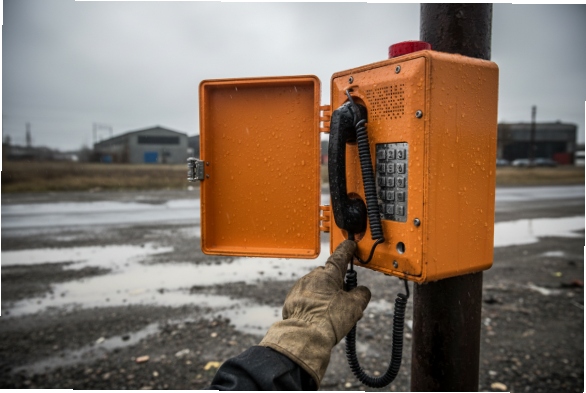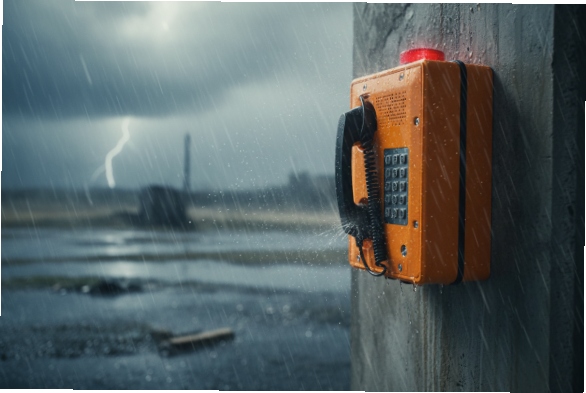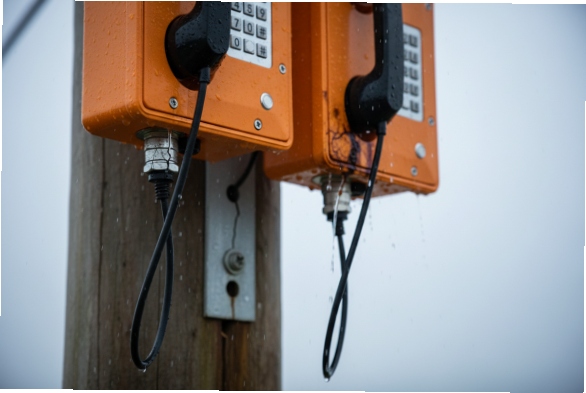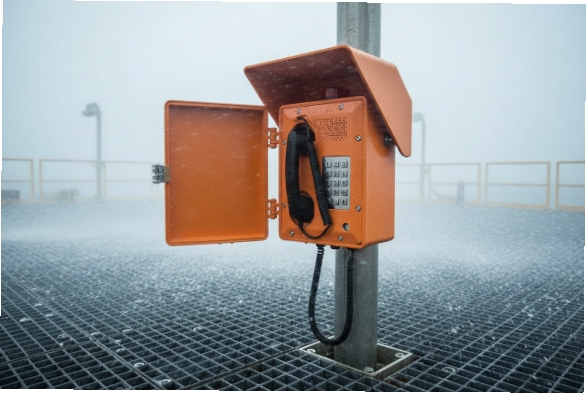
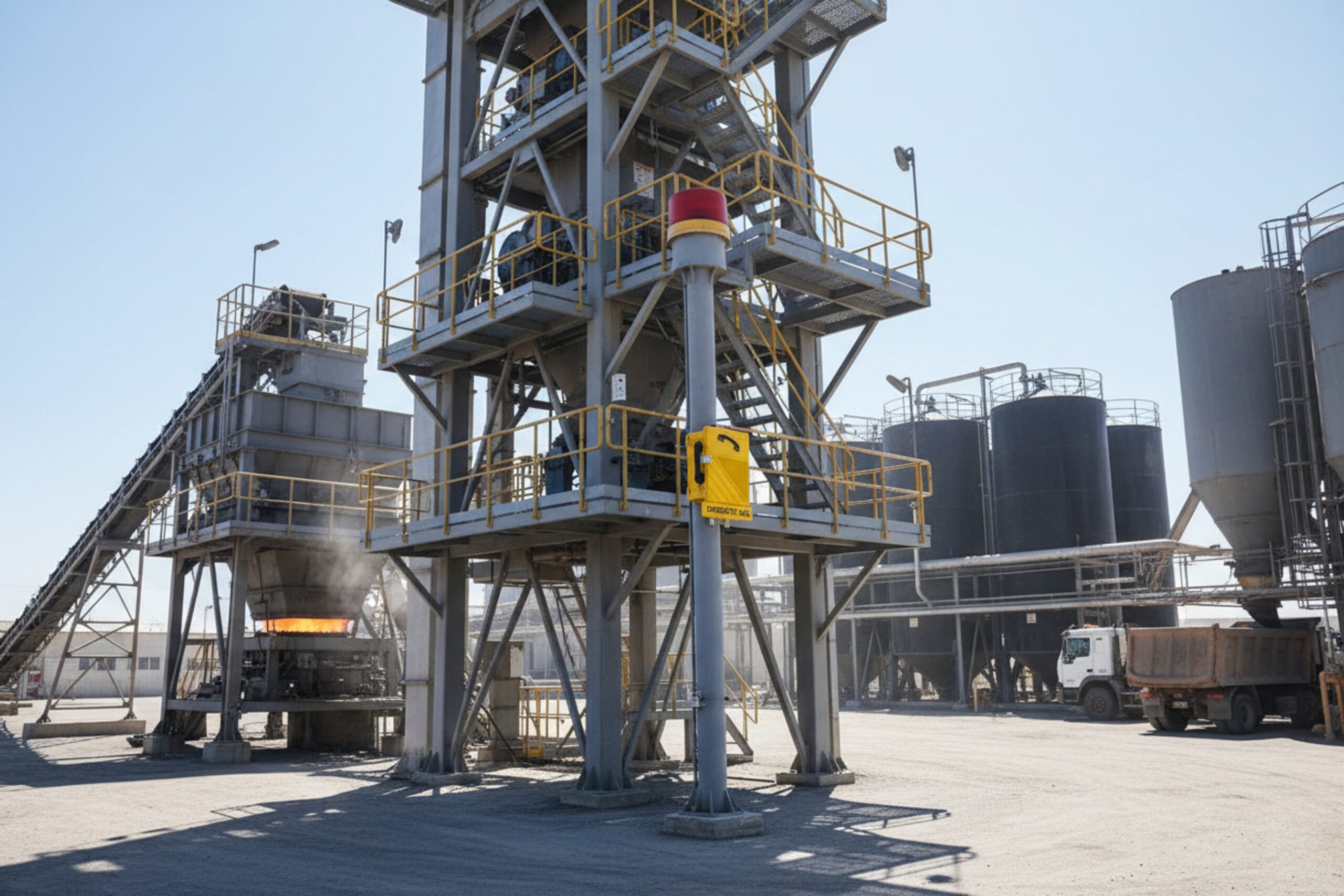
Dust, sun, and heat punish electronics at asphalt plants. Add fuel vapors near burners, and a normal phone can become the weak link in an emergency.
Yes—explosion-proof or Ex-rated SIP telephones can fit asphalt plants when the area is truly classified, the marking matches Zone/Div rules, and the enclosure, cabling, and heat limits suit the site.
A practical way to choose the right hazardous-rated phone for an asphalt plant
Separate the hazards: fuel vapors, oil mist, and combustible dust
An asphalt plant is not one single hazardous zone. The risk usually clusters around fuel systems, hot equipment, and material handling. Burners and gas trains can leak fuel gas. Bitumen tanks and lines can release oil mist or vapors during filling, venting, or maintenance. Dry aggregate handling can create combustible dust clouds in some areas. This matters because a phone marked only for gas/vapor may not cover a dust zone near baghouses or conveyors.
Zone systems define Zone 1 1 as an area where explosive gas atmosphere is likely in normal operation, and Zone 2 as not likely in normal operation and only short if it occurs. :contentReference[oaicite:0]{index=0}
In the NEC Class/Division system, Class I Division 2 2 is commonly described as vapors normally contained but present in ignitable concentrations only under abnormal conditions. :contentReference[oaicite:1]{index=1}
Decide how the phone will be powered and serviced
For most asphalt plants, PoE simplifies wiring and keeps power and voice on one cable. Still, hazardous approvals do not forgive sloppy cable entry. If the phone is flameproof/explosion-proof (Ex d 3 or explosionproof enclosure), the glands, plugs, and installation torque become part of safety, not just workmanship. If the phone is intrinsically safe 4, barriers and entity parameters become the project’s critical path.
Use a selection matrix instead of guessing
A simple matrix keeps purchasing aligned with safety, maintenance, and IT needs.
| Plant spot | Typical hazard driver | Common target rating (depends on area classification) | Extra selection notes |
|—|—|—|—|
| Burner gas train / valves | fuel gas leaks | Zone 2 or Class I Div 2 (sometimes Zone 1 near frequent venting) | keep away from radiant heat and hot casing |
| Fuel storage and transfer | filling, vents, hose connections | Zone 2 / Class I Div 2 | consider corrosion and UV for outdoor mounting |
| Bitumen tank top / vents | venting, sampling, filling | often Zone 2; Zone 1 near vents if frequent release | check T-class vs sun load and nearby hot surfaces |
| Baghouses / dry dust handling | dust clouds | Zone 21/22 or Class II Div 1/2 | may require dust-certified equipment too |
The phone is suitable when the marking matches the drawing, and the installation follows the certificate conditions. That is the difference between “installed” and “accepted.”
Now the details get easier when the plant is broken into the exact questions that show up at commissioning.
Which Zone 1/2 or Class I Div 2 ratings match burners and bitumen tanks?
A burner is hot by design. People assume the whole area is hazardous, then overbuy. Other teams assume it is unclassified, then fail inspection. Both cost money.
Most burner fuel systems and bitumen tank surroundings land in Zone 2 or Class I Div 2 in many outdoor plants, while Zone 1 is more likely right at frequent release points like vents, drains, and sampling—only your area classification can confirm.
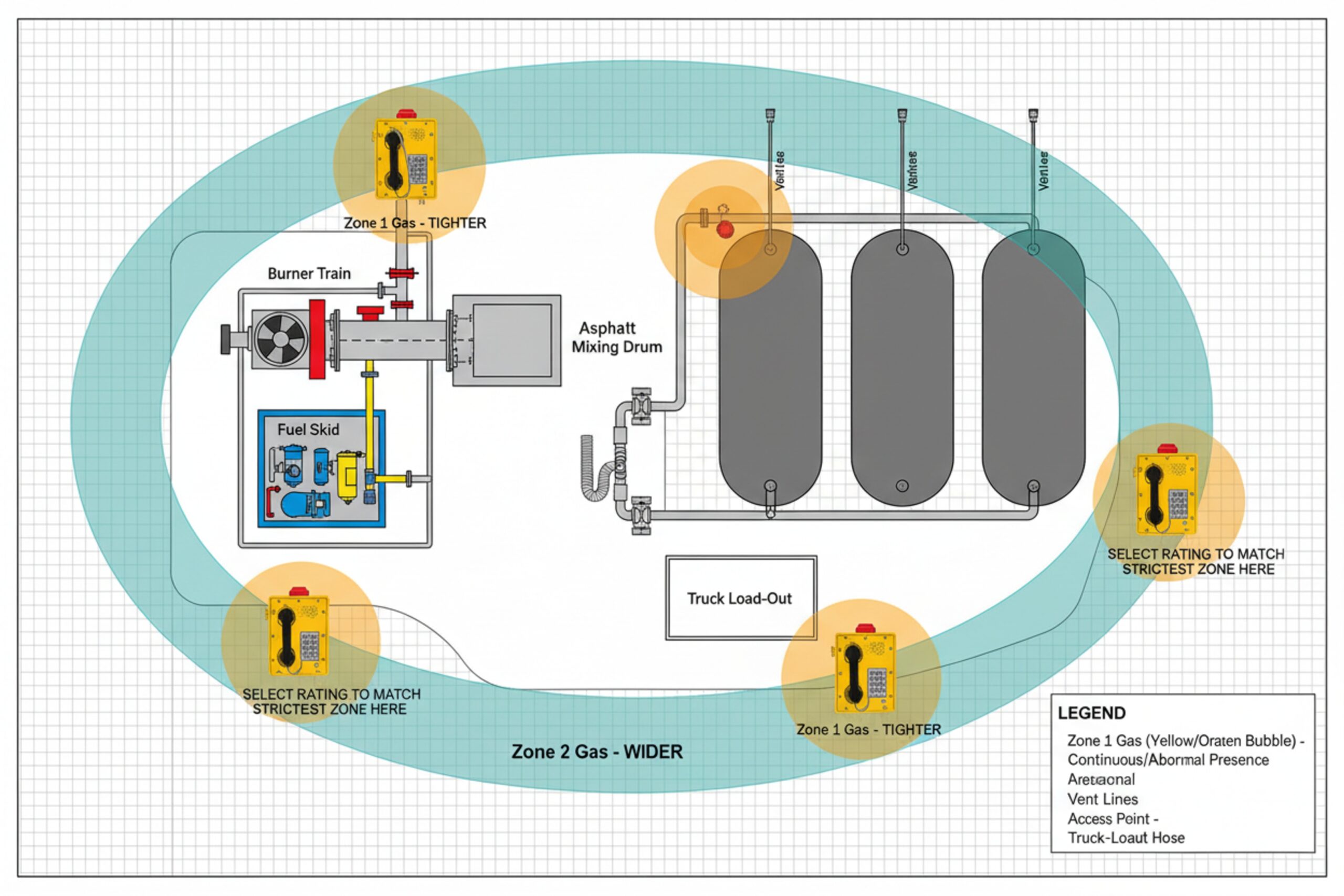
Burner areas: classify the fuel system, not the flame
The open flame is an ignition source, but it is not the reason the area becomes classified. The area becomes classified when flammable gas or vapor can mix with air outside containment. For asphalt plants, the burner fuel train and nearby joints are the common leak candidates. Many owners treat these as Class I Div 2 or Zone 2 because leaks are not expected in normal operation, and ventilation outdoors is strong. That aligns with the concept of Division 2 as “abnormal condition” presence. :contentReference[oaicite:2]{index=2}
Still, some burner racks include vents, bleed points, or frequent maintenance operations. Those are the spots that can push classification tighter. If the plant has an enclosed burner room, the classification can expand because dispersion is worse.
Bitumen tanks: the product can be “combustible” yet still create a local vapor risk
Bitumen 5 itself has a high flash point, but the practical risk is not only the binder. It is also the operating reality: truck unloading, tank filling, vent breathing, additives, and any lighter fractions present on site. Oil mist is also a factor near pumps and hot lines. Many asphalt sites handle diesel, waste oil, or other fuels for burners. Those fuels can change the classification around storage and transfer points.
A useful approach is to treat the tank system as a set of release points:
-
vent outlet
-
manway area during opening
-
sampling connections
-
pump seals
-
unloading hose connections
If the phone is placed near one of those points, choose the tighter rating that matches the boundary on the drawing, not the average rating for the whole tank farm.
A rating choice table that helps plant engineers
| Question | If the answer is “yes” | Lean toward |
|—|—|—|
| Is it outdoors with strong natural ventilation? | vapors disperse fast | Zone 2 / Class I Div 2 more likely |
| Are releases expected in normal operation (venting, draining, sampling)? | explosive mixture can occur occasionally | Zone 1 more likely near that source :contentReference[oaicite:3]{index=3} |
| Is it enclosed or partially enclosed? | vapors can accumulate | tighter zone/division and larger boundary |
| Are dust clouds credible in the same area? | dual hazard exists | consider gas + dust certified equipment |
The cleanest projects set the phone locations during the hazardous area study, not after. That avoids moving devices late when conduit is already installed.
Do IP66/67, UV/heat-resistant enclosures survive dust, oil mist, and sun?
Asphalt plants do not fail phones with one big event. They fail them slowly with heat cycles, UV, oil film, and abrasive dust. The phone still powers up, but audio drops, buttons stick, and seals age out.
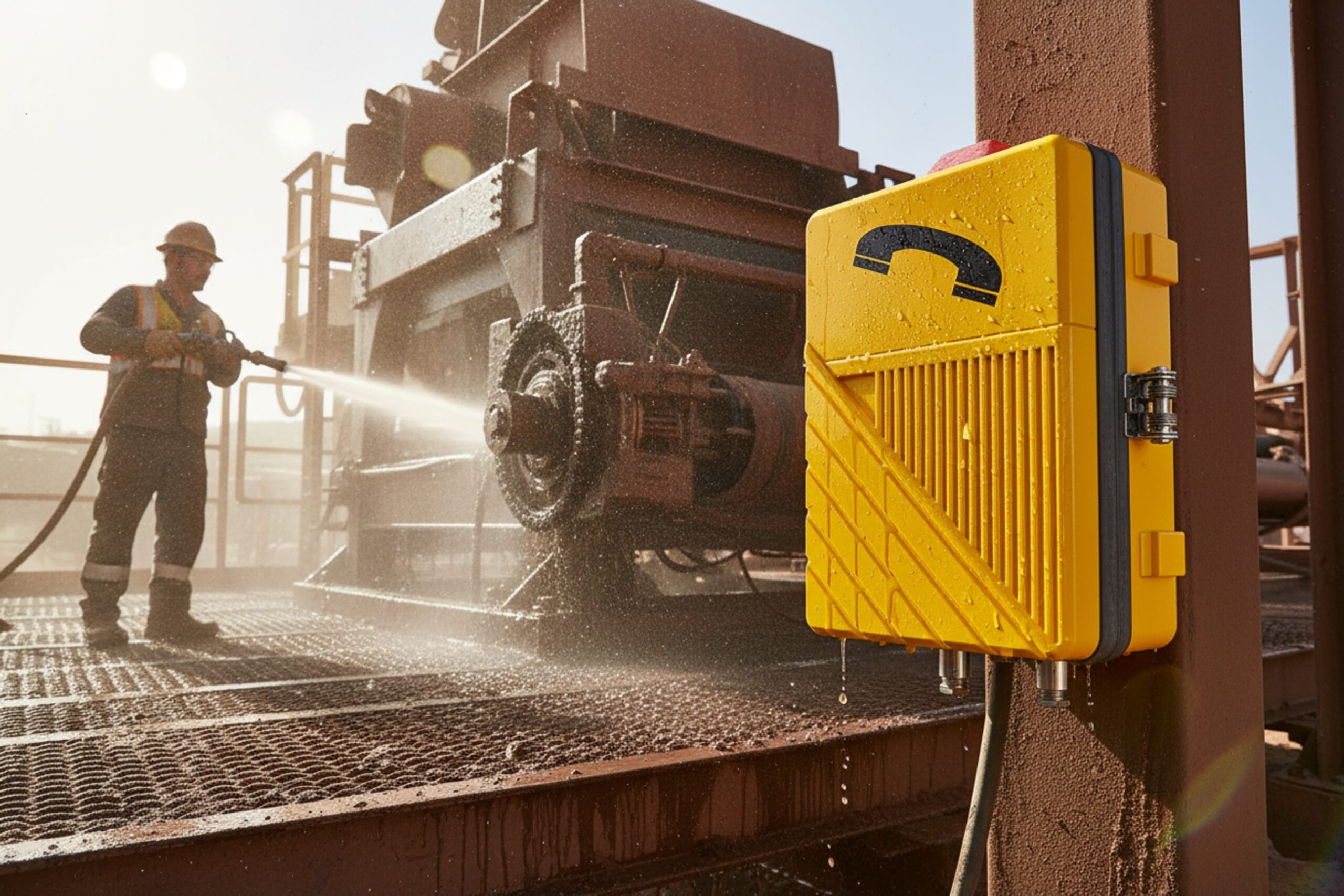
IP66/67 helps against dust and water ingress, but survival in an asphalt plant depends more on UV stability, temperature rating, gasket material, and oil resistance than on the IP code alone.
IP rating is necessary, not sufficient
IP ratings are defined under IEC 60529 6 and describe protection against dust and water ingress. :contentReference[oaicite:4]{index=4}
In simple terms, “6” for dust means dust-tight, and “7” indicates temporary immersion under test conditions, not permanent submersion. :contentReference[oaicite:5]{index=5}
For asphalt plants, the real value of IP66 is the dust protection. Dust is everywhere and will enter any weak gasket path.
Still, IP testing does not guarantee long-term sealing when:
-
gaskets harden from heat
-
UV cracks polymer housings
-
oil mist swells elastomers
-
vibration loosens fasteners
So the enclosure material and gasket chemistry matter as much as the IP number.
UV and heat: the real outdoor killers
Asphalt sites often mount phones on poles, near silos, and on control cabins. Those spots get direct sun. Surface temperature can climb far above ambient. A phone that is fine at 55°C ambient can still overheat on a dark mounting plate under full sun. For this reason, it helps to select:
-
a wide ambient rating with margin
-
light-colored or shaded mounting
-
metal sunshades when the location is exposed
-
keypad membranes rated for UV and oils
For outdoor industrial use, stainless steel housings and UV-stabilized 7 front interfaces age better than basic plastics. When a plastic front is needed, UV-stabilized polycarbonate or similar materials are safer choices.
Oil mist and dust: focus on seals, not just shell strength
Oil mist settles on everything near burner fuel systems and bitumen pumps. It works like a solvent over time. If the gasket swells, the door seal can deform and leak after a few heat cycles. The best field results come from:
-
oil-resistant gaskets (material selection matters)
-
cable glands matched to the cable jacket and oil exposure
-
regular inspection intervals on high-vibration mounting points
| Stressor | What it breaks first | What to specify |
|—|—|—|
| UV | keypad, labels, plastic windows | UV-stable materials, laser marking, sunshade |
| Heat cycles | gaskets, speaker membranes | high-temp gasket, wide ambient rating |
| Oil mist | elastomers, cable jacket | oil-resistant gasket and cable |
| Dust | mic ports, hinges, cable entry | IP66/67, protected mic path, correct gland compression |
On my side as a manufacturer, this is where I prefer to talk about real installation photos, not datasheets. The plant environment always finds the weakest detail.
Can phones integrate with IP PBX, PAGA horns, beacons, and E-stops?
At an asphalt plant, people move. A phone is only useful if it connects to the dispatch workflow, the horns, and the alarms. If it stays standalone, it becomes a “nice-to-have” and gets ignored.
Yes—SIP phones can register to IP PBX, support paging into PAGA horns via SIP or multicast, and trigger beacons through relay I/O or PLC logic; E-stops should stay hardwired, with phones used for alarm calling and confirmation.
IP PBX: keep it standard and resilient
A SIP 8 telephone should work with mainstream IP PBX systems using standard SIP registration and RTP audio. For asphalt plants, the practical requirements are:
-
dual SIP server support (primary/secondary)
-
auto-recovery after power loss
-
loud ringer and high-output speaker
-
noise handling for mixer and dryer areas
-
hotline keys for control room and maintenance
The plant does not need a fancy app phone. It needs a phone that always connects.
PAGA horns: three integration paths that work
There are three common ways to tie phones into plant paging:
1) SIP paging call from the PBX to horn speakers or paging gateways
2) Multicast paging for wide-area broadcast on the OT network
3) PBX to analog paging gateway if the plant uses legacy amplifiers
In all three, the phone can receive paging, originate paging, or do both. A best practice is to define priorities so an emergency call is not blocked by a page. Paging should also be restricted to trusted sources to prevent misuse.
Beacons and stack lights: use controlled interfaces
Visual alerts help in high-noise areas. A phone can trigger beacons in two safe ways:
-
a dry contact output from the phone goes to a PLC input or an interposing relay
-
the PBX/SCADA triggers a network beacon, and the phone is only the voice endpoint
For hazardous zones, it is often cleaner to keep high-power beacon circuits outside the classified boundary and only route low-energy control signals inside, based on the plant’s electrical design rules.
E-stops and safety logic: keep the safety function independent
E-stops should remain a dedicated safety loop. The phone should not be the safety device. Still, phones can support the process by:
-
auto-dialing the control room when an E-stop is pressed (PLC triggers call)
-
broadcasting a page announcement during a shutdown
-
providing a “call acknowledged” step in the dispatch workflow
| Integration target | What to use | Why it works in plants |
|—|—|—|
| IP PBX | SIP registration, ring groups, hotline | simple, standard, maintainable |
| PAGA horns | SIP paging or multicast, plus gateways | plant-wide voice in loud areas |
| Beacons | relay output to PLC or network beacon | clear visual alerting |
| E-stop loop | hardwired safety relay or PLC safety | auditable, deterministic safety function |
When a plant wants one-button “call + beacon,” I usually recommend letting the PLC own the beacon logic, and letting the phone own the voice session. That keeps both sides clean.
What cable specs, seal-offs, and T-class protect near hot surfaces?
Phones fail near asphalt equipment for two reasons: heat and bad terminations. Hot surfaces soften jackets. Bad glands let dust in. Missing seal-offs fail inspection. All three are avoidable.
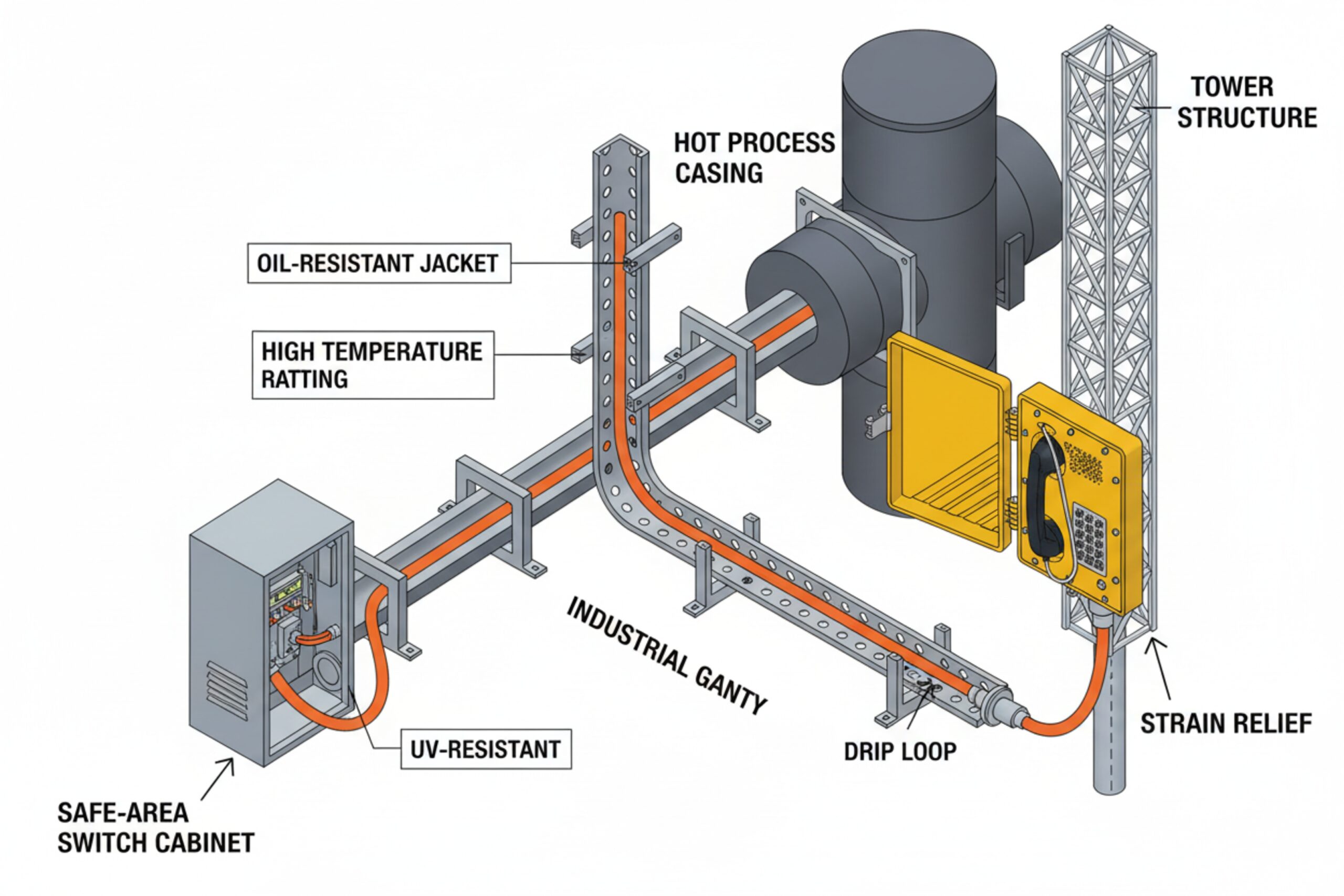
Use industrial Ethernet cable with UV and oil resistance, protect it from radiant heat, install certified glands and seal-offs where required, and choose a T-class that stays below ignition limits under worst-case ambient and sun load.

Cable specs: choose “industrial outdoor,” not office cable
For outdoor asphalt plants, the cable should be selected like other field instrumentation:
-
UV-resistant jacket for sun exposure
-
oil-resistant jacket for fuel and bitumen mist
-
temperature rating that matches the route
-
mechanical protection where trucks and loaders move
-
shielding where VFD noise is heavy
When the cable passes near the dryer, hot oil lines, or burner casing, do not rely on the jacket alone. Use standoffs, heat shields, and routing distance. Radiant heat can exceed cable ratings even when ambient air is moderate.
Seal-offs and entries: inspection follows the code and the certificate
In Class I locations, conduit sealing rules can apply. NFPA guidance for NEC 501.15 9 highlights cases where seals are installed within 18 inches of explosionproof enclosures for certain conduit sizes and configurations. :contentReference[oaicite:6]{index=6}
Even when the area is Division 2, the enclosure marking and wiring method can still require seals.
For Zone installations using Ex d equipment, barrier glands or certified sealing methods may be required based on the cable type and the equipment certificate conditions. The same idea applies: the seal is part of preventing flame transmission and gas migration through entries.
A good field habit is simple: treat every cable entry as a safety component, not a convenience part.
T-class: protect against ignition and against “too-close-to-hot”
T-class is about maximum surface temperature of equipment. A stricter T-class means a cooler maximum surface. For example, T6 is commonly associated with a maximum surface temperature of 85°C. :contentReference[oaicite:7]{index=7}
At asphalt plants, hot surfaces can be far above that. The phone should not be mounted where it is heated by nearby piping, burner housings, or exhaust ducts.
Three practical rules reduce risk:
-
keep the phone outside the “radiant heat zone,” even if the hazardous rating is correct
-
select a T-class with margin for sun load and high ambient
-
confirm the phone’s ambient range on the certificate, not only on the datasheet
| Risk near hot surfaces | What to do | What to verify |
|—|—|—|
| Radiant heat from dryer/burner | increase distance, add heat shield | device ambient rating and temperature rise |
| Hot oil / bitumen lines nearby | reroute cable, use standoffs | cable temperature rating and jacket type |
| Sun-heated mounting plate | add sunshade, avoid dark plates | worst-case surface temperature at noon |
| Hazardous boundary + heat | mount at safe thermal spot inside boundary | T-class and certificate conditions |
If the plant needs a phone near the burner for response time, a smart compromise is a safe-rated phone on a stand-off bracket with a heat shield, plus a clear call button and a beacon tied to PLC logic. That gives speed without cooking the device.
Conclusion
Explosion-proof SIP telephones 10 can work well at asphalt plants when the rating matches the classified zones, and the enclosure, cabling, seals, and T-class are chosen for dust, oil mist, and heat.
Footnotes
-
Area where an explosive gas atmosphere is likely to occur in normal operation. ↩
-
Area where flammable vapors are present only in abnormal conditions (e.g., accidental rupture). ↩
-
Flameproof enclosure protection method preventing internal explosion from igniting outside gas. ↩
-
Protection technique limiting electrical energy to levels below that required to ignite an atmosphere. ↩
-
Viscous hydrocarbon binder used in asphalt, capable of releasing flammable vapors when heated. ↩
-
International standard defining Ingress Protection (IP) ratings for dust and water. ↩
-
Material formulated to resist degradation and cracking from long-term sunlight exposure. ↩
-
Communication protocol used for signaling and controlling multimedia communication sessions. ↩
-
National Electrical Code section detailing conduit sealing requirements for hazardous locations. ↩
-
VoIP phones using SIP for signaling, integrating voice into data networks. ↩