
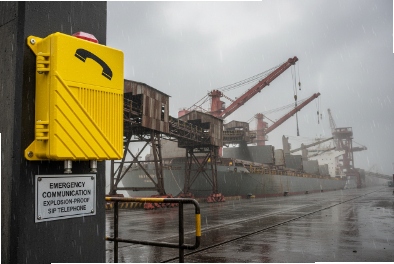
A bulk wharf is loud, dusty, and exposed. When an incident happens, crews do not have time to search for a working phone. If the device is not rated for combustible dust or fuel vapors, inspectors can stop operations.
Yes. Explosion-proof SIP telephones are suitable for bulk cargo wharfs when the selection covers the site’s dust and gas hazards, the enclosure survives impact and abrasion, and the installation includes armored cabling, surge protection, and vibration-safe mounting.
Wharf-ready selection: classify the hazard, then engineer durability and uptime
Bulk cargo wharfs combine dust, fuel, salt, and impact
Wharfs handle three hard realities at once:
-
Combustible dust 1 from coal, grain, or other powders
-
Fuel vapors from diesel bunkering, tank trucks, or fuel transfer lines
-
Marine exposure: salt-laden wind, storms, UV, and corrosion
-
Mechanical abuse: abrasion, vibration, and occasional impacts from tools and equipment
That mix means a “normal industrial IP phone” often fails quickly, and a “gas-only Ex phone” can still be wrong if dust hazards exist.
Use a “hazard + environment” spec, not an industry spec
A wharf project becomes simple when the requirement is written as:
-
Dust group and dust protection (if dust hazard exists)
-
Gas group and zone (if fuel transfer creates gas hazard)
-
Ingress and impact protection (IP and IK)
-
Corrosion resistance (316L and marine gland strategy)
-
Integration requirements (PBX, PAGA, alarms, location systems)
A practical wharf compliance map
| Wharf activity | Primary hazard type | What to prioritize in the phone |
|—|—|—|
| Coal conveyor and hopper | combustible dust + abrasion | Ex tb dust rating + IK10 + sealed keys |
| Grain handling | combustible dust + cleaning | Ex tb dust rating + IP66/67 + washdown tolerance |
| Fuel transfer/bunkering | flammable vapor | Zone 1/2 or Class/Div + correct gas group |
| Open quay areas | weather + impacts | IP66/67 + IK10 + corrosion resistance |
Once this framework is clear, the first question is hazard classification 2: coal, grain, and fuel transfer can each push different markings.
Which dust/gas classifications apply for coal, grain, and fuel transfer?
Many wharfs have both dust and vapor risks. The phone marking must cover the correct hazard category for the mounting point.
Coal and grain operations often require combustible dust classification support (Ex tb for dust), while fuel transfer areas may require gas/vapor classification support (Zone 1/2 or Class I Div 1/2). Coal and grain dust hazards are often treated as dust zones (Zone 21/22) in IEC-style schemes or as Class II/III areas in North American style schemes, and fuel vapors are treated as Class I or gas zones. The final classification must follow the site hazard study and the authority having jurisdiction.
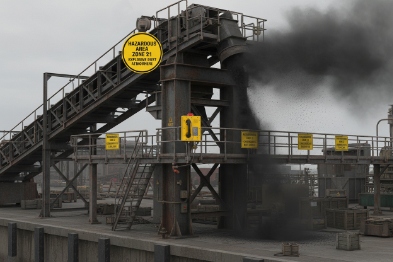
Coal: dust plus abrasion and conductive contamination risk
Coal dust is messy and can be fine. Even when it is not the most conductive dust, it builds up and increases tracking and wear. A wharf phone near conveyors, transfer towers, and hoppers should consider:
-
dust protection by enclosure (Ex tb)
-
a dust group rating that covers the site requirement
-
a maximum surface temperature 3 limit appropriate for dust ignition risk
-
sealing quality that prevents dust ingress into terminals and keys
Grain: often the strictest dust mindset
Grain dust can form explosive clouds, especially in enclosed or semi-enclosed transfer points. Grain wharfs often demand:
-
Ex tb dust protection
-
strong ingress protection and easy cleaning
-
stable gasket materials that resist washdown
Fuel transfer: gas/vapor classification near hoses and couplers
Fuel bunkering and transfer lines create vapor hazards at:
-
hose connections
-
pumps and manifolds
-
vent points and drains
For these points, a gas-rated Ex phone is needed:
-
Zone 1/2 or Class I Div 1/2 based on layout and ventilation
-
gas group per stored fuel type and local standard
-
correct T-class for ambient and heat exposure
Write requirements as dual-hazard when needed
If the phone is in an area where both hazards can exist, the specification should require both gas and dust markings on the nameplate. Many buyers miss this and order a gas-only device for a dust zone.
| Wharf zone type | Typical marking need | What to check on the nameplate |
|—|—|—|
| Dust zone near conveyors | Ex tb + dust group | IIIA/IIIB/IIIC and max surface temp |
| Gas zone near fuel transfer | Ex protection + gas group | Zone rating + IIA/IIB/IIC and T-class |
| Mixed area | dual marking | both gas and dust sections present |
Once the hazard marking is right, durability decides whether the phone survives the real wharf conditions.
Do IP66/67, IK10 enclosures survive abrasion, shocks, and weather?
Bulk cargo 4 wharfs destroy weak housings. Dust acts like sandpaper. Tools hit surfaces. Wind-driven rain pushes water into every gap.
Yes. IP66/IP67 sealing and IK10 impact resistance can survive wharf abrasion, shocks, and weather when the enclosure and hardware are corrosion-resistant, entry glands are marine-grade, and the faceplate design protects keys and windows from direct impact and dust buildup.
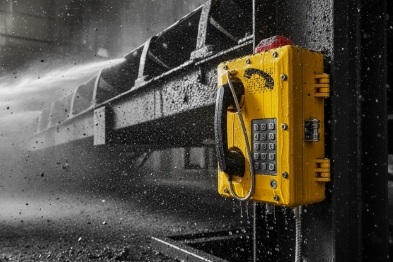
IP66 vs IP67: choose based on flooding and washdown
-
IP66 is strong for heavy rain and water jets from washdown.
-
IP67 adds protection for temporary immersion, which matters at low points where water pools during storms or high tide spray.
Most wharfs should treat IP66 as the minimum. IP67 is smart for:
-
low mounting points on the quay
-
areas exposed to wave splash
-
locations where washdown is aggressive
IK10: protect the user interface
-
windows and indicators
-
keypad and emergency button
-
hookswitch and handset cradle
-
enclosure edges
A good practice is to require a functional call test after impact, not only a visual inspection.
Abrasion: a wharf-specific detail
Dust and grit can grind into:
-
keypad legends
-
hinges and latches
-
handset cord sheathing
-
mounting bracket coatings
So the design should use:
-
sealed keymat or protected keypad
-
corrosion-resistant hinges and hardware
-
strong cord strain relief
-
smooth surfaces that are easy to rinse
| Stress | Better feature | Why it helps |
|—|—|—|
| Abrasion and dust | sealed keymat + smooth face | reduces grit intrusion and wear |
| Impacts | IK10 + reinforced window | prevents cracks and leaks |
| Weather | IP66/67 + marine glands | keeps ingress rating real |
| Corrosion | 316L fasteners + marine coatings | prevents seizure and rust stains |
Now, the phone must connect into the wharf communication and safety ecosystem: PBX, yard PAGA, location systems, and visible signals.
Can systems link with IP PBX, yard PAGA, RTLS, and beacon strobes?
A wharf is a wide area with moving equipment. Crews need paging, alarms, and location-aware response. SIP fits this well when the network is designed correctly.
Yes. Ex SIP telephones can integrate with an IP PBX for dispatch calling, connect to yard PAGA through multicast paging or controller triggers, support RTLS workflows through network and event data, and control beacon strobes using relay outputs or I/O modules.
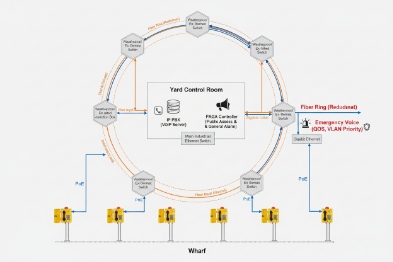
IP PBX: group calling and escalation
-
hotline keys to control room or gatehouse
-
escalation if no answer
-
call logs aligned with NTP for incident review
-
remote monitoring of endpoint status
For large wharfs, templates and zero-touch provisioning reduce commissioning time and MTTR.
Yard PAGA: paging across noisy areas
PAGA is critical on wharfs because:
-
ambient noise is often 85–105 dBA
-
operators wear hearing protection
-
visibility can be blocked by cargo piles
Two stable integration patterns:
-
multicast paging to PAGA endpoints with VLAN/QoS and IGMP snooping
-
relay trigger to a paging controller for predefined alarm tones
RTLS: what “integration” usually means
RTLS 7 systems (Wi-Fi, UWB, or other) typically do not connect directly to a phone, but they can integrate through:
-
location-based workflows in the control system
-
event correlation (who called, which zone, which camera)
-
asset tagging and dispatch rules
A phone helps RTLS workflows when it provides:
-
consistent device ID and location labels
-
reliable event logs
-
optional input triggers tied to local emergency points
Beacon strobes: make emergency points obvious
Relays can trigger:
-
local strobes at call points
-
mast-mounted beacons for long-distance visibility
-
controller inputs that synchronize horn + strobe
| Wharf system | Best link method | What to test |
|—|—|—|
| PBX | SIP + templates | call setup during link flap |
| PAGA | multicast or relay trigger | paging under high traffic |
| RTLS | event correlation + location labeling | correct mapping of device ID |
| Beacons | relay to controller | latching and reset behavior |
Now, the biggest wharf downtime driver is field wiring: long runs, lightning, and mechanical damage. That is solved with armored cabling, surge arresters, and smart mounting.
What armored cabling, surge arresters, and mast mounting reduce downtime?
Most wharf failures are not “device defects.” They are cable, surge, and mounting failures caused by exposure and movement.
Downtime is reduced by armored cabling with correct glands, fiber backbones to limit surge paths, PoE/Ethernet surge arresters at cabinet boundaries, and mast mounting that avoids direct impact while keeping emergency points visible. Corrosion control must also prevent galvanic issues at brackets, inserts, and bonding points.
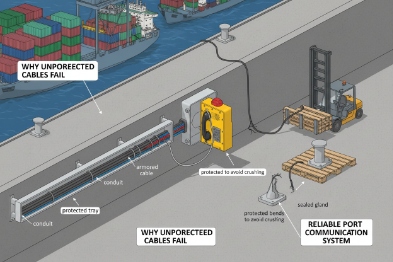
Armored cabling: protect against abrasion and snagging
Wharfs have moving equipment, chains, and sharp edges. Armored cable 8 helps, but only if:
-
the armor is terminated with the correct gland type
-
the cable is clamped and supported close to the entry
-
drip loops prevent water tracking into glands
-
bend radius is respected to avoid jacket damage
Surge arresters: treat every long outdoor run as a surge path
Storms and switching events induce surges into:
-
Ethernet pairs
-
PoE power
-
I/O wiring
A stable pattern includes:
-
fiber uplinks between cabinets and main network nodes
-
surge protection 9 on copper drops where needed
-
short bonding leads to the local equipotential bar
-
UPS-backed PoE switches in sheltered enclosures
Mast mounting: visibility plus protection
Mast mounting helps when:
-
the wharf needs emergency call points visible from a distance
-
beacons must be above cargo piles
-
the phone must be kept away from direct equipment strikes
Best practice mast details:
-
316L brackets or hot-dip + marine coating system
-
locking hardware and a re-torque plan
-
anti-vibration pads where allowed
-
cable routing inside conduit or protected channels
Corrosion control: stop galvanic pairs
On wharfs, mixed metals create galvanic corrosion 10 fast. A good approach includes:
-
316L fasteners and brackets
-
consistent metals at glands and locknuts
-
thread inserts (helicoils or solid inserts) where repeated service occurs
-
protective compounds and isolation washers where needed
| Uptime control | What to do | What it prevents |
|—|—|—|
| Armored cable + clamps | protect runs and support near entries | cut cables and gland stress |
| Fiber backbone | limit copper length | surge coupling and repeat port failures |
| PoE/Ethernet SPDs | protect at boundaries | reboot loops and port damage |
| Mast placement | improve visibility and avoid strikes | physical damage and blocked access |
| Corrosion discipline | match metals and protect joints | seized screws and broken bonds |
When these wiring and mounting rules are in place, an Ex SIP phone becomes a reliable part of the wharf safety system, not a frequent service item.
Conclusion
Explosion-proof SIP telephones fit bulk cargo wharfs when dust and fuel classifications drive dual hazard ratings, IP66/67 and IK10 handle abrasion and storms, integrations support PBX/PAGA/RTLS workflows, and armored cabling, surge protection, and smart mast mounting reduce downtime.
Footnotes
-
Safety information regarding explosive dust hazards in industrial settings. ↩
-
Methodology for defining risk zones in hazardous environments. ↩
-
Temperature limits to prevent ignition of flammable atmospheres. ↩
-
Overview of goods transported in large quantities without packing. ↩
-
Standard defining impact protection levels for electrical enclosures. ↩
-
Modern telephone switching system using internet protocol. ↩
-
Technology for tracking the immediate location of assets or people. ↩
-
Cable construction designed to protect against mechanical damage. ↩
-
Devices protecting equipment from voltage spikes and transients. ↩
-
Electrochemical process damaging metals in electrical contact. ↩








