
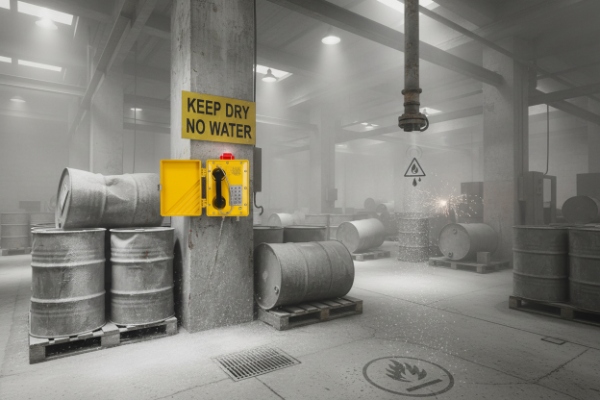
A wet spill in a calcium carbide shop can release acetylene fast. One small spark can turn a routine shift into a full shutdown.
Yes—explosion-proof SIP telephones are suitable for calcium carbide workshops when the phone is rated for acetylene (IIC / Group A), installed inside the right Zone/Div boundary, and built with corrosion-proof sealing for alkaline dust and moisture.
Understand the real acetylene risk before choosing hardware
Why calcium carbide areas create an “acetylene-first” hazard
Calcium carbide 1 itself is not a flammable gas. …The problem starts when it meets water. Even small moisture can generate acetylene, and that can form an explosive atmosphere around hoppers, reaction pits, bagging lines, or cleanup zones. Many workshops also have wet floors, steam lines, and washdown routines. That makes “accidental gas generation” a normal design case, not a rare event.
What “explosion-proof SIP phone” should mean in this workshop
A SIP phone is a network device, so it brings electronics, power, and cable entries into the area. The phone becomes suitable only if:
- the hazardous marking matches acetylene duty (IIC / Group A, not only “general gas”),
- the temperature class stays safe even during hot days and heat soak,
- the enclosure resists alkaline dust, damp air, and corrosion,
- …the cable entry and bonding are installed like safety parts, not like office IT.
A workshop can also have dust and mechanical damage. Forklifts, impacts, and vibration are common. That pushes the choice toward rugged housings, large buttons, and stable mounting.
…Quick “placement + protection” checklist
| Workshop spot | What can go wrong | Typical protection direction | Simple placement tip |
|---|---|---|---|
| Bagging / packing line | dust + moisture + small spills | Zone 2 / Div 2 in many layouts | mount above splash height, add hood |
| Reaction / hydrolysis zone | likely acetylene release | Zone 1 / Div 1 near sources | place at exit routes, not on equipment |
| Gas piping and manifolds | leaks at joints and maintenance points | Zone 1 close-in, Zone 2 outside | keep entries downward with drip loop |
| General corridor | low gas risk, high dust | non-hazard or Zone 2 | place where staff naturally run |
A good plan puts emergency phones where people run during an alarm, not where engineers prefer to route cable. After the layout is clear, the next decision is the rating itself.
If the rating is wrong, the phone becomes a commissioning blocker. If it is right, the project moves.
Which Zone 1/2 or Class I Div 1/2 ratings cover acetylene (IIC) risks?
Acetylene 2 is treated as one of the most demanding gases. If the phone is not rated for it, “explosion-proof” on a label does not help.
For acetylene areas, target IIC in Zone language and Group A in Class/Division language. Use Zone 1 / Class I Div 1 near credible release points, and Zone 2 / Class I Div 2 in surrounding ventilated areas, based on your hazardous area drawing.
Know the two naming systems and how acetylene maps
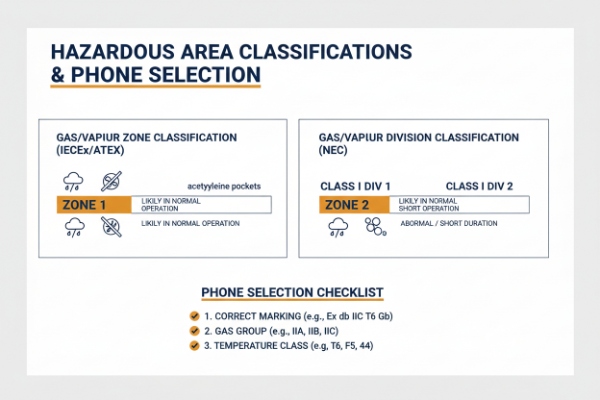
Many carbide projects involve mixed standards. The same physical risk may be expressed as:
- Zone 1 / Zone 2 (IEC/ATEX style), with IIC as the gas group for acetylene duty
- Class I, Division 1 / Division 2 (NEC style), with Group A for acetylene
A common mistake is buying a device rated for hydrogen (often “IIB + H2” or “Group B”) and assuming it covers acetylene. It does not. …Acetylene is a stricter case in many schemes, so the phone marking must clearly include acetylene coverage.
Where Zone 1 / Div 1 is most common inside a workshop
Zone 1 3 or Div 1 is normally used where an explosive atmosphere can be expected during normal tasks or frequent situations. In carbide workshops, that can include:
- reaction vessels or pits where carbide meets water by design
- vent outlets and relief paths
- drain points and sampling points
- manifold areas with frequent maintenance or cylinder filling work
Zone 2 or Div 2 is more common where an acetylene atmosphere is not expected in normal operation and would mainly follow an abnormal event, like a spill or equipment fault. …Strong ventilation often helps keep the wider area in Zone 2, but the drawing is still the authority.
A rating selection table that helps purchasing teams
| …If the phone is installed… | Choose marking that usually fits | What to double-check |
|---|---|---|
| Next to reaction/vent points | Ex d IIC (Zone 1) or Class I Div 1 Group A 4 | entry method, flamepath service rules |
| In ventilated surrounding area | Zone 2 IIC (or Ex ec IIC) / Class I Div 2 Group A | ambient rating and UV resistance |
| Outside classified boundary | industrial IP phone or rugged non-Ex phone | dust, water, and chemical resistance |
A safe pattern is to place the phone just outside the tightest boundary when possible, and still keep it reachable. When it must be inside, choose the correct acetylene marking first, then solve sealing and corrosion.
That leads to the next question, because carbide sites are dusty, wet, and alkaline.
Will IP66/67, 316L housings resist alkali dust and moisture exposure?
In carbide workshops, failure is usually slow. The phone works, then keys stick, audio drops, and entries corrode. …The root cause is almost always dust plus moisture at seals.
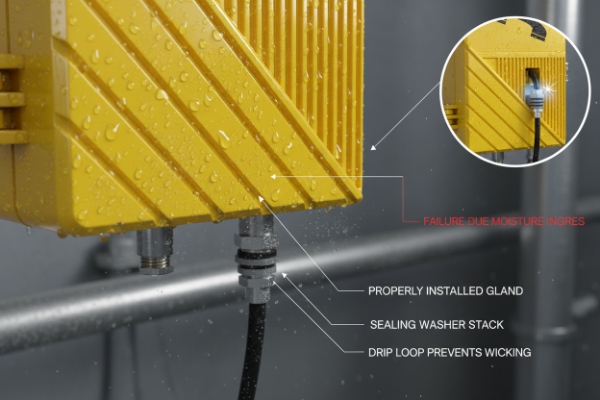
Yes—IP66/67 and 316L housings handle carbide workshops well when the keypad membrane, glands, and gaskets are also chosen for alkaline dust, damp air, and frequent cleaning. The weakest point is usually the cable entry, not the housing.
…What IP66/67 does well in this environment
IP66/67 5 helps block dust ingress and resists strong water spray. That is useful when fine alkaline dust settles everywhere and washdown is routine. Still, an IP rating does not guarantee chemical compatibility. Alkaline dust and wet paste can attack:
- the gasket line if liquid sits on it,
- the speaker and microphone membranes,
- the cable jacket near the gland,
- …fasteners and brackets where crevices trap moisture.
So IP66/67 is a starting requirement, not the finish line.
Why 316L is a strong baseline, and where it needs help
316L stainless 6 resists many corrosion modes and stays stable outdoors. It also avoids the fast “rust bloom” seen on painted steel in wet alkaline dust. Still, service life improves when the full build is consistent:
- …stainless housing,
- stainless mounting bracket,
- stainless glands and stopping plugs,
- anti-galling practice on stainless threads,
- …a gasket set that does not swell or crack in high pH.
The workshop often has temperature cycles too. Warm process air plus cold nights creates condensation. Condensation is the quiet killer inside enclosures, so good sealing and correct entry orientation matter.
Gaskets and membranes matter more than many teams expect
For alkaline exposure, PTFE and PTFE-based seals are often strong choices. EPDM also performs well against many caustic solutions, while some oil-focused elastomers are not ideal for strong bases. …The best practice is to match gasket material to the exact chemicals and cleaning agents used on site.
Durability checklist table
| Component | Better choice for carbide workshops | Why it lasts | Common early-fail choice |
|---|---|---|---|
| Housing | 316L stainless | resists corrosion and washdown | painted mild steel near wet dust |
| Main gasket | PTFE or PTFE-encapsulated | strong chemical resistance | generic rubber that hardens |
| Keypad membrane | chemical + UV resistant | stays flexible and sealed | low-grade membrane that cracks |
| Cable entry | stainless gland + correct insert | keeps seal under dust and moisture | plated glands that pit and seize |
When the enclosure system is right, the phone becomes a dependable tool instead of a maintenance item. Then the next goal is to make the phone part of the alarm workflow, not a standalone box.
Can phones integrate with IP PBX, PAGA horns, beacons, and gas alarms?
A workshop emergency is not a “dial and chat” event. People need paging, horns, and clear call paths. …The phone should support that flow without adding complexity.
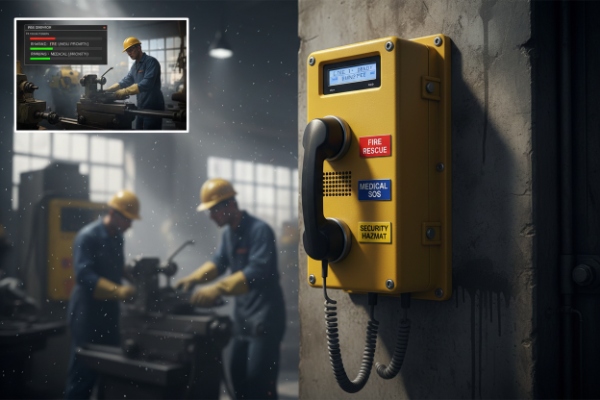
Yes—SIP phones can register to an IP PBX, support paging to PAGA horns, and link to beacons and gas alarms through PLC/alarm-panel logic, SIP paging, multicast, or relay I/O, while the safety decision stays in the control system.
PBX integration: keep emergency calling simple
Most plants do best with:
- a dedicated hotline key to the control room,
- ring groups for shift response,
- auto-recovery after PoE drop,
- …loud audio and clear mic for noisy lines.
This avoids directory hunting during alarms. It also keeps training simple.
PAGA horns and paging: choose one clear method
Paging usually works in three patterns:
1) SIP paging from the PBX to paging gateways and horns
2) Multicast paging for fast broadcast across the OT network
3) Hybrid where the PLC triggers a paging event during alarms
For carbide workshops, horns matter because dust collection fans and machinery are loud. A solid rule is that paging must not block emergency calls. Priority rules should be tested in commissioning, not guessed.
Gas alarms: connect detectors to PLC, then trigger calls and paging
Acetylene detection and local alarm panels should feed the control logic first. The control logic then:
- drives beacons and horns,
- triggers paging announcements,
- triggers auto-dial to emergency groups,
- …logs events for incident review.
The phone supports voice coordination and acknowledgement. It should not be the device that “decides” a trip.
A practical integration map table
| Event | Control owner | What the phone does | What the phone should not do |
|---|---|---|---|
| Acetylene alarm | detector + PLC/alarm panel | receive page, hotline call, status indication | replace trip logic |
| Evacuation page | PBX/PAGA system | auto-answer paging (trusted sources) | block emergency calls |
| Beacon activation | PLC output | optional trigger via dry contact input | power a beacon directly in zone |
| Emergency call | PBX ring group | stable SIP [^7] call path | rely on Wi-Fi in heavy EMI zones |
In my experience, the best integration is the simplest one that the maintenance team can test every month. If monthly tests are hard, the system will not be trusted during real events.
Now the final topic is the one many teams miss: acetylene has special material rules around copper, plus strict expectations for sealing and temperature class.
What non-copper alloys, sealing, and T-class meet safety rules?
Acetylene has a known reaction risk with copper and silver, and it also demands conservative ignition control. …If the phone uses the wrong metals in glands or fittings, service teams may reject it even if the Ex marking is correct.
Use stainless or other non-copper-rich materials for glands and wetted fittings, avoid copper-heavy alloys near acetylene service, use disciplined sealing to stop moisture ingress, and select a conservative T-class (often T3 or better) for margin near hot surfaces.
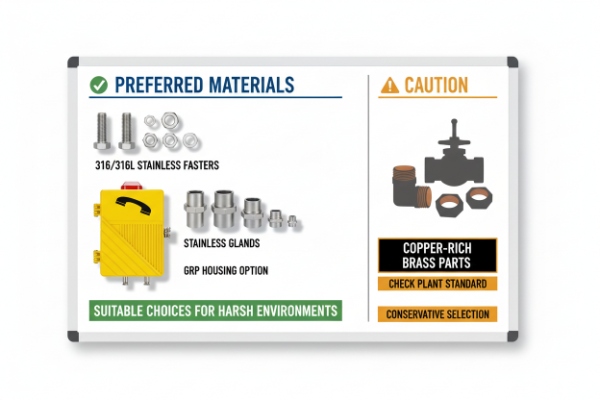
Non-copper alloy rule: focus on what touches acetylene and what sparks
Acetylene can form sensitive metal acetylides 7 with copper and silver, so many plants avoid copper-rich alloys in acetylene systems. …In practice, the most common risk inside phone installations is not the 316L housing. It is the small hardware choices:
- brass cable glands,
- brass adapters,
- copper mesh screens,
- …copper grounding straps used as a “quick fix.”
A safer material set for hazardous phone entries in acetylene zones is:
- 316 stainless glands and adapters,
- stainless stopping plugs,
- stainless or tinned-copper bonding conductors routed outside the gas path,
- …stainless brackets and fasteners.
The goal is simple: do not introduce copper-rich parts that can be questioned by the site safety rules.
Sealing practices that stop water-driven gas generation near the phone
Moisture control is a safety issue in carbide shops. A small leak into an enclosure can trap alkaline dust, create wet paste, and accelerate corrosion. Simple practices extend life:
- route cables with a drip loop before entry,
- orient entries downward when possible,
- avoid low points where wash water pools,
- add a small hood over outdoor or washdown-exposed stations,
- …close unused openings with certified plugs.
These steps reduce both corrosion and nuisance faults.
T-class selection: build margin around acetylene and hot surfaces
Acetylene has a relatively low auto-ignition temperature compared with many hydrocarbons, so temperature class should not be an afterthought. …A conservative approach is to target T3 or better where practical, then control the mounting location so the phone does not heat soak from hot equipment or direct sun.
Also watch ambient rating. A phone can be T-class compliant at 40°C ambient and not at 60°C ambient. In hot workshops, that matters.
Compliance table for acetylene-safe phone builds
| Topic | Best practice | Why it matters |
|---|---|---|
| Metal selection | avoid copper-rich alloys at entries | aligns with acetylene material rules |
| Glands | Ex d IIC certified glands, stainless | preserves protection and resists corrosion |
| Sealing | drip loops, correct torque, no pooling | stops moisture ingress and paste build-up |
| Earthing | solid bonding to equipotential network | reduces fault risk and static issues |
| T-class | conservative (often T3 or better) + cool mounting | protects margin near hot surfaces |
When these details are consistent, the phone meets the hazardous rating, it survives the workshop environment, and it stays easy to maintain. …That is the combination that keeps projects running.
Conclusion
Explosion-proof SIP phones are suitable for calcium carbide workshops when rated for acetylene (IIC/Group A), built with corrosion-proof sealing, and installed with non-copper-rich hardware and conservative T-class control.
Footnotes
-
Chemical facts and safety hazards of calcium carbide. ↩
-
Official safety data regarding flammability and handling of acetylene. ↩
-
Definition of hazardous areas where gas is likely during normal operations. ↩
-
Explanation of Class I Division 1 groups including Group A for acetylene. ↩
-
Comparison of ingress protection ratings for dust and water resistance. ↩
-
Properties of marine-grade stainless steel for corrosion resistance.[^7]: Standard protocol for initiating interactive multimedia sessions like voice calls. ↩
-
Details on the explosive reaction between copper and acetylene. ↩








