Hydrogen can appear where people least expect it, and chlorine punishes every weak seal. If the emergency phone fails, the whole response plan slows down.
Yes. Explosion-proof SIP telephones fit chlor-alkali plants when they are rated for hydrogen (IIC), placed per Zone 1/2 drawings, and built with corrosion-proof sealing for brine, caustic, and salt mist.

How to spec an emergency SIP phone that survives chlor-alkali duty
Treat chlor-alkali as two hazards, not one
A chlor-alkali 1 site is a special mix. Hydrogen 2 is the ignition hazard. Chlorine is the toxicity and corrosion hazard. These two hazards do not behave the same way, so the phone spec must cover both.
Hydrogen drives the Ex marking. It is a small molecule and it escapes from tiny paths, so Zone boundaries near cells, headers, compressors, dryers, and vent points can be strict. Chlorine drives materials and sealing. It attacks metals, labels, elastomers, and cable entries. Brine adds chlorides, and salt mist speeds up pitting and crevice corrosion. Caustic adds another chemical stress and can shorten the life of some plastics and coatings.
A phone can be “correct” for hydrogen and still fail in months if the glands corrode and the keypad membrane cracks. A phone can be “chemical resistant” and still be rejected if the Ex group is wrong for hydrogen.
Use a simple decision stack that avoids rework
When a project follows this stack, acceptance is faster and downtime is lower:
1) Confirm the hazardous area classification for the cell room and hydrogen systems.
2) Choose the gas group and Zone rating that matches hydrogen risk at the mounting point.
3) Choose a protection concept that fits the wiring plan (Ex d, Ex e, Ex i, or a certified equivalent).
4) Lock material and gasket choices for chlorine, brine, caustic, and washdown.
5) Build the network and alarm integration around plant workflow, not around a single device brand.
A quick spec matrix that purchasing teams can use
| Spec line | What it protects against | What to write in the RFQ | What to avoid |
|---|---|---|---|
| Ex gas group | hydrogen ignition risk | IIC rated for gas, Zone 1/2 as required | IIB-only devices near hydrogen sources |
| Surface temperature | hot surface ignition margin | conservative T-class + ambient rating | ignoring sun load and hot pipe proximity |
| Ingress | washdown, salt spray, brine aerosol | IP66/67 and corrosion-rated construction | IP rating with weak entry hardware |
| Materials | chlorine + chlorides + caustic | 316L or higher alloy + compatible seals | mixed metals that form galvanic pairs |
| Integration | emergency response speed | SIP PBX + paging + alarm I/O plan | standalone phones with no call flow |
A good build starts with the Zone plan, but reliability comes from sealing and corrosion control. The rest of this article breaks those parts down in a way that matches how chlor-alkali sites operate.
If the goal is a phone that both passes inspection and keeps working during a chlorine leak, the first hard decision is the right rating for hydrogen areas.
The next section tackles Zone 1/2 and IIC in plain plant terms.
Which Zone 1/2, IIC ratings address hydrogen and chlorine hazards?
Hydrogen zones can be over-scoped, and chlorine zones can be under-scoped. Both mistakes create risk, and both slow down operations during alarms.
Hydrogen drives the hazardous Ex rating. In many chlor-alkali plants, IIC-rated equipment is selected near hydrogen sources, with Zone 1 near likely release points and Zone 2 in surrounding ventilated areas, based on the site classification.
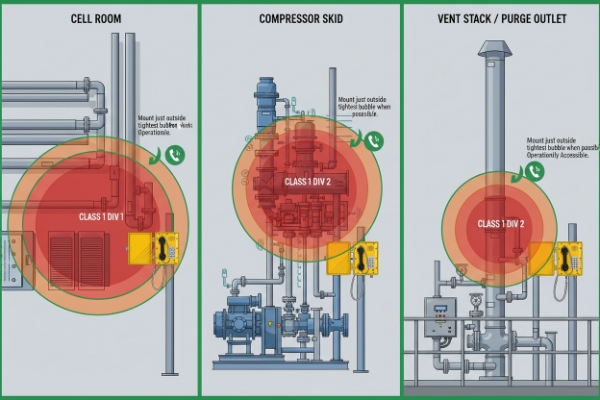
%[Hazardous area placement diagram for Class I Div 1 and Div 2 phones](http://sipintercommanufacturer.com/wp-content/uploads/02-illustrate-three-mini-scenes-in-one-frame-1-nea.jpg "Phone Placement Guide")
Hydrogen: use IIC where hydrogen can be present
Hydrogen is normally treated as the most demanding gas group in the common Ex group set, so IIC is the safe target when hydrogen is a credible atmosphere at the phone location. This matters most around:
- cell room hydrogen collection headers
- hydrogen compressors, dryers, and purification skids
- vent outlets and relief discharge paths
- maintenance points where lines can be opened
- any enclosed or semi-enclosed corners where gas can collect
A practical rule that works: if a phone is inside a boundary drawn for hydrogen, specify IIC. This avoids the “rated but not for hydrogen” problem that shows up late in FAT/SAT.
Zone 1 vs Zone 2: let release points decide the boundary
Zone 1 3 usually applies closer to places where a flammable atmosphere can occur during normal tasks, or during frequent operating conditions. Zone 2 usually applies where a flammable atmosphere is not expected in normal operation, and if it appears, it should be short and tied to an abnormal event.
In chlor-alkali plants, the Zone can change by area design:
- Strong ventilation and high ceilings often reduce the extent of tight zones.
- Enclosed galleries, trenches, pits, and small rooms can expand zones.
- A “cell room” label does not define the Zone by itself. The actual ventilation, monitoring, and release sources define it.
Chlorine: not the gas group driver, but a design driver
Chlorine is not normally the reason for IIC 4 or Zone 1 selection. It is the reason for corrosion-proof design and gas detection coverage. Chlorine changes how the phone must behave during emergencies:
- it must stay operable during a leak alarm
- it must resist corrosion so the enclosure stays sealed
- it must support clear call paths to the control room and muster points
A phone near chlorine handling points may sit outside the hydrogen classified area, yet it still needs the same rugged standard because chlorine is harsh even in small concentrations.
A marking and placement table that matches plant reality
| Area | Main hazard | Rating focus | Placement note |
|---|---|---|---|
| Hydrogen header/compressor zone | flammable hydrogen | IIC, Zone 1 near release points | mount off skid frames to reduce vibration |
| General cell hall | possible hydrogen in abnormal events | IIC, often Zone 2 in many designs | choose high-audio output for noisy bays |
| Chlorine handling corridor | toxic chlorine + corrosion | corrosion + detector integration | mount away from direct spray and washdown |
| Analyzer shelter | gas build-up risk | tighter zone if ventilation is weak | consider phone outside the shelter wall |
A simple and safe approach is to place phones just outside the tightest hydrogen boundary when possible, and still keep them reachable with clear signage. That cuts cost and makes maintenance easier.
Once the rating is correct, the next issue is survival. Chlor-alkali environments destroy weak metals, and most failures start at the cable entry.
Do IP66/67, 316L/Hastelloy housings survive brine, caustic, and salt mist?
The phone can be certified and still fail from corrosion. In chlor-alkali plants, corrosion is not slow. It can be fast and it often starts where nobody looks.
IP66/67 helps with washdown and aerosols, and 316L can work well in many outdoor and ventilated zones, but brine and salt mist can pit stainless over time. Hastelloy or better corrosion systems make sense in the harshest splash and mist areas.
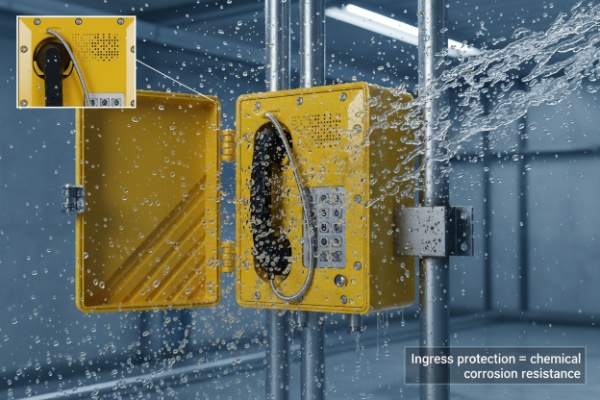
%[Water-spray test on rugged industrial phone showing ingress protection and corrosion resistance](http://sipintercommanufacturer.com/wp-content/uploads/03-create-a-realistic-washdown-scene-in-a-brine-rich-.jpg "IP Rated Phone")
IP66/67 keeps water out, but chemistry still attacks interfaces
An IP66/67 5 phone can handle heavy spray and washdown, but the IP label does not mean “chemical proof.” Chemical aerosols attack:
- cable gland seals
- keypad membranes and speaker diaphragms
- threads on entry hardware
- bracket joints and fasteners
- label inks and adhesive nameplates
So IP66/67 is a starting point. The long-life design is the whole sealing chain, not just the box.
316L is a solid baseline, but chlorides punish crevices
316L 6 is often used because it is available, strong, and corrosion resistant in many industrial sites. Still, brine and salt mist bring high chloride exposure. Chlorides target crevices and trapped moisture. A phone housing can look clean, while the gland threads and bracket joints pit under the surface.
In high chloride and wet zones, service life improves when:
- the surface finish is smooth and easy to rinse
- crevices are minimized
- fasteners match the housing alloy to reduce galvanic couples
- stainless threads use anti-galling practice for maintenance
Hastelloy and higher alloys: use them where replacement cost is high
Hastelloy 7 is not needed everywhere. It makes sense where:
- there is direct brine splash
- salt mist is constant and heavy
- chlorine-bearing moisture sits on hardware
- maintenance access is hard, and replacement needs shutdown permits
A practical approach is to match alloy level to exposure zones. Use 316L for general zones. Use higher alloy options for “red zones” near brine spray, drains, and chlorine-bearing wet points.
Gasket choice matters as much as housing alloy
For brine, caustic, and chlorine exposure, PTFE 8 and PTFE-encapsulated designs are common choices because they resist many aggressive chemicals. Still, gaskets must also keep compression under heat cycles and vibration. A gasket that resists chemicals but creeps under load can leak over time.
A stable sealing strategy often uses:
- PTFE or PTFE-encapsulated gaskets on main cover joints
- compatible secondary seals for cable entries
- controlled torque and compression limits
- drip loops and entry orientation that prevent liquid pooling
A material survival table for chlor-alkali phone builds
| Part | Better long-life choice | Why it helps | Weak point to watch |
|---|---|---|---|
| Housing | 316L or Hastelloy by exposure zone | resists corrosion and washdown | crevice corrosion at joints |
| Fasteners | matched stainless with anti-seize | avoids rust and seizure | mixed metals on brackets |
| Main gasket | PTFE or PTFE-encapsulated | broad chemical resistance | creep if compression is not controlled |
| Cable glands | stainless, corrosion-rated, certified | stops entry corrosion | plated glands in salt mist |
| Membranes | chemical + UV resistant | keeps keys readable | UV cracking and hardening |
When the enclosure and sealing survive, the phone becomes a reliable part of the safety system. If it corrodes, the plant loses both compliance and response speed.
Next comes connectivity. Chlor-alkali sites need paging, beacons, and detector-driven actions across long cell lines.
Can units connect to IP PBX, PAGA, beacons, and gas detectors across cells?
In a long cell building, people are spread out. Noise is high and PPE limits speech. A phone must connect fast and it must support paging and alarms.
Yes. SIP telephones can register to an IP PBX, support PAGA paging to horns and speakers, and tie to gas detectors and beacons through PLC or alarm-panel logic, as long as the network and event map are designed for the whole cell line.
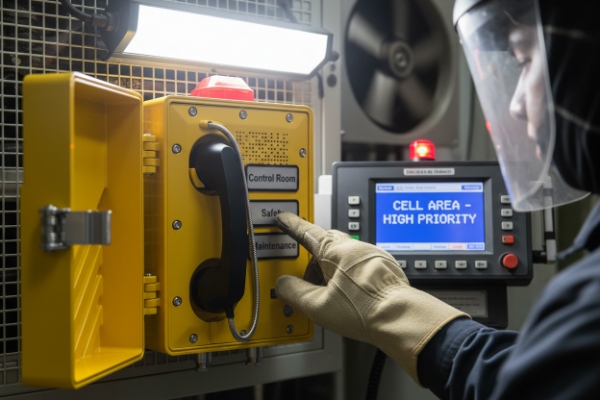
%[Operator activating high priority call on explosion-proof control room emergency phone](http://sipintercommanufacturer.com/wp-content/uploads/04-illustrate-a-close-up-of-an-explosion-proof-sip-ph.jpg "Control Room Call")
IP PBX integration: keep call paths short and predictable
A SIP phone in a cell hall should not rely on complex dialing during an alarm. The most useful features in practice are:
- hotline keys to control room and EHS
- ring groups for shift response
- auto-recovery after PoE drop
- clear, loud audio and high-output speaker
- simple status indicators that can be seen in fogged goggles
A plant can also use “auto-dial on lift” or “one button emergency” call flows for fixed stations. This works well when training time is limited.
PAGA paging: horns, speakers, and paging priority
PAGA 9 integration depends on how paging is built:
- SIP paging from PBX to PAGA gateways
- multicast paging in the OT network
- analog paging with SIP-to-analog gateways
A phone can fit any of these when it supports paging modes that the plant uses. The plant should also define priority rules so paging does not block emergency calls.
Beacons and gas detectors: let PLC logic do the heavy lifting
Gas detectors and beacons are usually part of a broader alarm system. The cleanest design is:
- gas detector alarms go to PLC/DCS/SIS
- PLC triggers beacons and paging logic
- PBX or dispatch server triggers callouts to phones
- phones provide two-way voice and acknowledgement, not the safety decision
This keeps audit trails clean. It also keeps the phone out of the safety-critical decision chain while still making it a strong emergency communication tool.
ESD integration: support, do not replace
ESD must remain deterministic and code-compliant. The phone can help after ESD initiation:
- automatic call to control room or emergency group
- paging announcement to clear or evacuate
- local beacon trigger for “call for help” stations (through PLC input)
Integration methods table for SRU communications
| System | Best integration method | Why it works |
|---|---|---|
| IP PBX | SIP register + ring groups + hotline | fast calling and simple training |
| PAGA | SIP paging or multicast + gateway | plant-wide alerts near noisy units |
| Beacons | phone relay to PLC input, or PLC-driven beacon | keeps high-power circuits controlled |
| Gas detectors | detector to PLC/DCS, then paging/callouts | avoids phone becoming safety logic |
| ESD/SIS | SIS triggers events, phones provide voice | keeps safety authority in SIS |
In DJSlink-style deployments, the projects that run smoothly define these interfaces early. It prevents late rework in the marshaling cabinets and the network design.
After integration, the last compliance checkpoint is always the same: cable entry, glands, seal fittings, bonding, and temperature class.
What EX glands, seal fittings, bonding, and T-class ensure compliance?
A certified phone can still be rejected if the installer uses the wrong gland, leaves an unused entry unsealed, or skips bonding. SRUs also add heat and corrosion, so the “almost right” installation does not last.
Compliance comes from using Ex-certified glands and stopping plugs that match the certificate, installing seal fittings per the site wiring method, bonding the enclosure into the plant earthing network, and selecting a T-class and mounting position that stay safe near hot equipment.
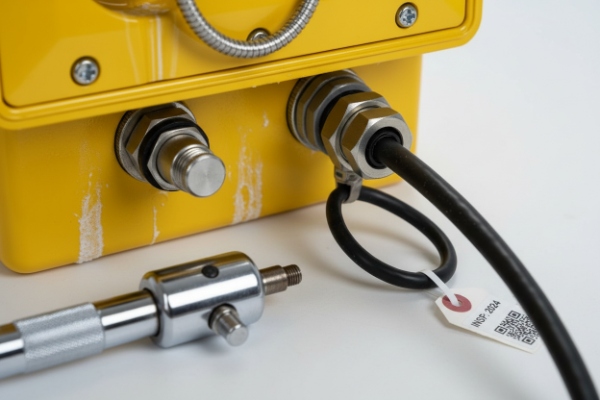
%[Close-up of explosion-proof phone cable glands, sealed fittings, and tagged wiring](http://sipintercommanufacturer.com/wp-content/uploads/05-create-a-macro-close-up-of-the-phone-s-cable-entry-1.jpg "Cable Gland Sealing")
EX glands and entries: treat them as part of the protection concept
For Zone equipment, the certificate often specifies the allowed cable entry style and any special conditions. For flameproof (Ex d 10) devices, correct glands and plugs are critical. In many real installs, the gland is the first corrosion failure point, so stainless gland selection is not a luxury in SRUs.
Good practice includes:
- Ex-certified glands matched to cable diameter and type
- barrier glands when the design calls for them
- certified stopping plugs on unused entries
- correct thread type and engagement depth
- correct torque so seals compress as designed
Seal fittings: follow the plant’s wiring method rules
In Class/Division conduit systems, seal fittings are often required near explosionproof enclosures and at boundary points, based on the electrical design and local code practice. In cable systems, the equivalent control is correct Ex glands and sealing methods.
The important part is consistency. Mixing “conduit rules” and “cable rules” in the same run without a clear design basis creates inspection questions.
Bonding: keep it simple and inspectable
Bonding is the boring work that saves lives. In an SRU, corrosion can weaken bonding over time, so the bonding path should be obvious and easy to inspect.
A good SRU bonding approach:
- use the phone’s external earth stud or bonding point
- bond to the local equipotential network
- avoid paint under bonding lugs unless the lug is designed for it
- use corrosion-resistant hardware and re-check during turnarounds
T-class and hot surfaces: do not mount a “cool-rated” phone on a hot frame
T-class is about the maximum surface temperature of the device. A stricter T-class gives more margin, but mounting location still matters. If the phone is mounted near hot piping, hot casings, or hot steelwork, the phone can heat up beyond its intended conditions even if it is electrically correct.
Practical controls that work well:
- keep distance from hot surfaces and radiant heat sources
- use standoff brackets and heat shields where needed
- choose a T-class that fits the gas risk and the worst ambient
- confirm the ambient range on the certificate, not only on the datasheet
Installation checklist table for SRU acceptance
| Item | What inspectors expect | SRU-specific failure mode |
|---|---|---|
| Glands and plugs | certified, correct type, correct torque | corrosion at the entry causes leaks |
| Unused entries | certified stopping plugs | temporary plugs left in place |
| Seals / seal fittings | installed per design rules | missing seal at boundary or enclosure |
| Bonding | solid, visible, corrosion-resistant | bonding lug loosens after heat cycles |
| T-class + placement | rating fits hazard, placement avoids heat soak | phone mounted too close to hot equipment |
| Maintenance | flamepaths and seals kept clean | gasket damage during service |
When these details are controlled, the phone becomes a reliable SRU tool. It supports fast response during H2S alarms. It survives the environment. It also passes compliance checks without last-minute rebuilds.
Conclusion
Explosion-proof SIP telephones are suitable for SRUs when the Zone/Div marking, gas group, T-class, corrosion materials, and certified installation parts all match the real Claus-area hazards.
Footnotes
-
Process for producing chlorine and sodium hydroxide. ↩
-
Safety guidelines for handling this flammable gas. ↩
-
Area where explosive gas is likely during normal operation. ↩
-
Classification for the most easily ignited gas group. ↩
-
Standards defining protection against dust and water ingress. ↩
-
Low-carbon stainless steel offering high corrosion resistance. ↩
-
Nickel alloys designed for extreme chemical environments. ↩
-
Synthetic fluoropolymer with high chemical resistance. ↩
-
Critical systems for facility-wide emergency announcements. ↩
-
Flameproof enclosure method to contain internal explosions. ↩