
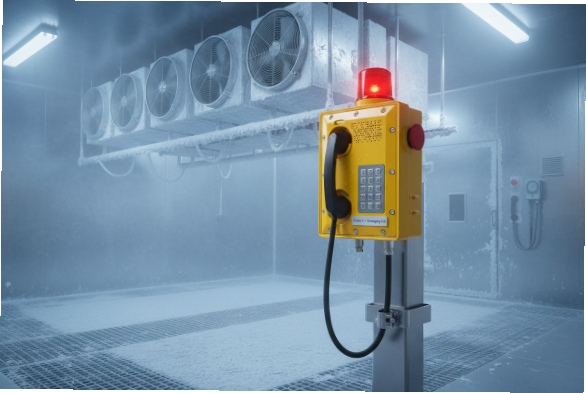
Cold storage facilities present a unique paradox: they must be sealed tight to maintain temperature, yet they rely on potentially hazardous refrigerants like Ammonia (NH3). A leak in a refrigeration valve can create a toxic and explosive atmosphere instantly. Combined with temperatures plummeting to -40°C, standard communication gear freezes, batteries fail, and LCDs go black.
Yes, explosion-proof SIP telephones are essential for cold storage environments, particularly those using ammonia refrigeration. Equipped with -40°C rated electronics and internal anti-condensation heaters, they ensure reliable operation in deep freeze. Their IP66/67, NEMA 4X housings resist frost, rigorous washdowns, and ammonia corrosion, serving as a vital safety link.
The Freeze-Thaw Challenge
In the logistics and food processing industry, the "Cold Chain" is unforgiving. Inside a blast freezer, equipment faces deep cryogenic 1 stress. When a door opens or a defrost cycle begins, humidity spikes, creating immediate condensation on cold surfaces.
In my experience at DJSlink, I’ve seen standard industrial phones fail not because of the cold itself, but because of the moisture that forms inside the device when it cycles between temperatures. Furthermore, the widespread use of Anhydrous Ammonia as a refrigerant introduces a Class I Division 2 (or Zone 2) explosion hazard. A spark from a non-rated phone during an ammonia leak could be catastrophic.
To survive this, a phone needs a "heart" that stays warm and a "skin" that stays sealed.
| Challenge | Cause | Solution |
|---|---|---|
| Component Freeze | Ambient < -20°C | Wide-Temp Industrial Chips |
| Display Failure | Liquid Crystal sluggishness | Internal Heating Element |
| Short Circuits | Condensation/Frost | Conformal Coating 2 & Heaters |
| Ammonia Risk | Refrigerant Leak | Zone 2 / Div 2 Certification |
Do −40 °C rated electronics and anti-condensation heaters ensure uptime?
Standard electronics give up around 0°C. Batteries lose chemical reaction speed, and LCD screens become slow or blank.
Absolutely. We utilize industrial-grade processors and memory chips rated for -40°C operation. Crucially, an intelligent internal heating circuit activates automatically when the temperature drops, keeping the PCB and LCD screen within optimal operating range and preventing internal condensation that causes corrosion.
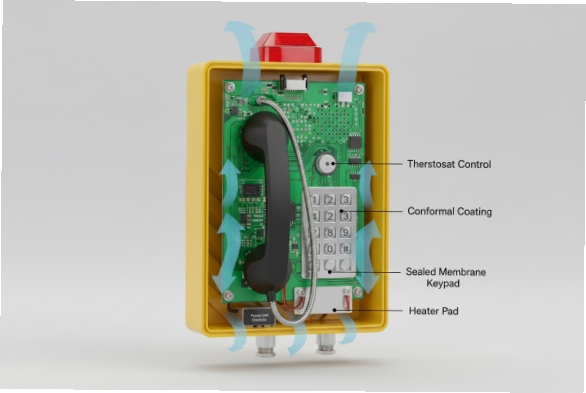
The Science of "Hot" Electronics in Cold Places
-
Intelligent Heating: The heater isn’t just a resistor; it’s a thermostat-controlled system. It maintains the internal temperature just above the dew point 3. This "positive pressure" of heat prevents moist air from being sucked in during cooling cycles.
-
LCD Visibility: Liquid Crystal Displays (LCDs) function by moving fluid crystals. At -30°C, this fluid becomes viscous. Our heated displays ensure the caller ID and status messages remain readable instantly.
-
No Batteries: Unlike mobile DECT phones which fail rapidly in the cold, our SIP phones are PoE (Power over Ethernet) powered. This eliminates the chemical failure point of Li-Ion batteries in freezing conditions.
Will IP66/67, NEMA 4X housings survive frost, washdown, and corrosion?
Hygiene is paramount in food cold storage. This means caustic chemical washdowns are frequent.
Yes. IP66/IP67 ratings guarantee the device withstands high-pressure water jets used during sanitation. The NEMA 4X rating ensures the 316L Stainless Steel or chemical-resistant GRP housing is immune to ammonia exposure and the corrosive detergents used to remove ice and grime.
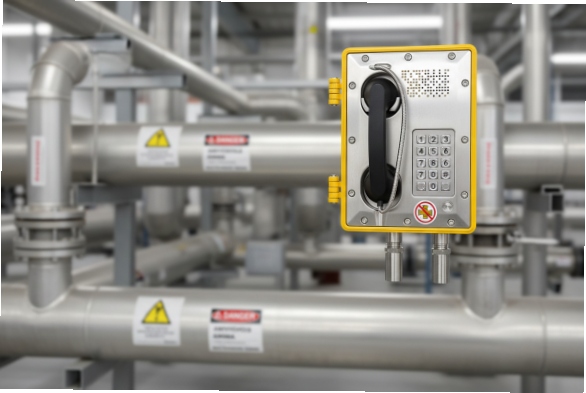
Material Selection: Ammonia vs. The World
-
Ammonia (NH3) Resistance: Ammonia is highly corrosive to copper, brass, and zinc. A standard phone with brass cable glands will corrode rapidly. Stainless Steel 316L 4 is chemically compatible and resists the pitting caused by cleaning agents.
-
The Washdown Test: Cleaning crews use high-pressure hot water. An IP66 rating means the phone can take a direct hit from a jet nozzle without water ingress.
-
Button Freeze: Standard buttons can freeze stuck if water enters the crevices. Our keypads use a monolithic silicone membrane or piezo-electric 5 buttons that have no moving parts to freeze.
Can phones integrate with IP PBX, PAGA, and temperature alarms?
A person trapped in a freezer is a life-threatening emergency (hypothermia).
Yes, these SIP phones integrate seamlessly with the facility’s IP PBX. They can interface with ammonia sensors and temperature monitors via I/O ports. If a "Trapped Person" button is pressed, or if the temp rises critically (door left open), the phone can trigger a PAGA alarm and dial the security desk immediately.
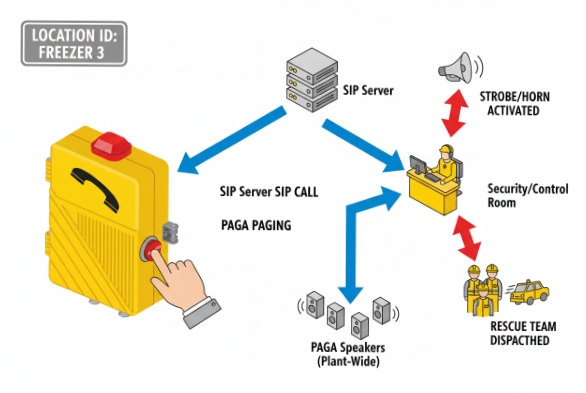
The "Trapped Person" Protocol
-
Emergency Call Button: Every cold room phone is a lifeline. A single button press can initiate a priority call to the control room. Because it’s SIP, it tells the operator exactly which freezer is calling.
-
Ammonia Leak Alerting: If the facility’s gas detection system trips (Ammonia > 300ppm), the SIP phone can act as an annunciation point, flashing its beacon and playing a "Leave the Area" warning, ensuring workers inside the noisy fan-filled room get the message.
-
Door Open Alarms: The phone’s digital input can monitor the door switch. If the door remains open for >5 minutes (threatening product integrity), the phone can silently ping the warehouse manager’s mobile app.
What gasket materials and cable glands prevent icing ingress?
The seal is the weakest link. Standard rubber gets brittle and cracks in deep freeze.
We exclusively use Silicone gaskets, which remain flexible and elastic down to -50°C, unlike Neoprene or EPDM which can harden and fail. Cable glands must be nickel-plated brass or stainless steel with silicone seals to prevent "cold flow" of the cable jacket and subsequent moisture entry.
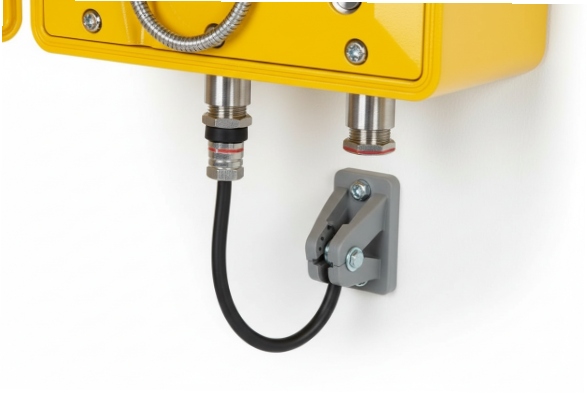
Sealing the Deal
-
Silicone Gaskets: The memory of the gasket material is vital. When the housing contracts in the cold, the gasket must compress. When it warms up, it must expand. Silicone offers the best thermal stability for this dynamic sealing.
-
Cable Gland Hygiene: In food storage, "cleanability" is key. The glands and the phone body are designed with smooth surfaces to prevent bacteria or ice buildup in crevices.
-
Conduit Sealing: To prevent warm, moist air from the corridor travelling through the conduit and condensing inside the cold phone, an EYS sealing fitting 6 is installed at the entry point, creating a vapor barrier.
Conclusion
Operating in a cold storage facility requires technology that respects the physics of freezing and the chemistry of ammonia. By deploying Zone 2/Div 2 certified SIP telephones with -40°C heated electronics and silicone-sealed NEMA 4X housings, you ensure that your communication lines remain open—whether for daily logistics or critical emergency response. DJSlink’s cold-chain ready solutions are built to perform when the mercury drops.
Footnotes
-
The production and behavior of materials at very low temperatures. ↩
-
A protective chemical coating or polymer film that protects circuit boards from harsh environments. ↩
-
The temperature to which air must be cooled to become saturated with water vapor. ↩
-
A molybdenum-bearing austenitic stainless steel known for its corrosion resistance. ↩
-
Electric charge that accumulates in certain solid materials in response to applied mechanical stress. ↩
-
Fittings used in conduit systems to prevent the passage of gases, vapors, or flames. ↩








