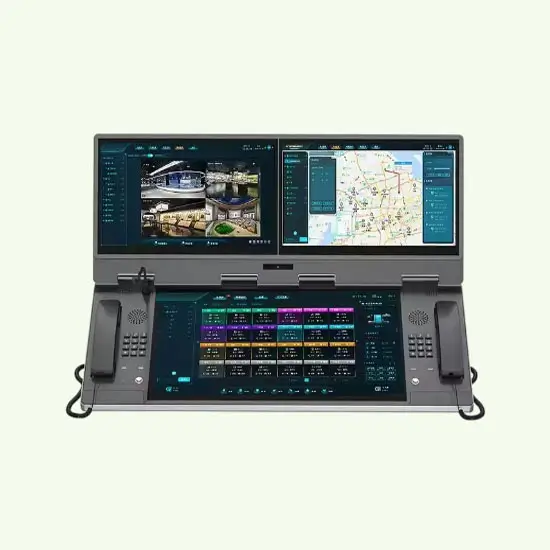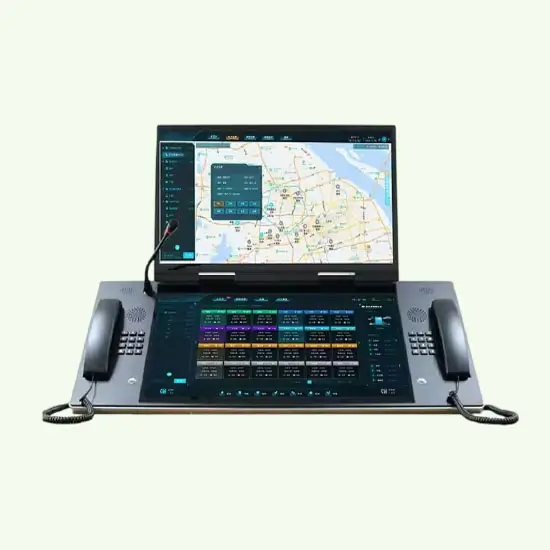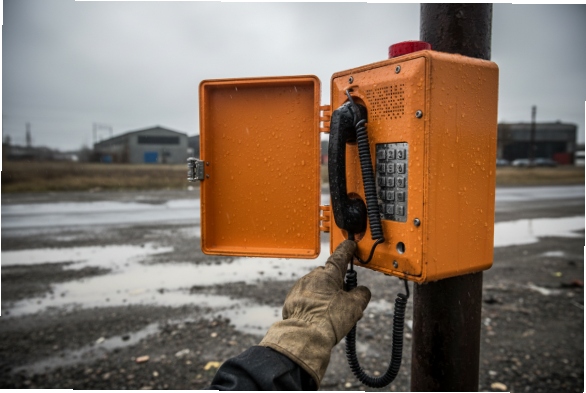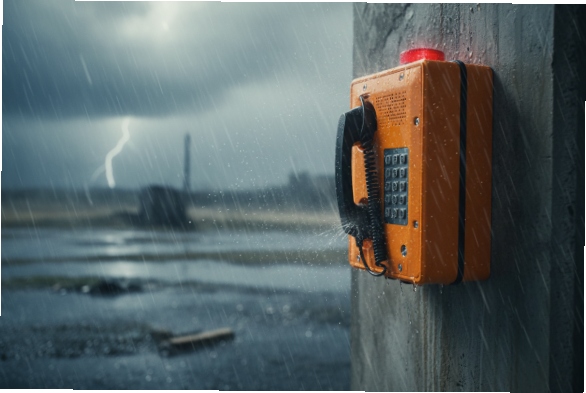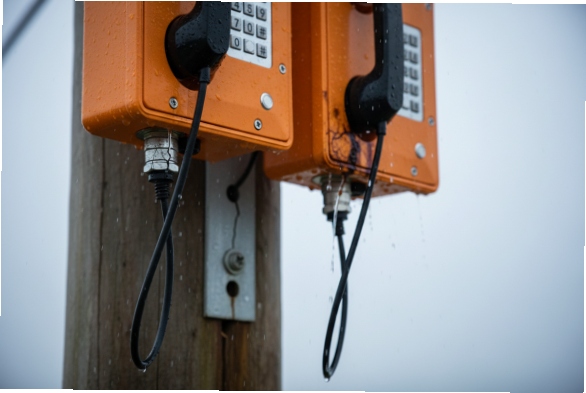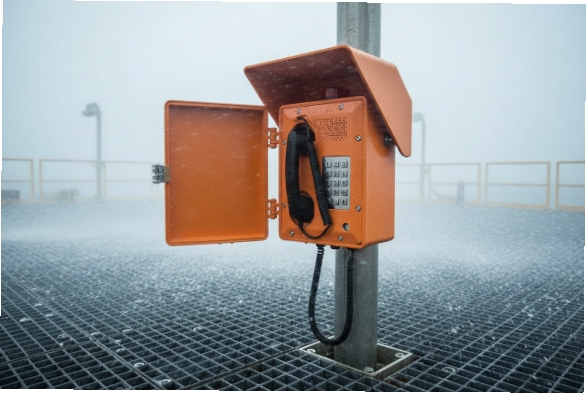
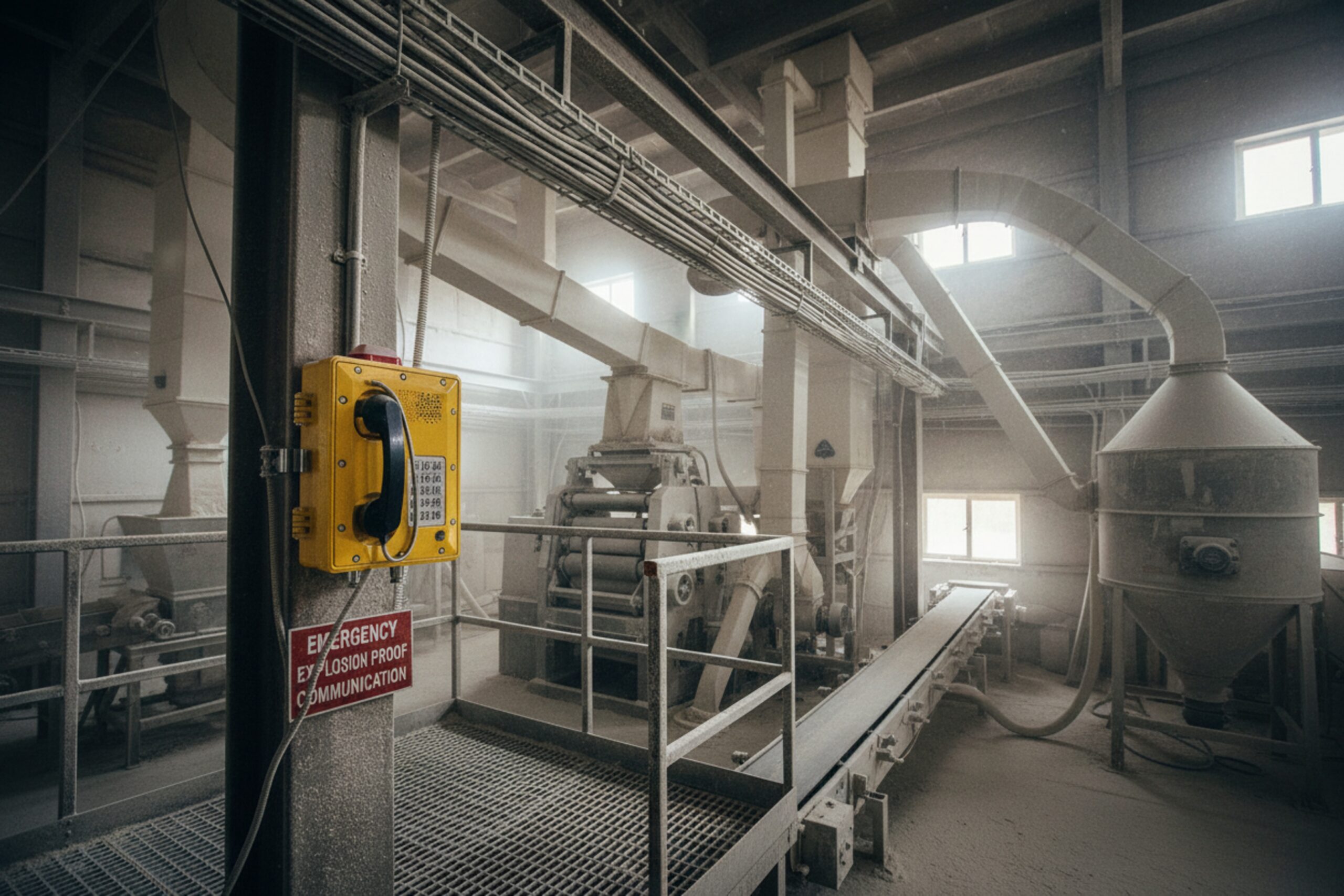
Combustible dust is a silent risk. It builds up on surfaces, hides in corners, and ignites when people least expect it. A normal SIP phone can ingest dust, spark internally, or fail inspection.
Yes. Explosion-proof SIP telephones are suitable for dust-hazard workshops when the device carries the correct dust certification (Zone 20/21/22 or Class II Div 1/2), uses dust-tight IP66/67 sealing with the right glands, and is installed with proper bonding and surface temperature limits for the dust present.
A dust-workshop blueprint: certify for dust, seal for dust, and control temperature
Dust hazards are not “gas hazards with dirt”
Combustible dust 1 behaves differently from gas. Dust can:
-
form explosive clouds when disturbed
-
create insulating layers that raise surface temperatures
-
build up in enclosures and cause tracking
-
become conductive in some cases and create short paths
So the phone must be certified for dust and designed for dust ingress control.
Where dust-hazard workshops typically exist
Common dust-hazard work areas include:
-
flour and sugar handling rooms
-
grain milling and bagging rooms
-
wood sanding and finishing workshops
-
coal handling and pulverizing shops
-
metal powder blending rooms (aluminum, magnesium)
-
plastics powder and additive dosing areas
In these sites, phones often sit near:
-
bagging stations and weigh scales
-
mixers and conveyors
-
E-stop pull cords and emergency exits
-
control points and stair landings
What a good dust-rated phone package includes
A reliable solution is more than a phone. It is:
-
dust-rated certification (Ex tb or Class II listing)
-
antistatic or bonded housing approach
-
correct surface temperature rating (T-class or Tmax) for the dust
-
integration to PBX and paging and emergency triggers
| Selection topic | What to specify | Why it matters in dust |
|—|—|—|
| Dust zone | Zone 20/21/22 or Class II Div | legal compliance |
| Dust group | IIIA/IIIB/IIIC | ignition risk and conductivity |
| Sealing | IP66/67 + dust-tight glands | prevents ingress and failure |
| Temperature limit | Tmax / T rating for dust | prevents hot-surface ignition |
| Integration | PBX + PAGA + beacon + E-stop interface | supports emergency workflow |
Now, let’s answer the first technical question: which dust ratings apply in Zone and Class/Div systems?
Which Zone 20/21/22 or Class II Div 1/2 ratings address combustible dusts?
This is the most common misunderstanding. Buyers select a gas-rated Ex phone, but the site hazard is dust. That creates a compliance gap.
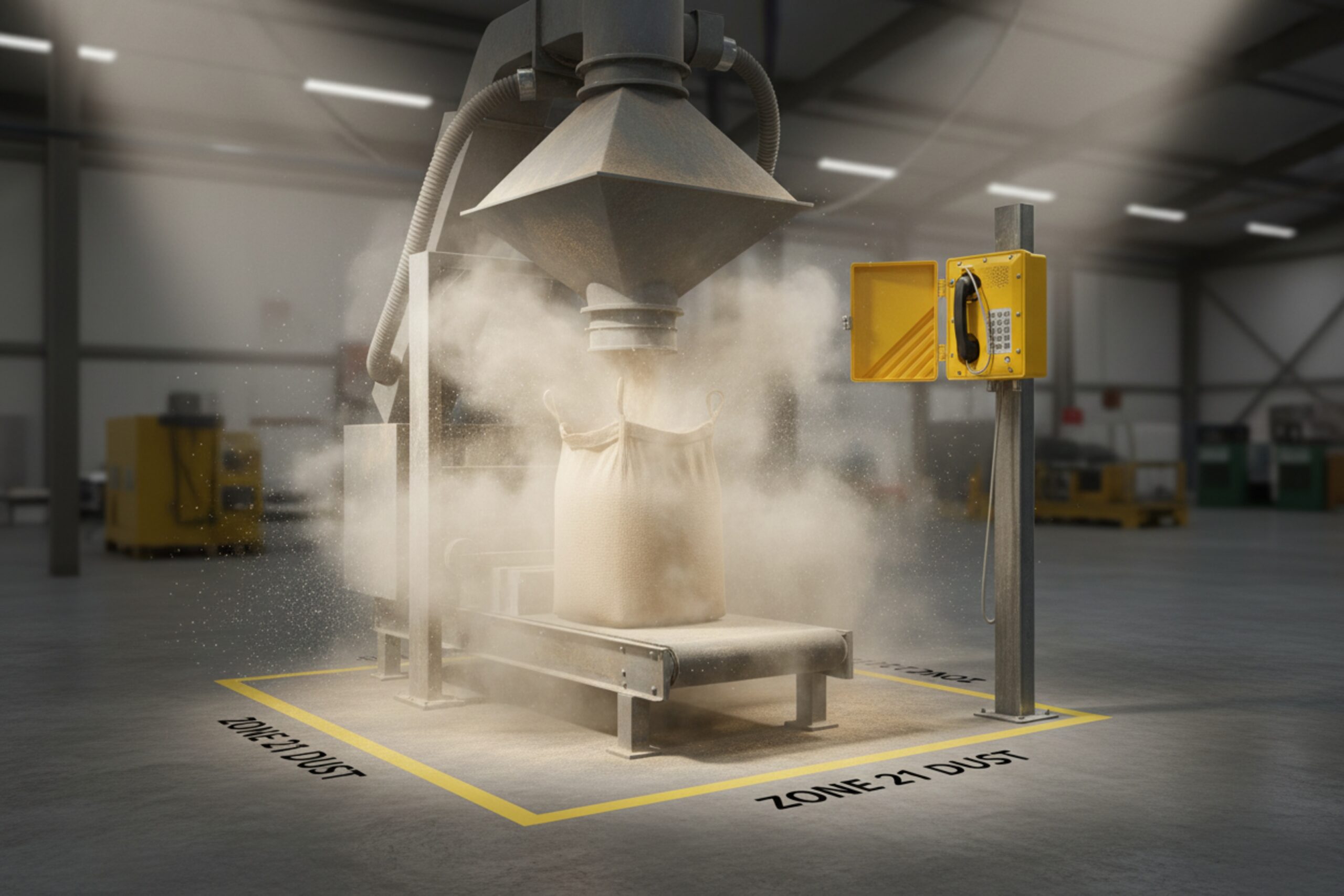
Combustible dust workshops require equipment certified for dust atmospheres. In IEC/ATEX terms, that means suitability for Zone 20/21/22 and a dust protection concept such as Ex tb. In NEC/CEC terms, it means Class II (combustible dust) Division 1/2 with the correct dust group. The correct rating depends on where dust clouds are likely during normal operation (more stringent) versus abnormal conditions (less stringent).
Practical mapping: where each zone/div is used
| Dust classification | What it implies | Typical workshop location |
|—|—|—|
| Zone 20 / Class II Div 1 (most strict) | dust cloud present continuously or frequently | inside enclosed equipment, some dust collectors |
| Zone 21 / Class II Div 1 or 2 (site-dependent) | dust cloud likely during normal operation | bagging, mixing, transfer points |
| Zone 22 / Class II Div 2 | dust cloud unlikely in normal operation, but possible | surrounding areas, corridors, near doors |
Many workshops avoid placing devices directly in Zone 20 by locating call points on landings or outside enclosures. Still, Zone 21 is common near bagging and mixing.
Dust groups: IIIA/IIIB/IIIC affects selection
Dust group 3 describes dust type:
-
IIIA: flyings (fibers, lint)
-
IIIB: non-conductive dust
-
IIIC: conductive dust (most demanding)
Metal powders can push toward IIIC. Many food powders are IIIB. The phone nameplate must match the required dust group, not only “dust rated.”
Temperature limits are part of the dust rating
Dust ignition risk is heavily linked to surface temperature. Dust layers can insulate and raise surface temperatures. This is why dust-certified equipment often uses a maximum surface temperature (Tmax) based on:
-
dust cloud ignition temperature
-
dust layer ignition temperature and assumed layer thickness
-
safety factors required by standards and site rules
Once the rating is correct, sealing becomes the next key. Dust ingress can create both reliability and safety issues.
Will IP66/67, antistatic housings and dust-tight glands prevent ingress?
A dust workshop is an ingress workshop. Fine powders find weak seals, then build up inside terminal chambers and keypads. Water washdown can make dust paste that blocks moving parts.
Yes. IP66/IP67 sealing, antistatic or bonded housing approaches, and dust-tight glands can prevent ingress when the cable entry system is specified and installed correctly, unused entries are sealed with certified plugs, and maintenance preserves gasket compression and gland torque.
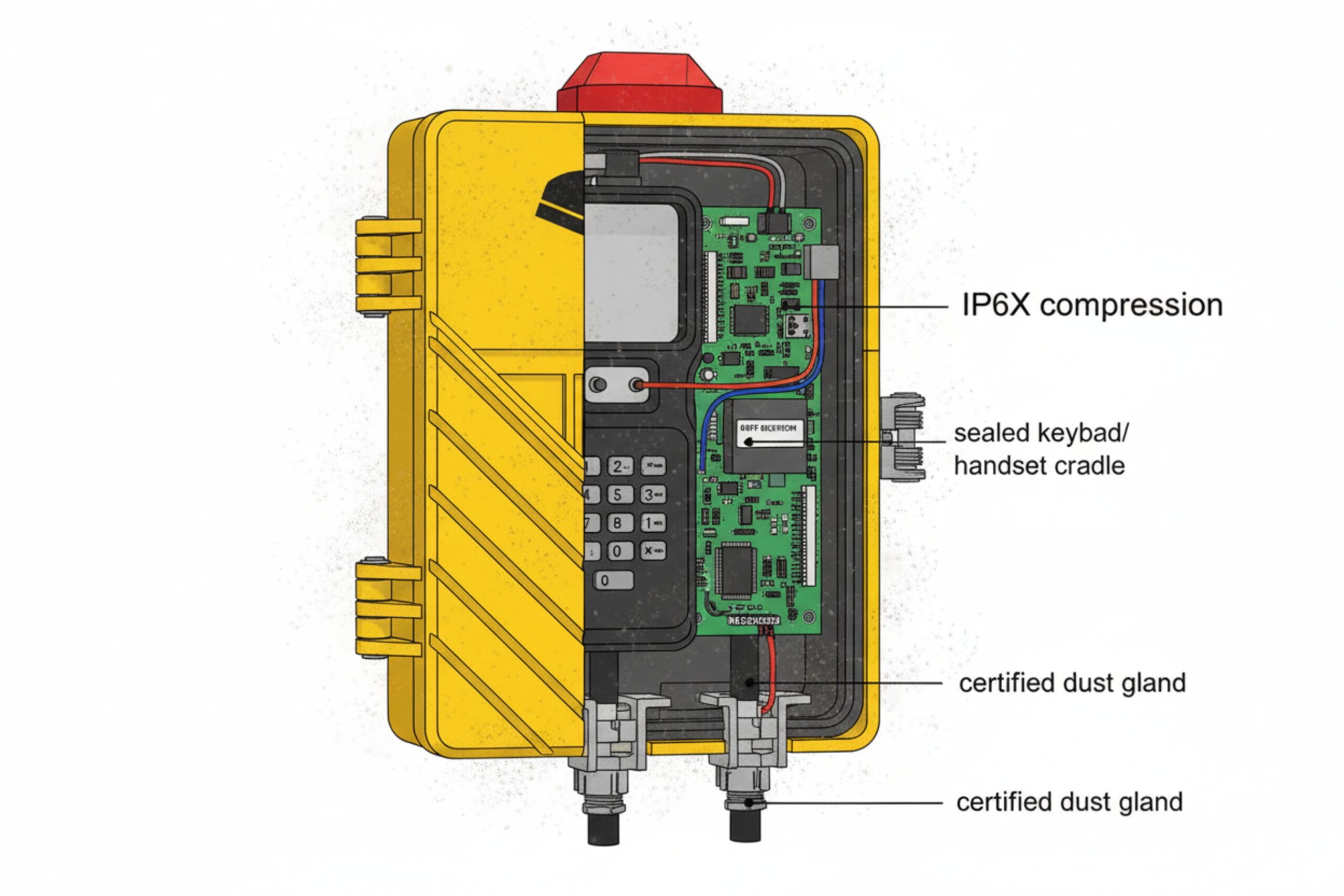
IP66 vs IP67 in dust workshops
-
IP66 is strong for dust and water jets.
-
IP67 adds protection where washdown creates pooling water or where equipment sits low and can be temporarily submerged.
For many workshops, IP66 is the baseline. IP67 is a smart upgrade near floor-level call points or wash areas.
Dust-tight glands: the real gatekeeper
Ingress protection is usually lost at:
-
the gland sized wrong for the cable OD
-
missing sealing washers or wrong gland type for the cable
-
unused ports left open or plugged with non-certified plugs
-
re-termination without cleaning sealing surfaces
A good spec should list:
-
the gland type, material, and seal range
-
the entry thread specification
-
a torque and inspection method
Antistatic housing: use it with bonding, not instead of bonding
Antistatic surfaces help reduce charge build-up on non-metal parts. Still, the most reliable static control is:
-
equipotential bonding of metal enclosures
-
correct grounding of cable shields where required
-
continuity checks during commissioning
| Ingress risk | What to specify | What to verify on site |
|—|—|—|
| Fine dust | IP66/67 + dust-tight glands | gland size and torque marks |
| Washdown | IP66/67 + gasket care | post-wash call and visual check |
| Maintenance | spare gaskets and clean faces | re-seal checklist |
| Static | bonding + antistatic materials | continuity test record |
Once sealing is handled, the phone becomes useful when it ties into the site emergency workflow: PBX calls, paging, beacons, and E-stop pull cords.
Can phones integrate with IP PBX, PAGA, beacons, and E-stop pull cords?
Dust workshops are noisy and often have long lines of machines. Paging and visible signals help direct response. E-stop pull cords are also common along conveyors and production lines.
Yes. Dust-rated Ex SIP telephones can register to an IP PBX for hotline and group calling, integrate with PAGA via paging groups or multicast, trigger beacons through relay outputs, and interface to E-stop pull-cord workflows through PLC or safety I/O—without being wired in series with the safety loop itself.
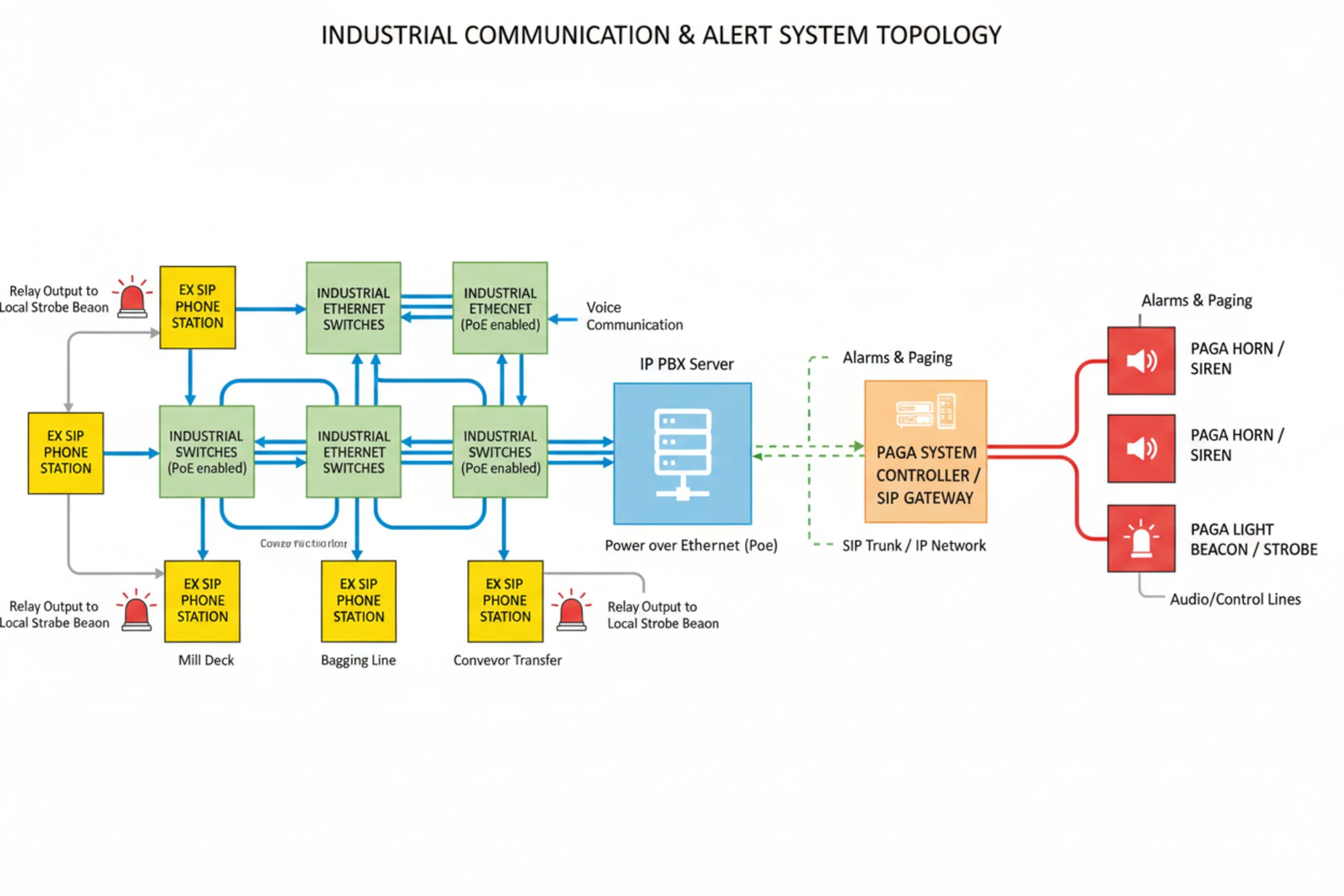
IP PBX: emergency calling made simple
A dust workshop phone should support:
-
SOS hotline to control room or supervisor
-
group calls for emergency response
-
clear call status indication in noisy environments
-
templates for fast replacement to meet MTTR
PAGA: paging is often the primary alert channel
Because machines are loud, PAGA 4 horns and speakers are often more effective than a handset ringer. Integration options:
-
multicast paging with VLAN/QoS and IGMP control
-
relay trigger into a paging controller input for a predefined tone
Beacons/strobes: essential in dusty visibility conditions
Dust can reduce visibility. A strobe at the call point helps responders locate the caller. Relay outputs can trigger:
-
local strobe
-
beacon controller input for a zone
-
horn/strobe combo controller input
E-stop pull cords: keep safety integrity intact
The right pattern is:
-
pull cord triggers safety relay or safety PLC
-
phone receives an input (E-stop active) and auto-dials or indicates alarm
-
phone relay outputs can signal “call point active” to a PLC input
-
the shutdown action remains controlled by the safety system
| Workflow | Interface | Why it is safe |
|—|—|—|
| SOS calling | SIP hotline | clear escalation |
| Plant alert | paging group or relay trigger | high audibility |
| Visible alert | relay to beacon controller | fast locating |
| E-stop awareness | PLC/safety I/O mapping | keeps safety loop independent |
Now, the last and most critical topic is safety limits: bonding, earthing, and surface temperature. Dust ignition risk is tightly linked to these.
What bonding, earthing, and surface temperature limits ensure safety?
In dust hazards, static and hot surfaces are the biggest ignition concerns. A phone must not accumulate charge, and it must not exceed safe surface temperatures with dust layers.
Safety is ensured by equipotential bonding and earthing that prevent static charge build-up, plus a maximum surface temperature (Tmax) suitable for the specific dust cloud and dust layer ignition temperatures, with margin for ambient heat and dust insulation.
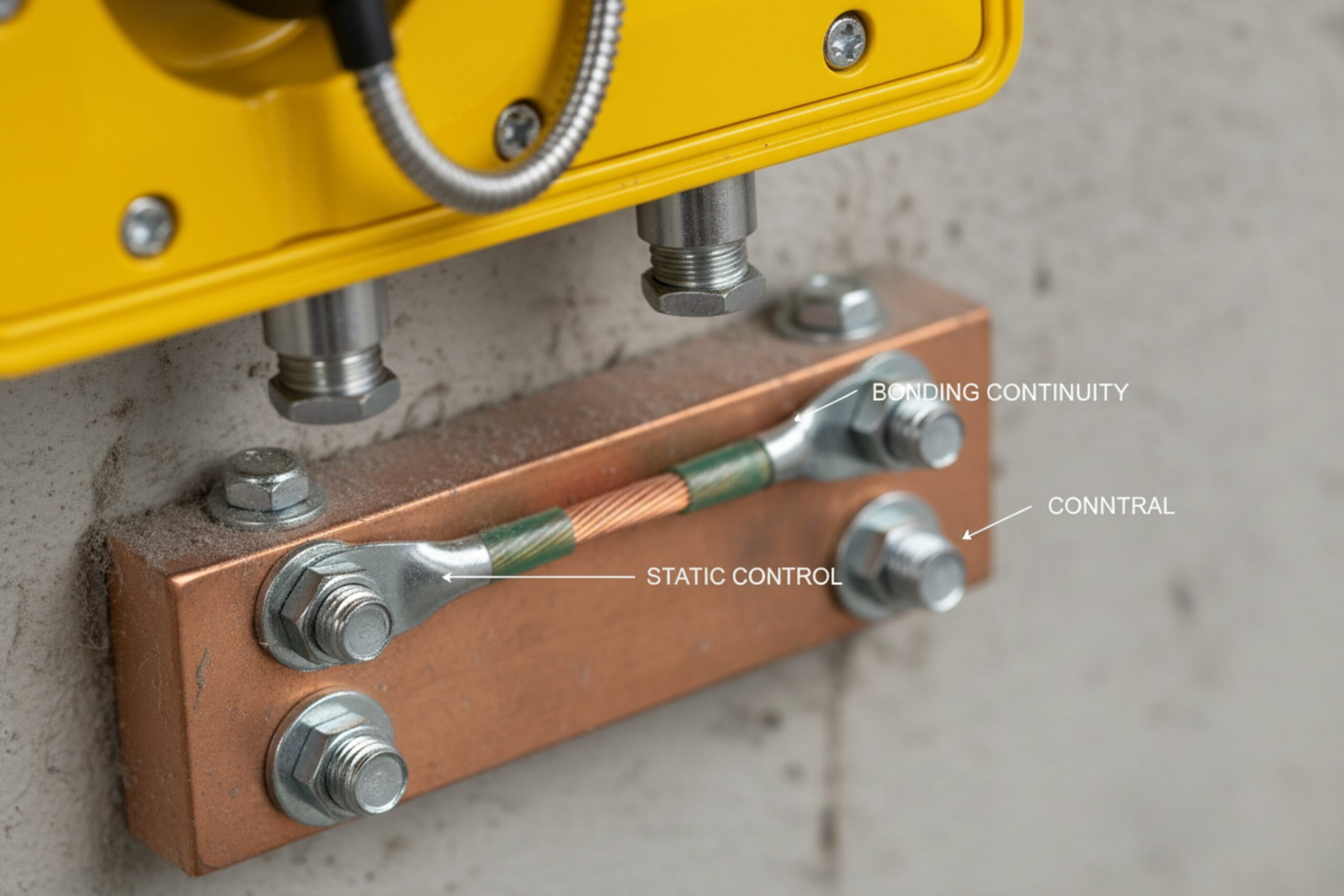
Bonding and earthing: make the path short and durable
A compliant installation should include:
-
bonding the phone enclosure to the local equipotential bar 5
-
short, corrosion-resistant bonding conductors and lugs
-
continuity checks recorded at commissioning
-
periodic inspection because dust and vibration can loosen joints
Bonding also improves surge behavior and reduces nuisance faults on Ethernet ports.
Surface temperature limits: think in dust layers, not only gas T-class
For dust, the key is the maximum surface temperature allowed for the dust in question. Dust can ignite by:
-
a hot surface in a dust cloud
-
a hot surface beneath a dust layer that insulates heat
So the phone selection should confirm:
-
dust-rated temperature marking (often a stated Tmax)
-
worst-case ambient temperature (Ta) and any solar load
-
placement away from hot equipment and direct radiant heat
-
cleaning plans to limit dust layer buildup on the device
Operational controls that strengthen safety
Engineering controls should include:
-
scheduled cleaning around call points and cable entries
-
inspections for dust buildup on the device body
-
verification that bonding remains intact
-
keeping devices out of Zone 20 where practical by placing call points at landings
A safety checklist table for dust workshops
| Safety item | What to set | Why it reduces ignition risk |
|—|—|—|
| Dust zone rating | Zone 21/22 or Class II Div 1/2 | legal compliance |
| Dust group | IIIA/IIIB/IIIC per dust | correct ignition coverage |
| Surface temp | Tmax below dust limits with margin | prevents hot-surface ignition |
| Bonding | short equipotential bond | prevents static charge buildup |
| Housekeeping | dust layer control plan | reduces insulation and ignition risk |
| Post-maintenance | re-seal and continuity checks | keeps IP and bonding intact |
When these items are controlled, Ex SIP phones become reliable emergency call points and operational phones in dust-hazard workshops, without creating new ignition risks.
Conclusion
Explosion-proof SIP telephones suit dust-hazard workshops when dust-zone and group ratings (Zone 20/21/22 or Class II Div) are correct, IP66/67 sealing and dust-tight glands prevent ingress, integrations support PBX/PAGA/PLC workflows, and bonding plus safe surface temperature limits are enforced.
Footnotes
-
Safety guidelines for managing combustible dust hazards in industry. ↩
-
Standard classifying protection against dust ingress and water jets. ↩
-
Classification system for dusts based on conductivity and particle type. ↩
-
System for broadcasting messages and alarms in large facilities. ↩
-
Connection ensuring metal parts stay at the same voltage potential. ↩