
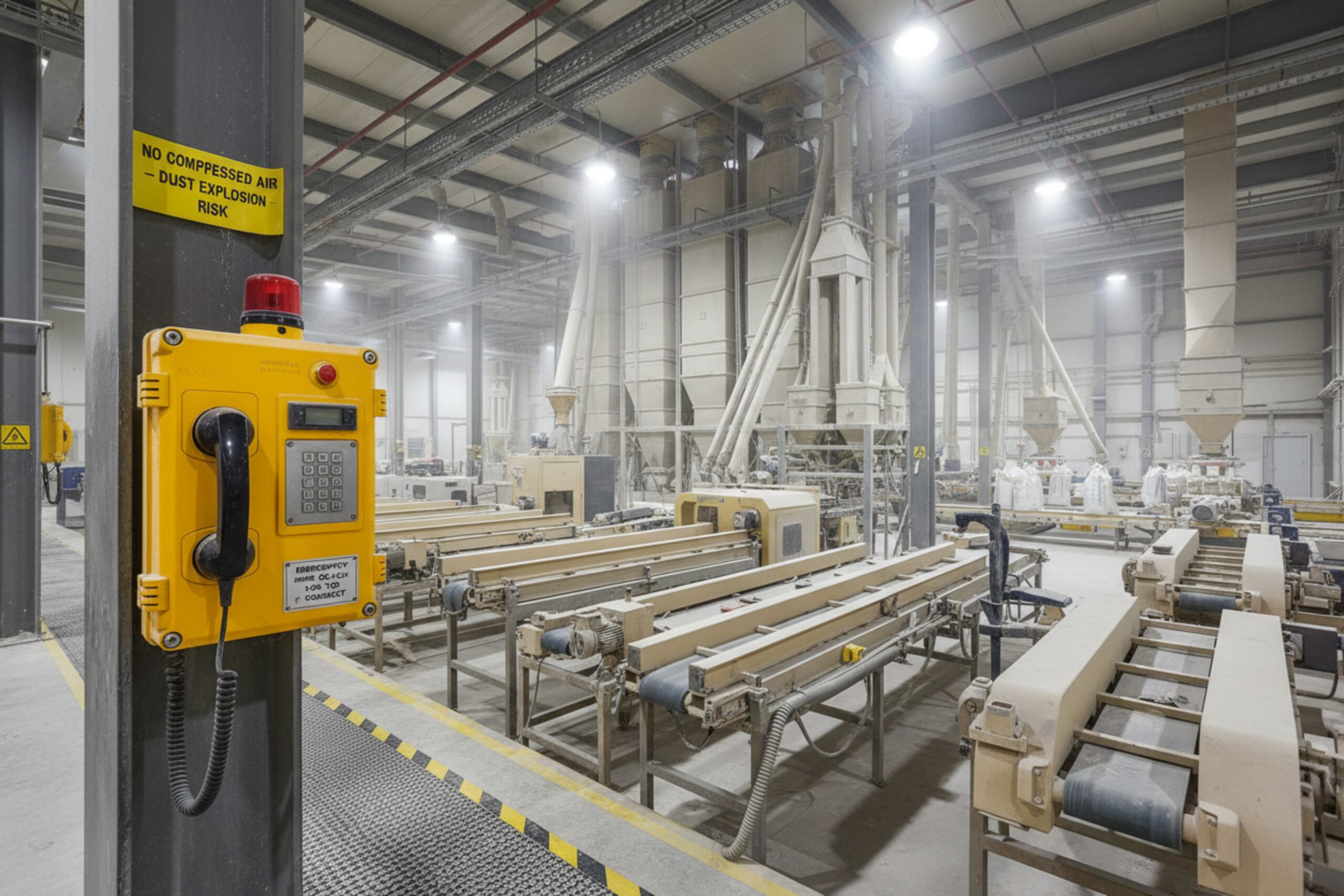
Flour dust looks harmless, but it behaves like fuel when it becomes a cloud. In a mill, dust gets everywhere, machines stay loud, and washdowns can turn powder into paste that destroys weak seals.
Yes. Explosion-proof SIP telephones are suitable for flour mills when the device is certified for combustible dust (Zone 20/21/22 or Class II Div 1/2), uses IP66/67 dust-tight sealing with the right glands, and is installed with correct bonding and dust surface-temperature limits.
Flour mill communication needs: dust compliance, rugged sealing, and loud emergency workflow
Flour mills create both dust clouds and dust layers
A flour mill has:
-
frequent dust clouds at transfer points (bagging, spouts, elevators)
-
heavy dust layer buildup on surfaces (beams, trays, device housings)
-
constant vibration from conveyors and fans
-
high noise that makes normal ringers easy to miss
-
cleaning and washdown routines that test IP sealing
So the selection must solve three problems at once:
-
certified dust protection (not just “gas Ex”)
-
ingress protection for dust and water
-
emergency alerting that works in noisy spaces
Where phones are most useful in mills
In practice, emergency and operational phones are placed at:
-
bagging lines and packing rooms
-
elevator headhouses and belt conveyors
-
control points at stair landings
-
silo access points and truck load-out
-
maintenance workshops and MCC entrances
The best strategy is to place call points where operators naturally pass, but avoid putting devices inside enclosed dusty equipment where Zone 20 1 is common.
Write the spec as a “package,” not a single line
A flour mill phone package should define:
-
dust zone rating + dust group (for flour, usually non-conductive dust)
-
maximum surface temperature for dust
-
IP66/67 sealing 2 and dust-tight gland system
-
IK impact resistance for knocks and vibration
-
antistatic/bonding strategy for static control
| Flour mill problem | What to specify | Why it prevents failure |
|—|—|—|
| Dust explosion compliance | Zone/Class II dust approval | passes audits and inspections |
| Dust ingress | IP66/67 + dust-tight glands | prevents terminal and keypad failures |
| Washdowns | chemical/water resistant seals | keeps IP rating after cleaning |
| Impacts/vibration | IK10 + rigid mounting | prevents cracked windows and loosening |
| Emergency response | PBX + PAGA + beacon triggers | helps crews hear and see alarms |
Now let’s answer the first compliance question: what dust-zone and Class II Div ratings match flour dust hazards?
Which Zone 20/21/22 or Class II Div 1/2 ratings fit flour dust hazards?
Many mills mistakenly buy a gas-rated phone because it says “Ex.” Flour dust needs dust certification. The nameplate must show dust suitability.
Flour mills typically require dust-certified equipment. In IEC/ATEX terms, that means suitability for Zone 20/21/22 and a dust protection concept such as Ex tb. In NEC/CEC terms, it means Class II Division 1/2 with the correct dust group for the material. Zone 20 (or Class II Div 1) applies inside equipment where dust clouds are frequent or continuous, Zone 21 applies where dust clouds can occur during normal operation, and Zone 22 applies where dust clouds are unlikely but possible under abnormal conditions.
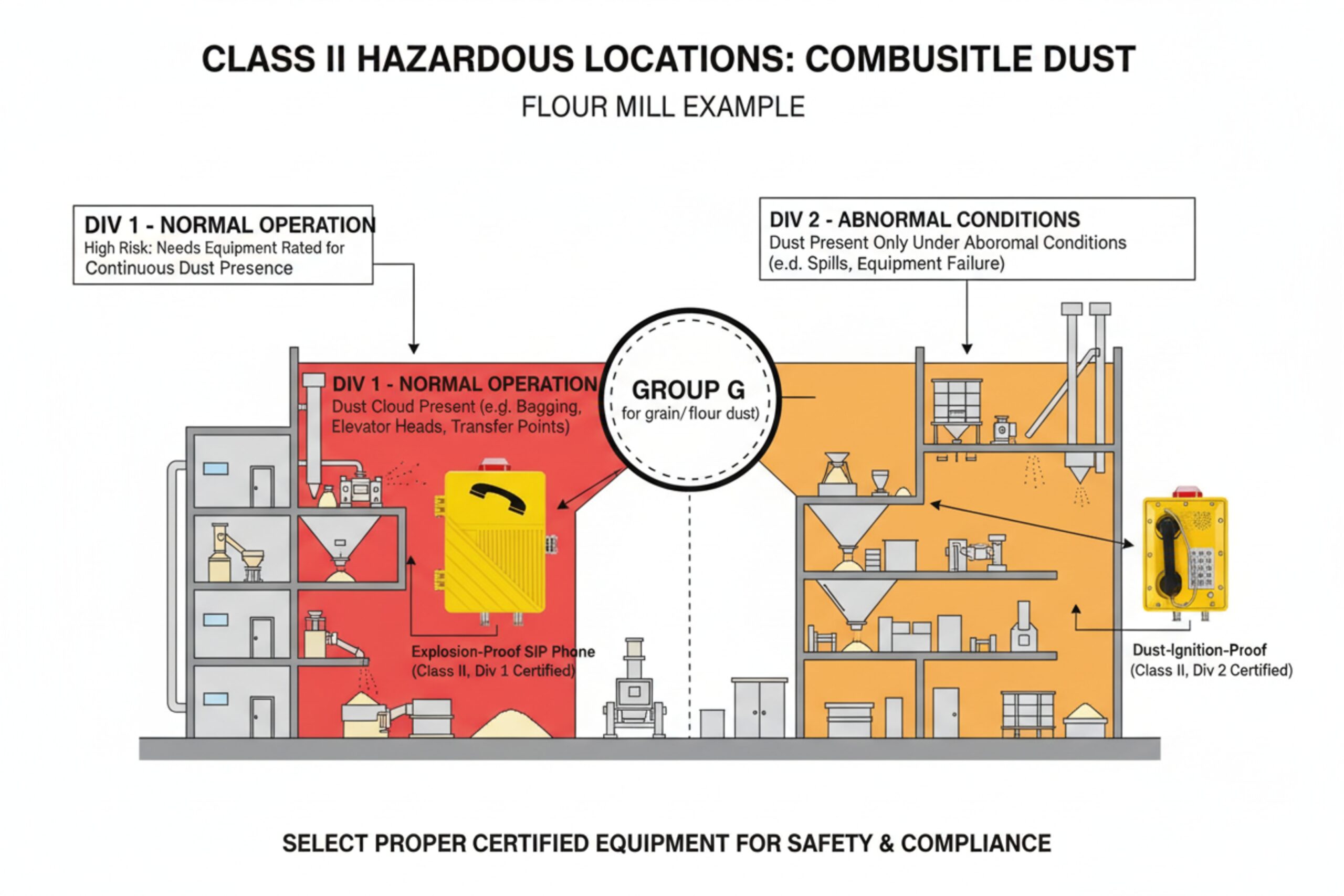
Practical placement guidance for phone projects
Phones are usually not placed inside Zone 20 equipment. Instead, place them:
-
at landings outside enclosed machines
-
at packing room exits
-
near bagging stations but outside direct dust discharge
-
at silo load-out platforms where staff gathers
This approach often allows Zone 21 4 or Zone 22 rated devices to cover most call points, while still respecting the hazard study.
A simple mapping table for common flour mill areas
| Mill area | Dust cloud likelihood | Typical classification direction | Practical phone target |
|—|—|—|—|
| Inside conveyors/elevators | very high inside equipment | Zone 20 / Div 1 | avoid installing phones inside |
| Bagging spouts | high during operation | Zone 21 / Div 1 or 2 (site-defined) | Zone 21 dust-rated phone |
| Packing room perimeter | moderate | Zone 22 / Div 2 | Zone 22 dust-rated phone |
| Control corridors | low | non-classified or Zone 22 | rugged phone or dust-rated by policy |
Dust group and temperature are part of the rating
For flour, the dust group is usually non-conductive dust in many schemes, but the facility classification plan is the source of truth. The key is that the phone must show:
-
dust group and protection concept
-
maximum surface temperature 5 allowed in dust
Once the rating is correct, durability and washdown resistance become the next concern.
Do IP66/67, IK10, antistatic enclosures endure abrasion and washdowns?
Mills are abrasive. Flour dust acts like fine powder that grinds into seams. Washdowns add water that makes dust paste, which can jam moving parts and degrade seals.
Yes. IP66/IP67 sealing, IK10 impact protection, and antistatic or bonded enclosure strategies can endure flour mill abrasion and washdowns when cable glands are dust-tight, gaskets are compatible with cleaning agents, and mounting prevents vibration loosening.
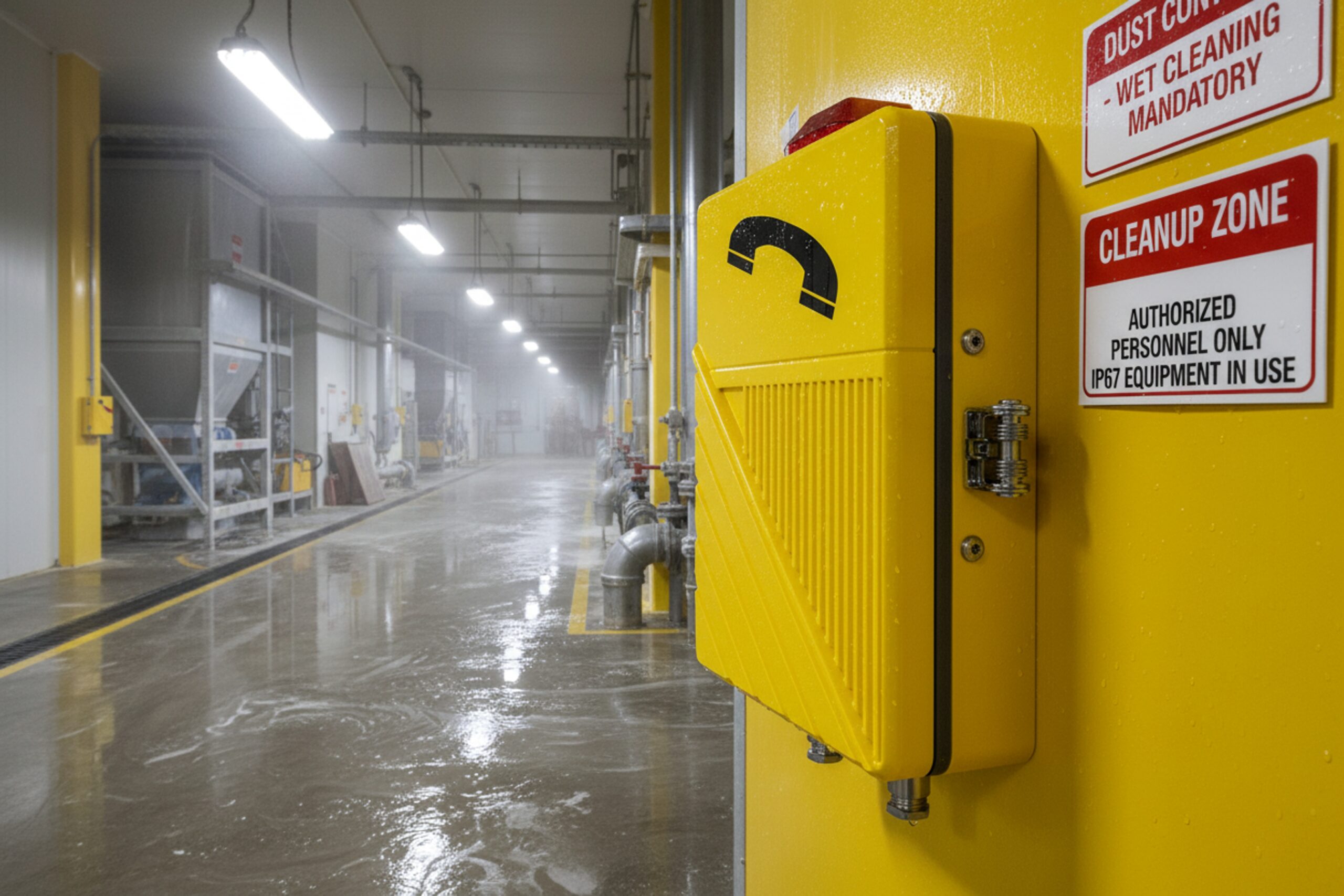
IP66 vs IP67 in a mill
-
IP66 is a strong baseline for dust and washdown jets.
-
IP67 adds margin for pooled water at floor level, especially near drains, load-out points, and wash zones.
Many mills specify IP66 for wall-mounted stations and IP67 for low mounting points and outdoor silo platforms.
IK10 and abrasion: protect the face and the cord
-
tool impacts during maintenance
-
bumps from pallets and carts
-
accidental knocks at landings
Abrasion protection also means:
-
sealed keymat and smooth faceplate for easy wipe-down
-
protected handset cradle that does not trap paste
-
strong cord strain relief and optional armored cord
Antistatic housing: helpful, but bonding is mandatory
Antistatic surfaces reduce charge build-up on non-metal parts, but the main control is:
-
equipotential bonding 7 of metal parts
-
continuity checks at commissioning
-
maintenance checks after repairs
| Stress | What fails first | Better requirement |
|—|—|—|
| Fine dust ingress | cable entry and gasket | dust-tight glands + clean sealing faces |
| Washdown paste | keys and seams | sealed keymat + smooth geometry |
| Impacts | window and cradle | IK10 + recessed faceplate |
| Vibration | brackets and screws | locking hardware + re-torque plan |
Once durability is handled, the phone becomes most valuable when it ties into the mill’s paging and safety signaling.
Can devices tie into IP PBX, PAGA horns, silo beacons, and SOS boxes?
Flour mills are noisy. People wear hearing protection. Paging horns and visible beacons are often more effective than a handset ring. Many mills also want SOS call boxes at key points.
Yes. Dust-rated Ex SIP telephones and SOS call boxes can register to an IP PBX for hotline and group calling, integrate with PAGA horns through multicast paging or controller triggers, and activate silo beacons and strobes through relay outputs or alarm controller inputs.

IP PBX: make SOS simple
PBX integration supports:
-
one-touch SOS hotline to the control room
-
escalation if no one answers
-
location-based extension naming (e.g., “Silo 3 Load-out”)
-
call logs and optional recording
For multi-building mills, templates and auto-provisioning reduce downtime when a unit is swapped.
PAGA horns: two stable patterns
-
Multicast paging from PBX/paging server to horns, with VLAN/QoS and IGMP snooping
-
Relay trigger from the phone to a paging controller input for predefined alarm tones
Relay triggers are often preferred for critical alarm tones because they stay predictable even if the network is congested.
Silo beacons and SOS boxes: make emergency points visible
A relay output can trigger:
-
a beacon at the silo platform
-
a strobe at an SOS box
-
an input to an alarm panel that drives multiple indicators
| Integration target | Best method | What to test |
|—|—|—|
| Control room calling | SIP hotline | escalation timing |
| Plant paging | multicast or relay trigger | paging during network reconvergence |
| Silo beacon | relay to controller input | latching/reset behavior |
| SOS stations | dedicated call box SIP | usability with gloves and noise |
Now, the last topic is the one that prevents ignition: dust-tight glands, bonding, and surface temperature limits.
What dust-tight glands, bonding, and T-class rules prevent ignition?
In flour mills, ignition risk comes mainly from:
-
dust clouds meeting an ignition source
-
hot surfaces under dust layers
-
static discharge on poorly bonded equipment
-
sparks from poor wiring practices
Ignition prevention depends on dust-certified protection (Ex tb or Class II listing), dust-tight cable glands and plugs that preserve IP66/67, robust equipotential bonding/earthing to control static, and maximum surface temperature limits (often marked as Tmax for dust) that stay below the dust ignition thresholds with margin for dust layers and ambient heat.
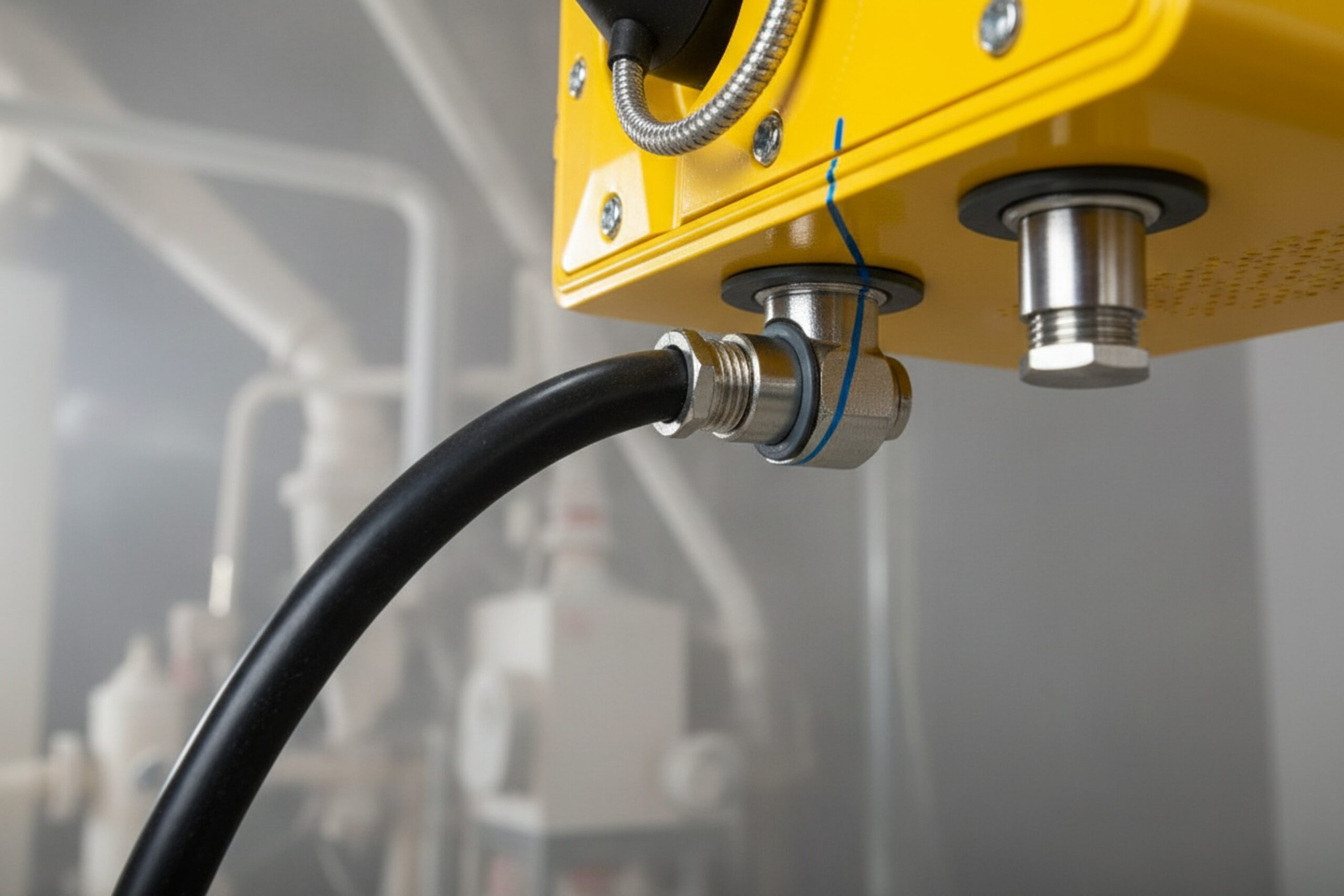
Dust-tight glands: the most common failure point
A compliant and reliable entry system includes:
-
certified dust-rated glands 8 sized for the actual cable OD
-
correct washers and locknuts
-
certified plugs for unused entries
-
cable support close to the gland to reduce movement
Post-maintenance re-sealing should be part of the SOP. Dust on sealing faces can cause leaks.
Bonding and earthing: make it measurable
A good installation uses:
-
a short bonding conductor from phone earth stud to the local equipotential bar
-
corrosion-resistant lugs and hardware
-
continuity checks recorded during commissioning
-
periodic checks because vibration can loosen joints
Bonding reduces static discharge risk and also improves surge resilience on long cable routes.
Surface temperature rules: dust needs a “Tmax mindset”
Gas T-class is common language, but for dust the key is often:
-
maximum surface temperature for dust (Tmax)
-
the dust layer and dust cloud ignition temperatures
-
assumed dust layer thickness in the area standard
-
safety margin for ambient and insulation
Good practice in mills includes:
-
placing phones away from hot motors and ducts
-
keeping devices clean so dust layers do not insulate the surface
-
using devices with clear temperature markings and wide Ta range
A simple flour mill ignition prevention checklist
| Control | What to set | Why it helps |
|—|—|—|
| Dust zone rating | Zone 21/22 or Class II Div | correct approval for dust cloud risk |
| Dust group | per facility dust analysis | correct coverage for dust type |
| Temperature limit | Tmax below dust limits with margin | prevents hot-surface ignition |
| Sealing | IP66/67 + dust-tight glands | prevents internal dust buildup |
| Bonding | short equipotential bond + test record | reduces static discharge risk |
| Housekeeping | dust layer cleaning plan | reduces insulation and cloud formation |
When these controls are applied, Ex SIP phones and SOS boxes become dependable communication points across a mill, including packing floors and silo platforms.
Conclusion
Explosion-proof SIP telephones 9 suit flour mills when dust-zone and Class II ratings match flour hazards, IP66/67 and IK10 designs survive abrasion and washdowns, PBX/PAGA 10/beacon integration supports loud emergency workflows, and dust-tight glands, bonding, and safe surface temperature limits prevent ignition.
Footnotes
-
Area where an explosive atmosphere is present continuously or for long periods. ↩
-
Standard defining protection levels against dust ingress and water immersion. ↩
-
Private telephone network used within a company or organization. ↩
-
Area where an explosive atmosphere is likely to occur occasionally. ↩
-
The highest temperature a device allows to prevent dust ignition. ↩
-
Highest rating for protection against external mechanical impacts. ↩
-
Connecting metal parts to earth to prevent static discharge. ↩
-
Cable entries designed to maintain explosion-proof enclosure integrity. ↩
-
Phones using Session Initiation Protocol for VoIP communications. ↩
-
Integrated system for public address and general emergency alarms. ↩








