
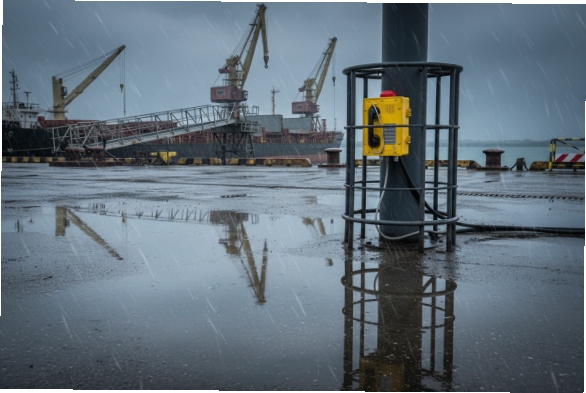
Freshwater ports look mild, but water, ice, and storms still destroy weak devices. One failed emergency phone can slow response when every minute matters.
Yes. Explosion-proof SIP telephones are suitable for freshwater ports when the Ex rating matches the hazard zone and the build is optimized for rain, splash, freeze-thaw, and condensation control.
Freshwater ports need “water + ice + uptime” engineering, not only an Ex certificate
Why freshwater ports still kill outdoor electronics
Freshwater is less corrosive than salt, but the environment is still aggressive. Piers see constant wetting, wind-driven rain, washdown, and freeze-thaw that opens micro-gaps in seals. Condensation is also common because cold nights and warm daytime sun push the enclosure across the dew point. If the port handles fuels, solvents, or bulk powders, hazardous area 1 boundaries may apply too. That is when Ex-rated SIP stations become the clean choice.
The reliability stack that actually works
In real deployments, long service life comes from stacking protections in a specific order:
1) Correct classification (Zone/Div marking must match the location).
2) Ingress protection (IP66/IP67 with the correct glands and plugs).
3) Condensation control (heater, vent strategy, conformal coating where needed).
4) Mechanical durability (IK impact resistance, guarded mounting, cable protection).
5) System integration (PBX + paging + gate workflows + monitoring).
A quick “fit check” before procurement
| Port condition | What fails first | What to specify up front |
|---|---|---|
| Splash + washdown | cable entry and keypad edges | IP66 2/IP67 system + sealed keypad + correct glands |
| Freeze-thaw | gasket compression and latch seams | cold-rated gaskets, stable fasteners, retorque plan |
| Condensation | PCB 3 corrosion and audio issues | heater/vent plan + conformal coating + desiccant upstream |
| Storm surges | PoE ports and switches | surge protection + bonding + fiber where possible |
| Public access | impacts and misuse | IK10 4 housing + guarded bollard mount + simple hotline |
A freshwater port phone works best when it is treated like outdoor infrastructure, not like indoor IT.
If water and ice protection is unclear, the rest of the system will never feel stable.
Do IP66/IP67, corrosion-resistant enclosures endure splash, rain, and freeze-thaw?
Ports do not leak once. They leak slowly. Then the first hard freeze makes it worse.
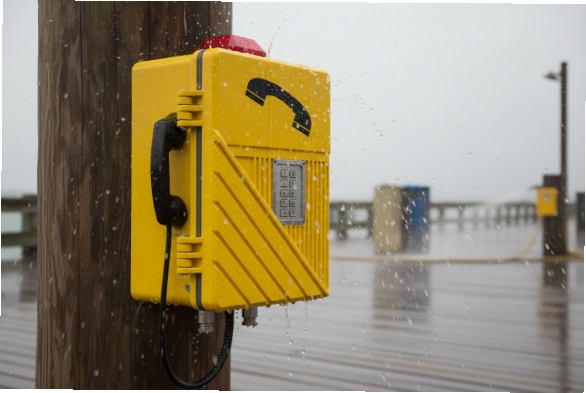
Yes. IP66/IP67 enclosures can endure splash and storms, and corrosion-resistant housings hold up well in freshwater, but freeze-thaw demands stable gaskets, correct entry orientation, and routine seal inspections.
What IP66/IP67 solves—and what it does not
IP66 is strong against heavy water jets and airborne dust. IP67 adds short-duration immersion resistance. These are excellent baselines for dock splash and rain. Still, IP ratings assume the enclosure is assembled correctly and stays that way. Freeze-thaw can reduce compression, and vibration from gangways or equipment can loosen hardware over time.
Enclosure materials that perform well in freshwater ports
Freshwater reduces chloride-driven pitting compared with seaside piers, so 316L 5 is often “more than enough.” Aluminum with a high-quality outdoor coating can also perform well when galvanic joints are controlled. The weak link is usually not the main box material. It is the small parts: hinges, latches, glands, and mixed-metal brackets.
A stable outdoor spec usually includes:
-
stainless or corrosion-rated fasteners
-
consistent bracket and housing materials to reduce galvanic couples
-
sealed keypads and protected acoustic ports
-
smooth, easy-clean surfaces that do not trap grime
Freeze-thaw: where failures start
Freeze-thaw damage typically begins at:
-
cover seam edges where water can sit
-
upward-facing entries that collect water
-
cable jackets that crack from cold bending
-
handset cradles where water freezes and blocks movement
A simple win is to mount the station with a slight tilt, keep entries downward, and use drip loops. Another win is to avoid “low points” under gutters or deck edges where meltwater drips constantly.
| Design point | Best practice in freshwater ports | Why it helps |
|---|---|---|
| Entry orientation | downward-facing when possible | prevents water pooling at glands |
| Gasket compression | controlled torque and serviceable design | freeze-thaw does not relax seals as fast |
| Housing + bracket | corrosion-consistent materials | reduces joint corrosion and seizure |
| External hood | small rain/snow shield | lowers water load and icing on seams |
| Inspection | seasonal check after winter | catches small leaks before electronics fail |
A port phone lasts through winter when the install prevents standing water, not only when the spec sheet says IP67.
Once the enclosure can keep water out, the next challenge is internal moisture that comes from temperature swings.
Do heaters, hydrophobic vents, and conformal coatings prevent condensation?
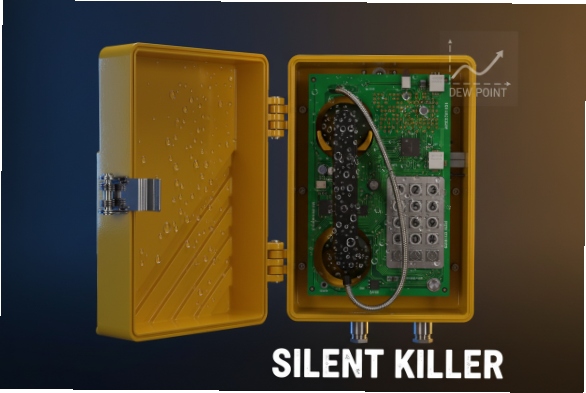
Many “waterproof” enclosures still fail because water forms inside. Condensation is the silent killer on docks.
Yes. Heaters reduce dew-point crossings, hydrophobic vents control pressure breathing, and conformal coatings protect electronics—but they must be used in a way that keeps Ex compliance intact.
Heaters: the simplest way to beat dew point
A small enclosure heater (often thermostat controlled) keeps internal surfaces a few degrees above ambient. That reduces condensation during cold nights and rapid warm-ups after sunrise. For outdoor SIP stations, heaters also improve keypad flexibility and audio performance in freezing weather.
In hazardous areas, heater options must be certified for the same protection concept. A safe project uses factory-certified heater kits or certified auxiliary devices. The heater must also respect the device temperature limits so it does not push surface temperature beyond the allowed marking.
Hydrophobic vents: reduce “breathing” through weak seals
Pressure changes from sun and cold can pull moist air into enclosures through micro paths. A hydrophobic vent membrane (often ePTFE 6) can relieve pressure in a controlled way. That reduces stress on gaskets and reduces random air exchange. It can be very effective in outdoor electronics.
For Ex enclosures, venting must follow the device certificate. If the phone’s Ex concept does not allow a vent in the enclosure, the better approach is to manage pressure and moisture in an upstream certified junction box or cabinet that feeds the phone, while leaving the phone enclosure unmodified.
Conformal coating: insurance, not a substitute for sealing
Conformal coating 7 helps PCBs resist moisture films, contamination, and corrosion. It improves survival when condensation does happen. Still, coating does not protect connectors, terminals, or pooled water. The best results come when coating is paired with clean manufacturing and good enclosure design.
A practical moisture plan usually includes:
-
heater for dew-point control
-
upstream desiccant in the cabinet feeding the device
-
conformal coating on PCBs for added tolerance
-
a moisture-aware cable routing plan (no “water highways” into glands)
| Moisture control | What it prevents | What to watch |
|---|---|---|
| Heater | dew-point condensation | certification and surface temperature limits |
| Hydrophobic vent | pressure-driven breathing | only if permitted by the protection concept |
| Conformal coating | corrosion/leakage on PCB | does not protect connectors and seals |
| Desiccant upstream | trapped humidity in cabinets | replace on a schedule |
| Drain/hood strategy | standing water and icing | avoid trapping water near seams |
Condensation control is the difference between “works in summer” and “works all year.”
After moisture is controlled, the next question is operational value: can the phone join the port’s PBX, paging, and gate workflows?
Can devices integrate with IP PBX, PAGA horns, and access control gates?
A dock phone that only dials is useful. A dock phone that also triggers paging and gates is what operators trust.
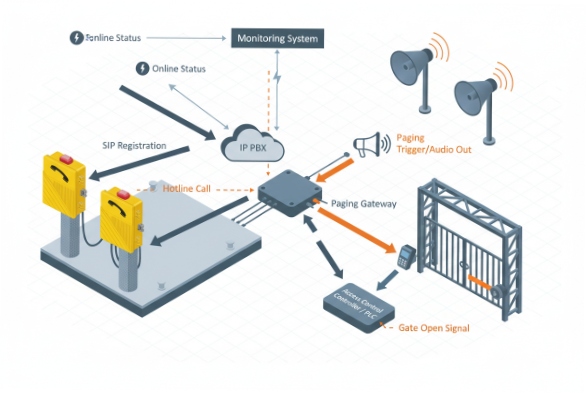
Yes. Ex-rated SIP telephones can register to an IP PBX, support PAGA paging through SIP or multicast, and interface with access control gates via relay I/O, PLC logic, or approved APIs.
IP PBX: keep the call path simple
Ports need fast calling under stress and bad weather. A stable configuration uses:
-
hotline keys to port operations and security
-
ring groups with escalation
-
clear location-based station names (“Gate 3 Dock A”)
-
automatic recovery after PoE bounce
If the port uses a dispatch console, a SIP station can also present location and trigger workflows in the console.
PAGA horns: paging is the attention layer outdoors
Wind and distance reduce audible ring performance. Horn paging usually works best by:
-
SIP paging from PBX to a paging gateway feeding amplifiers and horns, or
-
multicast paging to IP horn speakers
Priority rules matter. Emergency paging must override routine announcements, and emergency calls should not be blocked by paging playback on call stations.
Access control gates: keep safety logic in controllers
A phone should not become the gate controller. The clean pattern is:
-
phone triggers a dry contact or a network event to a PLC or access controller
-
controller decides whether to open, based on credential, mode, and safety inputs
-
PBX logs calls and can record voice confirmation when needed
This is also easier to audit and maintain.
| Workflow | Best owner system | Phone role |
|---|---|---|
| Emergency call | IP PBX/dispatch | hotline + location ID |
| Dock-wide alert | PAGA 8/paging gateway | trigger or receive pages |
| Gate intercom | access control system | call + optional trigger input |
| Fault visibility | NMS/BMS/SCADA | online status, registration status, PoE alarms |
Integration is straightforward when the physical installation is stable. The biggest integration failures on docks are actually cabling and surge issues, not SIP.
That leads to mounting and routing, because the station must survive forklifts, ice scraping, and storms.
What bollard mounting, cable routing, and surge protection are best?
Most dock failures happen below the phone: at the base, in the conduit, or at the cabinet where surges enter.
Use a guarded bollard or pedestal mount, route cables in sealed conduit with drip loops, and protect long outdoor runs with bonding and surge protection—prefer fiber backbones when possible.
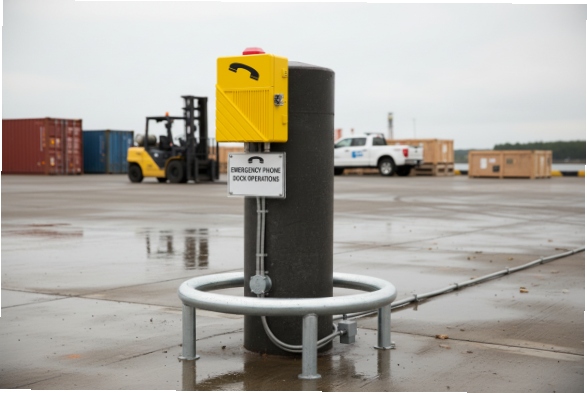
Bollard mounting that survives real port traffic
A good dock station is visible and protected. A bollard mount works well because it:
-
keeps the phone away from wall splash zones
-
reduces theft and impacts when paired with a guard ring
-
allows consistent height across the terminal
Heights vary by site, but a common practical target is to place the main button or handset grip in an easy reach band for gloved users, while keeping the device clear of snow piling and deck wash.
Cable routing: prevent water tracking and ice damage
Cables should be routed like outdoor instrumentation:
-
use sealed conduit or armored cable in traffic zones
-
avoid low points where water pools and freezes
-
keep entries downward with drip loops before glands
-
use water-blocking cable or sealed junction boxes where ducts are wet
Cable slack should be controlled. Too tight causes jacket stress. Too loose whips in wind and vibration.
Surge and lightning: freshwater still gets storms
Even without salt air, long outdoor copper runs on a pier behave like antennas. Induced surges can kill PoE ports and phones. A robust approach is layered:
-
fiber backbone to pier cabinets when feasible
-
surge protective devices at cabinet power entry
-
PoE/data surge protection where copper runs remain exposed
-
consistent bonding and grounding so surges have a preferred path
Shield handling should be consistent. Random shield grounding can add noise and create unexpected surge paths.
| Element | Best practice for ports | What it prevents |
|---|---|---|
| Mount | bollard + guard ring + clear signage | impacts and misuse |
| Conduit | sealed, corrosion-resistant fittings | water intrusion into pathways |
| Drip loop | mandatory before entry | water tracking into glands |
| Cable type | outdoor UV jacket, cold-rated if needed | cracking and moisture ingress |
| Surge protection | SPDs + bonding + fiber where possible | PoE failures after storms |
| Grounding | equipotential bonding across structures | destructive potential differences |
A freshwater port station becomes reliable when mounting and cabling are treated like critical infrastructure.
Conclusion
Explosion-proof SIP phones fit freshwater ports when water sealing, condensation control, robust mounting, and surge-aware cabling are engineered together with PBX, paging, and gate workflows.
Footnotes
-
A location where fire or explosion hazards may exist due to flammable gases, vapors, mists, or combustible dusts. ↩
-
Ingress Protection rating indicating an enclosure is dust-tight (6) and protected against powerful water jets (6). ↩
-
Printed Circuit Board: A board that connects electronic components using conductive tracks, pads, and other features etched from copper sheets. ↩
-
An international numeric classification for the degrees of protection provided by enclosures for electrical equipment against external mechanical impacts. ↩
-
A low-carbon version of 316 stainless steel, offering high resistance to corrosion and widely used in marine applications. ↩
-
Expanded Polytetrafluoroethylene: A durable, microporous material often used in vents to allow air passage while blocking water and dust. ↩
-
A protective chemical coating or polymer film applied to electronic circuitry to protect against moisture, dust, chemicals, and temperature extremes. ↩
-
Public Address/General Alarm: A system used to broadcast voice messages and alarm tones in industrial settings. ↩








