
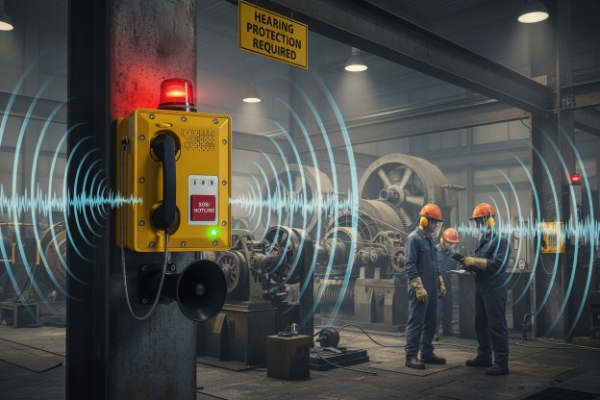
High-noise areas make people miss calls, miss alarms, and miss each other. The result is slow response and avoidable downtime.
Yes. Explosion-proof SIP telephones can work in high-noise zones when they use loud ringers plus strobes, strong noise control for speech, and the right paging and alarm integrations for the site.
How to design a “call can’t be missed” setup in loud industrial areas
Audible alerting is a coverage problem, not a spec-sheet problem
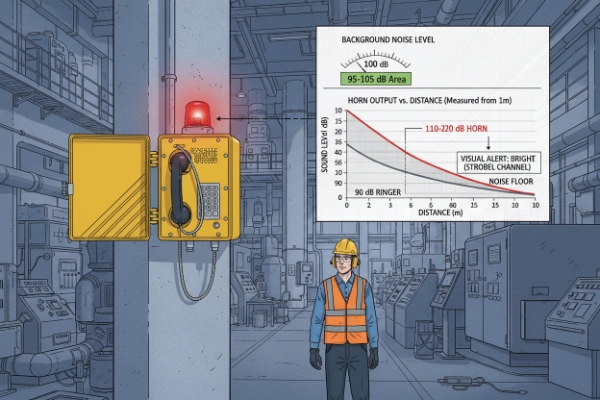
A horn listed as “110–120 dB” is often measured at 1 meter. Sound level drops fast with distance and obstacles. Machinery, walls, and moving vehicles also block or mask the sound. Because of this, the real question is not “is the horn loud?” The real question is “is the alarm loud enough at the listener’s ear where the person is standing?”
A simple planning rule is to target a signal that is clearly above the ambient noise at the point of use. In a 95–105 dB area, the horn may need to be extremely loud at close range to be heard at a distance. That can create another problem: local overexposure. A phone system should not trade missed calls for hearing damage.
Speech quality depends on microphone strategy and user behavior
Near compressors, grinders, and conveyors, a normal microphone picks up more noise than speech. This is why high-noise phones need a mix of:
-
directional or close-talk microphone placement
-
digital noise reduction and echo cancellation 1
-
full-duplex tuning that does not “pump” or clip speech
-
and sometimes a push-to-talk mode or a headset option for extreme noise
The best outcomes come from choosing the right mode per zone. A turbine deck often needs different settings than a packaging hall.
Ruggedness matters because “loud areas” are also “rough areas”
High-noise zones often include vibration, impacts, dust, and washdown. The enclosure must handle both the environment and the people. A strong IK impact rating and a sealed, easy-clean face help keep devices in service.
| Design goal | What to measure on site | What usually fixes it |
|---|---|---|
| Calls are noticed | dB level at the worker position | horn + strobe + placement + coverage mapping |
| Speech is understood | intelligibility during a live test call | noise-cancel mic + DSP + full-duplex tuning or PTT |
| Alarms are consistent | time from alarm to alert | PBX + PAGA + Andon integration, priority rules |
| Devices survive | failures per quarter | IP sealing, IK rating, correct mounting, cable protection |
A high-noise phone project succeeds when alerting, speech, and survivability are treated as one system.
If the alerting plan is weak, even the best SIP phone becomes a missed-call device.
The next sections break down the four decisions that decide success in loud plants.
Do 110–120 dB horns and strobe beacons ensure calls in 95–105 dB areas?
A loud horn looks like an easy answer. In practice, calls are still missed when the sound does not reach the worker, or when the worker wears heavy hearing protection.
Horns and strobes help a lot, but they do not guarantee calls in 95–105 dB areas unless coverage is designed and verified at the worker positions, not only at the device.
What “110–120 dB” really means in the field
Most horn ratings are measured in ideal conditions. Real plants add distance loss, reflections, and masking. A horn that is loud at 1 meter may drop below the needed level only a few meters away. Fans and motors also create narrow-band noise that can hide certain horn tones. So the horn frequency and pattern matter, not only the peak dB.
A practical method that works on sites is a simple “coverage walk”:
-
Pick representative worker spots and routes.
-
Trigger the phone ring or alarm.
-
Measure or at least validate detectability at each spot.
-
Adjust the plan: add a second beacon, move the horn higher, or change direction.
Why strobes are often the difference maker
In 95–105 dB areas, workers often wear hearing protection. That reduces the effective “heard” ring level. A bright strobe 2 gives another path. It also helps in areas where machines mask sound. Still, strobes must be placed where they are in the line of sight. A strobe behind a column does not help a worker facing the other way.
A good station in high noise usually uses both:
-
a high-output horn for “audible capture”
-
a strobe beacon for “visual capture”
-
and a clear label and big call button for “fast action”
How to avoid overexposure and nuisance
When horns are too loud near the device, workers may disable or avoid it. That is why it helps to:
-
place devices away from ear level at fixed workstations
-
use multiple lower-output devices rather than one extreme horn
-
use directional sounders aimed into the zone
-
and set different ring modes for day shift vs night shift if allowed
| Challenge | What happens | A better approach |
|---|---|---|
| Horn is loud at 1 m but missed at 6 m | uneven coverage | add devices and validate at worker spots |
| Workers wear double hearing protection | missed audible ring | add strobes and better placement |
| Horn is painfully loud near device | complaints and tampering | use more devices at lower output |
| Lights are ignored in bright halls | missed visual signal | use higher candela, better line-of-sight, add signage |
Horns and strobes are necessary tools in loud areas. They are not a guarantee by themselves. Coverage design is what turns them into reliability.
Once calls can be noticed, the next problem is speech. A call that connects but cannot be understood still fails.
Will noise-canceling mics and full-duplex improve intelligibility near machinery?
In loud zones, people often shout. Shouting changes the voice tone and can distort the mic. Noise can also trigger voice activity detection and cut speech in and out.
Yes. Noise-canceling microphones and well-tuned full-duplex audio can improve intelligibility, but results depend on mic placement, DSP tuning, and whether the site should use full-duplex or push-to-talk in the noisiest spots.

What actually helps speech in 95–105 dB environments
The strongest improvement usually comes from getting the microphone close to the mouth and rejecting background noise. This can be done with:
-
close-talk or directional mic geometry
-
wind and dust protection that does not block speech
-
noise suppression that targets steady machine noise
-
echo cancellation so the speaker does not feed back into the mic
Full-duplex 3 can help because it allows a natural back-and-forth. It reduces “over-talk” confusion where both sides speak and neither hears. But full-duplex can also amplify the problem if the speaker output re-enters the mic and the DSP 4 is weak.
When push-to-talk beats full-duplex
In very loud zones, a push-to-talk 5 (PTT) mode can be more usable than open-mic full duplex. It limits how much background noise is sent to the far end. It also gives the user a clear action: press, speak, release. This works well near grinders, hammering, and steam vents.
A good plant design sometimes uses both:
-
full duplex in moderate noise areas with better speech conditions
-
PTT in the extreme noise pockets
-
headset support for technicians who must talk while moving
Practical testing that shows the truth fast
The quickest way to validate intelligibility is a live test call during normal production:
-
Call from the phone to the control room.
-
Have two people read the same short phrase list.
-
Score whether the far end understands without repeats.
-
Repeat with hearing protection and PPE in place.
This test finds problems like:
-
pumping audio from aggressive noise reduction
-
clipped speech from too much AGC
-
echo from poor speaker/mic isolation
-
or mic ports clogged by dust or overspray
| Audio feature | Best use case | Common failure if misused |
|---|---|---|
| Noise-cancel mic | steady machinery noise | speech becomes thin and hard to parse |
| Echo cancellation | speakerphone calls | hollow sound and oscillation without tuning |
| Full duplex | normal conversation | background noise floods the far end |
| Push-to-talk | extreme noise pockets | users forget to press or hold long enough |
Noise control is not a checkbox. It is a plant-specific tuning exercise. When it is done right, voice becomes usable again near machines.
After intelligibility, the next goal is system behavior. Many sites want calls, Andon triggers, and paging to act like one coordinated alarm workflow.
Can systems interface with IP PBX, Andon alarms, and PAGA paging?
A phone that rings and talks is good. A phone that also triggers the right horn, light, and Andon workflow is what operators trust.
Yes. SIP systems can integrate with IP PBX for calling, with Andon for event escalation, and with PAGA for paging, as long as priority rules and alarm paths are defined and tested.
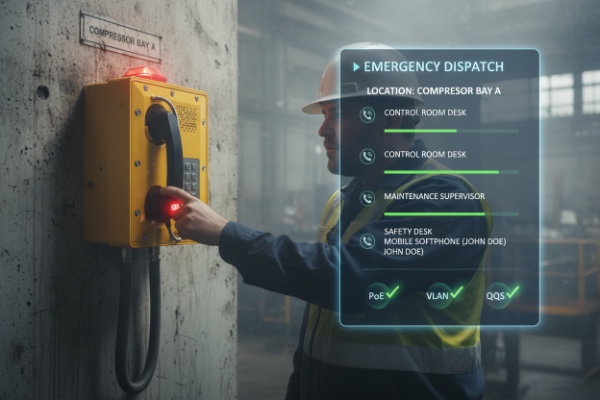
IP PBX: the core call path
A SIP 6 telephone can register to an IP PBX 7 and use ring groups, hotlines, and auto-answer paging. In loud zones, a simple call flow works best:
-
one emergency button auto-dials a staffed group
-
the PBX displays the station location name
-
the call is recorded or logged for audit
-
and the call stays up even after a brief network bounce
Redundancy matters more than fancy features. A second PBX node or a survivable gateway can keep calls alive during switch maintenance.
Andon: treat the phone as a trigger and a confirmation tool
Andon 8 systems usually drive line status and response workflows. A phone can integrate in three common ways:
-
a call station button triggers an Andon input (via PLC or I/O module)
-
the Andon event triggers an auto-dial callout to a response team
-
the Andon event triggers a PAGA page and beacon activation
The best pattern is to let the PLC or Andon controller own the logic, and let the phone own the voice call. This keeps safety logic deterministic and keeps voice simple.
PAGA paging: make paging louder than life, but controlled
In high noise, paging to horns and speakers is often the main way to reach people. Paging can be done by:
-
SIP paging to a paging gateway that feeds amplifiers and horns
-
multicast paging to IP horn speakers
-
or a dispatch server that triggers both audible and visible alerts
Priority rules are critical:
-
emergency messages must override routine pages
-
emergency calls must not be blocked by paging audio on a call station
-
only trusted sources should be allowed to auto-answer page devices
| Integration need | Best owner system | What to verify in FAT/SAT |
|---|---|---|
| Emergency call | IP PBX | ring group answers, location label, failover |
| Andon escalation | PLC/Andon controller | event triggers callout and logs correctly |
| Plant paging | PAGA gateway / dispatch | page priority, coverage, and timing |
| Beacons | PLC/alarm panel | correct mapping, no direct high-power switching from phone |
When these interfaces are clean, the plant gets one simple story: press one button, the right people hear it, see it, and respond.
After integration, the last topic is human safety and device ruggedness. Hearing protection, volume limits, and impact ratings decide whether the system is usable and durable year after year.
What NRR/PPE, volume limiting, and enclosure IK ratings are recommended?
High-noise communication fails when it ignores hearing safety. It also fails when devices break from impacts and vibration.
Use hearing protection sized for the exposure, keep call audio at safe levels at the ear, and select rugged enclosures (often IK10) for rough industrial areas.
PPE and NRR: plan for real-world attenuation, not lab numbers
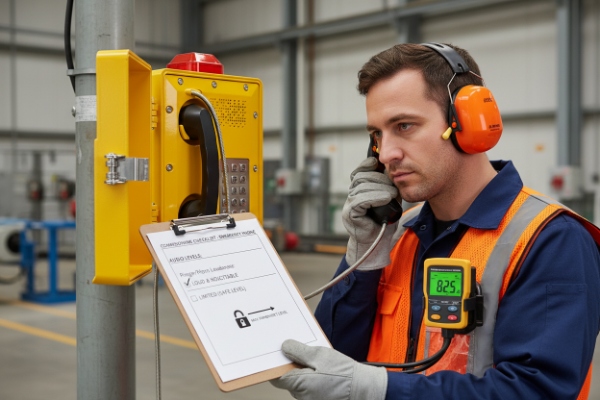
In 95–105 dB environments, hearing protection 9 is normal. The NRR on the box is not what most workers get in real use. Fit, hair, glasses, and movement reduce attenuation. A practical rule used by many safety teams is to derate NRR when estimating protection, then confirm with fit testing when possible.
In many plants, the workable PPE pattern is:
-
earmuffs for quick don/doff areas
-
plugs for long wear
-
double protection for the highest exposures or near impulse noise
-
and communication headsets for key roles where two-way talk is constant
Communication headsets can be a strong option because they combine protection and intelligibility. But they must be matched to the noise level and to the job. In some roles, a handset or close-talk mic is still better because it is simple and robust.
Volume limiting: keep calls safe while still audible
High-noise zones tempt people to raise call volume too high. That can create hearing risk, especially when a headset seals sound directly to the ear. A safer setup uses:
-
volume limiting at the handset or headset output
-
step-limited volume controls so users do not jump to unsafe levels
-
and a test procedure that checks “call is intelligible with PPE” without pushing to extreme volume
A good goal is simple: speech should be understood, not “as loud as possible.” If speech is not understood at safe levels, the fix should be better mic/noise control or a different alerting method, not unlimited volume.
IK ratings: plan for impacts, not only weather
High-noise zones are often high-traffic zones. Impacts happen from tools, carts, and accidental hits. An IK rating 10 shows impact resistance. For harsh industrial areas, IK10 is a common target because it provides the highest standard impact protection in the usual IK scale.
A strong mechanical spec also includes:
-
vandal-resistant handset cords or armored cords
-
metal keypads or protected membranes
-
strong mounting brackets that do not vibrate loose
-
and cable protection (conduit or armored cable) near traffic lanes
| Topic | Recommended baseline | Why it works in loud industrial zones |
|---|---|---|
| Hearing PPE | plugs or muffs sized for exposure, double when needed | protects workers and supports long-term compliance |
| NRR use | derate estimates, then fit test where possible | avoids false confidence from packaging numbers |
| Call volume | limit at the ear, keep controls step-based | reduces risk while keeping intelligibility |
| Enclosure impact | IK10 in rough areas | reduces breakage from hits and vibration |
| Extras | guarded button, large labels, strobe | reduces missed calls and misuse |
In high-noise projects, the best win is balance. The system should be loud enough to notice, clear enough to understand, and safe enough to use every day.
Conclusion
High-noise zones can support reliable SIP calling when horns and strobes are coverage-tested, speech is noise-controlled, integrations are simple, and PPE and volume limits protect hearing while IK-rated enclosures protect uptime.
Footnotes
-
A technique to remove the sound of the speaker from the microphone input to prevent feedback loops. ↩
-
A visual signaling device that flashes bright light to alert workers in high-noise areas where audio alarms might be missed. ↩
-
A communication mode where both parties can speak and hear simultaneously, allowing for natural conversation. ↩
-
A specialized microprocessor designed to manipulate audio signals for improved clarity and noise reduction. ↩
-
A method of conversation control where a button must be held to speak, reducing background noise transmission. ↩
-
The standard signaling protocol used for initiating, maintaining, and terminating real-time sessions like voice calls over IP. ↩
-
A telephone switching system that uses internet protocols to manage calls within a company. ↩
-
A manufacturing system often used to notify management or maintenance of quality or process problems. ↩
-
Equipment such as earplugs or earmuffs worn to prevent noise-induced hearing loss in loud environments. ↩
-
An international classification rating that defines the level of protection an enclosure provides against external mechanical impacts. ↩








